
The subscription app ads that bring paying subscribers show the app doing its job (visible progress, a real moment of use, the product on screen) and keep the free trial as a supporting line, not the headline. Judge every ad on cost per paid subscriber, which is cost per trial divided by its trial-to-paid rate, once its trials have ended.
The hard part is that your ad networks report installs per ad, while trials and subscriptions land in your MMP days later. Segwise is an AI creative analytics and creative generation platform that joins the two: it tags the message, offer, feature shown and format of every ad and ranks them by trial starts, paid subscriptions and renewals from AppsFlyer, Adjust, Branch, Singular or Kochava, so you can see which message brings people who pay and make your next ads from it.
This guide is for non-game subscription apps such as language learning, fitness, meditation and productivity. For channels, events and budgets across the whole funnel, start with our mobile app marketing guide; this post goes deeper on the creative.
TL;DR
- If you are choosing what to make: lead with the product working (progress, a real moment, the lesson or workout on screen). Test the free-trial offer as its own message, not as the hook of every ad.
- If you are measuring creative: put trial start and subscribe events on every ad, then rank ads on what each paying subscriber costs, not CPI or cost per trial alone.
- If you are deciding when to judge: read cost per trial after a few days, the cost of each paid subscriber only once the trial has ended and iOS postbacks have arrived, and first renewal after the first billing period.
- If cheap installs look good: check how many of their trials pay. An ad with the cheapest install can bring subscribers at more than twice the cost of your best ad.
Which creatives drive paid subscribers?
Creatives that show the reason to keep paying drive paid subscribers. A trial is easy to start and easy to cancel, so an ad that only sells the free week fills the trial with people who were never going to pay. An ad that shows what life in the app looks like after a few weeks pre-sells the subscription itself.
Ads that show the app working beat ads that lead with the offer
In subscription apps the paywall is a filter. Someone who taps an ad because the first week is free has been sold on the price of the trial, which is zero. Someone who taps because they saw a 47-day streak, or a person ordering coffee in the language they are learning, has been sold on the outcome. The second person is the one still around when the trial ends.
That is why the offer works best as a closing line ("Start your free week" on the button) rather than the hook. In the example later in this post, every Echo ad ends with a free-week button; only one leads with the offer, and that one brings the costliest subscribers.
Four creative angles worth testing for a subscription app
These are patterns to test, not guarantees. Tag every ad with one of them so you can compare them later.
| Angle | What the ad shows | What it tends to do | Watch for |
|---|---|---|---|
| Progress you can see | A streak, a before and after, a level reached | Pre-sells staying, so trials convert well | Claims of results the average user won't see |
| Real moment of use | A person using what the app taught them, in daily life | Strong install-to-trial rate, good payers | Looks staged if the moment is too perfect |
| Time it takes | "10 minutes a day", a short session on screen | Lowers the effort barrier | Can attract casual users who drop after the trial |
| The offer | Free week, discount, first month price | Cheapest installs and often cheapest trials | Low trial-to-paid, early cancellations |
Our post on creative patterns that raise subscription LTV covers more message patterns for subscription products.
Paywall-aware messaging: promise only what the first session proves
Trial users decide fast. RevenueCat's State of Subscription Apps 2026, built on more than 115,000 apps, found that 55.4% of all 3-day trial cancellations happen on Day 0 and 84% between Day 0 and Day 1. Whatever the ad promised has to show up in the first session.
So write ads you can keep on the first screen. If the ad shows a lesson in Spanish, the onboarding should land on a lesson in Spanish, not a settings page. If the ad promises "10 minutes a day", the first session should take ten minutes. An ad whose promise matches the first session gets judged fairly at the paywall; one that overpromises gets cancelled on Day 0 and looks like a cheap trial that never pays.
Trial length also changes which ads win. The same report gives a median trial conversion of 42.5% for trials of 17 to 32 days and 25.5% for trials under 4 days, while 46.5% of apps now run trials of 4 days or less. Compare ads only within one trial length.
How do you measure creative on trials and paid subscriptions?
You measure creative on trials by getting trial start and subscribe events onto each ad's row, then reading four numbers in order: cost per install, cost per trial, trial-to-paid and cost per paid subscriber. The last one decides.
Get trial and subscription events onto every ad
Every ad platform needs to see the events first. Meta's SDK has standard events for both: Start Trial ("The start of a free trial of a product or service you offer, such as a trial subscription") and Subscribe ("The start of a paid subscription"). Your MMP can send the same events to Meta, Google and TikTok and keep them for its own reports.
Then decide what each campaign optimizes for. Meta's app ad optimization docs say install optimization is "the recommended approach if your goal is to maximize the reach of your application", while app event optimization shows ads to "people likely to take a specific action in your app". You can optimize for one event at a time.
A decision rule for the event:
- Optimize for subscribe when an ad set can get about 50 paid subscriptions a week. Meta says ad sets usually exit learning "after about 50 results in the week after the ad set's last significant edit".
- Optimize for trial start when it can't. A rule of thumb: move to subscribe only once one ad set's weekly budget is at least about 50 times what one paid subscriber costs you; below that, trial start gives the campaign enough signal.
- On Google App campaigns,Google's best practices suggest a daily budget of at least 10 times the bid for installs with target CPA and 15 times for engagement, and warn that changes "before the first 100 conversions have registered may disrupt learning".
The four-number scorecard for subscription app creative
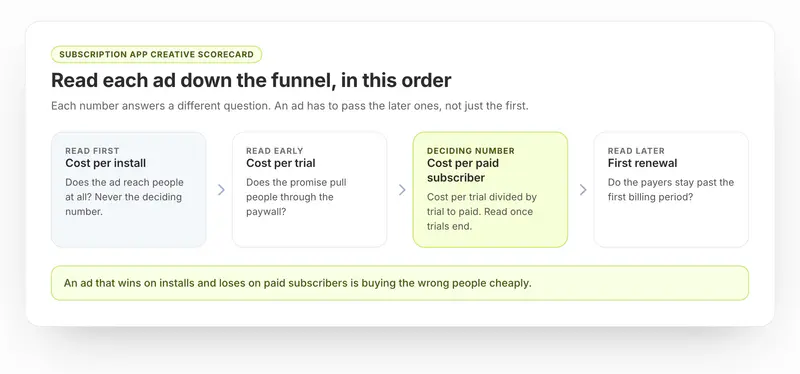
The formula that matters: cost per paid subscriber = cost per trial ÷ trial-to-paid rate. An ad with $4.08 trials and a 17% trial-to-paid rate pays $24 for each subscriber. An ad with $4.84 trials and a 44% rate pays $11. The cheaper trial is the more expensive ad.
When to read each number
Each number becomes trustworthy at a different time:
- Cost per install and cost per trial: after the first few days, once each ad has about 20 trials (a rule of thumb; fewer and the ranking flips week to week).
- What each paid subscriber costs: only after the trial length plus a day has passed for the trials you count. A 7-day trial started yesterday tells you nothing about paid yet.
- First renewal: after the first billing period. RevenueCat found the first month accounts for 35% of all annual-plan cancellations, so an annual plan sold by an ad is not safe revenue until then.
On iOS, add Apple's delay. AdAttributionKit sends postbacks for windows of days 0 to 2, 3 to 7 and 8 to 35, after a random delay of 24 to 48 hours for the first postback and 24 to 144 hours for the later ones. A 3-day trial's paid conversion lands in the second window, which closes on day 7, and its postback then waits another 24 to 144 hours, so expect it one to two weeks after install (sooner if your app locks the conversion value early). Our guide to testing creatives on iOS covers test design under these limits, and if Meta and your MMP disagree on installs, see why Meta and your MMP report different installs.
What this looks like with every ad ranked by paid subscribers

In this example, Echo's four ad messages are grouped by a custom "message" tag and ranked by what each paying subscriber costs. The free-week offer wins on CPI ($1.60) and on cost per trial ($4.08), but only 17% of its trials pay, so each subscriber costs $24.00. "Progress you can see", the Day 47 streak ad, costs more per install ($2.42) and brings subscribers at $11.00, less than half as much.
Segwise Creative Analytics builds this view from your own data: it takes spend and installs from each ad network, trial, subscription and renewal events from your MMP, and the tags on each ad, and puts them on one row. The subscription apps page adds that you can track each plan, upgrade or in-app purchase as its own event, so you can also see which messages bring subscribers who upgrade or pick an annual plan. The decision it settles is concrete: which message to stop funding, and which one to brief next.
Rank ads by paid subscribers: Segwise lets you sort every ad and every message tag by trials, paid subscriptions and renewals from your MMP, then make new ads from the winners. Book a demo.
Do cheap-install ads hurt revenue?
Yes, when their installs don't turn into paying subscribers. A cheap-install ad hurts revenue in three ways:
- It can take budget from better ads. Meta describes install optimization as built for reach, so a campaign optimized for installs tends to push spend toward the ads that get installs cheapest. The offer ad can win the auction while the streak ad starves.
- It fills trials that cancel. Offer-led trials skew toward people who wanted the free week, and with most 3-day trial cancellations happening on Day 0, those trials cost you the install and return nothing.
- It hides in the dashboard. CPI and cost per trial both look good, so the ad gets scaled. Only the cost of each paying subscriber shows the loss.
Worked example: the same $10,000 on two ads
Using the example numbers above:
| Free-week offer | Progress you can see | |
|---|---|---|
| Cost per install | $1.60 | $2.42 |
| Cost per trial | $4.08 | $4.84 |
| Trial to paid | 17% | 44% |
| Cost per paid subscriber | $24.00 | $11.00 |
| Paid subscribers from $10,000 | about 417 | about 909 |
The ad with the more expensive install brings more than twice as many subscribers for the same money. Put the $10,000 on the offer ad because its CPI is a third lower, and you give up roughly 490 subscribers.
Keep, cap or cut a cheap-install ad

A rule of thumb: cap any ad whose trial-to-paid rate is under half your account median, even when its CPI is the lowest you have. Keep it running at a small budget if it brings trials cheaply, because a cheap ad that reaches new people can still feed retargeting and broad learning. Just don't let it set your creative strategy.
Tip: Don't judge an offer ad and a product ad from different campaigns against each other. An ad set optimized for installs and one optimized for trial start find different people, so compare ads that share an optimization event.
How Segwise helps subscription app teams make more of the ads that bring payers
Once you know which message brings paying subscribers, the work is making more of it, faster than it fatigues.

Segwise's Creative Tagging tags every static and video you run: the hook headline, the feature shown, the people on screen, the offer and CTA text, and custom tags such as "message". Each tag is then tied to your MMP events, so the Day 47 streak ad above is not just "a good ad"; it is evidence that showing progress beats leading with the offer for this app. Your team can review and adjust any tag.
From there, the payoff is in what you can do with it:
- Ask a question and get an answer from your own data. The Segwise MCP is available to every Segwise account and connects your data to Claude, ChatGPT, Cursor, Codex or Grok Bot. Ask "which message brought the cheapest paid subscribers on Meta last month, and what did those ads show in the first frame?" It reads your Segwise data and answers, but it can't change your campaigns or ad data.
- Make the next batch from the winner. The Creative Generation Agent lets you make statics and videos up to 30 seconds, including AI UGC-style ads, from your winning messages, exported in the sizes each network needs. You can adapt a winner for a new language and market, with the voiceover redone for video.
- Score before you spend. Pre-flight Testing lets you upload up to 10 creatives at a time and scores each out of 100 against the ads already winning in your account, with a Run, Refine or Hold verdict, so the offer-led variants don't get budget just because they look clean.
- Catch the slide. Fatigue tracking alerts you by email or Slack when a winning message starts to decline. See our guide to ad fatigue in mobile app campaigns for what to watch.
You can use each agent on its own, or do it all in one place by chatting with the Segwise agent: ask how your ads are performing, see what competitors are running, and make new ads from your winners.
Consumer app teams already doing this
Mode Mobile, which runs consumer apps including the Mode Earn App, NGL, Trimbox and Applock Pro, used Segwise's tagging to define what a winning creative looks like for its ads. According to the Mode Mobile case study, the Creative Strategy Agent flagged breakout creatives earlier in their lifecycle, and the team now generates statics from its top-performing elements. Nick Cullen, Director of UA and Growth: "For any UA or growth team trying to scale creative output without scaling headcount, Segwise is the tool I'd point them to."
Influence Mobile, which runs UA for its rewards app Rewarded Play, tied every creative tag to performance in Segwise. The team reports that ads built from those findings lifted D7 ROAS about 10% and D1 ROAS about 9%, and that roughly a third of monthly spend now goes to them, per the Influence Mobile case study.
When you don't need a tool for this
If you run one network, launch fewer than about 20 new ads a month and have one trial length, your ad platform plus your MMP's cohort report and a tagged spreadsheet will do. A tool earns its place once two of these are true: you buy on two or more networks, you launch more than about 20 ads a month, nobody joins MMP subscription events to individual ads today, or your designers wait on media buyers to learn what worked.
What Segwise doesn't do: it doesn't buy media or change your campaigns, Pre-flight Testing needs connected ad network data to benchmark against, and history import goes back up to 3 months. Setup is no-code; most networks connect by sign-in and a few (AppLovin, Mintegral, Unity, Moloco) ask for an API key. Segwise starts at $999/month for advertisers spending up to $250K/month; startups spending under $50K/month pay $499/month (limited eligibility). For a wider look at the category, see our roundup of creative intelligence platforms for apps and DTC.
What to change in your subscription app ads this week
Stop judging subscription app ads on installs. The creatives that drive paid subscribers show the app working and keep the free trial as a closing line, and the only number that proves it is what each paying subscriber costs you, read after the trial ends. Your next step: export the last 30 days of ads with their trial and subscribe events, tag each one by message, and divide cost per trial by the share of trials that pay. Cap the cheapest-install ad if its subscribers cost twice your best ad's, and brief your next batch from the winner.