
Pick Segwise if you buy across several ad networks or report from an MMP, and knowing what to make next is your bottleneck: it reads every ad you run, shows which elements win, and builds the next ads from them. Madgicx is a narrower tool, an AI media buyer for Meta that handles budgets, bids and rules from $45 a month, aimed at ecommerce brands and agencies spending mostly on Meta, under $30K a month. Meta-heavy teams can also run both.
Segwise is an AI creative analytics and creative generation platform. It tags every hook, CTA, character and visual style you run across 15+ ad networks and 5 MMPs, flags fatigue, scores new ads before you spend, and helps your team turn winning patterns into statics, video (including AI UGC-style ads), playables and CTV spots. It does not buy media. Madgicx is close to the reverse: its own information page for AI assistants calls it "the agentic AI advertising platform for Meta ads", and its creative tools sit inside a Meta media-buying product. If you are weighing more than these two, our list of Madgicx alternatives covers the wider field.
TL;DR: who should pick which
Mobile game and app teams on AppLovin, Unity, Mintegral or Moloco, or anyone reporting from an MMP: Segwise. Madgicx's product and pricing pages name none of those networks or MMPs.
Teams stuck on what to make next, especially video, playables or CTV: Segwise, which drafts video from your own winners and delivers playables and CTV spots as managed services. Madgicx describes its generator as making image ads.
Meta-first ecommerce brands and agencies under $30K a month: Madgicx. You get a daily AI audit with one-click actions, automation rules, server-side tracking for Meta and image ad generation, priced by spend.
Meta is your biggest channel, but creative is the real constraint: run both. Madgicx runs the Meta account and Segwise decides what to make. At $25K a month in spend, that is about $828 a month on monthly billing, before any startup discount.
You want an AI agent in Claude or ChatGPT that changes your Meta account: Madgicx. Its Facebook Ads MCP can pause ads and change budgets. Segwise's MCP is read-only.
How do Segwise and Madgicx compare side by side?
What is each tool built to do?
The overlap is smaller than the feature lists suggest. Both analyze creative and both generate ads, but each one wraps that around a different core job.
Madgicx: an AI media buyer for Meta
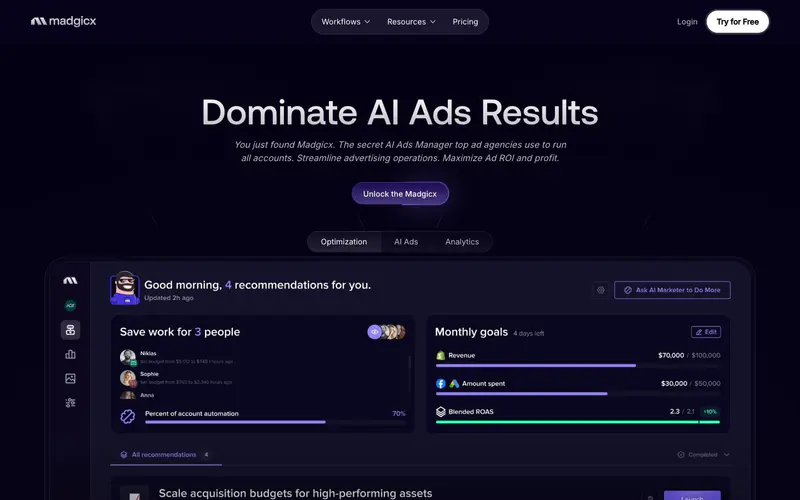
Madgicx's center of gravity is the Meta ad account. Its AI Marketer, in the words of Madgicx's information page, "audits Meta ad accounts every day, finds wasted spend and scaling opportunities, and delivers actions that are ready to run", and each action goes live after one click of approval. Around that sit automation rules built from more than 300 metrics that run campaigns 24/7 on conditions you set, Ads Manager 2.0 for bulk edits, audience tools, and Madgicx Cloud Tracking, which hosts Meta's Conversions API Gateway so Meta sees more of your conversions.
Creative is a second layer. Creative Insights labels the elements in your images and videos with computer vision and flags fatigue, and the AI Ad Generator makes new image ads. Reporting reaches past Meta: One-Click Report pulls Meta, Google Ads, GA4, Shopify, Klaviyo and TikTok into dashboards that agencies can share by link, export as PDF or white-label. Madgicx is also candid about its sweet spot. Its FAQ says the app "is most suitable for high-spenders with a monthly Facebook ad budget of $2,500+".
Segwise: the creative layer across every network

Segwise starts from the ad itself. Its Creative Tagging Agent watches, listens to and plays every ad you run, including playables, and tags each element. Every tag is matched to the metrics you care about (IPM, CPI, ROAS, LTV), with data joined from your ad networks and, if you have one, your MMP. The Creative Strategy Agent answers questions about that data in plain language. Fatigue tracking warns you when a winner starts to fade. Then the Creative Generation Agent lets you draft new ads from your winning patterns, then edit and ship them.
You can use each agent on its own, or do it all in one place by chatting with the Segwise agent: ask how your ads are performing, see what competitors are running, and make new ads from your winners.
What Segwise leaves out matters as much: it never touches bids or budgets. WGT says its early concept-to-test cycle dropped from 2 to 3 weeks to 2 to 3 days, according to the WGT case study. The agency HiveMinds reports cutting its weekly creative review from 2 hours to about 30 minutes, and CPA by 25% on Meta and 28% on Google on a refreshed campaign, as described in the HiveMinds case study.
Where does Madgicx genuinely beat Segwise?
If these are your priorities, Madgicx is the better buy.
It acts on your Meta account. AI Marketer recommendations, automation rules and bulk edits change budgets, bids and ad status. Segwise tells you what to change and what to make, but the change happens elsewhere.
It costs much less at small spend. Under $1K a month, Madgicx is $45 on monthly billing, and $129 at $5K to $10K. At list price, Segwise's $499 starting point sits above every Madgicx band up to $30K.
It fixes Meta's tracking. Cloud Tracking and the $49 Tracking Pro add-on send conversions server to server. Segwise reads data; it does not run tracking.
Its MCP can write. From Claude or ChatGPT, the Facebook Ads MCP can "pause, start, budgets, bids, naming" across 48 tools. Segwise's MCP only reads.
Generated ads reach Ads Manager in one click. Segwise exports files in each network's specs, and direct publishing to networks is still on its roadmap.
Ecommerce reporting comes in the box. Shopify, Klaviyo and GA4 sit next to Meta in white-label client reports, which suits Shopify brands and the agencies that serve them.
Where does Segwise go further than Madgicx?
Networks beyond Meta. Segwise connects 17 live ad channels through its no-code integrations, including AppLovin (Axon), Unity, Mintegral, Moloco and Liftoff. For a mobile game or app, that is where much of the budget goes, and Madgicx's pages name none of them.
MMP data as the source of truth. Segwise connects AppsFlyer, Adjust, Branch, Singular and Kochava, with setup guides such as its AppsFlyer integration, so creative is judged on installs, D7 ROAS and post-install events. Madgicx's product and pricing pages name no MMP.
Deeper tagging. Segwise tags audio (voiceover, music, hook lines) and plays playables end to end, and you can add custom tags on top of 20+ standard ones. Madgicx describes visual labeling of images and video.
More formats. Segwise's Creative Generation Agent lets you make statics and videos up to 30 seconds, including AI UGC-style ads, and the Segwise team delivers playables and CTV spots as managed services. Madgicx describes its generator as making image ads.
A score before you spend.Pre-flight Testing rates up to 10 new creatives out of 100 against your own winners and checks each network's placement specs.
One starting price up to $250K a month. Segwise starts at $499 a month for spend up to $250K. Madgicx's price rises with each spend band and is not published above $30K.

Can Madgicx build ads and run creative tests in one tool?
Partly, and only on Meta. Madgicx's information page says the AI Ad Generator makes image ads from a prompt, an image or any ad in the Meta Ad Library, ready to edit. Its AI ads page adds the next steps: upload the ads to Ads Manager in one click or launch them from Madgicx. That page says it is "built for creative testing" and lets you "set up A/B tests much faster". Creative Insights then shows which formats and elements won. Madgicx's Ad Library page adds a human step for edits: leave a comment on an AI-generated ad and its designers make the change "within 24-48 hours".
Three gaps are worth knowing. Madgicx does not describe video generation or a score for a creative before launch, and it tests only on Meta. Segwise covers those three: it drafts video, including AI UGC-style ads, scores drafts before spend, and analyzes results on every connected network. It does not launch the test for you, though. Your team uploads the exports and sets up the test in each network.
How do they handle creative fatigue detection and refresh?
Both detect fatigue, and they act on it differently. Madgicx's Creative Insights tracks how each Meta creative performs over time, and its information page says it "flags creative fatigue so advertisers know when to refresh". Because Madgicx also runs automation rules, a Meta team can pair that signal with rules that act on conditions it sets.
Segwise's fatigue tracking watches for a sustained drop in a metric you choose, such as a 20% fall in ROAS over 7 days, on every connected network, and alerts the team by email or Slack. The refresh is where the two differ most. Segwise knows which elements made the fading ad win, so it can draft new variations that keep the hook and change what has worn out. For the Meta side of this, see our guide to Meta ads creative fatigue.
Copilot vs Creative Strategy Agent: which AI chat answers what?
Madgicx's Copilot is an assistant "built into every page" that answers from your Meta ad account. Since January 2026 you can attach specific campaigns, ad sets and a date range as context. Ask it why spend shifted or which ad sets to scale, and it answers like a media buyer.
Segwise's Creative Strategy Agent answers like a creative strategist. Ask "what is different about my top 5 creatives versus my bottom 5" or "brief me two new hooks for the French market", and it answers from tagged creative data across every network, with charts and briefs. Both companies also offer an MCP. Madgicx's can take action on Meta. Segwise's (available on request through your account manager) lets Claude, ChatGPT, Cursor or Codex query your creative data, but it cannot change anything.
What does each tool cost at your ad spend?
Segwise starts at $499/month for advertisers spending up to $250K/month, with a special 50% discount for startups spending under $50K/month, and includes a 7-day free trial. Madgicx prices by monthly ad spend; the figures below come from the price table on its pricing page.
Segwise's starting price, quoted above, covers every row of this table, because its starting plan runs to $250K a month in spend.
Three things change the totals. Madgicx's Tracking Pro adds $49 a month per connected account. Its plans include two ad accounts, and agencies pay for more. On the pricing page's own table, quarterly billing cuts the monthly price by about 15% ($329 to $280 a month) and annual billing by about 30% ($329 to $230), but annual is paid 12 months up front. Madgicx's FAQ still quotes 8% and 20%; the pricing table is what you pay. If your spend passes the plan limit, Madgicx moves you up a tier automatically.
At $4K to $10K a month on Meta alone, Madgicx costs a fraction of Segwise, and a paid creative analytics layer may not pay back yet. At $25K spread across Meta, TikTok and AppLovin, Madgicx optimizes only the Meta share, while Segwise covers every network at its starting price. Running both at $25K costs $329 plus $499, or $828 a month on monthly billing, which is about 3.3% of spend. That figure assumes no Segwise startup discount and prices Madgicx on the full $25K, since its pricing page asks for your monthly ad spend without saying whether spend outside Meta counts.
Which should you pick? A decision rule
This is a rule of thumb, not a law. Use it to shortlist, then test on your own data during the free trials.
Choose Madgicx when Meta carries 80% or more of your spend, you want AI to change budgets and bids for you, and image ads cover most of what you ship. Madgicx itself points to Facebook budgets of $2,500 a month or more.
Choose Segwise once 2 of these 4 are true: more than 20% of your spend runs outside Meta; you judge creative on MMP data; you need video, playables or CTV; you launch more than about 20 new creatives a month and no one has time to tag them by hand.
Run both when Meta is more than half your spend and 2 of the 4 points above are also true.

What are the limitations of each tool?
Madgicx limitations
It optimizes Meta only. Google Ads and TikTok appear in reports, but the AI actions and rules work on Meta.
It describes image ad generation only, and we found no page that says it generates video, playables or TV spots.
Its product and pricing pages name no MMP and no mobile gaming network, which makes it a weak fit for app install campaigns outside Meta.
Two ad accounts are included. Agencies with many clients pay for more.
Above $30K a month in spend, the price is not public.
Its own FAQ says small budgets make results harder to see, and it accepts credit cards only.
Segwise limitations
It does not buy media. There are no bid, budget or pause rules, so you still need Ads Manager, your buyers or a tool like Madgicx for that.
Its MCP is read-only and enabled on request.
At small Meta-only budgets, it costs more than Madgicx.
Generated ads come out as exports. Pushing them straight to ad networks is not live yet.
Pre-flight Testing needs connected ad network data to compare against, and history import is 14 days on the trial and 3 months on paid plans.
How do you switch from Madgicx to Segwise, or run both?
You do not have to rip Madgicx out. You can move the creative work and keep or replace the buying work on purpose.
Split the jobs. List what Madgicx does for you today: audits, rules, tracking, reports, ad generation. Buying and tracking stay with Madgicx or Ads Manager. Creative analysis, briefs and generation move to Segwise.
Connect Segwise. Start the free trial and connect Meta and your other networks with the no-code setup. Then add your MMP; the AppsFlyer guide, for example, asks you to share an AppsFlyer V2.0 API token. The trial imports 14 days of history, and paid plans import 3 months.
Run both for two to four weeks. Compare Madgicx's Creative Insights with Segwise's tags on the same Meta ads, and check whether the extra networks and audio tags change what you would brief next.
Export what you need. Save Madgicx reports as PDF. Your campaigns and their data stay in your Meta ad account after you cancel, as Madgicx's FAQ confirms.
Rebuild rules before you cancel. Unsubscribing switches off Madgicx's automated rules. If you are leaving Madgicx entirely, recreate the stop-loss rules you rely on in Meta's own Ads Manager first.
Time the contract. Annual Madgicx plans are prepaid for 12 months, and access runs to the end of the billing cycle, so plan the switch for your renewal date.
Tip: Run the side-by-side on the same Meta ads you already analyze in Madgicx. If Segwise's tags only repeat what Creative Insights shows, you probably do not need both yet. If they change your next brief, they will pay off faster on your other networks.
For agencies weighing this across many client accounts, our guide to creative analytics tools for agencies covers per-client views and reporting. For a broader look at tools built only for creative analysis, see the top creative analytics tools. Mobile game studios can see how this works on gaming networks on the Segwise mobile gaming page.