
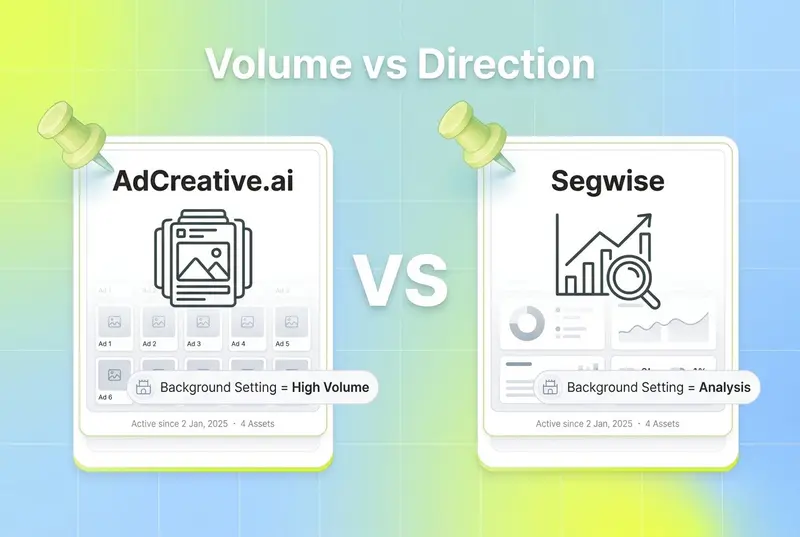
Quick answer: Segwise (from $499/month) and AdCreative.ai (from $39/month, now owned by Appier) both generate ad creative: AdCreative.ai for cheap template volume across image, video, and copy; Segwise for data-backed generation grounded in your own winning patterns, with the creative analytics and tagging layer attached.
TL;DR
- AdCreative.ai generates a high volume of video, text, and image ads fast using templates. It starts at $39/month, claims more than 4.2 million users, and has been owned by Appier since March 2025.
- Segwise also generates ads, but data-backed. It tags every creative automatically, learns which elements actually win, and generates net-new and variation creatives across image, video, and playable formats grounded in those winning patterns.
- The core tradeoff sits between template-driven volume and data-backed, closed-loop creative. AdCreative.ai gives you more ads fast. Segwise generates from what is already working and tells you why it works.
- Pick AdCreative.ai when you need to produce creative at scale cheaply and don't yet have the spend to justify optimization: $39 to $249/month covers most small teams. Pick Segwise when you're past "just generate more" and want generation grounded in your own performance data across 15+ ad networks and MMPs, plus the intelligence to know why creatives win or lose.
What Segwise and AdCreative.ai actually do
AdCreative.ai is a generation engine built to produce ad creative fast and in bulk. You feed it a product, a brand, or a campaign brief, and it returns video, text, and image ads drawn from a large library of templates and layouts. The company says more than 4.2 million users rely on it to spin up variations across formats in minutes, which makes it well suited to teams that need a steady stream of fresh assets without waiting on a design queue. Beyond static and display ads it now covers product videos, UGC-style content and fashion videoshoots from stills, studio-grade product photography from raw photos, AI stock imagery, buyer personas, and compliance checking, plus a creative scoring model the company markets as 90%+ accurate at predicting conversion, and competitor campaign intelligence.
One thing many comparison articles still get wrong: AdCreative.ai is no longer an independent startup. Appier, the Taiwan-listed AI and adtech company, announced its acquisition on 12 February 2025 and closed it around 4 March 2025 for $38.7M total ($27.3M base). The product continues under its own name, and Appier has been wiring its generation engine into the AIRIS CDP so audiences identified in AIRIS feed straight into creative generation. AdCreative.ai's Paris operation gives Appier a European base. If you are evaluating vendor stability or roadmap direction, that ownership matters.
Generation is still the whole product. The tool gets you creative, and what you do with that creative afterward sits largely outside its scope.
Segwise is a fully agentic creative intelligence and generation platform. It analyzes your ads across video, audio, and text together, tags every creative element automatically, and feeds real-time performance data back to you. A dedicated creative strategy agent lets you query that data in plain language and ask which elements are driving conversions and which are dragging spend. A separate creative generation agent then turns the winning patterns it finds into net-new creatives and variations across image, video, AI UGC-style video, and interactive playable formats, plus scene-by-scene video storyboards. A fourth agent tracks and tags competitor ads. Segwise doesn't just make more ads. It learns which ads and which parts of them win, then generates more of what works.
The data underneath comes from 15+ ad networks and MMPs connected without code: Meta, Google, TikTok, Snapchat, YouTube, Axon (AppLovin), Unity Ads, Mintegral, IronSource and more, alongside AppsFlyer, Adjust, Branch, and Singular. A single network takes about 5 minutes to connect and all your sources 10 to 15. The 7-day free trial imports up to 2 weeks of history automatically, and paid plans backfill up to 3 months, so the tagging has something to chew on from day one. Segwise is also the only platform that tags playable (interactive) ads, which matters if you run mobile game UA.
That difference in starting point defines the whole comparison. AdCreative.ai produces many creatives quickly from templates and predicted scores. Segwise generates from your own winning patterns and keeps the loop closed, tagging and tracking every creative it makes once it goes live. One answers "how do I make more ads," and the other answers "how do I make more ads that actually work." The rest of this guide weighs where each priority earns its cost.
Comparison at a glance
Both tools generate ad creative, but they start from different places. AdCreative.ai produces volume from templates, while Segwise generates from your own winning patterns and tells you which creative is worth producing more of. The table below sorts out where each one earns its place, so you can match the tool to how far along your team is.
| Criteria | AdCreative.ai | Segwise |
|---|---|---|
| Generation approach | Broad template-driven output across video, text, and image | Data-backed generation of net-new and variation creatives across image, video, and playable ads |
| Performance feedback loop | Limited connection back from in-market results | Real-time, closed loop tying creative elements to outcomes |
| Multimodal analysis | Generates across modalities, but analyses assets largely in isolation and pre-launch | Analyzes video, audio, and text together |
| Creative tagging | Tags templates and formats for generation; no tag-to-performance mapping after launch | Automatic multimodal tagging of every creative, each tag mapped to spend and conversion data and queryable in plain language |
| Pricing model | Monthly, by generation credits and number of brands, not per seat | Monthly, tiered by ad spend, with unlimited seats on every plan |
| Ideal team size/budget | Teams scaling creative output early | Teams running enough spend to need optimization |
| Entry price | $39/month (Starter, 10 credits, 1 brand) | From $499/mo (50% off under $50K spend) |
| Top published tier | $999/month (Ultimate, 100 credits, 25 brands); Enterprise custom | From $499/mo (50% off under $50K spend) |
| Ad network / MMP data | None: it is a generator, not an analytics layer | 15+ ad networks and MMPs (AppsFlyer, Adjust, Branch, Singular) in one dashboard |
| Playable ad support | No | Generates and tags interactive playable ads |
| Ownership | Acquired by Appier, announced Feb 2025, closed Mar 2025 ($38.7M) | Independent |
| Free trial | 7 days, cancel anytime | 7 days, no credit card |
Read the table as a maturity split rather than a feature scorecard. Teams still building raw creative volume will value AdCreative.ai's template breadth, and teams already spending enough to care why an ad works will lean toward Segwise's data-backed generation and feedback loop.

How this comparison was scored
Six criteria decide this comparison, and each maps to a real buying question. Generation approach measures how each tool produces creative and what that output is grounded in. The performance feedback loop measures whether the tool tells you which elements worked in-market. Multimodal analysis, creative tagging, pricing model, and ideal team size round out the picture.
We weighted the feedback loop most heavily because teams asking "which tool" have usually solved raw output and now want direction. Knowing why a creative won, and generating more like it, matters more than counting one more template format.
This is a buyer's guide, not a takedown. Both tools are judged on what they set out to do, and each wins for a specific kind of buyer.
Every price quoted here was read off each vendor's own pricing page in August 2026 rather than lifted from a third-party summary: several of which still carry AdCreative.ai's older Ultimate price and describe it as an independent company.
Generation approach and creative output
AdCreative.ai builds its whole product around fast, template-driven output, and that shows in the format range it covers. You feed it a product URL or brand assets, pick a format, and it generates image ads, video ads, and ad copy in batches you can push straight into campaigns. The library of ad templates spans display sizes, social placements, and video formats, so a team running paid social across five channels can produce dozens of on-brand variations in an afternoon. For teams whose bottleneck is producing enough creative to keep tests fresh, that volume is the entire value.
The tradeoff is that AdCreative.ai treats generation as the finish line. It scores variations before they run using a predicted conversion model, but the tool doesn't build much of a bridge from what actually happened in-market back to what you should generate next. You get a lot of creative, and you decide on your own which directions were worth pursuing.
Segwise approaches generation from the other direction. Instead of starting from templates, it starts from your data. Its multimodal AI reads video, audio, and text together, tags the elements inside each ad, and maps every tag to performance. Its creative generation agent then produces net-new creatives and variations built around the elements that are actually winning, across static images, video, and interactive playable ads, the last of which most generators cannot handle. It can remix winning hooks, CTAs, and visual styles from across your top creatives into new ads, generate scene-by-scene video storyboards, and let you edit outputs by prompting before exporting them in each network's aspect ratios.
The loop stays closed. Every creative Segwise generates is automatically tagged and tracked once it goes live, so its results feed straight back into the same intelligence that produced it, and each round of generation learns from the last. That is the piece a template generator leaves to you.
Put plainly, AdCreative.ai wins if you need the most creative the fastest and are comfortable directing it yourself. Segwise wins if you want every creative you generate grounded in what your own account shows is working, with the analysis layer attached. A team early in scaling paid media often values raw speed first. A team already spending enough to have clear winners and losers in the data gets more from generation that builds on those winners, and many end up wanting both.
Performance feedback and the "why" behind creative results
Segwise connects each creative element to its in-market outcome and tells you what to make more of, which is the mechanism most generation tools skip entirely. When Segwise ingests a live ad, its multimodal AI breaks the creative into tagged components. It records the hook style, the pacing, the on-screen text, the audio track, the color palette, and the call-to-action treatment. It then binds those tags to the actual spend and conversion data flowing back from your ad accounts. A specific hook or a specific voiceover stops being a guess about why one video beat another. It becomes a labeled attribute with performance numbers attached.
The creative strategy agent turns that tagged data into answers you can query in plain language. You can ask which hook style drives the lowest cost per install across your top-spending campaigns, or which video length holds attention past three seconds for a particular audience. The agent reads across your tagged library and responds with the pattern, not just a single winning asset. That answer directs your next round of production toward the elements already earning their spend, and Segwise can generate those variations for you, so you produce with a reason rather than generating and hoping.
Real-time feedback matters here because creative fatigue moves fast on paid social. Segwise flags when a previously strong element starts losing efficiency, which gives you a window to refresh before performance decays. You are not waiting for a monthly report to notice that a hook stopped working. The signal arrives while you can still act on it.
AdCreative.ai runs a much thinner loop back from results to production. Its scoring predicts how a creative might perform before you launch, based on patterns in its training data, but that prediction is not the same as measured in-market performance tied to your own accounts. Once an ad is live, the platform gives limited structured feedback on which specific element inside a winning creative earned the win. You see that an ad performed, without a tagged breakdown of the hook, the pacing, or the audio that produced the result. The next generation cycle then starts from templates and prediction again rather than from your own performance evidence.
That difference decides who each tool serves. Generation without a feedback loop produces volume without direction, and Segwise supplies the direction, then generates against it.
Multimodal analysis and automatic creative tagging
Segwise reads a video ad the way a viewer experiences it, analyzing the footage, the audio track, and the on-screen or spoken text together rather than scoring each in isolation. A hook that lands only because the voiceover reinforces the first three seconds of visual gets recognized as a combined effect. Most tools treat a video as a single asset or split it into separate files, which loses the connection between what someone sees and what they hear at the same moment.
That joint analysis feeds automatic tagging, and the tagging is what makes performance data usable later. Segwise labels each creative by its elements as it processes it. It records the hook type, the pacing, whether a face appears early, the call-to-action wording, and the audio style. You do not name these attributes by hand or maintain a spreadsheet of which ad used which format.
Once every creative carries tags, the performance data becomes queryable. You can ask which hook style holds attention longest, or whether ads with a spoken CTA in the first five seconds convert better than ads with a text overlay. Without tagging, that question has no answer, because nobody labeled the ads consistently enough to group them. You are left comparing individual ad IDs with no way to see the pattern across dozens of variations. That same tag-to-performance map is what Segwise's generation agent draws on to build new creatives around your winning elements.
AdCreative.ai tags its output for generation purposes, mapping templates and formats so it can produce variations quickly. Its tagging serves the creation step rather than a downstream performance query. You get structured output going out, but you do not get an analysis layer that connects a specific audio or visual element back to how the ad performed in-market.
Pricing model and team fit
AdCreative.ai prices around generation volume, which fits its role as an output engine. The billing basis is monthly, by credits and number of brands: not by seat, which is a common misdescription. Starter is $39/month (10 credits, 1 brand), Professional is $249/month (50 credits, 10 brands, marked most popular), and Ultimate is $999/month (100 credits, 25 brands). Enterprise is custom. Quarterly billing is promoted at 25% off and annual at 50% off, and there is a 7-day free trial you can cancel anytime.
One caution for anyone checking figures elsewhere: some third-party listings still show the Ultimate tier at $599/month. The vendor's own site shows $999, and that is the number to plan against.
Segwise prices around the intelligence layer rather than the raw output count, and tiers by ad spend rather than by asset count. Segwise starts at $499/month for advertisers spending up to $250K/month, with a special 50% discount for startups spending under $50K/month. Every plan includes unlimited seats and the full platform: analytics, tagging, the strategy agent, and generation. The 7-day trial needs no credit card.
The gap is real and it is the honest headline of this comparison: at the entry tier AdCreative.ai costs roughly a twelfth of what Segwise does. That is not a rounding error, and it is why the two tools rarely compete for the same buyer at the same moment.
The pricing logic tells you which buyer each tool expects. AdCreative.ai assumes you need more creative and want to lower the cost per asset. Segwise assumes you already have enough creative running to know what works, and want to generate more of it with the guesswork removed.
That difference maps cleanly onto maturity. If you are early in scaling creative output and the bottleneck is simply producing enough variations to test, a volume-based template generator matches your stage and your budget. If you are past that point and running enough spend that wasted creative costs real money, a platform that generates from your own performance data earns its price by cutting the guesswork out of what to make next. The line falls at the moment volume stops being your problem and direction starts.
Where AdCreative.ai genuinely wins
A comparison written by one of the two vendors is worth reading only if it is honest about the other. Here is where AdCreative.ai is the better answer, and none of it is close:
- Price. $39/month gets you a working ad generator. There is no tier of Segwise, or of any creative intelligence platform, that competes at that number. For a solo marketer, a founder running their own ads, or an agency testing a new client before the retainer starts, this is decisive.
- Breadth of output formats. Static and display ads, social placements, product videos, UGC-style content, fashion videoshoots from stills, studio-quality product photography from raw photos, AI stock imagery, headlines and copy, and brand-specific templates. As a single place to make many kinds of asset, it covers more ground than a performance-first tool needs to.
- Backing and roadmap. Being part of Appier means engineering resources and CDP integration behind the product, rather than a small independent team. If your worry with AI creative tools is whether the vendor is still around in two years, that acquisition reads as a point in its favour.
- Zero setup dependency. AdCreative.ai does not need your ad accounts connected to be useful on day one. Segwise's whole value depends on ingesting your performance data, so if you have almost no spend history, there is not much for it to learn from yet.
The honest framing: these tools mostly serve different moments, not different camps. If your problem is that you don't have enough creative, AdCreative.ai solves it for $39 a month. If your problem is that you have plenty of creative and no idea which parts of it are working, no amount of extra template output fixes that, and that is the point at which Segwise starts to pay for itself.
Verdict: which tool fits which team
Pick AdCreative.ai if your bottleneck is production volume. Teams that need to fill many placements across video, text, and image formats every week get the most from its template engine, and its claimed 4.2M+ user base reflects how well it serves the "we need more creative, fast" problem at a $39 to $249/month price point. If you are early in scaling paid social and your ad account still runs a handful of variations at a time, generation speed is the constraint worth solving first, and AdCreative.ai solves it directly.
Choose Segwise once you are producing enough creative that the harder question becomes which variations to keep making. Its multimodal analysis and creative strategy agent tell you which hooks, audio cues, and visual elements move performance, and its generation agent turns those winning elements into net-new creatives and variations, including playable ads, so your next batch follows evidence instead of guesswork. Performance marketing teams running real spend usually hit this point fast, because the cost of generating the wrong creative at volume outweighs the cost of generating from what already works.
Some teams still run both, using AdCreative.ai for sheer template volume while leaning on Segwise to generate data-backed creatives and to learn what actually performs. Either way, the honest deciding factor is your spend level. Small budgets reward raw volume, and larger budgets reward generation and iteration grounded in your own performance data.

FAQs
Is Segwise a replacement for AdCreative.ai or a complement to it?
It can be either. Segwise generates data-backed creatives from your winning patterns and tells you which creatives work, so some teams use it in place of a template generator, while others pair it with AdCreative.ai's raw volume. AdCreative.ai focuses on fast template output; Segwise focuses on generating and identifying what actually performs.
Which tool is better for performance marketing teams?
Segwise fits performance marketing teams better because it ties specific creative elements to in-market outcomes and generates new creatives around the ones that win, through real-time feedback and its creative strategy agent. AdCreative.ai serves teams that need fast, template-driven output more than deep performance analysis. Your spend level and maturity decide which matters more.
Do either of these AI ad tools generate ad creative automatically?
Both do. AdCreative.ai produces video, text, and image ads at scale from templates. Segwise generates net-new and variation creatives, including interactive playable ads, grounded in your winning creative patterns rather than templates, and automatically tags and tracks each one once it goes live. If raw template volume is the priority, AdCreative.ai leans that way; if you want generation backed by your own performance data, Segwise does.
Which tool is right for a small team just starting to scale creative?
AdCreative.ai suits smaller teams that need to produce many ad variations quickly without a large budget: its $39/month Starter tier is genuinely accessible in a way no creative intelligence platform is. Segwise earns its place once you run enough spend to justify generating from performance data and tracking what works. Many teams start with template volume and add Segwise as optimization becomes the bottleneck.
How much does AdCreative.ai cost?
$39/month for Starter (10 credits, 1 brand), $249/month for Professional (50 credits, 10 brands), and $999/month for Ultimate (100 credits, 25 brands). Enterprise is custom. Billing is by credits and number of brands rather than per seat, with 25% off quarterly and 50% off annual, and a 7-day free trial you can cancel anytime. If you see $599 quoted for Ultimate, that figure is stale: the vendor's own site shows $999.
How much does Segwise cost?
Segwise starts at $499/month for advertisers spending up to $250K/month, with a special 50% discount for startups spending under $50K/month. All plans include unlimited seats and the complete platform. The 7-day free trial needs no credit card.
Who owns AdCreative.ai?
Appier, a Taiwan-listed AI and adtech company. The acquisition was announced on 12 February 2025 and closed around 4 March 2025, valued at $38.7M total ($27.3M base). The product still runs under the AdCreative.ai name, and Appier has been integrating its generation engine with the AIRIS CDP. Any article describing AdCreative.ai as an independent startup is out of date.
Does either tool handle playable ads?
Only Segwise. It both generates interactive playable ads and tags them for performance analysis, which is a real gap for mobile game studios evaluating template generators. AdCreative.ai covers static, display, social, and video formats, not playables.
Which tool connects to my ad accounts and MMP?
Segwise. It connects 15+ ad networks and MMPs with no code, Meta, Google, TikTok, Snapchat, YouTube, Axon (AppLovin), Unity Ads, Mintegral, IronSource and more, plus AppsFlyer, Adjust, Branch, and Singular, and joins that data to creative-level tags. AdCreative.ai is a generator, not an analytics layer, so it does not ingest your ad account performance data.
Written by the Segwise team. We build creative intelligence software, so we have an obvious stake in this comparison, which is why every AdCreative.ai figure above is sourced from its own pricing page or from Appier's acquisition release, and why the section on where AdCreative.ai beats us is in the article rather than left out. Spot something out of date? Tell us and we'll fix it.