
Seedance 2.5 is ByteDance's new AI video model, launched July 31, 2026, that generates 30-second clips with synchronized audio in a single pass, accepts up to 50 reference files, and lets you edit specific moments without regenerating the whole video. For performance marketers, that puts a full-length video ad at roughly $3 in generation cost, which moves the real bottleneck from making ads to knowing which ads to make and proving they work.
ByteDance shipped Seedance 2.5 on July 31, 2026, rolling it out through Dreamina, the CapCut-family creation platform, starting with subscribers in Europe, Asia, the Middle East, and South America. The headline specs read like a direct answer to the complaints ad teams have had about AI video since the first Seedance: clips were too short for a full ad narrative, product accuracy fell apart across generations, and fixing one bad second meant regenerating everything.
The 2.5 release attacks all three. Single-pass generation doubles from 15 to 30 seconds. Reference capacity jumps from 12 files to 50. And a new edit mode lets you revise a specific timestamp or a specific character while leaving the rest of the video untouched.
If you run user acquisition or creative strategy, this is worth 10 minutes of your attention. The model itself is not the story. The economics of video ad production just shifted again, and the teams that adapt their workflow first tend to bank the arbitrage before everyone else catches up.
Here is what actually changed, where you can use it today, and what it means for how creative teams should operate now.
Also read How to Keep AI-Generated Ads On-Brand in 2026
Key Takeaways
Seedance 2.5 launched July 31, 2026 via Dreamina, generating up to 30 seconds of video with synchronized audio in one pass, double the previous 15-second cap (Dreamina press release)
Reference capacity jumped from 12 to 50 files per generation: up to 30 images, 10 video clips, and 10 audio files, which makes brand and product consistency far more workable (PR Newswire)
Intelligent Edit Mode revises specific timestamps or characters without full regeneration, so hook swaps and product fixes no longer cost a full re-render (XenoSpectrum)
Launch pricing on Dreamina starts at $0.097 per second for eligible subscribers, putting a 30-second ad at under $3 in raw generation cost (PR Newswire)
API access through BytePlus ModelArk was still listed as coming soon at launch, so production pipelines are limited to Dreamina's interface for now (CometAPI)
Per the IAB, 30% of digital video ads are already built or enhanced with generative AI, projected to hit 39% in 2026, so cheap 30-second generation lands in a market that is already saturating with AI creative (Marketing Dive)
What is Seedance 2.5?
Seedance 2.5 is the latest version of ByteDance's flagship video generation model, built by the same Seed research team behind Seedance 1.0 and 2.0. ByteDance describes it as an audio-video joint generation model built for 30-second storytelling, with precise reference control and editing capabilities. Audio is not bolted on afterward. Ambience, dialogue, and music generate together with the visuals, matched to what happens on screen.
The rollout is phased. Dreamina announced availability starting July 31, 2026 for paying subscribers aged 16 and up, across Europe, Asia, the Middle East, and South America, with accounts activating over the following weeks rather than all at once. North America is notably absent from the announced regions, and neither ByteDance nor Dreamina has given a timeline for it. Free daily credits exist for testing, but the new model's full feature set sits behind a subscription.
Dreamina's product page also lists a beta long-video mode that extends output to 180 seconds while holding character and scene consistency, 4K output, and multilingual dialogue across 11 languages including English, Spanish, Portuguese, Arabic, and Japanese. For ad teams running geo-localized campaigns, that last one matters more than the resolution bump.
What's new compared to Seedance 2.0
The jump from 2.0 to 2.5 is less about prettier pixels and more about production control. The specifics:
Beyond the table, the release adds production tools that read like a nod to professional pipelines: green-screen post-production support, 3D white-model control for guiding camera moves and blocking, and compatibility with Blender and Maya assets, per the launch announcement. ByteDance's own page adds performance blocking and professional camera movement to the list.
One honest caveat: ByteDance has published no benchmark scores for 2.5, and third-party coverage of the announcement notes that ByteDance concedes complex motion and multi-subject interactions still need improvement. Treat any "20% better" claims floating around vendor sites as marketing until independent tests land.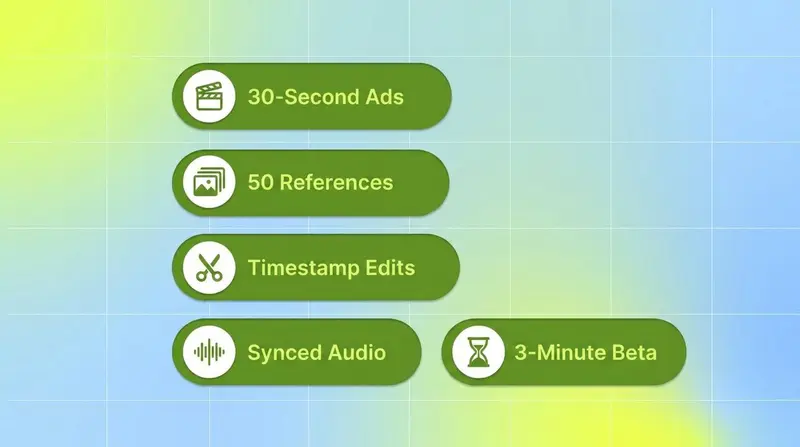
Where you can use it right now
Dreamina is the only place Seedance 2.5 is actually live as of early August 2026. Everything else is a waitlist or a landing page. Higgsfield shows a notify-me signup. TopView, OpenArt, Hedra, and similar platforms list the model as coming soon or early access. Developer API access through BytePlus ModelArk was announced as coming soon, and aggregators like WaveSpeed confirm their Seedance 2.5 endpoints are not live yet.
Worth knowing before you budget around it: a search for Seedance 2.5 surfaces a crowd of lookalike sites quoting prices and specs for a model they cannot access yet. If the offer is not from Dreamina, ByteDance Seed, or BytePlus, check it twice.
Why this matters for ad creative production
A full ad narrative in one generation
Fifteen seconds forced a choice: generate a fragment, or stitch clips and watch your character's face drift between cuts. Thirty seconds fits the classic direct-response arc in one take. Hook in the first three seconds, problem, product demo, social proof, CTA. The press release frames the launch explicitly around killing clip stitching, visual drift, and rework, which is a fair summary of where AI ad production actually loses its time.
Synchronized audio compounds this. A UGC-style talking ad needs dialogue that matches lips and pacing that matches cuts. Generating audio and video together, with improved lip sync and more reliable on-screen text, removes an entire post-production step for the low-fi ad formats that dominate paid social.
50 references make brand consistency workable
The old limit of 12 reference files sounds like plenty until you try to lock a product, a spokesperson, a set, a logo treatment, and a voice at the same time. The new ceiling of 30 images, 10 video clips, and 10 audio files means you can feed the model your actual product from every angle, your brand colors, your existing winning ad as a motion reference, and a voice sample, all in one generation.
For DTC brands, that is the difference between AI video that looks vaguely like your product and AI video you can actually run. For mobile game studios, character consistency across an episodic ad series stops being a prompt-engineering lottery. Dreamina's R2V reference system also accepts green-screen or white-model references for controlling movement and camera position when the shot has to land a specific way.
Cheap, surgical iteration
Intelligent Edit Mode lets you select a specific timestamp or a specific person and revise just that, keeping everything else intact. Think about what that does to variant math. Testing five hooks against the same 30-second body used to mean five full generations and five chances for the body to drift. Now it is one master and four surgical edits.
At launch pricing of $0.097 per second, a 30-second ad costs about $2.91 to generate. Even tripling that for retries and rejects, you are producing full-length video variants for less than the coffee budget of the meeting where you discuss them. That is a real change from 2024-era production, when a single UGC ad from a creator marketplace ran $150 to $500.
The bottleneck moves from production to intelligence
Here is the uncomfortable part. None of this is proprietary to you. Every competitor in your category gets the same 30 seconds, the same 50 reference slots, the same $3 ads. The IAB already found that 30% of digital video ads are built or enhanced with generative AI, heading for 39% in 2026. When production capacity stops being scarce, it stops being an edge.
What stays scarce is knowing what to make. Which hook, which emotion, which character style, which CTA actually drives installs or purchases for your audience. And the flood of cheap variants makes that question harder, not easier: more ads live means faster creative fatigue, more tests running at once, and more performance data scattered across networks.
This is where creative intelligence earns its keep. Segwise uses multimodal AI to automatically tag every element in your creatives, hooks, CTAs, characters, visual styles, emotions, and audio, and maps each tag to performance metrics across 15+ ad networks and MMPs (Meta, Google, TikTok, Snapchat, YouTube, AppLovin, Unity Ads, Mintegral, IronSource, plus AppsFlyer, Adjust, Branch, and Singular). Its Creative Generation Agent then turns those winning patterns into new creatives, including AI UGC-style video ads and scene-by-scene video storyboards you can hand straight to a tool like Seedance 2.5. Teams using this loop report saving up to 20 hours per week and improving ROAS by 50%.
How to fold Seedance 2.5 into your workflow
The steps below are synthesized from Dreamina's published workflow and standard creative testing practice, adapted for ad teams.
Start from winning elements, not a blank prompt. Pull your tag-level performance data before you generate anything. The hooks, angles, and visual styles that already win for you are the brief. A 30-second ad built around a proven hook beats ten built around vibes.
Build a reference library once, reuse it everywhere. Collect product shots from every angle, brand assets, your best-performing ad as a motion reference, and approved voice samples. With 50 reference slots, the quality of your library, not your prompt, sets your consistency ceiling.
Generate one master, then edit for variants. Use the 30-second single pass for the full narrative, then use Intelligent Edit Mode to swap hooks, CTAs, or on-screen text at specific timestamps. A master plus five hook variants costs under $20 at launch pricing, and you get clean variant families where only one variable changes, which is exactly what honest creative testing needs.
Tag and track everything the moment it goes live. Cheap production means more concurrent tests and faster creative fatigue. Set fatigue thresholds and success criteria up front so winners scale early and decliners die before they burn budget.
Bottom Line
Seedance 2.5 makes the expensive part of video advertising cheap: 30-second ads with synced audio, consistent products, and surgical edits, live now on Dreamina with API access coming. What it does not make cheap is judgment. When every team can generate a full ad for $3, the winners are decided by who knows which ad to generate and who spots fatigue first.
So the question worth sitting with is this: you can now produce a 30-second video ad for about the price of a coffee. Do you know which 30 seconds to make? If your creative data can answer that, Seedance 2.5 just became your production arm. If it cannot, Segwise is built to close exactly that gap.
Frequently Asked Questions
What is Seedance 2.5?
Seedance 2.5 is ByteDance's AI video generation model released on July 31, 2026. It generates up to 30 seconds of video with synchronized audio in a single pass, accepts up to 50 reference files (30 images, 10 videos, 10 audio) for character and product consistency, and supports editing specific timestamps or characters without regenerating the full clip. It launched through Dreamina, CapCut's AI creation platform, with a phased rollout across Europe, Asia, the Middle East, and South America.
What is the difference between Seedance 2.0 and Seedance 2.5?
Seedance 2.5 doubles single-pass duration from 15 to 30 seconds, roughly quadruples reference capacity from 12 to 50 files, and adds Intelligent Edit Mode for revising specific moments or characters instead of regenerating everything. It also adds a beta long-video mode up to 3 minutes, green-screen support, 3D white-model camera control, and Blender and Maya asset compatibility. Dreamina prices 2.5 from $0.097 per second versus $0.066 for 2.0.
How much does Seedance 2.5 cost?
On Dreamina, launch pricing starts at $0.097 per second for eligible subscribers, so a 30-second generation runs about $2.91. Pricing varies by subscription plan and region, and the launch rate is tied to qualifying annual memberships. API pricing had not been officially published at launch since BytePlus ModelArk access was still listed as coming soon.
Is there a Seedance 2.5 API?
Not yet as of early August 2026. ByteDance's announcement pointed to API access through BytePlus ModelArk as coming soon, and third-party aggregators like WaveSpeed confirm their Seedance 2.5 endpoints are not live. Teams that want to build automated pipelines can prototype against Seedance 2.0 endpoints today and swap the model name when 2.5 access opens.
Can I use Seedance 2.5 to make ad creatives?
Yes, and ad production is one of its clearest use cases. The 30-second single pass fits a complete direct-response arc, the 50-reference system keeps products and brand elements consistent, and timestamp editing makes hook and CTA variants cheap. The catch is direction and measurement: generation tools like Seedance via Dreamina produce the video, while a creative intelligence platform like Segwise tells you which elements to build around and tracks whether the resulting ads actually perform across your networks.
Is Seedance 2.5 better than Veo or Sora for ads?
There is no honest benchmark answer yet, since ByteDance has published no evaluation scores for 2.5 and independent head-to-head tests had not appeared at launch. Its practical advantages for ad work are the 50-file reference system and timestamp-level editing, which competing models do not match as of August 2026. Its disadvantages are phased availability and no public API. For most teams the deciding factor is workflow fit rather than raw model quality.
How do I know if my AI-generated ads are actually working?
Track them at the creative element level rather than only the campaign level. Platform dashboards like Meta Ads Manager show you which ad won, but not which hook, character, or CTA inside it did the work, and manual tagging in spreadsheets does not survive AI-scale creative volume. Segwise automates this by tagging every creative element with multimodal AI, mapping tags to metrics like ROAS and CPI across networks and MMPs, and flagging fatigue before performance drops become budget waste.