
The most effective PPC tech stacks in 2026 combine five distinct software layers: Segwise for creative intelligence, Google Ads Editor for campaign management, Optmyzr for automation, SEMrush or SpyFu for competitive intelligence, and Supermetrics with Looker Studio for reporting. Most specialists have four of these covered, the creative intelligence layer is the one that's almost always missing.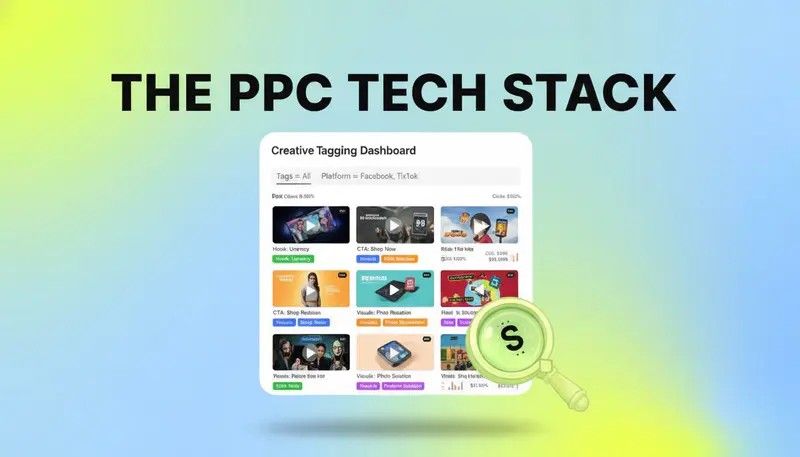
If you've been running PPC campaigns for more than a year, you know the tech stack problem intimately. You start with Google Ads, add a keyword research tool, bolt on a reporting connector, find yourself copy-pasting data between spreadsheets at 10 PM, and wonder how the whole thing got so fragmented.
The PPC category is bloated with tools that all claim to do everything. Most don't. The ones that actually stick in a specialist's workflow earn their place by solving a specific, painful job exceptionally well, and nothing more.
I've seen what real PPC specialists use week to week, not what vendors say they should use. There are five categories that almost every competent PPC practitioner has covered: campaign management and automation, keyword research and competitive intelligence, bid management, reporting and data connectors, and creative intelligence. Get each layer right and the stack becomes a compound advantage. Leave any one layer broken and everything downstream gets harder.
Also read Mobile PPC Strategy: How to Optimize Campaigns for Conversions
Here's the rundown.
TL;DR
Segwise is the creative intelligence layer most PPC specialists are missing: AI-powered tagging and fatigue detection across 15+ networks and 4 MMPs, saves teams up to 20 hours per week on manual creative analysis
Google Ads Editor is still non-negotiable for bulk campaign work, offline edits, and Performance Max management
Optmyzr handles PPC automation and rule-based optimizations without requiring full-blown developer infrastructure
SEMrush (or Ahrefs) owns the keyword research and competitive PPC intelligence layer
SpyFu is underrated for budget-conscious practitioners who need specific competitor PPC data without enterprise pricing
Supermetrics solves the data connector problem so you stop manually pulling reports from five platforms
Looker Studio (free from Google) gives you flexible, shareable PPC dashboards once you have the data plumbing in place

1. Segwise: Best for Creative Intelligence Across Multiple Networks
Most PPC stacks have a gaping hole at the creative layer. Specialists know which ads are winning by ROAS, but they don't know why they're winning. That gap gets expensive when you're scaling or iterating under time pressure.
Segwise fills that gap. It's an AI-powered creative intelligence platform that connects to 15+ ad networks (Meta, Google, TikTok, Snapchat, YouTube, AppLovin, Unity Ads, Mintegral, IronSource, and more) and four MMPs (AppsFlyer, Adjust, Branch, Singular), then automatically tags every creative element using multimodal AI: hooks, CTAs, visual styles, audio tone, on-screen text, characters, and even interactive elements in playable ads. No other platform handles that last one.
Every tag maps automatically to performance metrics: installs, ROAS, CTR, CVR, CPI, and custom conversion events. So instead of manually reviewing 200 creatives to understand why your top 10 perform differently, you see it in a tag-level dashboard in minutes.
Key features:
- Multimodal AI creative tagging (video, image, audio, text, simultaneously)
- Cross-network unified dashboard: one view for Meta, Google, TikTok, and 12+ other networks
- Creative fatigue detection with custom threshold alerts before performance crashes
- Competitor tracking dashboard with AI tagging of competitor ads (Meta currently)
- AI chat interface for natural language queries across all your creative data
- Creative generation from winning tag patterns; statics available, video in closed beta
- Asset clustering to track creative reuse and compare treatment performance
When you should try it:
When you're running creatives across more than two networks and can't answer the question "which hook style drove installs last month" without a half-day spreadsheet project, Segwise pays for itself. It's especially essential for mobile game studios, DTC brands, and performance agencies where creative velocity is high and the cost of wrong iteration is real.
Also the right choice if your team still spends hours manually tagging creatives to extract creative insights, that's up to 20 hours per week, gone on day one.
Limitations:
Competitor tracking is currently Meta-only, with more platforms in development. The platform is built for teams with active paid social and app campaigns, overkill for very small, single-platform advertisers running under a few thousand per month.
Pricing:
Custom pricing based on ad spend and number of integrations. Free trial available. Learn more at segwise.ai/creative-analytics.
2. Google Ads Editor: Best for Bulk Campaign Management at Scale
This one isn't glamorous, but it belongs in every PPC specialist's list because no one has built a better tool for managing Google Ads at scale. Google Ads Editor is a free desktop app that lets you make bulk edits offline, review changes before pushing live, and manage Performance Max, Search, Display, and Demand Gen campaigns from a single interface.
The 2026 updates (version 2.12) added total budget management, expanded Performance Max asset group editing, and deeper Demand Gen campaign controls, making it meaningfully more useful for teams managing complex account structures.
Key features:
- Offline bulk editing with staged changes before going live
- Multi-account management from a single interface
- Find-and-replace across campaigns, ad groups, and ad copy
- Performance Max and Demand Gen campaign support
- Advanced filtering and search across large accounts
- Import and export of changes as CSV or XML
When you should try it:
If you're managing Google Ads accounts with more than 10 campaigns, you need Google Ads Editor. The time savings on bulk updates alone justify the switch from working in the browser interface. It's also the go-to tool when an account needs structural changes, restructuring ad groups, adding negatives across 50 campaigns, or doing a sitelink refresh at scale.
Limitations:
Only works for Google Ads. You need separate tools for Meta, Microsoft, or TikTok campaigns. Doesn't handle real-time bidding adjustments or smart bidding configuration. No cloud sync, so working across multiple devices requires careful file management.
Pricing:
Free. Available from Google.
3. Optmyzr: Best for PPC Automation Without Developer Resources
PPC automation has a middle ground problem. Google's Smart Bidding handles macro-level bid optimization, but it doesn't give you control over the logic. Writing custom scripts requires developer time. Optmyzr sits in between: a no-code automation platform that lets PPC specialists build rules, run one-click optimizations, and apply systematic changes without touching JavaScript.
Over 75,000 advertisers in 70+ countries use it, and users report an average of 65% more revenue within six months according to Optmyzr's published data.
Key features:
- Rule-based automation engine with pre-built optimization recipes
- Bid management overlays to complement Smart Bidding with business rules
- Budget pacing and management across campaigns and accounts
- Ad text optimization and A/B testing workflows
- Account audits to surface waste and opportunities
- PPC Investigator for root cause analysis on performance changes
- Multi-platform support: Google Ads, Microsoft Ads, Meta (limited), Amazon
When you should try it:
Optmyzr is the right call when your account has outgrown manual management but you don't have a developer to build custom scripts. It's particularly useful for agencies managing multiple client accounts that need systematized optimization processes applied at scale.
Limitations:
Can be complex to set up for first-time users. The rule library is extensive and requires time to navigate. Enterprise features like custom reporting and API access are locked to higher tiers. Not a replacement for deep attribution modeling or creative analytics.
Pricing:
Starts at around $249/month for smaller accounts. Scales based on ad spend. 14-day free trial available.
4. SEMrush: Best for Keyword Research and Competitive PPC Intelligence
SEMrush is the tool most PPC specialists default to for keyword research, competitive intelligence, and understanding the paid landscape before building campaigns. Its Advertising Research module shows what competitors are bidding on, their estimated spend, and their actual ad copy, which is invaluable for campaign planning.
The 2026 updates added AI-assisted keyword clustering and the new Semrush One plan at $199/month, which bundles both SEO and AI visibility tools into a single subscription.
Key features:
- Keyword Magic Tool with volume, CPC, and competition data for billions of keywords
- Advertising Research: competitors' keywords, estimated budget, ad copies, and landing pages
- PLA (Product Listing Ad) research for ecommerce PPC
- Ad Builder to draft and save ad copy templates
- Position tracking for both organic and paid rankings
- Traffic Analytics for competitor share-of-voice estimates
When you should try it:
Essential for any specialist building campaigns from scratch or doing quarterly audits on competitive positioning. If you're entering a new vertical or product category, SEMrush's competitive data gives you a keyword and bidding baseline that would take weeks to build from first-party data alone.
Limitations:
Can be expensive for solo practitioners (Pro plan starts at $139/month). Competitive data is estimate-based, treat it as directional, not precise. For keyword research that goes deep, Ahrefs has a comparable product at a similar price point; most practitioners pick one and stick with it.
Pricing:
Pro at $139/month, Guru at $249/month, Semrush One at $199/month. 14-day free trial available.
5. SpyFu: Best for Deep Competitor PPC History on a Budget
SpyFu has been around since 2006 and remains the most cost-effective tool for deep competitor PPC intelligence. Where SEMrush gives you a broad view across SEO and paid, SpyFu goes deep on historical PPC data, showing 15+ years of competitor ad history, the keywords they've bought and abandoned, and estimated budget trends over time.
Key features:
- Unlimited competitor keyword lookups and search results
- 15+ years of historical PPC data per domain
- Competitor ad copy history and frequency metrics
- Kombat feature: three-way keyword overlap analysis between you and two competitors
- PPC recommendations based on competitor gap analysis
- Domain comparison reports
When you should try it:
SpyFu is the smart pick when you need solid competitor intelligence without paying SEMrush enterprise rates. It's particularly valuable for identifying competitor keyword patterns over time, which terms they've consistently bid on for 2+ years signals genuine profitability for them, which is a much better starting hypothesis than current volume data alone.
Limitations:
No mobile app. UI feels dated compared to newer tools. Data accuracy can lag on newer or smaller competitors with thin ad history. Less powerful for SEO work than SEMrush or Ahrefs.
Pricing:
Basic plan at $39/month, Professional at $79/month. Annual plans offer significant discounts.
6. Supermetrics: Best for Cross-Platform PPC Data Pipelines
One of the most expensive time sinks in PPC is manually pulling data from Google Ads, Meta, TikTok, and whatever else you're running and trying to reconcile it all in a spreadsheet. Supermetrics solves this at the data plumbing level. It connects your ad platforms to Google Sheets, Looker Studio, BigQuery, or data warehouses, and keeps everything synced automatically.
It supports 100+ marketing data sources, making it the default choice when you need cross-platform reporting that updates itself.
Key features:
- 100+ marketing data source connectors (Google Ads, Meta, TikTok, LinkedIn, Amazon, etc.)
- Destinations: Google Sheets, Looker Studio, Power BI, BigQuery, Snowflake, and more
- Automated data refresh on schedules you define
- Pre-built templates for common PPC reporting use cases
- Team sharing and multi-user access
- Data transformation options before loading
When you should try it:
When your team is spending more than two hours per week pulling reports manually across platforms. Also essential when clients or stakeholders need live dashboards rather than static spreadsheet exports. Supermetrics is the connective tissue of a data-driven PPC operation.
Limitations:
Pricing adds up quickly when you need many data sources. The 2026 pricing model charges per data source connection and can reach $500+/month for comprehensive stacks. Some users report occasional API sync delays with newer platform connections. Not a reporting or visualization tool on its own. You need a destination (Sheets, Looker Studio, etc.) to actually see the data.
Pricing:
Core plans start around $29/month per data source. Volume bundles available. 14-day free trial.
7. Looker Studio: Best for Free PPC Reporting and Client Dashboards
Looker Studio (formerly Google Data Studio) is the free reporting tool that holds the PPC stack together at the visualization layer. Connect your ad data via Supermetrics or native connectors, build shareable dashboards, and give clients or stakeholders live access to the numbers that matter without exporting a new PDF every Monday morning.
Key features:
- Free with a Google account, no per-seat licensing
- Native connectors for Google Ads, Google Analytics, Search Console, and more
- Third-party connectors (via Supermetrics, Coupler.io, etc.) for Meta, TikTok, and other platforms
- Drag-and-drop report builder with charts, tables, and scorecards
- Shareable live links or scheduled email delivery
- Template library with pre-built PPC dashboard structures
When you should try it:
Looker Studio is the right choice when you need client-ready reporting that refreshes automatically and doesn't require a BI tool subscription. It's particularly useful for agencies managing multiple client accounts who need lightweight, branded dashboards without enterprise costs.
Limitations:
Performance can lag with large data sets and complex calculated fields. Advanced features (Blended Data, multi-source joins) require careful setup to avoid calculation errors. Requires solid data connector work first. Looker Studio is only as good as what you pipe into it.
Pricing:
Free. Looker Studio Pro at $9/user/month adds service-level agreements and enterprise access controls.
Comparison Table
How to Build Your Stack by Role
Not every PPC specialist needs every layer. Here's how to prioritize by situation:
Solo practitioner or small in-house team ($5K-$50K/month spend):
Start with Google Ads Editor (free), SpyFu ($39/month), and Looker Studio (free). Add Supermetrics when manual reporting time exceeds 3 hours/week. Add Segwise when you have multiple active creatives across two or more networks.
Mid-market PPC specialist or small agency ($50K-$500K/month spend):
The full stack applies. Google Ads Editor, SEMrush for competitive intelligence, Optmyzr for automation, Supermetrics + Looker Studio for reporting, and Segwise as the creative intelligence layer. Segwise becomes especially high-value here because creative volume increases and the cost of iterating without element-level data grows fast.
Enterprise or large agency (>$500K/month spend):
All tools above, plus consider building out BigQuery-backed data infrastructure as your data warehouse layer. Segwise's cross-network unified view and 15+ platform integrations save analyst time at this tier, that's where the "20 hours/week saved" outcome actually shows up at scale.
Decision Framework: Where to Start
If you already have the basics (Google Ads Editor, one keyword research tool, basic reporting), the most neglected gap in most PPC stacks is the creative intelligence layer.
Ask yourself:
- Do you know which specific creative element drove your best results last month, not the ad, but the element inside it?
- Can you tell whether a specific hook style is fatiguing before performance visibly drops?
- When you iterate on a creative concept, are you working from data or gut feel?
If those answers are uncomfortable, that's the gap. The rest of your stack can be perfectly tuned and you'll still waste budget on creative decisions made without element-level data.
Conclusion
Every layer of the PPC tech stack serves a distinct function. Campaign management, keyword intelligence, automation, reporting pipelines, and creative analytics are different problems. They need different tools, and no single platform genuinely covers all of them well.
The gap most specialists hit as they scale is creative intelligence. You can have an airtight bidding strategy, perfect keyword coverage, and real-time reporting dashboards, and still miss the most controllable lever in your PPC performance: which elements inside your creatives are actually driving results.
That's where Segwise earns its place in the stack. Stop manually reviewing creatives and cross-referencing spreadsheets to understand what's working. Connect your ad networks and MMPs once, let multimodal AI do the tagging, and start making creative decisions backed by data instead of instinct.
Frequently Asked Questions
What is a PPC tech stack?
A PPC tech stack is the combination of software tools a pay-per-click specialist uses to manage, analyze, optimize, and report on paid advertising campaigns. A typical stack covers campaign management, keyword research, bid management or automation, data connectors, reporting dashboards, and increasingly, creative intelligence.
Do I need all these tools to run effective PPC?
No. Start with what solves your most expensive problem. For most specialists, that's campaign management (Google Ads Editor), competitive intelligence (SEMrush or SpyFu), and reporting (Looker Studio). Add automation and creative intelligence as spend and complexity increase.
What's the difference between bid management and PPC automation?
Bid management focuses specifically on adjusting CPC, target CPA, or ROAS bids based on signals. PPC automation is broader. It covers rules, optimizations, workflow actions, and structural changes. Tools like Optmyzr do both. Google's Smart Bidding handles bid automation natively within the platform.
Is Segwise only for mobile app advertisers?
No. While Segwise has particularly deep capabilities for mobile game studios (including playable ad tagging, which is unique in the market), it serves DTC brands, subscription apps, and performance marketing agencies across Meta, Google, TikTok, and 12+ other ad networks.
How does Segwise differ from a standard analytics tool?
Standard analytics tools show campaign-level metrics, which campaign, ad set, or ad won. Segwise shows element-level intelligence: which hook style, visual style, CTA, audio cue, or character inside the ad drove performance. It's the difference between knowing which ad won and knowing why it won.
What's the best free PPC tool?
Google Ads Editor is the strongest free tool in the stack. Bulk campaign editing, multi-account management, and offline change staging are features that save significant time without any cost. Looker Studio is the best free reporting option once you have data connectors in place.
How much should a PPC tech stack cost per month?
A functional mid-market PPC stack typically costs $300-$700/month depending on the specific tools chosen and the number of data source connections needed. Solo practitioners can run a strong stack for under $150/month using free tools (Google Ads Editor, Looker Studio) and budget-tier options like SpyFu.
When does creative intelligence become necessary in a PPC stack?
When you're actively testing multiple creative variants across more than one platform and can't answer basic questions about which creative elements are driving performance without a manual review session. In practice, most teams reach this point around $30K-$50K in monthly creative-driven spend, or whenever creative iteration velocity increases beyond what manual tagging can sustain.