
Quick answer: The best Pencil alternatives in 2026 are Segwise for creative intelligence that generates as well as analyses, AdCreative.ai for high-volume cheap AI creative, and Motion for DTC teams that want an always-on AI analyst.
Key Takeaways
Pencil Gaps: Pencil excels at AI ad generation, but it lacks automated element-level tagging, deep MMP integrations, fatigue alerts, and playable analysis, limiting true performance-driven creative optimization. It is very much alive: owned by The Brandtech Group since 2023 and sold as two products, self-serve Pencil from $14/month and enterprise Pencil Pro.
Generation Trap: Producing more variations doesn’t equal better results. Without understanding which creative elements drive ROAS and LTV, scaling becomes guesswork.
Optimization Shift: Modern creative strategists need tools that connect hooks, visuals, messaging, and formats directly to business outcomes, not just workflows and templates.
Smarter Alternatives: Segwise, AdCreative.ai, Bannerflow, Vidmob, Creatify, Motion, Bestever, GetCrux and Atria each extend beyond raw generation, adding analytics, scaling systems and performance visibility, at prices from $10/month to four-figure enterprise contracts.
Segwise Advantage: Combines automated tag-level creative element mapping, deep MMP integration, proactive fatigue detection, and playable ad tagging in one unified creative intelligence platform, turning creative strategy into a measurable growth engine.
Are you spending hours creating and testing ad creatives, yet still feeling unsure about which ideas actually work?
When your growth depends on high-performing creatives, the wrong tool leads to wasted ad spend, slow iteration cycles, and missed opportunities to scale winning ideas. As a creative strategist, you’re expected to constantly deliver new concepts that perform. But without clear insight into which hooks, visuals, or storylines drive results, creative decisions quickly turn into guesswork.
If you’ve been using Pencil and feel it’s not giving you enough insight to optimize creatives effectively, this guide is for you. This blog covers where Pencil falls short and the best alternatives that help you uncover winning creative patterns, iterate faster, and build better ad creatives for a stronger creative strategy.
Why You Need an AI-Powered Creative Optimization Tool
An AI-powered creative optimization tool uses artificial intelligence to analyze ad creatives and identify which elements drive better performance. These tools can also generate new creative variations based on performance insights, helping you test, improve, and scale winning creatives faster.
As a creative strategist working with mobile games, DTC brands, subscription apps, or agency clients, managing multiple creatives across campaigns can quickly become complex. Instead of relying on manual reviews and guesswork, AI-powered tools help you make faster and more confident creative decisions.
Here are some key reasons why an AI-powered creative optimization tool becomes essential: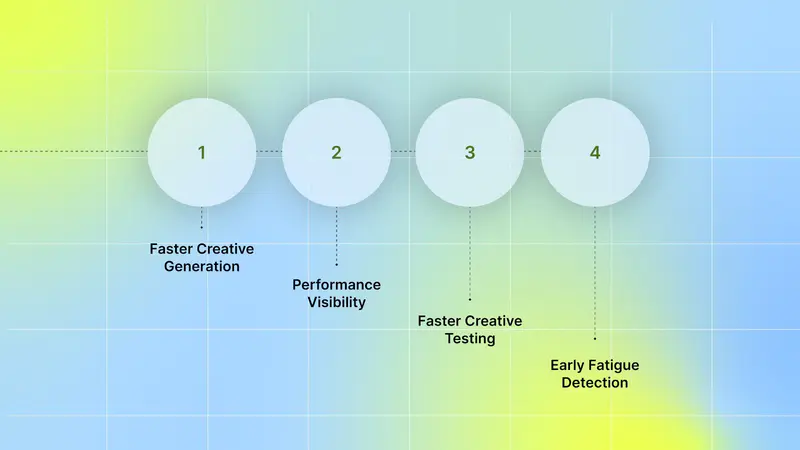
1. Faster Creative Generation and Iteration
Creating new ad variations manually often takes time and slows down testing cycles. AI-powered tools help you quickly generate creative variations based on existing assets and insights, allowing you to test more ideas and iterate faster.
2. Clear Visibility Into What Drives Performance
When analyzing creatives manually, it’s difficult to pinpoint why one ad performs better than another. AI tools analyze elements like hooks, visuals, and messaging, helping you understand which creative patterns consistently drive results.
3. Faster Creative Testing and Learning
Manual analysis of campaign results can delay learning from your creative tests. AI-powered tools automatically highlight winning and underperforming creatives, helping you quickly decide what to scale and what to improve.
4. Early Detection of Creative Fatigue
Creative fatigue is often noticed only after performance drops significantly. AI-powered tools continuously monitor performance trends and help you identify declining creatives earlier so you can refresh your strategy in time.
But how do you detect creative fatigue before it impacts your campaign results and budget allocation? This is where Segwise comes in.
With fatigue tracking, you can catch performance decline before it impacts budget allocation and campaign results. You can also set custom fatigue criteria and monitor creative performance across Facebook, Google, TikTok, and all major ad networks, to catch fatigue before it impacts your ROAS.
5. Build a Data-Driven Creative Strategy
Without structured insights, creative strategy often relies on intuition. AI-powered tools turn creative performance data into actionable insights, helping you plan future creatives based on proven patterns.
However, before choosing the right solution, it’s important to understand how Pencil approaches creative optimization and where its capabilities may not fully support your creative strategy.
Also Read: How to Combat Creative Fatigue with AI Solutions
What Is Pencil and Where It Falls Short
Pencil is an AI-powered ad creation platform that positions itself as “Marketing’s GenAI operating system.” It helps you generate, edit, scale, and launch ads using generative AI models within one workspace. The platform focuses heavily on AI-driven ad production, automation, and workflow management.
The platform helps you quickly create large volumes of ad creatives and manage them inside a single system.
Who owns Pencil, and is it still around? Yes, and this trips people up. Pencil was acquired by The Brandtech Group in August 2023, but it was never shut down or absorbed out of existence. It runs today as two distinct products: self-serve Pencil at trypencil.com, and enterprise Pencil Pro sold through Brandtech with brand-safety, data-protection and IP-ownership guarantees, Adobe Firefly Services integration and Google Cloud model access.
Pricing: Self-serve Pencil is metered by generations: Core $14/month ($11/month billed annually, 50 generations) and Growth $55/month ($44/month billed annually, 250 generations). Pencil Pro publishes no pricing and is contact-sales only.
Key Features
AI Ad Generation: Pencil allows you to chat with AI to generate ads using branded templates. You can create video and image ads by entering prompts, adjusting elements, and producing multiple variations from the same concept.
Multi-Model Access in One Place: It provides access to multiple frontier GenAI models through one interface: current integrations include Claude (Fable 5 and Sonnet 5) for copy, Gemini Omni Flash and Nano Banana 2 Lite for image and video, and ElevenLabs for AI voiceovers reusable across the Editor, Canvas and Workflows surfaces. This lets you generate text, images, video and audio without switching tools.
Automation & Scaling Tools: You can generate thousands of ad variations, localize content, personalize messaging, and adapt creatives across formats.
Browser-Based Creative Studio: You can edit text, images, video, and even HTML inside the browser. There is no need for heavy software downloads. You can version creatives and manage assets inside one workspace.
End-to-End Workflow & Collaboration: Pencil supports briefing, editing, approving, commenting, and launching ads across platforms. It also offers predictive scoring, ROI tracking, centralized brand controls, and enterprise-grade compliance features.
Where Pencil Falls Short
While Pencil is strong in creative generation and automation, it has limitations when you are focused on building a long-term, data-driven creative strategy.
Here are the key gaps:
1. No Automated Creative Tagging at Element Level
Pencil helps you generate variations, but it does not automatically tag creative elements like hook type, character style, emotion, or CTA pattern and connect them directly to performance outcomes. This makes it harder to identify which specific creative components consistently drive results across campaigns.
2. No MMP Integration for Full-Funnel Insights
If you work with mobile games or subscription apps, you rely on MMP data to understand results. Pencil does not integrate deeply with MMPs, which means you cannot easily connect creative elements directly to post-install performance outcomes.
3. No Creative Fatigue Tracking or Performance Alerts
Creative fatigue is a real challenge when you manage high-volume campaigns. Pencil does not offer proactive fatigue detection or automated performance alerts. You may only notice declining performance after results have already dropped.
4. No Playable Ad Tagging or Analysis
For mobile game marketers, especially, playable ads are critical. Pencil does not provide dedicated tagging or element-level analysis for playable creatives, making it difficult to understand which interactive components actually drive engagement.
If you're a creative strategist managing creatives across mobile games, DTC brands, subscription apps, or agency clients, you need more than creative generation. You need clear visibility into which creative elements drive performance, when creatives start declining, and how to optimize based on full-funnel data.
That’s where many teams begin exploring stronger Pencil alternatives built specifically for AI-powered creative optimization.
If creative generation alone isn’t enough to support a truly data-driven strategy, it becomes important to look at platforms that focus on measurable creative performance.
Top 9 Pencil Alternatives in 2026
If you’re looking to move beyond basic AI ad generation and want deeper creative optimization, there are stronger platforms available. The right alternative should help you not just create ads, but understand what truly drives performance.
Here are the alternatives worth shortlisting, compared at a glance:
Tool | Best for | Key feature | Pricing |
Segwise | Mobile UA, gaming, DTC and agency creative teams | Multimodal tagging incl. playable ads, MMP-connected analytics, AI creative generation | 7-day free trial. Segwise starts at $499/month for advertisers spending up to $250K/month, with a special 50% discount for startups spending under $50K/month. |
Pencil (the baseline) | Solo marketers and small teams, plus global brands on Pencil Pro | Complete ads generated with brand guidelines applied automatically | Core $14/mo ($11 annual); Growth $55/mo ($44 annual); Pro custom |
AdCreative.ai | SMBs and small agencies needing high-volume AI creative | AI ad generation with conversion scoring | $39/mo Starter; $249 Professional; $999 Ultimate |
Bannerflow | Enterprise display and creative management at scale | Master creatives auto-scaled across formats, with live ad updates | Custom pricing, contact sales |
Vidmob | Enterprise brands piping creative intelligence into AI tools | Vidmob360 composable MCP/API intelligence layer | Not publicly listed (contact sales) |
Creatify | Fast, cheap AI video ads from a product URL | URL-to-video generation with AI avatars and voiceovers | Free tier; $39/mo Starter; $99/mo Pro; Enterprise custom |
Motion | DTC and consumer-app teams spending $50k+/mo | Runneth, an always-on AI agent on a dedicated VM, in every paid plan | $750/mo Starter; $1,200/mo Pro; Growth custom |
Bestever | Small DTC brands wanting the cheapest AI ad generation | Ad generation with built-in hallucination/QA checks | $10/mo Essential; $99/mo Advanced; Enterprise custom |
GetCrux | Teams at $1M+ ad spend wanting analysis plus generation | Creative Analyzer, Audience Analyzer and Creative Generator agents | Starter $1,500/mo (up to $100K/mo ad spend); no free plan |
Atria | DTC performance marketers deciding what to make next | 25M+ ad library, review mining, Raya AI strategist | $129 to $959/mo, billed annually |
Pricing verified August 2026.
1. Segwise

Segwise is an AI-powered creative intelligence and analytics platform that helps creative teams understand which creative elements drive performance, when creatives start fatiguing, and where budgets should shift before results drop.
Rather than just generating ads, Segwise shows you what parts of your creatives drive results so you can iterate smarter and boost ROAS. It connects creative elements (hooks, dialogs, visuals, formats, etc.) directly to business outcomes (ROAS, CPA/CPI, LTV, IPM, conversion rates), so teams stop guessing what works and start scaling creatives with data-backed confidence.
Key Features
1.Tag-Level Creative Element Mapping: See which specific creative elements drive performance. With this, you can discover patterns like "this hook appears in 80% of top-performing creatives" with complete MMP attribution integration.
2. Automated Creative Tagging: Segwise uses multimodal AI to automatically identify and tag creative elements like hook, characters, colors, and audio components across images, videos, text, and playable ads to reveal their impact on performance metrics like IPM, CTR, and ROAS.
3. Fatigue Tracking: You can catch performance decline before it impacts budget allocation and campaign results. Also, you can set specific performance targets for NEW creatives you want to monitor.
4.One Place for All Your Creative Data: You don't need to jump between Facebook Ads Manager, Google Ads, TikTok, and your MMP dashboard. Also, see creative-level ROAS, CPA, LTV, and conversion rates from all sources in one unified view.
5.Creative intelligence-driven generation: Auto-generate new ad creative variations using creative elements that drive performance - winning hooks, CTAs, visual styles, and characters identified through your creative insights. The Creative Generation Agent produces net-new statics, video ads, AI UGC-style creatives, playables and video storyboards, and every generated ad is automatically tagged and tracked once it goes live, so its performance feeds straight back into the intelligence that produced it.
6. Creative Strategy Agent (AI Chat): An always-on AI creative strategist with full context across your account. Ask anything in plain language, “which hook style drove the most installs last month?” or “what separates my top five creatives from my bottom five?”, and get an answer instantly, or ask it to build and share a report on demand.
7. 15+ Ad Networks and Five MMPs: No-code integrations with Meta, Google, TikTok, Snapchat, YouTube, Axon (AppLovin), Unity Ads, Mintegral, IronSource and more, plus AppsFlyer, Adjust, Branch, Singular and Kochava. Setup takes 10 to 15 minutes with no engineering support.
How Segwise Is the Best Pencil Alternative
Unlike Pencil, which mainly focuses on ad generation, Segwise gives you creative intelligence at scale. It not only produces creative variations but also automatically tags elements, connects them to performance, detects creative fatigue early, and even handles interactive/playable ad tagging. Together, these strengths help you build a data-driven creative strategy, not just more ads.
Limitation
Its competitor ad tracking covers Meta only, so teams that research rivals on other networks may want a research tool alongside it.
Pricing: Segwise starts at $499/month for advertisers spending up to $250K/month, with a special 50% discount for startups spending under $50K/month. You can start with the 7-day free trial, which automatically imports up to 2 weeks of historical data (up to 3 months on paid plans).
In short, Segwise gives you the depth of insight, creative optimization capabilities, and full-funnel performance visibility that creative strategists need to make smarter decisions and consistently improve ROAS.
2. AdCreative.ai

AdCreative.ai is an AI-powered advertising platform that helps you generate high-converting ad creatives for social, search, and display campaigns. It uses artificial intelligence to create banners, ad copies, product visuals, and videos designed to improve click-through rates and conversions.
The platform combines fast creative generation with performance scoring, allowing you to see which ads are more likely to perform before launching them.
Key Features
Creative Scoring AI: The platform provides a conversion score for each generated creative. This proactive performance scoring helps you prioritize creatives that are more likely to convert before you spend budget.
Multi-Platform Ad Adaptation: AdCreative.ai automatically resizes and adapts creatives for platforms like Meta, Google, LinkedIn, and display networks, helping you launch across channels without manual redesign.
Creative Utility Suite: It includes tools like background removal, image upscaling, face enhancement, and visual editing to refine creatives without needing separate design software.
Why AdCreative.ai Is a Better Alternative to Pencil
Unlike Pencil, which focuses heavily on generative workflows, AdCreative.ai adds predictive performance scoring, creative fatigue monitoring, and competitive benchmarking. This gives you more guidance on which creatives to prioritize before launch.
Limitation
However, the platform is still primarily generation-focused. It does not deeply tag and analyze individual creative elements like hooks, messaging angles, or scene-level components and connect them to full-funnel performance data. It is also no longer independent: Appier acquired AdCreative.ai in a $38.7M deal announced in February 2025 and is folding its generation engine into the AIRIS CDP.
Pricing: Starter $39/month (10 credits, 1 brand), Professional $249/month (50 credits, 10 brands), Ultimate $999/month (100 credits, 25 brands), Enterprise custom; 7-day free trial.
3. Bannerflow

Bannerflow is a creative management and automation platform designed to help you design, scale, personalize, and publish digital ads across channels. It combines creativity, AI, and automation to maximize your ROI: all in one platform.
If you are managing high-volume campaigns, Bannerflow helps you streamline production workflows and maintain brand consistency while launching ads across multiple formats and markets.
Key Features
Creative Studio & Automated Scaling: Bannerflow allows you to design master creatives and automatically scale them across formats, sizes, and channels. You can produce thousands of variations without coding, making high-volume campaign execution easier.
Live Ad Updates: Bannerflow enables instant updates to live campaigns. You can modify copy, pricing, or creative elements across all formats from one place, helping you stay agile.
Update entire campaigns: Make copy and design changes in one master creative, then instantly update all campaigns.
Why Bannerflow Is a Better Alternative to Pencil
Bannerflow goes beyond basic AI ad generation by offering a complete creative production and campaign management platform. You can design, scale, personalize, and publish ads across channels from one centralized system.
Limitation
However, Bannerflow does not offer deep integration with mobile measurement partners (MMPs). This makes it difficult to connect creative performance directly to post-install metrics such as retention, ROAS, or LTV.
Pricing: Not publicly listed. All three Bannerflow products, Creative Studio, Campaign Management and Creative Personalisation, are sold as “custom pricing, tailored to your team”, so every quote runs through sales.
4. Vidmob

Vidmob is a creative data and performance analytics platform that helps brands and creative teams improve advertising effectiveness through creative insights. It combines AI and platform integrations to evaluate ad performance and guide creative strategy decisions.
Vidmob aims to help teams understand overall creative effectiveness across campaigns and channels.
Key Features
Creative Analytics: It provides performance insights across campaigns, platforms, and audiences. It helps teams evaluate how creative contributes to media outcomes and identify trends at a broader level.
Creative Scoring: The platform offers scoring systems aligned with brand and platform best practices, helping teams assess whether creatives follow proven guidelines.
Cross-Channel Insights: Vidmob enables brands to compare creative performance across regions, formats, and platforms, supporting better media allocation decisions.
Why Vidmob Is a Better Alternative to Pencil
Compared to Pencil, Vidmob adds a stronger layer of creative analytics and performance measurement. It supports data-backed creative decisions rather than just creative production.
Limitation
However, Vidmob does not allow teams to set custom success criteria to detect creative fatigue based on their own performance benchmarks. This can limit timely and precise creative optimization. It also has no AI creative generation product, so it is a complement to Pencil rather than a straight swap.
What changed in 2026: on 10 June 2026 Vidmob launched Vidmob360, moving from a standalone SaaS app to a composable intelligence layer delivered through MCP services and APIs, so creative data flows into AI assistants such as Claude, Gemini and ChatGPT and into enterprise media workflows. Phase 2 adds more AI agents later in 2026.
Pricing: Not publicly listed: enterprise contract, contact sales, with no self-serve tier or free trial.
5. Creatify

Creatify is an AI-powered video ad creation platform designed to help brands and performance marketers quickly produce high-converting video ads. It enables users to generate ads from product URLs, images, or scripts and automatically create multiple variations at scale.
The platform focuses on speed, automation, and batch production, making it especially useful for teams running high-volume paid social campaigns.
Key Features
URL-to-Video AI Generator: It allows you to paste a product URL and instantly generate multiple video ads. The AI analyzes product information and media assets to create ready-to-launch creatives in minutes.
AI Avatars & Voiceovers: The platform offers ultra-realistic AI avatars and text-to-speech voiceovers, enabling brands to produce UGC-style or spokesperson-style ads without filming.
Batch Mode for Scalable Variations: With Batch Mode, users can generate multiple ad variations simultaneously. This supports rapid testing of hooks, formats, and messaging angles.
Why Creatify Is a Better Alternative to Pencil
While Pencil emphasizes generative workflows, Creatify is highly focused on fast, performance-oriented video ad production. Creatify’s production speed, variation scaling, and built-in testing capabilities make it more aligned with teams who prioritize iteration and measurable results over broad creative management.
Limitation
However, Creatify is primarily built for fast video ad production and scaling, and it lacks deep tag-level element mapping or attribution-integrated insights that some teams require.
Pricing: A free plan (10 monthly credits, watermarked exports), Starter $39/month (100 credits), Pro $99/month (300 credits) and a custom Enterprise tier, with annual billing discounted.
6. Motion
Motion comes at the problem from the opposite end to Pencil: instead of generating ads, it tells you which of the ads you already run are working and why. In 2026 it repositioned from a reporting dashboard into an AI-agent product, and every paid plan now includes Runneth, Motion’s always-on AI agent on a dedicated VM. It answers in Slack, writes briefs, makes static ads and runs scheduled reports and alerts.
Key Features
Ad Leaderboard and Creative Analytics: Rank creatives on any metric with AI tags applied automatically, and group similar ads to find winning patterns.
Slack-Native AI Workflows: Ask in Slack and Motion ships briefs, hooks, reports, recurring routines, iteration finders and alerts.
Inspo: Brand Intel competitor tracking, boards and a Discover feed of 600+ brands, on paid plans.
Why Motion Is a Better Alternative to Pencil
If your real problem is not producing enough ads but not knowing which ideas deserve production budget, Motion answers that directly, and it hands your creative team briefs grounded in what actually ran.
Limitation
It generates only static ads (through Runneth), the floor is four figures a month, and there is no MMP or CDP integration (Northbeam and Google Analytics instead) and no playable ad analysis.
Pricing: Flat monthly fee tiered by ad spend, unlimited seats: Starter $750/month (up to $50k monthly spend), Pro $1,200/month (over $50k), Growth custom (over $125k).
7. Bestever
Bestever is the cheapest credible entry point into AI ad generation. It analyses your existing text, image and video ads, reports what is working, and generates winning variations, with industry-specific pipelines for apparel, CPG/retail and agencies.
Key Features
Generate From What Already Works: Ingests your live ads and competitor ads, then generates variations off proven creative strategies rather than a blank prompt.
Hallucination Detection and QA: Built-in checks flag classic AI errors, extra fingers, wrong logos, inconsistent details, before an ad ships.
Performance Feedback Loop: Ingests Meta, TikTok and Google data to iterate on the creative personas that win.
Why Bestever Is a Better Alternative to Pencil
At $10/month it undercuts even Pencil’s Core tier, and its QA layer addresses the single most common complaint about generated creative: visible AI artefacts reaching a live campaign.
Limitation
It lacks tag-level insight and MMP-connected data, so it is a generation tool rather than a creative intelligence platform. Note too that Samba (Samba TV) acquired Bestever on 22 June 2026; the product is still live and selling, but the announcement did not state whether it continues standalone long term.
Pricing: Essential $10/month (40 credits), Advanced $99/month (400 credits), Enterprise custom; you generate free and are charged at download.
8. GetCrux
GetCrux packages creative intelligence as three AI agents, a Creative Analyzer, an Audience Analyzer and a Creative Generator, and can publish the creatives it generates straight back to Meta, Google and TikTok.
Key Features
AI Creative Analyzer: Breaks ads into elements, finds patterns in the winners, and writes brand-aligned briefs and scripts.
AI Audience Analyzer: Mines comments, reviews and competitor ads for objections and fresh creative angles.
AI Creative Generator with Publishing: Generates creatives (included from Starter), checks brand compliance and publishes them to Meta, Google and TikTok.
Why GetCrux Is a Better Alternative to Pencil
Where Pencil stops at the asset, GetCrux closes the loop from analysis to generation to launch, and its connectors, AppLovin, Moloco, The Trade Desk, Criteo, plus AppsFlyer and other attribution tools (AppLovin and MMPs on Professional), suit app and mobile advertisers rather than only web brands.
Limitation
The published entry price is steep at $1,500/month, and it only covers up to $100K of monthly ad spend. Pre-flight testing and MMP data are on the Professional tier and above; generation is on Starter.
Pricing: Starter $1,500/month for up to $100K monthly ad spend; Professional and Enterprise are custom. No free plan.
9. Atria
Atria is built for deciding what to make before you make it: combining a 25M+ Meta and TikTok ad library with performance grading and customer-review mining, then generating scripts and image ads from those insights.
Key Features
Radar Analytics: Grades your ads A to D on ROAS, CTR, hook rate and retention, with prescriptive fixes.
Review Mining: Extracts ad angles and customer language from Amazon, Google and uploaded reviews.
Raya AI Agent: Reported to have launched in February 2026 and trained on $5B+ of ad spend, Raya auto-tags creatives, monitors competitors and generates weekly ad concepts unprompted.
Why Atria Is a Better Alternative to Pencil
Pencil optimises output volume; Atria optimises input quality. If your generated ads underperform because the angles are guesses, Atria fixes the upstream problem.
Limitation
It is Meta- and TikTok-centric for DTC, with no MMP integration, no playable ad analysis and no mobile ad network coverage, so mobile UA teams outgrow it quickly.
Pricing: Core $129/month, Plus $479/month, Business $959/month (all billed annually), Enterprise custom.
Conclusion
Choosing the right AI-powered creative optimization tool can significantly impact how quickly and confidently you scale winning ads. While Pencil offers strong generative capabilities and workflow automation, it falls short when it comes to deep element-level insights, MMP integrations, fatigue detection, and full-funnel creative intelligence. If your goal is to move from guesswork to a measurable creative strategy, exploring strong Pencil alternatives becomes essential.
If you are a performance-focused creative strategist looking for deeper insights beyond ad generation, Segwise is the strongest choice.
Its a creative intelligence platform designed to connect creative elements directly to business outcomes. It brings together your campaign performance and attribution data into a single view, allowing you to clearly identify which creatives drive users. Moreover, with automated tagging and detailed tag-level element mapping, your team gets the clarity and control needed to confidently scale what truly works.
Here are the key reasons why Segwise beats all other alternatives:
See exactly which hooks, visuals, dialogs, CTAs, and playable components drive ROAS, CPI, and LTV with element-level performance visibility.
Multimodal AI automatically tags videos, images, text, and playable ads so you don’t rely on manual categorization.
Set your own performance benchmarks and get early alerts when creatives start declining.
Generate new ad variations based on proven winning creative patterns instead of guesswork.
Connect to AppsFlyer, Adjust, Branch, Singular and Kochava for unified attribution data alongside ad network metrics.
Instead of starting from scratch, teams can quickly iterate on proven concepts with winning elements, significantly reducing creative production time.
The Creative Generation Agent produces net-new statics, video, AI UGC-style ads, playables and storyboards from your winning patterns, then tags and tracks each one once it is live, closing the loop between generation and analysis.
The Creative Strategy Agent (AI Chat) answers anything about your creative data in plain language, and builds shareable reports on demand.
15+ ad networks and MMPs connect with no code in 10 to 15 minutes, with historical data imported automatically: up to 2 weeks on the 7-day free trial and up to 3 months on paid plans.
So, are you ready to stop guessing and start optimizing with clarity? Start your free trial today and experience data-driven creative intelligence in action!
FAQs
1. Is Pencil still available in 2026?
Yes. Pencil is live and selling. The Brandtech Group acquired it in August 2023, and it now runs as two products: self-serve Pencil at trypencil.com (Core $14/month, Growth $55/month) and enterprise Pencil Pro sold through Brandtech. Anything you read describing Pencil as shut down or absorbed is wrong.
2. How much does Pencil cost?
Self-serve Pencil is metered by generations: Core is $14/month ($11/month billed annually) for 50 generations, and Growth is $55/month ($44/month billed annually) for 250. Pencil Pro publishes no pricing and is contact-sales only.
3. What is the best Pencil alternative in 2026?
It depends what you are missing. For creative intelligence that generates and measures, element-level tagging, MMP-connected analytics, fatigue detection and generation in one loop, Segwise. For cheap high-volume generation, AdCreative.ai or Bestever. For analytics only, Motion.
4. Which alternative is best for mobile games and apps?
Segwise. It tags playable (interactive) ads, integrates with gaming networks including Axon (AppLovin), Unity Ads, Mintegral and IronSource, and connects AppsFlyer, Adjust, Branch, Singular and Kochava so creative performance ties to installs, retention and LTV rather than clicks.
5. What is the cheapest Pencil alternative?
Bestever at $10/month, followed by Creatify’s free tier and AdCreative.ai at $39/month. Note that Bestever was acquired by Samba TV in June 2026.
6. Do any of these tools connect creative data to MMPs?
Segwise does on every plan, via AppsFlyer, Adjust, Branch, Singular and Kochava, and GetCrux does from its Professional tier. Pencil, AdCreative.ai, Bannerflow, Vidmob, Creatify, Motion, Bestever and Atria do not, which is the single biggest gap for app and game advertisers.
7. Does generating more ad variations actually improve performance?
Not on its own. Volume without element-level feedback just produces more untested guesses. The tools that move the needle are the ones that tell you which hook, CTA, character or visual style is driving the result, then generate the next batch around those winning elements.
About This Guide
Written by the Segwise creative intelligence team, who work daily with UA, growth and creative teams running creative analytics and AI creative generation across Meta, Google, TikTok, Snapchat, YouTube, Axon (AppLovin), Unity Ads, Mintegral and IronSource, alongside AppsFlyer, Adjust, Branch and Singular.
Methodology: each tool was assessed in August 2026 on five criteria: creative generation quality and format coverage, element-level tagging depth, ad network and MMP coverage, fatigue detection, and pricing transparency. Every price above was read from the vendor’s own pricing page in August 2026. Where a vendor publishes no price, we say so rather than estimate.