
Key Takeaways
Creative First: Mobile PPC success is driven by your creatives, not just targeting. Strong hooks, clear messaging, and platform-native formats directly impact conversions.
Test Systematically: Stop guessing and start structured testing. Continuously test hooks, visuals, and CTAs to identify patterns and scale what actually works.
Fix Friction: Even high-performing ads fail with poor mobile experiences. Fast-loading pages, simple flows, and clear CTAs are critical for conversions.
Optimize Continuously: Monitor performance data closely and act fast. Identify drop-offs, refresh creatives, and adjust campaigns before performance declines.
Scale Winners: Focus your budget on proven creatives and strategies. Use data-backed insights to double down on what drives ROAS and cut wasted spend.
Are your mobile PPC campaigns getting clicks but still not driving real conversions?
You keep increasing budgets, testing new ads, and switching platforms, but the results don’t scale. Your best mobile ads stop performing without warning, and suddenly your CPA spikes while ROAS drops. And the worst part? You don’t really know which part of your creative is actually working.
This blog covers how to build a strong mobile PPC strategy, optimize campaigns for real conversions, and identify what actually drives performance, so you can optimize mobile campaigns for better results.
What Is PPC in Mobile Marketing?
Mobile PPC (pay-per-click) is a performance marketing model in which you pay each time someone clicks your ad on mobile platforms like Meta Ads, TikTok, Google, or in-app placements. These ads are shown to targeted users based on signals like behavior, interests, device, and location, with the goal of driving installs, purchases, or subscriptions.
As a creative strategist, it’s about turning attention into conversions through the right creative. Your ad creative (hooks, visuals, messaging) decides whether a user stops scrolling and takes action. The better your creative matches user intent, the higher your chances of driving real results, not just traffic.
Next, it’s important to see how it has evolved over time.
The Evolution of Pay-Per-Click Advertising
PPC has evolved from simple keyword-based search ads to a multi-platform, data-driven system where creative, targeting, and user experience all impact performance. Today, mobile PPC is shaped by user behavior, platform algorithms, and most importantly, how your creatives perform.
Here’s how PPC has evolved over time:
Search-first advertising (early stage): PPC started with search engines, where you bid on keywords and showed basic text ads next to search results.
Expansion to mobile devices: As mobile usage grew, PPC moved beyond desktop to mobile apps and feeds, allowing you to reach users anytime, anywhere.
Rise of display and visual ads: Banner ads, videos, and interactive formats became important, making visual elements key to performance.
Social media PPC took over: Platforms like Meta Ads and TikTok enabled deep targeting using user behavior, interests, and engagement data.
Smarter ad auctions (beyond bids): Winning ads are no longer just about higher bids; platforms now prioritize:
Ad relevance.
Creative quality.
User experience.
For you as a creative strategist, this means creating ads that actually connect, convert, and scale.
Now, let's understand how mobile behavior differs from desktop becomes critical to improving campaign performance.
Also Read: The Ultimate Guide to Understanding Different Types of Target Audiences
Key Differences Between Mobile PPC and Desktop PPC
Mobile PPC and desktop PPC follow the same core concept, but they behave very differently because users interact with each device in a different way. To drive conversions on mobile, you need faster, simpler, and more creative-led strategies compared to desktop PPC.
Here are the key differences you need to understand:
1. Screen Size
On mobile, you are dealing with smaller screens, so your ads need short, clear messaging, strong visuals, and direct calls to action. The entire flow from ad to landing page must feel smooth and quick.
While in desktop PPC, you have more space to explain, use longer copy, and guide users through more detailed pages.
2. User Behavior Shift
User behavior is also very different. Mobile users are usually scrolling on the go and want quick answers or instant actions. They won’t spend time figuring things out. That means your mobile PPC campaigns need to focus on speed, relevance, and instant clarity.
While in desktop PPC, users are more patient and often in research mode, giving you slightly more time to convince them.
3. Performance Requirements
Platforms like Google prioritize mobile-friendly experiences when ranking ads and pages. So your mobile PPC strategy must focus on fast-loading pages, responsive design, and easy navigation.
While desktop PPC can handle more complex layouts, mobile performance depends heavily on how fast and seamless the experience feels to the user.
The next step is knowing what actually makes a campaign convert on mobile.
Components of a Successful Mobile PPC Campaign
A successful mobile PPC campaign depends on how well your creatives, targeting, and user experience work together to drive conversions. It’s not just about getting clicks; it’s about making sure every step is optimized for how users behave on mobile.
Mobile users move fast, so your ad-to-landing flow must feel quick, simple, and frictionless. If the experience is slow or confusing, you lose the conversion instantly.
Here are the key components you need to focus on: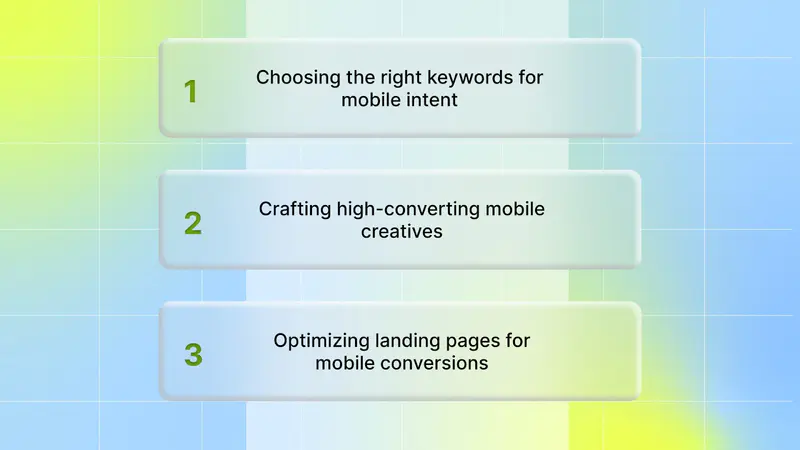
1. Choosing the right keywords for mobile intent
Focus on keywords that reflect quick, action-driven intent, especially for search campaigns. Use long-tail keywords like “buy skincare online” to attract more relevant users and reduce wasted spend. Regularly optimize by removing irrelevant queries and scaling keywords that bring high-quality conversions.
2. Crafting high-converting mobile creatives
Your creative is the biggest driver of performance in mobile PPC. You need strong hooks, clear messaging, and visuals that align with the platform's behavior. Keep testing different angles, formats, and CTAs to consistently find and scale what converts.
3. Optimizing landing pages for mobile conversions
Your landing page must be fast, simple, and built for small screens. Use clear layouts, strong CTAs, and minimal steps to guide users through completing an action. Even small delays or friction can drop your conversion rate, so continuous testing is critical.
The next step is choosing the right ad formats that align with your goals and audience behavior.
Types of PPC Ads in Mobile Marketing
Mobile PPC includes different ad formats designed to match how users behave across search, social media, and mobile apps. Each ad type serves a different goal, whether it’s driving intent, building awareness, or converting users through engaging creatives.
Here are the main types of mobile PPC ads you should focus on:
1. Search ads (high-intent traffic)
Search ads appear at the top of search results when users actively look for something. They are powerful for capturing demand and driving users who already have the intent to take action.
As a creative strategist, your role is to align messaging with user intent. Strong copy, relevant keywords, and a smooth landing page experience are critical to convert these high-intent clicks.
2. Display ads (visual awareness and retargeting)
Display ads use banners or visuals to grab attention across websites, apps, and social platforms. They are best for building awareness and retargeting users who have already interacted with your brand.
Here, your focus should be on visuals and messaging that stand out instantly. Unlike desktop, mobile display ads need to be simple, bold, and easy to understand.
3. Video ads (primary performance driver on mobile)
Video ads are one of the most effective formats in mobile PPC, especially for DTC brands, mobile games, and subscription apps. They help you tell a story, show product value, and create emotional engagement.
As a creative strategist, this is your biggest lever; strong hooks, fast pacing, and platform-native content (like TikTok-style videos) can directly impact conversions.
Choosing the right ad formats is only one part of the strategy; where you run those ads plays an equally important role.
Mobile PPC Platforms for High-Converting Campaigns
Mobile PPC performance depends heavily on choosing the right platforms and aligning your creatives with how users behave on each one. Each platform has different strengths, formats, and targeting capabilities, so your strategy needs to adapt accordingly.
Here are the key platforms you should understand:
1. Google Ads (intent-driven performance)
Google Ads is strong for capturing high-intent users through search campaigns. It helps you reach users who are actively looking for solutions, products, or apps.
As a creative strategist, your focus should be on aligning ad copy and landing pages with user intent. Google also offers strong targeting options (location, device, behavior), helping you reach the right audience efficiently.
2. Meta Ads (Facebook & Instagram)
Meta Ads allow you to reach users based on their interests, behaviors, and demographics. This makes it powerful for both scaling campaigns and retargeting.
Your creatives need to feel native to the feed, simple, engaging, and scroll-stopping. Strong hooks and relatable messaging work best here, especially for DTC and subscription products.
3. TikTok Ads (creative-first performance)
TikTok is a highly creative-driven platform where short-form video content performs best. It’s ideal for reaching highly engaged users, especially through native, organic-style ads.
As a creative strategist, this is where experimentation matters most. Focus on trends, storytelling, and fast-paced hooks to drive engagement and conversions.
4. Apple Search Ads (high-intent iOS acquisition)
Apple Search Ads are critical for mobile apps, especially if you’re targeting iOS users. These ads appear directly in the App Store when users search for apps.
Here, your focus should be on aligning keywords and app store creatives (icons, screenshots, copy) with user intent to drive installs and conversions.
For you, as a creative strategist, success comes from adapting your creative style, messaging, and formats to match how users interact with each.
Choosing the right platforms sets the foundation, but real performance comes from how you execute and optimize your campaigns.
Strategies That Drive Higher Conversions from Mobile PPC Ads
To drive higher conversions in mobile PPC campaigns, you need to align your creatives, targeting, and user experience with how users behave on mobile. Success comes from continuously testing, optimizing, and scaling what actually works based on real performance data.
Here are the key strategies you should focus on:
1. Understand your audience before creating ads
Before you create any ad, you need clarity on who you’re speaking to and what drives them to act. For mobile games, it could be excitement or competition. For DTC brands, it could be solving a problem or showcasing results.
Break your audience into segments based on behavior, intent, and stage (new users vs returning users). When your creative speaks directly to a specific need or desire, it feels more relevant, and that directly improves conversion rates.
2. Focus on strong hooks and first impressions
On mobile, you need to capture attention instantly. Your hook should clearly communicate value in the first 2–3 seconds, or the user scrolls past.
Test different hook types:
Problem-based (“Struggling with…?”).
Result-based (“Get clear skin in 7 days”).
Curiosity-based (“You won’t believe this…”).
The stronger your hook, the higher your chances of stopping the scroll and driving engagement.
But how do you know which hooks are actually driving conversions? This is where a creative intelligence platform like Segwise comes in.
With tag-level creative element mapping, you can see which specific creative elements drive performance. You can also discover patterns like "this hook appears in 80% of top-performing creatives" with complete MMP attribution integration.
3. Use automation to stay efficient and control costs
Managing campaigns manually becomes difficult as you scale. Automation helps you stay efficient by handling tasks like bid adjustments and ad scheduling.
You can set rules such as:
Increase bids when performance is strong.
Reduce spend when conversions drop.
At the same time, regularly check conversion data to identify drop-off points. For example, if users click but don’t convert, the issue could be your landing page or checkout flow. Fixing these friction points can improve conversions without increasing your ad spend.
4. Use visual and interactive formats
Mobile is a visual-first environment, so your creatives must stand out instantly. Use formats like short-form videos, UGC-style content, carousels, or playables (especially for gaming apps) to increase engagement.
Interactive formats make users participate instead of just watching. This improves both engagement and recall. But always balance creatives with performance; heavy creatives that load slowly will hurt your results.
5. Set the right budget and bidding strategy
Start by defining a clear budget based on your campaign goals, whether it’s installs, purchases, or subscriptions. Then choose a bidding strategy that aligns with those goals.
Manual bidding gives you more control over individual keywords or placements.
Automated strategies like target CPA or target ROAS help optimize bids based on performance.
You should continuously review how your budget is distributed across campaigns. Shift more budget toward high-performing creatives and audiences, and reduce spend on underperforming areas.
6. Test creatives continuously (A/B testing)
You should treat every creative as a test, not a final version. Instead of making big changes randomly, test specific elements one at a time, like hooks, visuals, or CTAs.
Create a structured testing system:
Launch multiple variations.
Track performance at a granular level.
Identify patterns in what works.
Over time, this helps you move from guesswork to a repeatable creative strategy.
7. Monitor and optimize campaign performance regularly
Tracking performance regularly is critical to improving ROI. Focus on key metrics like CTR, conversion rate, cost per conversion, and ROAS to understand what’s working.
A well-structured account also plays a big role. If your campaigns, ad groups, or creatives are not organized properly, it becomes harder to identify winning patterns. Regular monitoring allows you to make faster decisions and optimize campaigns before performance drops.
8. Personalize creatives for different audience segments
One message won’t work for everyone. Users at different stages respond to different triggers. For example:
New users → need awareness and curiosity.
Returning users → need proof or urgency.
Use audience data (interests, past behavior, purchase signals) to tailor your creatives. Personalized ads feel more relevant, which leads to better engagement and higher conversions.
9. Use retargeting to bring users back
Most users won’t convert on the first interaction. Retargeting helps you re-engage them with more relevant messaging.
Show users ads based on what they have already interacted with:
Viewed product → show benefits or reviews.
Added to cart → show urgency or offer.
Installed app but didn’t convert → highlight features or value.
This keeps your brand top of mind and increases the chances of conversion without acquiring new users from scratch.
10. Improve ad rank and overall performance quality
Ad rank determines how often and where your ads appear. Improving it can increase visibility without increasing your spend.
To improve ad rank, focus on:
Writing relevant and engaging ad copy.
Maintaining a high-quality score.
Optimizing your landing page experience.
When your ads are more relevant and aligned with user intent, they perform better and drive more conversions at a lower cost.
Even with the right strategies in place, a few common mistakes can quietly hurt your performance, reduce conversions, and kill your ROI.
Also Read: Mobile App Retargeting – Win Back High-Intent Users
Common Mistakes That Kill ROI
Many mobile PPC campaigns fail not because of low traffic, but because of poor creative decisions, weak optimization, and slow iteration. Small mistakes in your strategy can quickly increase CPA and reduce conversions without you realizing it.
Here are the most common mistakes you should avoid:
Focusing too much on targeting and ignoring creatives: You might spend a lot of time refining audiences and keywords, but in mobile PPC, creatives drive most of the performance. If your ad doesn’t grab attention or connect with the user, even the best targeting won’t convert.
Not refreshing creatives: If you keep running the same creatives for too long, performance will drop. CTR goes down, CPA increases, and conversions decline. Without regular creative refreshes, your campaigns will slowly stop delivering results.
But how do you know when a creative is starting to fatigue? This is where Segwise comes in. With Fatigue tracking, you can catch performance decline before it impacts budget allocation and campaign results.
Sending users to poor mobile landing pages: Even if your ad performs well, a slow or confusing landing page will kill conversions. Mobile users expect fast loading, simple navigation, and clear actions. Any friction in the experience leads to drop-offs.
Optimizing for clicks instead of conversions: High click-through rates can look good, but they don’t always mean better results. If your PPC campaigns are driving clicks but not conversions, you’re attracting the wrong audience or setting the wrong expectations.
Testing creatives without a clear structure: Running random tests without tracking what changed makes it hard to learn what works. You need a structured testing approach where you test one variable at a time and analyze results properly.
Ignoring performance data and user drop-offs: If you’re not analyzing where users drop off, you miss key optimization opportunities. You should regularly check conversion data and identify weak points in your funnel to improve results.
Conclusion
Optimizing mobile PPC campaigns is no longer just about targeting or increasing budgets; it’s about understanding what actually drives conversions. From choosing the right platforms and ad formats to building strong creatives, optimizing landing pages, and continuously testing, every step plays a role in performance.
As a creative strategist, your biggest advantage is your ability to identify what works, iterate quickly, and turn insights into high-performing creatives that scale.
This is where a creative intelligence platform like Segwise becomes valuable.
Instead of guessing which creatives are working, you can use tag-level performance optimization to see exactly which creative elements, themes, and formats drive results across all your campaigns and apps. It connects creative elements (hooks, dialogs, visuals, formats, etc.) directly to business outcomes (ROAS, CPA/CPI, LTV, IPM, conversion rates), so teams stop guessing what works and start scaling creatives with data-backed confidence.
With AI-powered creative analytics, automated tagging, and fatigue tracking, you can move faster, reduce wasted spend, and build a repeatable system for scaling winning creatives.
So, why wait? Start your free trial to optimize your creatives for better conversions!