
The best Motion alternatives for DTC brands in 2026 are Segwise, Atria, and Foreplay. Choose Segwise if you want analytics and finished ads in one tool, Atria if you run mostly on Meta, and Foreplay if ad research is your edge. Motion's Starter plan is $999 a month for up to $50K of ad spend.
Segwise is an AI creative analytics and creative generation platform for DTC and performance teams. For a DTC team, the right Motion alternative is the one that ties your own performance data to the next ad you make, so each round of creative is backed by what your account has already proven instead of a guess.
Motion is a good tool, and plenty of DTC teams are happy on it. It reads Meta, TikTok, YouTube, and LinkedIn, tags Meta creatives with AI, shows frame-by-frame video drop-off, and has an AI agent called Runneth that writes briefs and static ads. Four gaps are worth knowing about before you commit: Motion analyzes four channels, its AI tagging runs on Meta only, it has no MMP integration (its attribution links are Google Analytics 4 and Northbeam, from the Pro plan up), and the $999 Starter price on its pricing page, read on 21 October 2026, stops at $50K in monthly ad spend, with Pro and Growth priced on a call. If you want more networks, a lower price, numbers tied to profit or installs, or finished ads out of the same tool, the eight options below are where DTC teams look. For the wider category view, see our Motion alternatives guide and the head-to-head Segwise vs Motion breakdown.
TL;DR
Best all-in-one for DTC: Segwise. Creative analytics across 17 ad channels plus five MMPs, built-in fatigue alerts, pre-flight scoring, and generation of statics, video, AI UGC-style video, and playables in one loop.
Best Meta-first ecommerce pick: Atria. Meta and TikTok analytics, AI tagging, static ad generation, and ad launching to Meta, from $129 a month billed annually.
Best for ad research: Foreplay. A large ad library, competitor tracking, and AI briefs, with Lens analytics on Meta and TikTok from the Workflow plan.
Best cheap reporting: Superads. Creative reports, AI tagging, and an AI chat across Meta, TikTok, Google, and LinkedIn from $125 a month, with no ad generation.
Best for profit-true numbers: Admetrics. Ranks creatives by real CAC and profit from your shop's orders, from €339 a month billed annually.
Motion's gaps are the reason to look: it covers four channels, tags Meta only, and has no MMP integration, so most of these picks add networks, a lower price, attribution, or finished ad generation.
Leaving Motion has a cost: plans start with a 3-month commitment, monthly plans need 30 days' notice, and disconnecting an ad account deletes its data. Export first, then run both tools for a week.
Motion alternatives at a glance
Quick pick by spend: under $50K a month and mostly Meta and TikTok, Motion may already be enough, or try Superads (up to $100K) or Atria. From $50K to $250K and want analytics plus generation, Segwise. If you can start with a demo, GetCrux (Starter covers up to $100K) or, for agents that also buy media, Hawky. If your problem is profit rather than creative, Admetrics. Details are in each entry and in the choose section below.
1. Segwise - Best for DTC creative analytics plus generation in one loop
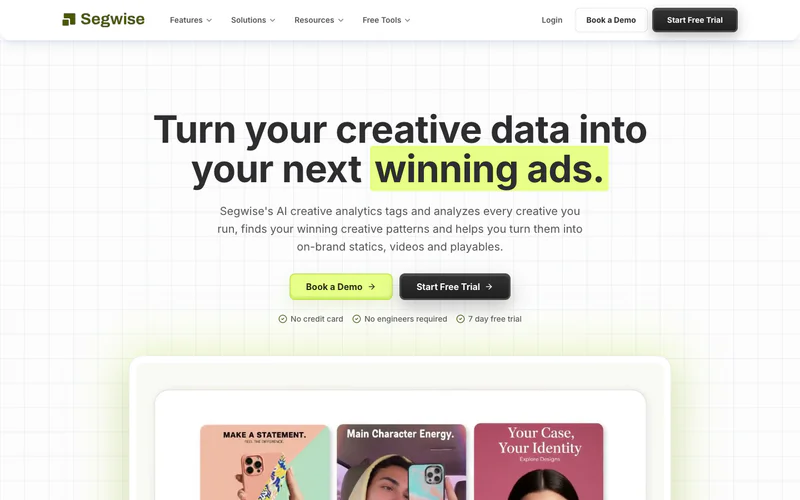
Segwise is an AI creative analytics and creative generation platform built to help DTC, performance, and creative teams get more out of every ad. Where Motion covers four channels and writes briefs and static ads, Segwise joins the data from more networks, tags every element, and helps you make the next round of ads from what is winning.
Best for: DTC and ecommerce brands that want one tool to analyze creative, catch fatigue, score new ads before spend, and generate finished creative, instead of stitching three tools together.
Key features:
- Connects 17 usable ad channels, including Meta, TikTok, Google Ads, Snapchat, AppLovin (Axon), and Moloco, plus five MMPs: AppsFlyer, Adjust, Branch, Singular, and Kochava. That lets Segwise report creative-level ROAS, CPA, and CAC against post-install data, which a tool with no MMP connection cannot.
- Multimodal tagging of video, image, audio, and text, with every tag mapped to metrics like ROAS, CPA, IPM, and CTR, across every connected network rather than one.
- An always-on Creative Strategy Agent you can ask in plain language, grounded in your own creative and performance data.
- Built-in fatigue tracking with email and Slack alerts on thresholds you set, such as a 20% ROAS decline over seven days.
- Pre-flight Testing that scores a creative out of 100 against the ads already winning in your account and gives a run-or-hold verdict before you spend.
- Creative generation of statics, video up to 30 seconds, AI UGC-style video, and playables, with per-network exports and prompt-based editing.
Pricing: Segwise starts at $499/month for advertisers spending up to $250K/month, with a special 50% discount for startups spending under $50K/month. Every feature is on every plan, and there is a 7-day free trial with no credit card.
Limitations: Competitor tracking is Meta-only today, so if you need rival ad tracking across TikTok and Google as well, pair Segwise with a research tool like Foreplay. Playable and CTV generation run as managed services rather than self-serve, and the free trial is 7 days, shorter than Motion's 14.
One customer number, reported by the customer: in its case study, smart-home brand ecobee says Segwise gave its marketing team back 20 to 30 hours a week on manual reporting across six ad platforms. You can read more in our rundown of creative analytics tools for DTC brands.
2. Atria - Best for Meta-first ecommerce brands

Atria is a Meta-first creative platform built for ecommerce brands and agencies, with an AI teammate called Raya at the center. It combines analytics, tagging, an ad library, static generation, and ad launching in one place.
Best for: DTC brands that live mostly on Meta and want analytics, AI tagging, and static ad generation close together, with the option to launch straight to Meta.
Key features:
- Analytics on Meta and TikTok ad accounts, with Google Ads feeding Raya only.
- Radar grades every ad from the last 30 days on hook, retention, click-through, and conversion as letter grades.
- AI creative tagging on persona, core desire, USP, emotion, visual hook, and offer type, plus custom tags.
- Static image ad generation from references, a competitor ad, or a Radar insight, plus scripts, hooks, and briefs.
- An MCP server to use Atria inside Claude, ChatGPT, and Cursor, and a REST API.
Pricing: Core is $159/month billed monthly, or $129/month billed annually, covering up to $500K in monthly ad spend. Plus is $479/month annually and Business is $959/month annually. There is a permanent free plan with no credit card. Atria's own pages disagree on whether AI tagging is included on Core or only on Plus and above, so confirm that before you buy.
Limitations: Atria does not list the five MMPs that Segwise connects, and launching ads is Meta only (TikTok is analysis only). Its documented generation is static image ads and video scripts.
3. Foreplay - Best for ad research and creative briefs

Foreplay started as an ad inspiration and swipe-file tool and is still research-first. It now bundles five apps: Swipe File, Discovery, Spyder competitor tracking, Lens analytics, and Briefs.
Best for: DTC creative strategists who build from inspiration and competitor research, and want AI scripts and storyboards to speed up pre-production.
Key features:
- A large community-curated ad library plus a Chrome extension to save ads from Meta, TikTok, LinkedIn, and YouTube Shorts.
- Spyder tracks competitors' Meta ads 24/7 with up to three years of history.
- Lens adds creative analytics on your own Meta and TikTok ad accounts, with AI metadata like hook transcription, themes, and custom tags.
- Briefs generates AI scripts, storyboards, and storyboard images in 150+ languages.
- A live MCP server and public API to connect the ad library to Claude, ChatGPT, and other tools.
Pricing: Basic is $59/month ($49 billed annually), Workflow is $175/month ($149 annually), and Agency is $459/month ($389 annually). Pricing does not change with ad spend, and Lens analytics starts on the Workflow plan. Every paid plan has a 7-day free trial.
Limitations: Lens connects Meta and TikTok only and names no MMP, so attribution-backed CAC is out of scope. Briefs produces scripts, storyboards, and storyboard images rather than finished ads, and Foreplay does not list playable analysis. Foreplay is the stronger research companion than analytics tool.
4. Superads - Best for low-cost creative reporting across Meta, TikTok, Google, and LinkedIn

Superads is a creative analytics and ad reporting platform that calls itself an AI paid media expert. It is the leanest option here: reports, tags, scores, and an AI chat, at a price that sits far below Motion's.
Best for: DTC brands and agencies under about $100K a month in ad spend that mainly need clean creative reporting, AI tagging, and plain-language questions on Meta, TikTok, Google Ads, and LinkedIn, and do not need the tool to make ads.
Key features:
- Reports and boards that put creative thumbnails next to metrics across Meta, Google, TikTok, and LinkedIn.
- AI tagging of every ad by visual format, hook, product, angle, and more, with no manual work.
- Superads Score, which scores each ad against your own history, broken down by hook, hold, click, and conversion.
- Superads AI, a chat that answers questions about your own ad accounts, plus Workflows that run an analysis on a schedule you set.
- Inspiration, which follows competitor brands, shows their ads, and saves the best ones into shared collections.
Pricing: On its pricing page, read on 21 October 2026, Professional starts at $125/month billed yearly ($1,500) for up to $100K in monthly ad spend, plus $100/month for each extra $100K. There is a 14-day free trial and the page says "no fixed contracts." Enterprise is custom.
Limitations: Superads says on its own LLM info page that it does not generate ad creatives. That page, last updated in May 2026, also lists attribution integrations (GA4, Triple Whale, Northbeam) as planned rather than live and names no MMP, so it has fewer attribution links than Motion does. If you only want inexpensive creative reporting, that is a fair trade.
5. Madgicx - Best for Meta media buying with a creative layer

Madgicx sells itself as an agentic AI advertising platform for Meta ads. It is mainly a Meta media-buying and optimization tool, with creative analysis and image ad generation added on top.
Best for: DTC brands that want to run and optimize Meta campaigns and get a creative layer in the same tool, rather than a dedicated cross-network analytics platform.
Key features:
- AI Marketer audits Meta ad accounts daily with one-click actions, and Copilot answers questions from your account data.
- Creative Insights uses AI vision to label creative elements, including in video, and flags creative fatigue.
- The AI Ad Generator makes new image ads from a prompt, an image, or an ad in the Meta Ad Library, and can launch them to Ads Manager.
- Reporting pulls Meta, Google Ads, GA4, Shopify, Klaviyo, and TikTok into one place.
- A Facebook Ads MCP (read and write, 48 tools) and a read-only Google Ads MCP, both included with plans.
Pricing: Priced by monthly ad spend, from $45/month (monthly billing, under $1K spend) up to $229/month at the $10K to $20K band, with higher bands shown in-app. A Tracking Pro add-on is $49/month per account, and Madgicx's FAQ describes the AI Ad Library and AI Ad Generator as a separate $29/month paid subscription.
Limitations: Madgicx optimizes Meta only and names no MMP, so it is not a cross-network analytics platform. Its generator is documented for image ads. This is a difference in job: Madgicx buys and optimizes media, and a creative analytics tool sits next to it.
6. Admetrics - Best for DTC brands that want creative ranked by profit

Admetrics is a European e-commerce analytics platform that connects your shop and your ad accounts, shows what each campaign earns after costs, and says it is trusted by more than 100 DTC brands. It is not a like-for-like Motion swap. Creative reporting is one part of a profit and attribution system.
Best for: DTC brands whose main problem is trust in the numbers. If platform ROAS and your shop's real orders disagree, and you want creative judged on real CAC and profit, this is the closest fit on the list.
Key features:
- Creative Intelligence ranks every creative by real CAC, profit, and share of new customers, with video previews next to spend, CAC, POAS, and hook rate.
- It groups the same asset into one result when it runs under different names in different campaigns.
- It flags fatigue early, when CTR, CPC, and frequency climb while conversion sinks.
- It credits creatives that start customer journeys but get no last-click credit, so you stop cutting your best opener.
- Multi-touch attribution, marketing mix modeling, and experiments sit next to it, with an MCP server and a data API for your own AI tools.
Pricing: Priced in euros, as its pricing page showed on 21 October 2026. Growth is €399 a month on monthly billing, or €339 a month billed annually (15% less), and covers €20,000 of monthly ad spend plus 1.5% of spend above that. Business is €899 monthly or €764 annually for €70,000 plus 1%, and Custom starts at €1,100 monthly or €930 annually. The trial is 21 days with no credit card.
Limitations: The Creative Intelligence page describes ranking, fatigue, and grouping, but not AI tagging of creative elements and not ad generation. The pages we read name no MMP. Admetrics is built for the question "what did this campaign really earn after returns and shipping." Element-level questions, such as which hook to copy in the next ad, are not what its pages describe.
7. GetCrux - Best for larger DTC spenders who want a Creative OS

GetCrux calls itself a Creative OS. It pairs creative analytics and AI tagging with a Copilot, competitor intel, creative generation, and pre-flight testing on its higher tier.
Best for: Larger DTC brands and agencies that want creative analytics, generation, and a team of AI agents in one platform and are comfortable starting with a demo.
Key features:
- AI tagging across video, static, carousel, and ad copy, plus custom labels and deterministic naming rules.
- A Copilot AI chat with a choice of LLMs, and a Creative Bucket view that groups visually related ads.
- Fatigue reporting with severity, likely cause, and alerts on thresholds you set by KPI and channel.
- Creative generation from Starter (1,000 credits), covering statics, video, carousels, scripts, and storyboards, with auto-publish to Meta, Google, and TikTok.
- Creative Pre-Flight Testing and MCP on the Professional tier.
Pricing: Starter is $1,500/month for teams spending up to $100K a month. Professional (ad spend $100K to $1M) and Enterprise ($1M+) are custom. There is a free one-off Scan report but no free trial.
Limitations: MMP integrations and AppLovin start on Professional, not Starter, so an entry-plan Copilot has no post-install data. GetCrux does not list playable tagging.
8. Hawky - Best for agentic performance marketing

Hawky is an agentic performance marketing platform. It runs paid media with AI agents and also does element-level creative analysis, generation, and competitor tracking.
Best for: DTC and growth teams that want AI agents to help buy media and analyze creative together, and are evaluating through a sales-led walkthrough.
Key features:
- Automatic element-level tagging of hook, frames, copy, audio, and CTA on every tier.
- Element-level fatigue alerts that name the specific element, included on every tier. Slack and Teams delivery starts on its Ask tier.
- Pre-launch scoring of draft creatives before spend.
- Creative Studio generates images and video, with one-click launch to Meta, Google, and TikTok.
- Ties creative elements to revenue, CAC, and LTV through CRM, GA4, and AppsFlyer on its higher tiers.
Pricing: Quote-only. Hawky prices per brand and scales with usage, with a subscription minimum plus KPI-tied upside, aimed at brands spending $50K to $5M+ a month. There is no self-serve free trial, though its blog mentions a 30-day Performance Agent pilot.
Limitations: Hawky's analytics cover Meta, Google (including YouTube), and TikTok, and it names AppsFlyer as its only MMP, so the network and attribution breadth is narrower than Segwise. It lists no playables and keeps pricing quote-only.
How to choose a Motion alternative

Pick by the job you most need done, and start from your own data wherever you can. Spend bands matter here, so they are in the list.
If you want one tool to analyze creative, catch fatigue, score ads pre-spend, and generate new creative, at up to $250K a month in spend, choose Segwise. It is the only option here that joins 17 ad channels and five MMPs and generates statics, video, AI UGC-style video, and playables from your winners.
If you live mostly on Meta, spend up to $500K a month, and want analytics plus static generation and launching, choose Atria.
If your edge is ad research, swipe files, and competitor inspiration, choose Foreplay, and pair it with an analytics tool for performance data.
If you spend under about $100K a month and want cheap, clean creative reports on Meta, TikTok, Google, and LinkedIn, choose Superads. You give up generation and MMP data.
If you want to run and optimize Meta media with a creative layer attached, choose Madgicx.
If your real problem is that platform numbers and shop revenue disagree, choose Admetrics, and judge creative on profit.
If you can start with a demo and want a Creative OS (GetCrux Starter is $1,500 and covers up to $100K a month), look at GetCrux, or Hawky if you also want agents buying media.
If you only run Meta and TikTok, are under $50K a month, and are happy with Motion's reports, you may not need to switch at all. The gap only bites when your performance data and your creative work live in separate places, which is where an analytics-only tool runs out of road.
Enterprise brand teams that need creative governance across dozens of markets or large-scale media operations are a different buyer. CreativeX and Smartly serve that job, and they are left out of this list on purpose.
How to switch from Motion to Segwise

Leaving Motion costs two things: the contract you are in, and the data you want to keep. Look at both before you connect anything new. Steps 1 and 2 apply whichever tool you pick next; steps 3 and 4 use Segwise as the worked example.
Check your Motion billing terms. According to Motion's help center, every plan starts with a 3-month commitment, then moves to month-to-month, and only the account Owner can cancel. Motion's terms of service add that monthly plans need notice at least 30 days before the next billing date, annual plans cancelled mid-term owe the remaining balance, and prepaid fees are not refunded. Put your notice date in the calendar now so you do not pay for a month you did not use.
Export before you disconnect. Motion's help center warns that disconnecting or deleting an ad account removes all its data in Motion for good, and the Snapshot links you shared die with it. Snapshots are frozen copies, not live reports. Download the reports you rely on as CSV, and copy your key winners with their metrics into a deck. Custom tags are not in the CSV, so write down any custom tag list yourself.
Start the Segwise trial and run both tools for a week. Open a 7-day Segwise trial with no credit card, connect Meta, TikTok, Google Ads, and any other network with OAuth, and add your MMP: AppsFlyer, Adjust, Branch, Singular, or Kochava. The trial backfills 14 days of history and paid plans backfill up to three months, so compare the last two weeks in both tools. Check that your top 10 winners match, and note where the two disagree. If the gap comes from install or post-install numbers, that is MMP data, which Motion does not have. While both run, set fatigue alerts to Slack or email on your own thresholds, and run Pre-flight on your next batch of creatives before you spend on it.
Switch over and cancel Motion on the right date. Once the week looks good, move your reporting to Segwise, start generating statics, video, and AI UGC-style ads from your winners, and send your Motion cancellation inside the notice window. Keep Motion's Inspo or a tool like Foreplay if ad research is what you liked most.
The week of overlap is cheap insurance. You are inside Motion's notice window anyway, the Segwise trial costs nothing, and you will know before you cancel whether the numbers hold.
For DTC brands in 2026, the best Motion alternative is the one that turns your own performance data into the next ad, and that is where Segwise lands: analytics, fatigue, pre-flight, and generation in one loop, starting at $499 a month for up to $250K in monthly ad spend, and you can start the 7-day trial with no credit card.