A modern app UA creative team in 2026 is not a designer plus a UA manager anymore. It is a Creative Strategist who owns the testing roadmap, a UA Manager who owns spend and signal density, an Editor who turns winning footage into ad units, an AI Producer who runs the generation pipeline, and a Performance Designer who sits between brand and performance. Sizing depends on monthly spend, not headcount tradition. Segwise's Creative Strategy Agent and Creative Generation Agent let leaner teams behave like bigger ones, and bigger teams ship without bottlenecks.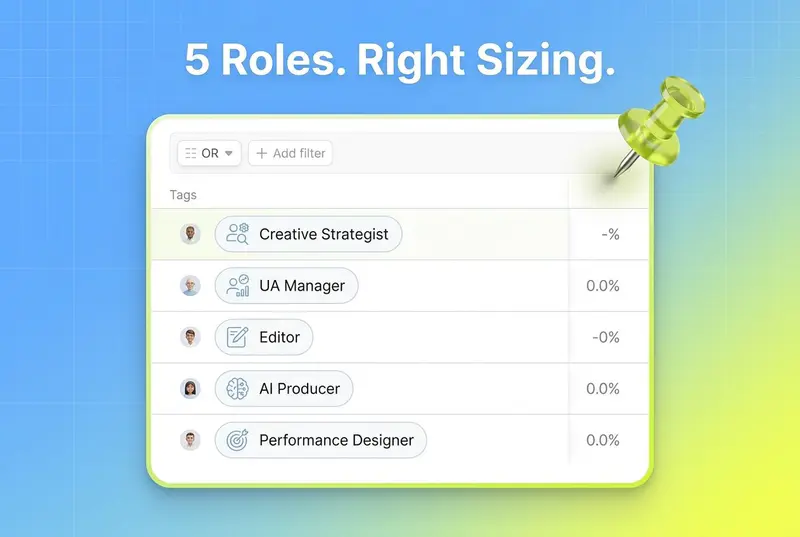
Also read How to Iterate Winning Creatives: A Modular Variant System That Beats Fatigue
Introduction
The creative team for app UA used to be small and quiet. One UA manager, maybe a designer or video editor on retainer, an agency in the background for overflow. That setup is gone.
According to AppsFlyer and Newzoo's 2026 State of Gaming for Marketers report, top advertisers (over $4M per quarter in UA spend) produced between 2,400 and 2,600 creative variations per quarter in 2025, a jump of 25 to 30 percent year on year. Even small advertisers spending under $500K per quarter pushed production volumes up 20 to 40 percent. Creative scale is no longer a luxury reserved for the top tier. It is the operating baseline.
At the same time, Layer's GDC 2026 recap observed that the debate over AI adoption is over. The conversation has shifted from "should we use AI" to "how do we operationalize it" without losing IP consistency, creative direction, or speed. Studios want systems, not tools. That sentence, in practice, is an org chart problem.
And Mavan's 2026 growth playbook frames the underlying shift in a useful way. Growth in 2026 is a cross-functional orchestra. UA, product, live ops, analytics, and CRM all play instruments. Someone has to conduct. The creative team is one of the loudest sections in that orchestra, and how you structure it decides whether you make music or noise.
This piece breaks down the five roles that matter on a modern app UA creative team, how to size the team by monthly spend, when to mix in-house, agency, and creator network, how AI rewires the org chart, and the hiring profile to look for in each seat.
Key Takeaways
The five core roles on a modern app UA creative team in 2026 are Creative Strategist, UA Manager, Editor, AI Producer, and Performance Designer. The AI Producer and Performance Designer are the new additions, and they exist because production scale and platform fragmentation now require dedicated owners.
Team sizing tracks monthly UA spend, not company size. Under $500K per month: 2 to 4 people, heavy use of AI and freelancers. $500K to $2M per month: 5 to 8 people in-house plus a creator network. $2M+ per month: 10+ people split into pods, often with a dedicated creative testing budget and sprint cadence, as observed in Mavan's $50M ARR scaling stage.
In-house vs agency is the wrong question. The real question is which layer of the work to keep in-house: strategy and analysis stay in, production volume goes hybrid, niche formats and creator-led content go to a creator network or specialist agency.
AI shifts the org chart by absorbing repetitive production and giving every junior seat leverage. According to Layer, AI is moving from assistant to operator, and the new bottleneck is creative judgment, not creative supply.
Hiring profiles favor cross-functional thinkers. According to Mavan, live ops experience is the first interview question for any gaming hire because cross-functional fluency outranks single-discipline depth in 2026.
Why the 2026 Creative Team Looks Different
Three pressures changed the shape of the team. They are not new, but in 2026 they finally collide.
The first is creative volume. The AppsFlyer and Newzoo report shows ad impressions in mobile gaming jumped 20 percent year on year, and paid install share rose 10 percent. More inventory, more competition, more pressure on the asset side. Hitting that volume with traditional production cycles is not possible without AI in the pipeline.
The second is signal density. Mavan's Sam McLellan calls signal density "by far your biggest lever" in the 2026 environment. If each platform needs roughly 50 conversion events per campaign per week to optimize properly, splitting a small budget across five channels starves every campaign. That changes what the UA Manager does day to day, and it changes what the creative team needs to ship: fewer half-tested ideas, more variants on a winning thesis.
The third is the AI question. Layer's recap describes a clear arc. Two years ago studios were asking whether AI quality was good enough. In 2026 they are asking how to integrate AI into pipelines without losing IP consistency. Mavan's McLellan is sharper about the risk: "If your competitor is using the same AI tools, feeding it the same type of prompts based on the same market research, the output will converge." His phrase for that converged output is "a photocopy of everything that's been done." AI does not solve creative differentiation. It just makes the production layer cheaper.
A team built for those three pressures looks different from a team built for 2022.
The Five Roles on a Modern App UA Creative Team

Creative Strategist
The Creative Strategist owns the testing roadmap. They translate performance data into briefs, pick which hooks and angles to test next, decide what to kill, and run the postmortem on every batch. They are not just a creative person with opinions. They work from tag-level performance data and competitive analysis.
This role used to be embedded inside the UA Manager seat. In a 2026 team it is its own position because the volume of creative decisions is too high for a UA manager who is also running spend, channels, and reporting.
What changed: the Creative Strategist now spends more time querying creative intelligence platforms and less time in spreadsheets. They live in the data layer. According to Layer, the new creative pipeline runs AI ideation, rapid testing, and scaling winners as a single loop, and the Creative Strategist owns that loop.
Hiring profile: 4 to 7 years of experience across creative and performance, strong instinct for visual hooks, comfortable with tag taxonomies and SQL-light analytics, opinions backed by data.
UA Manager
The UA Manager owns spend, signal density, channel mix, attribution, and the relationship with ad platforms. They do not own creative production, but they do own the feedback loop that decides which creatives get more budget and which get paused.
In 2026 this role becomes more analytical and less hands-on with creative. As Mavan's playbook notes, the UA Manager at a scaling studio works inside a cross-functional growth function. They are part of an orchestra, not a soloist. According to the Mobile Dev Memo UA Questionnaire, studios spending over $1M per month historically employ 5 or more people in their UA function. That ratio still holds in 2026, but the roles inside the UA function have specialized.
Hiring profile: 3 to 6 years of paid acquisition experience across at least two of Meta, Google, TikTok, AppLovin, Unity Ads, or programmatic, fluent in MMP attribution (AppsFlyer, Adjust, Branch, Singular), comfortable with incrementality and MMM.
Editor
The Editor is not a junior anymore. In 2026 the Editor turns winning footage into variants, runs the cut-down pipeline, manages the asset library, and owns motion language for the brand. They are often the heaviest user of AI tools on the team, and they sit closest to the Creative Strategist on the day-to-day workflow.
Editors at top advertisers are shipping a lot. The AppsFlyer and Newzoo report documents top advertisers producing 2,400 to 2,600 variations per quarter. Most of that volume is editorial work: hook tests, length tests, end-card tests, localization, vertical and square cuts. The Editor seat carries it.
Hiring profile: 3 plus years editing short-form video, comfortable with AI video tools, knows the differences between Meta, TikTok, AppLovin, and DSP creative specs, opinionated about pacing and audio.
AI Producer
The AI Producer is the newest role on the chart. They run the AI generation pipeline: prompts, workflows, model selection, IP safety, governance, and the asset taxonomy that feeds everything downstream. They are part technical artist, part creative ops, part QA.
The role exists because, as Layer's recap puts it, "AI is moving from assistant to operator." Once AI is running parts of the workflow, somebody has to own the structure around it: governed workflows, consistent art direction, integration with existing pipelines, production reliability. That is the AI Producer. Without this seat, AI creates chaos instead of scale.
What the AI Producer actually does: builds reusable prompt templates and workflows, defines IP-safe generation rules, runs QA on every batch, integrates AI output with the editor's pipeline, partners with the Creative Strategist on what to generate next.
Hiring profile: technical artist or motion designer background, fluent in current image, video, and audio model stacks, builds workflows not one-off prompts, comfortable owning governance.
Performance Designer
The Performance Designer is the bridge between brand and performance. They design for the algorithm and the audience at the same time. Static creatives, end cards, app store assets, playable wireframes, all of it.
This role used to be either a brand designer pulled into performance work or a junior designer learning on the job. In 2026 it is its own seat because the visual systems that drive paid performance are different from the visual systems that drive brand recognition, and you need someone who is fluent in both.
Hiring profile: 3 to 5 years of design experience with a strong portfolio in performance creative, understands hook architecture, can design playable concept frames, knows the creative specs across all major networks.
Sizing the Team by Monthly Spend Tier

There is no single right size. The right size is the smallest team that can sustain the creative volume your spend tier demands, given your channel mix and your AI maturity. Three reference points below.
Under $500K per Month: Lean, AI-Heavy, Freelance-Augmented
Most teams in this tier run with 2 to 4 people in-house plus a tight freelancer roster. The typical setup:
1 Creative Strategist (often doubles as Head of Growth or UA lead)
1 UA Manager (sometimes the same person at the lower end)
1 to 2 Editors or a hybrid Editor or AI Producer
1 Performance Designer (full-time or contract)
This tier leans heavily on AI for variant production. According to the AppsFlyer and Newzoo data, advertisers in the under-$500K-per-quarter band still pushed creative output up 20 to 40 percent year on year. AI closed the gap with mid-tier producers. It did not close the gap with the top tier, which is why teams at this stage should focus less on competing on volume and more on competing on testing quality.
Mavan's playbook at the $1M ARR stage is consistent: one or two paid channels, consolidated campaigns, a single optimization event, an imperfect but functional LTV model. The creative team mirrors that. Lean, focused, fast.
$500K to $2M per Month: In-House Core, Creator Network, Hybrid Production
Teams in this band tend to run 5 to 8 people in-house plus a creator network and one or two specialist freelancers. The typical setup:
1 Creative Strategist
1 to 2 UA Managers (split by channel or geo)
2 to 3 Editors
1 AI Producer
1 to 2 Performance Designers
This is where the AI Producer role becomes a real position, not a side hat. Production volume scales, governance starts to matter, and you cannot run the AI workflow as a shared spreadsheet of prompts.
This is also the tier Mavan calls "the messy middle." The temptation is to widen channels. The discipline is to deepen first. Translation for the creative team: invest in testing infrastructure and variant production on your top two channels before scaling headcount for a third.
$2M+ per Month: Pods, Dedicated Testing Budgets, Sprint Cadence
At this scale, teams of 10 or more split into pods. A common structure is one pod per major channel or per app, each pod containing its own Strategist, Editor, and Designer, with shared AI Production capacity and a central UA Management function.
Mavan's $50M ARR stage describes "dedicated creative testing budgets as a formal line item with own sprint cadence and reporting." That is the operational signature of this tier: creative testing is funded, scheduled, and measured like any other line of business. Competitive intelligence becomes an operational input rather than an occasional curiosity. Attribution gets sophisticated: incrementality, MMM, geo lift, holdout tests.
This is also the tier where the Creative Strategist function fully separates from the UA Manager function, and where the AI Producer often grows into a Director of Creative Production or Head of Creative Ops.
In-House vs Agency vs Creator Network

The old framing, all in-house vs all agency, is dead in 2026. The right question is which layer of the work to keep in-house, which to outsource, and which to build through a creator network.
Keep In-House: Strategy, Analysis, Performance Brain
Creative Strategy, UA Management, performance analysis, and the AI Producer function. These are the seats that hold the context and the institutional memory. According to Mavan, the "conductor" of the growth function cannot be outsourced. The same logic applies to the creative strategist. They need full access to performance data, internal product roadmaps, and competitive context.
Hybrid: Production Volume
Editing, design, and AI production can be hybrid. A core in-house team plus a roster of trusted freelancers or a specialist creative agency for volume spikes. This is how most teams in the $500K to $2M per month band actually operate.
Outsource or Network: Creator Content, Niche Formats, UGC
UGC, influencer-led creative, playable specialists, and 3D animation tend to live outside the in-house team. A creator network gives access to a wider talent pool than any in-house team can sustain, and the variety helps fight the AI convergence problem Mavan flagged. Specialist agencies are useful for niche formats like playable ads where the engineering effort is not worth building in-house.
How AI Shifts the Org Chart

The honest version of what AI does to the org chart: it absorbs repetitive production and changes the bottleneck.
Pre-AI, the bottleneck was supply. You could only ship as many variants as your editors and designers could produce. UA managers waited for assets. Strategists ran out of patience. Production was the constraint.
In 2026, supply is no longer the constraint. Layer's recap describes a solo developer at Layer building a full game with hundreds of assets in 3 weeks for under $300 using Claude and Layer. That is one person doing what used to take a studio. The same logic applies to ad creative production.
The new bottleneck is judgment. Which idea is worth scaling. Which variant is on-brand. Which test should run next. Which AI output is a "photocopy" of the market and which one actually differentiates. That is human work, and it sits squarely on the Creative Strategist's desk.
The AI Producer role exists because once AI is running parts of the production line, somebody has to own the IP safety, the workflow governance, and the asset taxonomy. Without that seat, the team is just prompting in parallel and hoping for the best.
Mavan's framing is worth repeating: "The best creative ideas still come from a group of people in a room riffing on something unexpected. AI can help you get those ideas into market faster. It cannot replace the room." The org chart should reflect that. The room is the Creative Strategist plus the Performance Designer plus the UA Manager arguing over a hook. The pipeline is the AI Producer plus the Editor turning that argument into 40 variants by Friday.
Hiring Profile per Role
A quick reference for what to look for in each seat. None of this is rigid, but it is what most successful 2026 teams converge on.
Creative Strategist. 4 to 7 years across creative and performance. Has shipped at least one breakout creative concept that scaled past $1M in spend. Comfortable with creative tagging, SQL-light analytics, and reading tag-to-metric reports. Strong opinions, lightly held.
UA Manager. 3 to 6 years in paid acquisition. Two-plus major channels mastered. Fluent in MMP attribution across AppsFlyer, Adjust, Branch, and Singular. Comfortable with incrementality testing and MMM at the higher end. Cross-functional thinker. Mavan's first interview question for any gaming hire is live ops experience, and the principle generalizes: hire UA managers who think in product terms, not just campaign terms.
Editor. 3-plus years in short-form video. Fluent in current AI video tools. Knows the differences between Meta, TikTok, AppLovin, and DSP creative specs. Builds reusable cut-down templates, not one-off edits.
AI Producer. Technical artist or motion design background. Builds workflows, not prompts. Has shipped a generation pipeline in a previous role. Cares about IP safety and governance. Often the most technically curious person on the team.
Performance Designer. 3 to 5 years of design with a portfolio of performance creative. Understands hook architecture and end-card design. Can design playable concept frames. Knows the visual systems that scale across networks.
Where Segwise Fits
A modern creative team is bottlenecked on two things in 2026: strategy bandwidth and production capacity. Segwise is built for both.
The Creative Strategy Agent is your always-on creative strategist. It maintains full context across every creative, tag, and competitor across 15+ ad networks (Meta, Google, TikTok, Snapchat, YouTube, AppLovin, Unity Ads, Mintegral, IronSource) and 4 MMPs (AppsFlyer, Adjust, Branch, Singular). It tags every creative element using multimodal AI including video, audio, image, text, and playable ads. It detects fatigue early, clusters assets, and answers any question about creative performance in plain language. For a lean team, it is the difference between having one Creative Strategist and behaving like you have three. For a bigger team, it is the difference between your strategists spending Mondays in spreadsheets and your strategists spending Mondays in a room arguing about hooks.
The Creative Generation Agent is the tireless production engine. It generates new winning creatives built around the tags that actually drive performance. It exports in every aspect ratio your team needs for Meta, TikTok, Google, Snapchat, and the rest. For teams under $500K per month, it lets the AI Producer ship at the volume of a $2M per month team. For teams over $2M per month, it removes the production bottleneck on proven winners so editors and designers can focus on new concept work, not endless variant production.
Smaller teams ship more. Bigger teams remove bottlenecks. The org chart stays human. The pipeline stops being the constraint.
Bottom Line
The modern app UA creative team is five roles, not two. Sizing follows monthly spend, not company size. In-house vs agency is the wrong dichotomy in 2026: the right call is which layer of the work to keep in, which to hybridize, and which to network. AI does not shrink the team. It shifts the bottleneck from production to judgment, and it adds the AI Producer seat to keep the pipeline coherent. The teams that win are the ones that built systems early, kept strategy in-house, and treated AI as infrastructure rather than as a magic shortcut.
Frequently Asked Questions
What roles belong on a modern app UA creative team in 2026?
A modern app UA creative team in 2026 has five core roles: a Creative Strategist who owns the testing roadmap, a UA Manager who owns spend and signal density, an Editor who turns winning footage into ad variants, an AI Producer who governs the generation pipeline, and a Performance Designer who bridges brand and performance. The AI Producer and Performance Designer are the new positions compared to a 2022 team. Tools like Segwise, AppsFlyer, and Adjust support these roles by unifying performance data across ad networks and MMPs.
How many people should be on an app UA creative team at different spend tiers?
Team size in 2026 tracks monthly UA spend rather than company size. Teams spending under $500K per month typically run 2 to 4 people in-house plus freelancers. Teams spending between $500K and $2M per month run 5 to 8 people in-house plus a creator network. Teams spending over $2M per month run 10 or more people split into pods, often with dedicated creative testing budgets. According to the Mobile Dev Memo UA Questionnaire, studios spending over $1M per month historically employ 5 or more people in their UA function, and that ratio still holds in 2026. Platforms like Segwise help leaner teams operate at the production velocity of larger ones.
What does an AI Producer actually do on a UA creative team?
An AI Producer owns the AI generation pipeline for an app UA creative team. They build reusable prompt templates and workflows, define IP-safe generation rules, run QA on every batch, integrate AI output with the editor's pipeline, and partner with the Creative Strategist on what to generate next. The role exists because, as Layer's GDC 2026 recap notes, AI is moving from assistant to operator, and somebody has to own the workflow governance. Tools used by AI Producers include Layer, Segwise's Creative Generation Agent, and open-source video and image models.
Should app UA creative teams be in-house, use an agency, or build a creator network?
The right answer in 2026 is a mix of all three, split by layer. Strategy, UA management, and AI production should stay in-house because they hold institutional context. Editing, design, and variant production can be hybrid using a core in-house team plus trusted freelancers. UGC, influencer content, playable specialists, and niche formats are best handled through a creator network or specialist agency. According to the Mobile Dev Memo UA Questionnaire, only about 20 percent of mobile UA teams have used a full UA agency, and the in-house-plus-network model has only grown more common since.
How does AI change the creative team org chart?
AI does not shrink the team. It changes where the bottleneck sits. Before AI, supply was the constraint and creative production set the team's pace. With AI, production is cheap and judgment becomes the constraint. The Creative Strategist becomes more important, the AI Producer becomes a new dedicated role, and the editor and designer seats get more leverage per person. Mavan's growth playbook warns that AI output converges across the market if everyone uses the same tools and prompts, so the differentiation work shifts to humans. Platforms like Segwise help by surfacing what is actually working in the data, so creative judgment is informed rather than guessed.
What is the difference between a Creative Strategist and a UA Manager?
A Creative Strategist owns the testing roadmap and creative direction: which hooks to test, which variants to kill, which winners to scale. A UA Manager owns spend, channel mix, attribution, and the bidding strategy on each platform. In a 2026 team they sit next to each other and share data, but they are separate seats because each role has too much volume to run as a side function. Tools like Segwise, AppsFlyer, and Singular help both roles share a common view of creative performance across networks and MMPs.
How much creative volume should a UA team produce?
According to the AppsFlyer and Newzoo 2026 State of Gaming report covered by ContentGrip, top advertisers spending over $4M per quarter produced 2,400 to 2,600 creative variations per quarter in 2025. Mid-tier advertisers spending $0.5M to $1M per quarter stagnated unless they scaled output beyond 1,000 creatives per quarter. Even smaller advertisers under $500K per quarter increased production volume 20 to 40 percent year on year. Use those numbers as benchmarks, then size your team and AI pipeline to hit your tier's range. Segwise's Creative Generation Agent helps smaller teams scale variant production without scaling headcount.
What should you look for when hiring for a UA creative team in 2026?
Hire cross-functional thinkers. According to Mavan, live ops experience has been the first interview question for any gaming hire for over a decade, and the principle generalizes to UA creative roles: people who can think across creative, product, and analytics outperform single-discipline specialists. For the Creative Strategist seat, look for shipped breakout concepts plus data fluency. For the UA Manager, look for multi-channel experience and MMP fluency across AppsFlyer, Adjust, Branch, and Singular. For the AI Producer, look for technical artists who build workflows rather than one-off prompts.