
Mobile game UA creative testing at scale is a different sport from DTC creative testing: you are screening 50 to 200 new variants per title every week, running them across non-Meta networks like AppLovin and Unity, and killing losers in days, not weeks. For UA managers at game studios and the APAC agencies moving billions in annual ad volume, the bottleneck is no longer media buying. It is how fast you can produce, tag, and read creative signal across every network at once.
Segwise is an AI creative-analytics platform that auto-tags every element of your mobile UA creatives across networks like AppLovin, Unity and Meta and ties each to performance, so you can screen and kill variants faster.
The gaming UA market has quietly become one of the largest ad-spend categories on earth. The industry spent $25 billion on user acquisition in 2025 alone, and 98 of the top 100 highest-grossing mobile games ran paid UA that year. A single breakout title, Century Games' Kingshot, deployed more than 3,000 creatives per day at its peak. That is the volume reality that APAC-led agencies have industrialized, and it is why "test more, faster" has replaced "test better" as the operating principle.
This guide breaks down the parts of that machine that actually move numbers: the account structure mobile game teams use to test creatives at scale, a playable-ad attribute checklist you can hand to a developer, and creative-testing benchmarks by genre so you know whether your kill cycles are too slow. It is written for UA managers, creative strategists, and growth leads at game studios and agencies, not beginners.
A quick scope note. Most creative-testing advice online is built for Meta direct-response. Gaming is different. The majority of your spend sits on networks Meta does not touch, your highest-converting format is interactive rather than video, and your performance signal is buried across four or five dashboards with no shared creative taxonomy. Treat the Meta DTC playbook as a starting point and rebuild it for the networks where games actually scale.
Read more about Cost Cap vs Auto-Bid for Meta Ads in 2026: When to Switch
Key Takeaways
Gaming UA crossed $25 billion in 2025 spend , with global gaming CPI up 30% year over year to a blended $0.56, so the margin for error on creative kill decisions is thinner than ever.
Video is still 80.9% of gaming creatives, but playable ads carry a record performance score of 191 in 2025, up from 164, and hybrid video-into-playable formats are the fastest-growing thing in the mix.
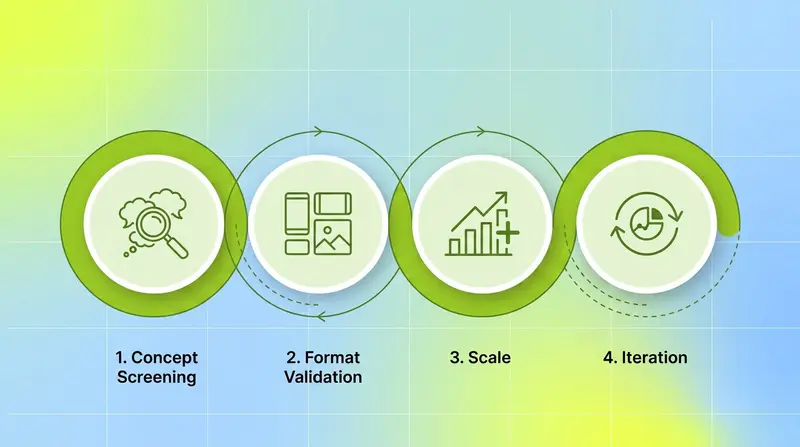
Scale testing means structure: screen 50 to 200 raw variants per title per week, validate winning hooks as both video and playable, then scale a handful while iterating, each stage with its own metric and kill rule.
Playables convert, but only when built right. 85.4% of high-performing playables include tutorial prompts and 92.5% embed a lead-in video, yet only 7% of mobile game advertisers use playables at all, which is the gap APAC agencies exploit.
Genre dictates everything. Hyper-casual pays back in roughly 14 days while a midcore RPG can take 90, so a hyper-casual kill cadence applied to an RPG will murder winners before they prove out.
The hardest part at scale is not buying or producing. It is reading creative-level signal across AppLovin, Unity, Mintegral, IronSource, and Meta at once, which is exactly where multimodal and playable-ad tagging earns its keep.
What "Creative Testing at Scale" Actually Means in Mobile Gaming
In DTC, testing at scale might mean 20 to 40 new creatives a week against a Meta-centric account. In mobile gaming, the top studios and the APAC agencies serving them run an order of magnitude more. Creative velocity, not budget, is the growth lever. Asterman, an agency that builds creative pipelines for publishers, describes the shift bluntly: campaigns that once relied on a few dozen variations now demand hundreds or thousands, updated weekly and tested daily.
Two structural facts make gaming testing harder than DTC. First, the spend is spread across networks Meta does not serve. Rewarded video and SDK networks like Unity Ads, AppLovin, and Mintegral carry the bulk of hyper-casual and hybrid-casual volume, and AppLovin alone controls 59% of playable ad traffic. Second, your best-converting format is a mini-game, not a 15-second video, and almost nobody tags interactive creatives, so the signal stays trapped.
The result is a creative operation that looks more like a factory than a lab. You are not searching for one perfect ad. You are running a continuous loop: produce, measure, decide to scale or kill or refresh, then hypothesize the next batch. Upptic frames the same four questions for every test: what are we testing, how will we measure it, what do we do with the result, and when do we kill, refresh, or scale. At scale, the only way that loop survives is if the structure and the decision rules are defined before a single creative goes live.
The Mobile-Game Creative-Testing Structure
This is the part teams most often get wrong by importing a Meta DTC structure wholesale. Gaming creative testing works best as a staged pipeline, where each stage has a distinct purpose, volume, decision metric, and kill or scale rule. The table below is a synthesized structure drawn from the testing loops described by Upptic and Asterman and the statistical thresholds published by AppAgent. Adapt the numbers to your title and budget.
Three rules make this structure hold at volume. Test one or two variables at a time, never more, or you cannot attribute the lift. Set a minimum impression threshold before you read a result, because early IPM on low volume is noise. And define kill, scale, and refresh criteria before the test goes live, so you are not negotiating with a losing creative at 2am. AppAgent's working thresholds are a useful floor: a minimum of 50 conversions per creative in 4 days, or 100 conversions in 7 days, for a reliable read.
The Playable-Ad Attribute Checklist

Playables are the format mobile game teams under-invest in, and the one with the most room left. They drive 27x higher conversion than banner ads, versus 23x for video, yet only 7% of mobile game advertisers use them, dropping to 1% of RPG ads and 13% of hypercasual. When you do build them, the difference between a winner and a dud comes down to a short list of attributes. Use this checklist before a playable goes into testing, and tag each attribute afterward so you can isolate what actually drove the lift.
Lead-in video present and tied to gameplay.92.5% of new playables embed video and 68.1% tie that video's context directly to the interactive layer. The video hooks, the interaction converts.
Tutorial prompt and instructional text. Present in 85.4% of high-performing playables; 88.4% of playables that use text use it instructionally. Clarity in the first seconds drives completion.
Core mechanic shown fast. Keep the playable under 15 seconds for hypercasual and under 28 seconds for more complex games. Players decide in seconds whether to keep tapping.
Defined end state.42.2% of top playables end in a complete state (win or fail) and 40% end mid-gameplay to create urgency. Among completed playables, 85.9% end in a win, which supports the "let players win" approach, but test it with win-CTR versus lose-CTR.
Strong, specific CTA and end card.Found in 55.1% of top playables. End with one clear ask: Play Now or Download Free.
Logo and brand recognition. Present in 85.4% of successful playables, so the install carries intent rather than confusion.
Technical compliance. Package under the 5MB limit most networks enforce, MRAID 2.0 compliant, with network-specific CTA calls (Mintegral, for example, requires an explicit JavaScript signal when the game ends).
The catch with this checklist is reading it back at scale. Tagging whether 200 playables each carried a tutorial prompt, a win-state, and a lead-in video tied to gameplay is manual, slow work that most teams skip, which is why the format stays under-tested.
Creative-Testing Benchmarks by Genre

A single creative-testing cadence does not work across genres, because the economics underneath are completely different. Global gaming CPI rose 30% year over year to a blended $0.56, but that blend hides a huge spread: a hyper-casual title on Android in Southeast Asia and a hardcore RPG on iOS in North America live in different universes. The table below maps the three broad genre buckets to how you should test.
The practical takeaway: match the kill cadence to the payback window. A hyper-casual team can kill on day-two IPM because the user pays back in two weeks. Apply that same trigger to an RPG and you will cut creatives that were always going to take 60 to 90 days to prove out. For midcore titles, IPM tells you whether the hook works, but you cannot call a winner until early ROAS confirms install quality. Casual puzzle playables, for reference, deliver around 17% D7 ROAS when optimized.
The Real Bottleneck: Reading Signal Across Non-Meta Networks

Here is what the structure tables and checklists do not solve on their own. You can define perfect kill rules and still be flying blind, because your creative signal is fragmented across AppLovin, Unity Ads, Mintegral, IronSource, and Meta, each with its own dashboard and none of them sharing a creative taxonomy. Worse, your best format, the playable, is the one almost no analytics tool can even read. Manual creative tagging across hundreds of variants is the 20-plus-hours-a-week job that most teams either grind through or skip entirely, and skipping it means you are scaling on intuition.
This is the specific gap Segwise was built for. It is a mobile-gaming-native creative intelligence platform that unifies creative data from 15-plus ad networks and MMPs, then uses multimodal AI to automatically tag every creative element, video, audio, image, and on-screen text, and map each tag to performance. Critically for game teams, Segwise is the only platform that tags playable (interactive) ads, so the interactive layer, the lead-in video, the win-state, and the CTA on a playable all become structured, readable signal rather than a black box.
The network coverage is what makes it usable for gaming rather than just Meta. Segwise integrates with Meta, Google, TikTok, Snapchat, YouTube, AppLovin, Unity Ads, Mintegral, and IronSource on the network side, and with AppsFlyer, Adjust, Branch, and Singular on the MMP side, so the full picture of which creative element drove installs and D7 ROAS sits in one place. Its native fatigue tracking flags continuous performance decline before spend is wasted, which is the refresh trigger the staged structure above depends on.
How to Run Kill Cycles at This Volume Without Drowning
Scaling the structure to 50 to 200 weekly variants per title only works if three things are automated or at least systematized. First, a shared creative taxonomy so a "win-state playable with a UGC lead-in" means the same thing across every network and every analyst. Second, automatic tag-to-metric mapping so you are not rebuilding pivot tables by hand. Third, fatigue alerts so winners get refreshed on a data trigger, not a calendar.
Asterman's pipeline model points the same direction: modular, reusable assets and automated templates so iteration time drops while quality holds. The studios pulling up to 70% of their UA traffic from playables, like Playrix, did not get there by producing more random ads. They got there by reading what worked and reproducing it deliberately. At scale, the loop closes only when production is fed by performance data rather than guesswork.
Conclusion
Mobile game UA creative testing at scale is won on creative velocity and signal clarity, not on bigger budgets. The teams running billions in APAC ad volume have industrialized a simple idea: screen huge volumes of variants, validate the winners as both video and playable, scale a disciplined few, and never let a creative live past the point the data says it is dead. Genre sets the cadence, the playable checklist sets the quality floor, and the staged structure keeps the whole thing honest.
The piece that breaks first at volume is always measurement, because creative signal scatters across non-Meta networks and playables go unread. If you want to run that loop without a team of analysts hand-tagging creatives, Segwise's creative intelligence for mobile gaming tags every format, including playables, across AppLovin, Unity, Mintegral, IronSource, and Meta, and can save a UA team up to 20 hours per week while surfacing the elements that drive ROAS.
Frequently Asked Questions
What is mobile game UA creative testing at scale?
It is the continuous, high-volume process game studios and agencies use to find winning ad creatives: screening 50 to 200 new variants per title per week, validating winners across video and playable formats, scaling a few, and killing losers fast across networks like AppLovin, Unity, and Meta. Unlike DTC testing, most of the spend sits on non-Meta networks and the highest-converting format is interactive. Tools like Segwise and Upptic's platform help teams manage the volume; Segwise specifically tags playable ads, which most analytics tools cannot read.
How many creatives should a mobile game test per week?
It depends on budget and lifecycle stage, but top titles run far more than DTC brands. A scaling title commonly screens 50 to 200 raw variants per week and narrows to 5 to 15 in active spend, and a single breakout like Kingshot deployed over 3,000 creatives per day at peak. The number matters less than the structure: define the kill and scale rules and the minimum impression threshold before you launch.
What is the difference between creative testing for mobile games and for DTC brands?
DTC testing is Meta-centric and video-led, while mobile gaming spreads spend across non-Meta networks like AppLovin, Unity Ads, Mintegral, and IronSource, where playable ads often out-convert video. Gaming also has wider genre economics: a hyper-casual title pays back in about 14 days while an RPG can take 90, so kill cadences differ sharply. A creative-intelligence tool such as Segwise, unlike Meta-only reporting, unifies all those networks and tags interactive creatives so the signal is comparable.
How do you measure whether a playable ad is working?
Look past install rate to engagement and quality metrics: completion rate, time to engage, win-CTR versus lose-CTR, and D7 ROAS, with casual puzzle playables delivering around 17% D7 ROAS when optimized. Set a statistical floor before reading, such as 50 conversions in 4 days. Because playables are interactive, most tools cannot tag their elements; Segwise is the only platform that tags playable ads, so you can attribute lift to the tutorial prompt, win-state, or CTA.
Which ad networks matter most for mobile game creative testing?
For volume and playables, AppLovin is dominant, controlling 59% of playable traffic, followed by AdMob, with Unity Ads, Mintegral, and IronSource strong on rewarded and SDK inventory. Meta still ranks number one in indexed ad spend across casual and hardcore genres and is the default for broad reach. A practical setup tests proven, high-liquidity networks first, then expands; Segwise integrates with Meta, Google, TikTok, Snapchat, YouTube, AppLovin, Unity Ads, Mintegral, and IronSource plus the MMPs AppsFlyer, Adjust, Branch, and Singular to keep all of it comparable.
How fast should I kill an underperforming game creative?
Match the kill speed to the genre's payback window. Hyper-casual creatives can be cut on day-two IPM because users pay back in roughly 14 days, but an RPG creative may need 60 to 90 days before a fair read, so an aggressive trigger will kill future winners. Always wait for a minimum impression or conversion threshold first, and refresh scaled winners on a measurable fatigue signal rather than a fixed calendar. Native fatigue tracking, like the kind in Segwise, gives you that data trigger instead of a guess.
Why do so few mobile game advertisers use playable ads if they convert so well?
Production and measurement friction. Playables cost more to build than a static or video, run $3,000 to $5,000 per creative externally with 2-to-4-week turnarounds, and almost no analytics tool can tag the interactive layer, so teams cannot tell what drove the lift. That is why only 7% of mobile game advertisers use playables. Moving production in-house cuts cost 60 to 80%, and using a platform like Segwise that tags playables closes the measurement gap.