
Winning mobile ad creative in 2025 comes down to three repeatable moves: borrow proven mechanics across genres, build a real human presence into the frame, and treat connected TV (CTV) as a performance channel, not a branding afterthought. For user acquisition (UA) teams, that means the bottleneck is no longer ideas, it is the speed at which you can tag what worked, spot it fading, and ship the next version. Segwise's creative intelligence handles that loop, tagging every element and flagging fatigue before spend leaks.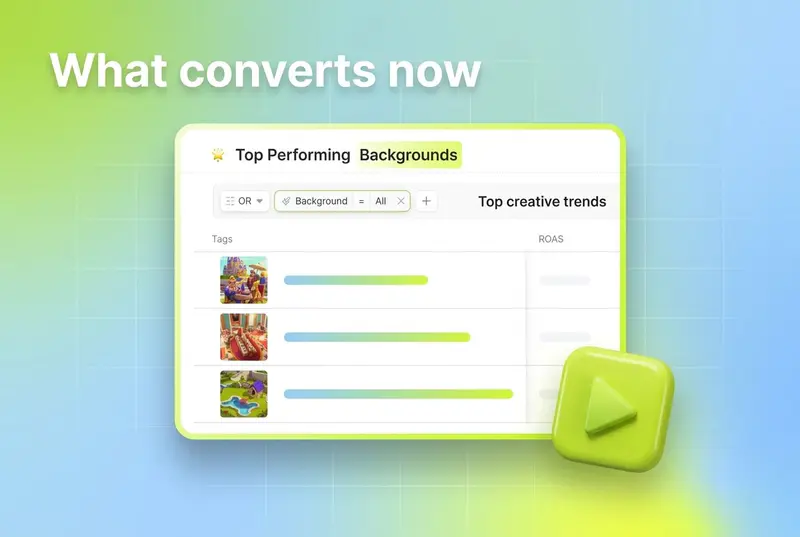
AppLovin's in-house creative studio, SparkLabs, produces tens of thousands of ads a year. When a team at that scale publishes what is working, it is worth reading closely. Their Performance-Driven Ad Trends report is built on more than 81.2 billion impressions, 33.1 billion clicks, and 412 million installs, as summarized by Adjust. That is not a survey of opinions. It is a readout from one of the largest creative pipelines in mobile.
This post pulls the practical signal out of that report and pairs it with fresher 2025 and 2026 data, so you get a playbook you can act on this quarter. We will cover the specific creative concepts that performed, why generative AI changed the production math, where CTV fits, and how to run the test-and-iterate loop without drowning your design team.
The short version: the trends are knowable and repeatable. The hard part is operationalizing them across hundreds of live creatives without losing track of what is fatiguing and what is about to win.
Also read 7 Best AI Ad Creative Tools in 2026 (Tested and Compared)
Key takeaways
SparkLabs scaled its use of AI in creative concepting and production by nearly 3x from 2022 to 2023, saving roughly 1,600 hours, according to AppLovin's report via Adjust and PocketGamer.biz.
"Metaplay" ads, which feature simplified mini-game mechanics that differ from the actual core gameplay, emerged as a high-performing concept because they tap the same user motivations that drive installs.
Genre-bending, borrowing proven mechanics and styles from other verticals, beat sticking rigidly to your category's defaults.
More than half of SparkLabs' best non-gaming ads in 2023 were CTV creatives, and CTV ad spend is on track for roughly $32.57 billion in 2025 per eMarketer data.
Creative fatigue now arrives faster: video ad fatigue onset compressed toward roughly 9 days, and refreshing every 7 to 10 days has become the practical standard, per RevenueCat.
87% of marketers use generative AI in at least one workflow in 2026, up from 51% in 2024, per MarketingProfs.
What the SparkLabs report actually found
SparkLabs sits inside AppLovin and builds ads at industrial scale. That vantage point is the reason the report carries weight: the patterns come from live spend, not focus groups. A few findings stand out for any UA or creative team.
Generative AI rewired the production math
The headline shift is volume. SparkLabs scaled its use of AI across creative concepting and production by nearly 3x between 2022 and 2023, which freed up around 1,600 hours of working time, as Adjust reported and PocketGamer.biz confirmed.
Those hours did not disappear. They got reinvested into more concepts and more experimentation. That is the real lesson. AI did not replace the creative team, it changed what the team spent its time on, moving from manual production toward idea generation and testing.
The report's guidance on adopting AI is refreshingly grounded. It recommends building a foundation first, prioritizing team-wide adoption over scattered individual usage, and treating AI as a tool that keeps changing rather than a fixed solution.
Metaplay: ads that aren't the actual game
One of the more interesting concepts in the report is metaplay. The idea is that the ad focuses on gameplay mechanics that are not the core loop of the actual game, often a simple mini-game designed to pull in casual players.
The report's example is Card Shuffle Sort. The real gameplay and the ad creative clearly differ, but both tap the same underlying user motivation. That last part matters. Metaplay is not bait-and-switch for its own sake, it works when the simplified mechanic still signals the satisfaction the real game delivers.
For UA teams, the takeaway is to think in motivations, not screenshots. What does your game actually make people feel, and what is the lowest-friction way to promise that in five seconds?
Genre-bending beats staying in your lane
Each vertical has creative styles that tend to perform. The report's finding is that the best marketers in 2023 stopped treating those defaults as fences. Borrowing successful elements from other genres, what the report calls genre-bending, drove results.
A puzzle game might lift a tension-and-release hook from a hyper-casual title. A finance app might borrow the satisfying-progress visual language of a mobile game. The mechanic that works in one vertical often works in another because human attention does not respect category boundaries.
CTV is now a performance channel
For years, connected TV lived in the brand budget. The SparkLabs data points the other direction. More than half of the studio's best-performing non-gaming ads in 2023 were CTV creatives, according to PocketGamer.biz.
The market backs this up. CTV ad spend is forecast to reach roughly $32.57 billion in 2025, nearly double its 2021 level, per MNTN Research citing eMarketer. More than two-thirds of advertisers now treat CTV as essential to their media plans.
What works on CTV is different from a mobile interstitial. The big screen rewards storytelling: live-action, mini-cinematic spots that build a connection over a few seconds rather than firing a fast hook. The report frames CTV as the place to explore immersive, larger-screen presentations that resonate on a deeper level than a phone-sized ad can.
Borrowing proven mechanics, building genuine human presence, and treating the big screen as a performance channel are the moves that separated 2023's winners from the pack, and the same logic holds heading into 2026.
If you are expanding your channel mix, the practical move is not to repurpose your 9:16 mobile cut for the TV. It is to design for the screen, then track CTV creatives with the same rigor you apply to social.
The human presence advantage
A recurring theme across the report is that real human presence in creatives drives connection. People respond to people. A live actor, a believable reaction, a face on screen, these outperform sterile product shots in many tests.
This pairs neatly with the generative AI trend. As AI makes synthetic and stylized content cheaper to produce, genuinely human moments become a differentiator rather than a default. The teams winning in 2025 use AI for speed and variation, then keep a human in the loop and a human in the frame.
How generative AI changed creative velocity
SparkLabs is early, but the rest of the market caught up fast. 87% of marketers now use generative AI in at least one workflow in 2026, up from 51% in 2024, per MarketingProfs. Marketers recover an average of about 6 hours a week using AI in their workflows.
The performance side is just as real. AI-optimized creatives have shown the potential to deliver up to 2x higher click-through rates compared with manually designed versions, according to adoption data compiled by Amra and Elma.
Here is the catch the SparkLabs report keeps circling back to: AI multiplies output, but output without insight is just noise. If you generate 50 variants and cannot tell which element drove the lift, you have spent compute, not learned anything. The teams pulling ahead are the ones who close the loop between generation and measurement.
How to run the test-and-iterate loop
The trends above are only useful if you can act on them at scale. Reading that metaplay works does not help if you cannot tell whether your metaplay ad is the one carrying your campaign. The discipline is the same loop SparkLabs runs: produce, tag, measure, iterate.
1. Produce against motivations, not formats
Start from what your product makes people feel, then borrow the mechanic that promises it fastest. Use AI to generate variations of the concept, not 50 random ideas. SparkLabs reinvested its saved hours into more concepts, not more clutter.
2. Tag every element before you launch
You cannot learn from a creative you have not labeled. Manual tagging is where most teams break down, spending 20+ hours a week categorizing hooks, characters, CTAs, and visual styles. Segwise's multimodal AI tagging does this automatically across video, audio, image, and text, and it is the only platform that tags playable (interactive) ads, which matters for gaming UA.
3. Measure at the element level
Campaign-level metrics tell you a creative worked. Element-level data tells you why. Map every tag to performance so you know whether the win came from the metaplay hook, the live actor, or the CTA. That is how genre-bending becomes a repeatable system instead of a lucky swing.
4. Catch fatigue before it costs you
Creative fatigue arrives faster than it used to. Video ad fatigue onset has compressed toward roughly 9 days, and refreshing every 7 to 10 days is now the practical standard, per RevenueCat. Monitoring that manually across hundreds of creatives is not realistic. Segwise's fatigue tracking watches for continuous performance decline and spend-share drops, and alerts you before budget burns.
Where the data lives across your stack
Most teams run these trends across many networks at once, which is exactly where the visibility breaks. Your creative data sits in Meta, TikTok, Google, Snapchat, AppLovin, Unity Ads, and more, while your attribution sits in your MMP. Reconciling it by hand is the work nobody has time for.
Segwise connects to 15+ ad networks and MMPs through no-code integrations, unifying creative and performance data in one place. On the ad network side that includes Meta, Google, TikTok, Snapchat, YouTube, AppLovin, Unity Ads, Mintegral, and IronSource. On the MMP side it connects AppsFlyer, Adjust, Branch, and Singular, so attribution sits next to creative metrics instead of in a separate tab.
That unified view is what makes trend-spotting possible. When all your creatives are tagged and all your data is in one place, you can ask which hook style drove the most installs last month and get an answer, instead of building a report.
The bottom line
The SparkLabs report makes one thing clear: high-performing creative is not luck, it is a system. Borrow proven mechanics across genres, build genuine human presence into the frame, treat CTV as a real performance channel, and use AI to multiply output, not to replace judgment. The winners are not the teams with the most ideas, they are the teams that can tell which idea is working fastest and ship the next version before fatigue sets in.
That speed is the whole game now. Manual tagging and dashboard-hopping cannot keep pace with 9-day fatigue cycles and AI-scaled output. Segwise gives creative and UA teams the intelligence to act on these trends: automatic multimodal tagging, element-level performance mapping, native fatigue detection, and AI-powered creative generation built from your own winning patterns. Teams using it save up to 20 hours a week per app and have seen up to 50% ROAS improvement by catching fatigue early and doubling down on what works.
Frequently asked questions
What are the top mobile ad creative trends right now?
The most reliable trends are genre-bending (borrowing proven mechanics across verticals), metaplay ads (simplified mini-game hooks that tap core user motivations), genuine human presence in the frame, and treating CTV as a performance channel rather than a branding buy. AppLovin's SparkLabs report identified these from billions of impressions. Tools like Segwise help you confirm which of these trends actually drives results in your own account by tagging every creative element and mapping it to performance, where attribution platforms like AppsFlyer or Adjust stop at the campaign level.
What is metaplay in mobile advertising?
Metaplay is an ad concept where the creative shows simplified gameplay mechanics that differ from the game's actual core loop, often a mini-game built to attract casual players. It works when the simplified mechanic still signals the same user motivation the real game satisfies. AppLovin's SparkLabs report cites Card Shuffle Sort as an example, where the ad and the real game differ visually but tap the same underlying desire. Segwise can tag and isolate metaplay-style hooks across your creatives so you can measure their lift, something a generic reporting tool will not surface.
How fast does mobile ad creative fatigue set in?
Creative fatigue has accelerated. Video ad fatigue onset has compressed toward roughly 9 days, and the practical standard is now refreshing creatives every 7 to 10 days, according to RevenueCat. The exact timing depends on spend level, audience size, and auction density. Segwise's fatigue tracking detects continuous performance decline and spend-share drops across all your networks and alerts you early, whereas MMPs like Singular focus on attribution rather than creative-level fatigue signals.
Is CTV worth it for performance marketers?
Yes, increasingly so. More than half of SparkLabs' best non-gaming ads in 2023 were CTV creatives, and CTV ad spend is forecast near $32.57 billion in 2025. The key is to design for the big screen with storytelling and live-action rather than repurposing a vertical mobile cut. Segwise lets you track CTV creatives alongside your social and network creatives in one unified view, so you can compare performance instead of guessing, while platforms like Adjust handle the underlying CTV measurement.
How do I use generative AI for ad creative without losing quality?
Use AI to multiply variations of concepts that already map to a user motivation, keep a human in the loop for judgment, and keep genuine human presence in the creative itself. SparkLabs reinvested its AI-saved hours into more concepting and testing, not just more output. Segwise's creative generation builds new variations from your own winning tag patterns, so the AI is grounded in what already performs for you, unlike standalone generators that produce variations with no performance context.
How do I know which creative element is actually driving performance?
You tag every element (hook, character, CTA, visual style, audio) and map each tag to performance metrics like ROAS, CTR, and installs. Campaign-level reporting tells you a creative worked; element-level tagging tells you why. Segwise does this automatically with multimodal AI across video, audio, image, and text, and is the only platform that also tags playable ads. Competing analytics tools and MMPs like Branch report on campaigns and attribution but do not break performance down to the creative element.
Can I track creative performance across multiple ad networks in one place?
Yes. Segwise connects to 15+ ad networks and MMPs through no-code integrations, including Meta, Google, TikTok, Snapchat, YouTube, AppLovin, Unity Ads, Mintegral, and IronSource, plus AppsFlyer, Adjust, Branch, and Singular on the attribution side. That unifies creative and performance data so you can spot cross-platform patterns. Most attribution tools cover the MMP side well but do not unify creative-level analysis across every ad network the way Segwise does.