
Meta's Muse Image is coming to Advantage+, which means your ads will soon be generated by a model Meta owns and trained on performance data only Meta has. For advertisers, that promises better Meta creatives but a closed loop: you get the output, not the reasoning, and none of those learnings carry to TikTok, AppLovin, or YouTube. Cross-network creative intelligence like Segwise is how you keep a learning loop that works everywhere you buy.
On July 7, 2026, Meta launched Muse Image, its first foundation image generation model built by Meta Superintelligence Labs. It's live for consumers in the Meta AI app, on Instagram Stories in the US, and in WhatsApp in limited countries. But the announcement that matters most for anyone running paid social is a quieter one: Meta confirmed that in the "coming weeks," Muse Image will generate ad creative directly inside Advantage+.
That's a bigger deal than another AI image tool. It means the creative your campaigns run on Meta will increasingly come from a model Meta built, tuned against its own advertiser performance data, and wired into its own ranking systems. This post breaks down what shipped, why the Advantage+ integration is the real story, and what it means for how you measure and improve creative, especially if you buy across more than one network.
Key Takeaways
Muse Image is Meta's own foundation image model, launched July 7, 2026 by Meta Superintelligence Labs, available in Meta AI, Instagram Stories (US), and WhatsApp (limited countries)
It's coming to Advantage+ in the "coming weeks" to generate ad creative directly, upgrading the existing image generation features
Muse Image is agentic: it uses search and coding tools, self-refines its own drafts, and improves the more it "thinks" at inference time
Meta frames it as "native reasoning" that understands creative briefs the way a designer would, producing on-brand variations "with fewer iterations"
The strategic point is ownership: Meta can train and tune the model against placement-level performance data no outside provider has, creating a closed-loop creative advantage.
The catch for advertisers: Meta's loop stays inside Meta. You get better Meta creatives, but not the reasoning behind them, and the learnings don't transfer to TikTok, AppLovin/Axon, or YouTube.
A preview of Muse Video was also shared, with native audio support, coming soon to creators and Meta AI
What Is Muse Image?
Muse Image is Meta's most advanced image generation model to date, and its first media model from Meta Superintelligence Labs. Instead of directly mapping a prompt to an image, Meta describes it as an agent: it invokes tools, self-refines its output, and scales its quality with more compute at generation time.
Three capabilities stand out from Meta's technical description:
Tool use. Muse Image can write and run code (to produce accurate plots and QR codes, for example) and search the web to ground images in real facts and references. Meta says search improves factual accuracy on knowledge-heavy prompts.
Self-refinement. The model reflects on its own draft inside its chain of thought, making a local edit when a small detail is off or regenerating from scratch when more is wrong. Meta notes this behavior wasn't designed in, it emerged during reinforcement learning because it produced better images.
Test-time compute scaling. Like a language model, Muse Image gets better the more it reasons before finishing. More compute means more reasoning, more tool calls, and more refinement steps.
On the public Arena leaderboards, Meta reports Muse Image holds the No. 2 spot for text-to-image, single-image editing, and multi-image editing by human preference, as of July 5, 2026. It also supports precise, instruction-based image editing and multi-reference composition, pulling people, objects, clothing, styles, and environments from several input images into one.
Meta also previewed Muse Video, built on the same base with native audio, ranked No. 3 for text-to-video on Arena at the time of writing and "coming soon" to creators and Meta AI.
The Real Story: Muse Image Inside Advantage+
For consumers, Muse Image is a fun way to reimagine photos and make Stories effects. For advertisers, the important line is buried in a separate Meta for Business post: image generation in Advantage+ will soon be powered by Muse Image.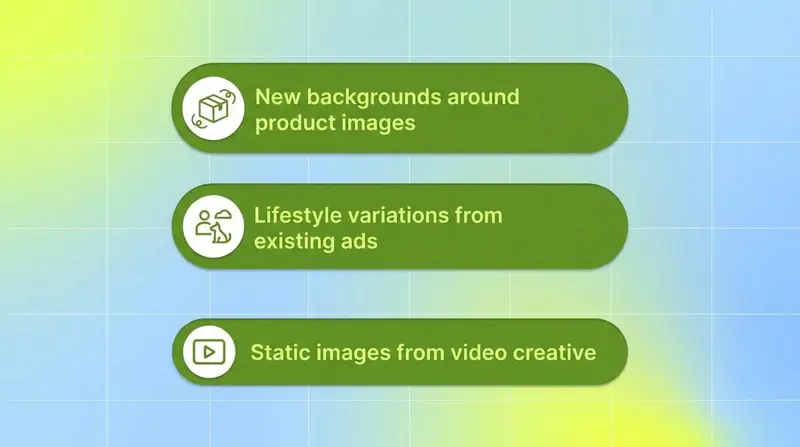
Advantage+ Creative already does generative image work today. Per Meta, it can generate new backgrounds around product images, create full lifestyle image variations inspired by existing ads, and produce static images directly from video creative, all in service of the creative diversity Meta says improves campaign performance.
Muse Image upgrades that engine. In Meta's words, it brings "agentic visual reasoning and self-refinement," meaning it "understands complex creative briefs the way a designer would, not just individual keywords." Meta says this native reasoning lets it adjust elements, swap styles, and create variations from the advertiser's creative, producing "high-quality, on-brand ad variations with fewer iterations."
The practical shift is simple to state: the creative generation inside your Meta campaigns will be supplied by a foundation model Meta owns, rather than a third-party model or a lighter prompt wrapper.
Why Model Ownership Is Meta's "Moat"
Why build its own model instead of plugging in someone else's? Because owning the model is what turns creative generation into a closed loop.
As industry analyst Eric Seufert argues in his breakdown of Meta's "Muse moat," the deepest benefit isn't that Meta can make ad images. It's that Meta can "train, tune, align, and evaluate its own model against domain-specific advertiser performance data that only it possesses." A model wired into Meta's own ranking and retrieval systems can enforce brand safety, control cost and latency, and produce creative that's more use-case-native than fine-tuning a generic model ever could.
There's also a supply-chain point. Owning the model means Meta isn't exposed to an outside provider whose pricing, access, or roadmap could change. That independence is worth a lot when the rest of the industry is renting models from a handful of labs.
Put plainly: Meta's advantage is not image generation. It's building creative capabilities around the proprietary performance signals, placement data, and ranking systems of its own ad marketplace. That's the loop, and Meta just confirmed it's the part worth owning.
What the Loop Actually Requires

A creative loop works like this: generate a creative, run it, measure it, feed the results back, then generate a better one. The middle steps are the hard ones. For results to make the next creative better, the system has to know why a creative worked. That means tagging creative elements, the hooks, styles, formats, characters, and mapping each element to performance. A model can't learn from a black box.
Generation got easy in 2026. Knowing why a creative won, or will win, is still the hard part. Meta building Muse Image against its own performance data is a direct admission that this measurement-and-attribution half is where the real edge sits.
So while the Advantage+ integration is genuinely good news if you advertise only on Meta, there's a catch for everyone else: Meta's loop stays inside Meta. You'll get better creatives for Meta placements, but you won't see the reasoning, and because you can't see it, those learnings aren't transferable. What Muse learns about your winning hooks on Instagram doesn't help you on TikTok, AppLovin/Axon, or YouTube.
What This Means for Advertisers
If Meta is your only channel, this is a straightforward win. Expect faster, more on-brand variations inside Advantage+ and fewer manual iterations.
If you buy across networks, the picture is more nuanced. A per-network loop that you can't inspect creates three practical problems:
No cross-network transfer. Creative learnings locked inside Meta don't inform your TikTok or YouTube strategy, so you rebuild the same knowledge separately on each platform.
No visibility into "why." On-brand output with no exposed reasoning makes it hard to brief your own team, or to know which element actually drove the lift.
Platform-shaped incentives. A model optimized against Meta's marketplace optimizes for Meta outcomes, which may not match your blended, cross-channel goals.
The answer isn't to avoid Muse. Own the measurement-and-learning half yourself, across every network you run, so you're never dependent on a loop you can't see into.
This is exactly the gap Segwise was built to close. Segwise runs the same generate-measure-learn loop, but with full visibility and across all your networks. Its Creative Tagging Agent uses multimodal AI to automatically tag every element across video, audio, image, and text (and even playable ads), then maps each tag to performance. Its Creative Strategy Agent unifies that data across Meta, Google, TikTok, Snapchat, YouTube, Axon, Unity Ads, Mintegral, and IronSource, plus MMPs including AppsFlyer, Adjust, Branch, and Singular. And its Creative Generation Agent turns those winning patterns into net-new creatives, automatically tracking each one once live so performance feeds back into the same intelligence that produced it.
The difference is transparency and reach. Meta's loop gives you the answer for one platform. A cross-network loop gives you the reasoning, and lets you apply it everywhere.
The Privacy Footnote
Muse Image's consumer launch hasn't been friction-free. As TechCrunch reported, a feature that lets users generate images from other people's public Instagram photos, opt-out by default, has drawn immediate privacy criticism. Meta says users can disable it in settings and has added an invisible watermarking system called Content Seal to mark AI-generated images. It's a reminder that AI creative tooling brings governance questions along with productivity gains, especially for brands mindful of how their assets and audiences are used.
The Bottom Line
Meta launching Muse Image and wiring it into Advantage+ is a clear signal: the company sees closed-loop, performance-trained creative generation as the prize, and it's building a moat around owning that loop end to end. For Meta-only advertisers, that's a real upgrade. For everyone running multi-network campaigns, the lesson is that generation is now the easy part, and the durable advantage is owning the measurement and learning that tells you why a creative works across every platform you run.
That's the loop Meta is keeping inside its walls. It's also the loop Segwise is building to work everywhere you advertise, with full visibility into the reasoning, not just the result.
Frequently Asked Questions
What is Meta Muse Image?
Muse Image is Meta's first foundation image generation model, built by Meta Superintelligence Labs and launched on July 7, 2026. It works as an agent that uses search and coding tools, self-refines its own output, and improves with more compute at generation time. It's available in the Meta AI app, Instagram Stories (US), and WhatsApp (limited countries), and is being integrated into Advantage+ for ad creative (Meta AI blog).
How does Muse Image work inside Advantage+?
Meta says Muse Image will power image generation in Advantage+ Creative, generating new backgrounds around product images, full lifestyle variations inspired by existing ads, and static images from video. Meta describes it as bringing "agentic visual reasoning and self-refinement" to produce on-brand ad variations with fewer iterations (Meta for Business). It's expected to roll out in the "coming weeks."
What does the Muse Image and Advantage+ integration mean for advertisers?
If you advertise only on Meta, it means faster, more on-brand creative variations with less manual work. If you run campaigns across multiple networks, the trade-off is that Meta's creative learning loop stays inside Meta, you get the output but not the reasoning, and those insights don't transfer to TikTok, AppLovin/Axon, or YouTube. Tools like Segwise exist to give you a transparent creative loop across all networks.
Why did Meta build its own image model instead of using a third-party one?
Owning the model lets Meta train and tune it against advertiser performance data only it has, and wire it into its own ranking systems for brand safety, cost, and latency control. It also removes dependence on outside providers whose pricing or access could change. Analyst Eric Seufert calls this Meta's "Muse moat", a closed-loop creative advantage rooted in proprietary data.
Can Muse Image learnings help my TikTok or YouTube campaigns?
No. Because Muse Image is trained on Meta's own performance data and its reasoning isn't exposed to advertisers, the creative learnings stay within Meta's ecosystem. To carry insights across TikTok, YouTube, AppLovin/Axon, and others, you need a cross-network layer that tags creative elements and maps them to performance on every platform, which is what Segwise's creative tagging is built to do.
How do I actually know why one of my ads is winning?
You need creative-level attribution, not just campaign metrics. That means tagging each creative's elements (hooks, CTAs, characters, visual styles, audio) and mapping every tag to performance so you can see which element drove the result. Segwise's Creative Tagging Agent does this automatically across video, image, audio, text, and playable ads, then connects it to metrics from your ad networks and MMPs.
Is Muse Image safe to use for brand creative?
Meta has added Content Seal, an invisible watermark that marks AI-generated images, and says advertisers get on-brand output through Advantage+. That said, the consumer launch drew privacy criticism over a feature that generates images from public Instagram photos by default (TechCrunch). Brands should review AI creative governance and settings before scaling usage.
What is Muse Video?
Muse Video is Meta's preview video generation model, built on the same base as Muse Image with native audio support. Meta reports it ranked No. 3 for text-to-video on the Arena leaderboard at the time of writing and says it's "coming soon" to creators and Meta AI (Meta AI blog).