
Meta creative strategy for ecommerce in 2026 means treating creative volume, hook quality, and fatigue management as your primary performance levers, because Advantage+ has absorbed the targeting work that used to separate winners from losers. The brands scaling profitably are shipping 15 to 50 active creatives per ad account, refreshing every 10 to 14 days, and running tight testing systems instead of fiddling with bids. Segwise's creative analytics and fatigue tracking sit in the middle of that workflow, turning every test into compounding data about which hooks, formats, and angles actually move revenue.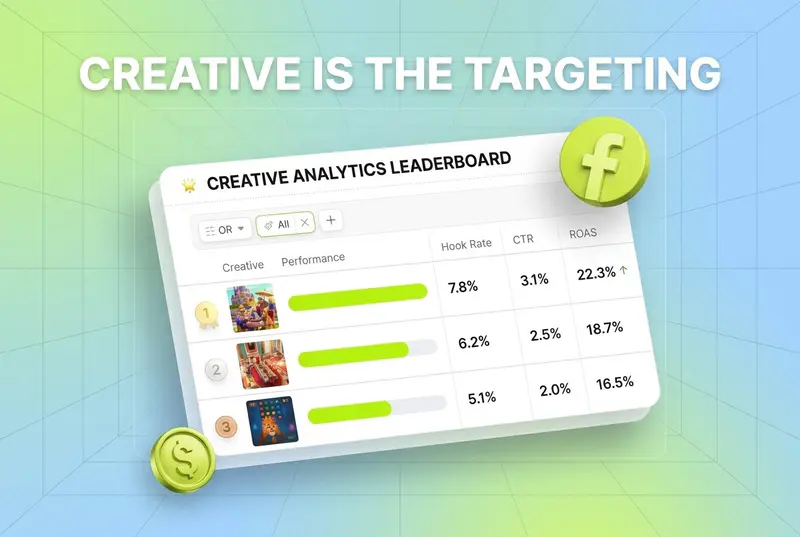
Introduction
If you still spend most of your Meta day inside the audience tab, you are working on the wrong problem. A 2025 AppsFlyer report found that 70 to 80% of Meta ad performance now comes from creative quality, not budget or targeting. Advantage+ audience tools quietly took over the targeting layer, and the result is that creative is the targeting. For ecommerce, that shift is bigger than it sounds.
The brands winning on Meta in 2026 are producing more variations, testing more systematically, and killing losers without sentiment. That requires a different shape of work. Less bid optimization, more creative production. Fewer "winning ads run forever" stories, more disciplined refresh cycles. Less polished studio output, more native-feeling UGC.
This guide is the system. It covers why creative is the lever now, when UGC beats produced content (and when it does not), which Meta formats to pick for each funnel stage, how to write hooks that survive the 3-second cutoff, how to structure a testing system that compounds, how to manage fatigue before it eats your ROAS, and how to run all of it on an SMB budget. Every recommendation is grounded in 2025 to 2026 data, not vibes.
By the end, you should have a usable Meta creative strategy for ecommerce that you can stand up in a week and keep running for the rest of the year.
Also read How to Structure a Modern Creative Team for App UA in 2026
Key Takeaways
Creative quality drives 70 to 80% of Meta ad performance in 2025 to 2026, with Advantage+ absorbing most targeting decisions (source: AppsFlyer 2025 Creative Optimization Report).
Meta now needs 15 to 50+ active creatives per account for proper optimization, and creative lifespans have shrunk to 3 to 6 weeks on Meta and 7 to 14 days on TikTok (OptiFOX Media, 2026).
UGC-style ads reduce CPA by roughly 23% on average and outperform polished brand content on CTR by up to 48% (Hustler Marketing, Spray Marketing).
Advantage+ Audience cuts CPA by up to 32% and lifts ROAS by ~22% for ecommerce accounts with enough conversion data (Conversios, 2026).
Frequency above 3.0 is a fatigue trigger; ads run beyond 3 to 4 weeks without a refresh can see CPMs rise up to 29% and CTRs fall up to 35% (Pixel Panda Creative).
A solid Hook Rate is 25% (3-second views / impressions), 30% is good, 40%+ is elite (Sovran, Vaizle).
For most SMB brands, 1,000 to 2,000 impressions and 7 days is the minimum test window before scaling or killing a creative (AdManage.ai).
Why Creative Is Now the Primary Meta Performance Lever
Meta advertising used to reward people who built clever audiences. Layered interest stacks, exclusion logic, hand-tuned lookalikes. That edge is mostly gone. Meta's machine learning, primarily through Advantage+ audiences and Advantage+ Shopping, finds buyers better than most advertisers can target them. The lever that still moves the needle is the asset you put in front of those buyers.
The numbers are blunt. Creative quality drives 70 to 80% of Meta ad performance in 2025. Industry analysis of 550,000+ ads from 6,000+ advertisers found that only 5 to 8% of ads become real winners and roughly 50% never spend meaningfully. That distribution forces a volume game, because winners are the only thing that funds the account.
Here is the shift in one table.

Worth noting: Advantage+ is not magic for everyone. ATTN Agency reports that for some DTC brands with niche positioning, low conversion volume, or hyper-local targeting, manual setups still win. Treat Advantage+ as the default and pressure-test against it, not the other way around.
UGC vs Produced Creative: The 2026 Data
User-generated content (UGC) ads are paid ads built to look like real-person content. Customer reviews, unboxings, tutorials shot on a phone. They outperform polished brand creative on Meta because they feel native instead of disruptive.
The data is consistent. UGC ads reduce CPA by roughly 23% on average and outperform brand creative on CTR by up to 48%, according to Hustler Marketing's 2026 analysis. Spray Marketing's review of 400+ DTC brands found UGC outperformed polished creative by 3 to 5x on conversion rate and ROAS in 2024 to 2025.
But the picture has nuance. UGC dominates on cold prospecting and lower-AOV products. Produced creative still wins at higher price points, for brand awareness pushes, and for seasonal launches where polish signals trust.
When each format wins
Three types of UGC for ecommerce
Customer-created content. Reviews, unboxings, styling videos from actual customers. Highest authenticity, often highest conversion. Slow to source. Always get written permission before running these as paid ads.
Creator-produced UGC. Content from paid creators shot in a UGC style. Reliable production, scripted messaging, native look. Most SMB brands use this as their primary UGC source. Platforms like Billo and Insense source it for $50 to $400 per video.
AI-generated UGC. AI avatar or AI-generated creator content. Cheapest, fastest. Performance is improving fast but still below human creator UGC for most product categories. Best for high-volume hook testing, not as the primary creative.
Volume of testable concepts beats the quality of any single execution. A brand spending $5,000 on 50 raw UGC concepts will outperform a brand spending the same on one polished production every time. Even if 45 concepts underperform, the 5 winners carry the account.
Ad Formats and When to Use Each
Meta offers more ad formats than most brands use well. Picking the right format per funnel stage is one of the cheapest performance wins available.
Format mix by brand stage
Early stage (under $5K/month spend). Single image and single video only. Easy to produce at volume, easy to test, easy to analyze. Add carousel when you have a winning angle to expand into multi-frame storytelling.
Mid stage ($5K to $20K/month). Add Dynamic Product Ads for retargeting. This is non-negotiable at this spend level since the pixel has enough data for DPA to perform. Add Advantage+ catalog for prospecting.
Scaling stage ($20K+/month). Run all formats with intent. Single video for UGC prospecting, DPA for warm retargeting, collection for catalog browsing, Advantage+ for algorithm-driven prospecting. Every format has a distinct job.
A counterintuitive note: static image ads remain the highest-ROAS format for direct response ecommerce when the concept is strong. Do not dismiss statics in favor of video. The best creative strategy combines both, statics for direct response efficiency, video for reach and top-of-funnel engagement.
The Hook: Winning the First 3 Seconds
On Meta in 2026, the hook is the ad. A scroller decides in under 2 seconds whether to stop. For video, the first 3 seconds decide whether the rest of the creative ever gets seen. For static, the visual and headline must earn attention before the body copy gets read. Everything else is irrelevant if the hook fails.
The metric to watch is Hook Rate: 3-second video views divided by impressions. A 25% hook rate is table stakes, 30% is good, 40%+ is elite, per Sovran's 2025 benchmarks. Sovran also notes that hook rate often correlates more strongly with downstream conversion than CTR does, which is why it has become the lead optimization metric for creative teams.
Anatomy of a strong hook
Immediate visual contrast. Something unexpected, visually striking, or emotionally resonant in the first frame. Before/after split, unexpected use case, relatable problem moment.
Pattern interrupt. Break the visual language of organic content just enough to stop the scroll without looking like an ad. Native-looking UGC does this naturally.
Specificity. "This changed my morning routine" is weaker than "I replaced my $4 face wash with this $22 one and here is what happened after 30 days." Vague hooks do not stop scrolls.
Audience signal. The first frame or first line should signal clearly who this is for. A hook that tries to speak to everyone speaks to no one.
8 hook types that consistently work for ecommerce
Problem hook. Open with the pain. "If your [product category] does [frustrating thing], this is why." Stops scrollers who have the problem.
Result hook. Open with the outcome. "I lost 12 pounds in 6 weeks using this exact routine." Strong for health, fitness, transformation.
Myth-bust hook. "Stop doing [common practice]. Here is what actually works." Curiosity plus authority positioning.
Number hook. Specific numbers stop scrolls better than adjectives. "3 things I wish I knew before buying my first espresso machine."
Question hook. "Do you have combination skin that breaks out in the T-zone?" Self-qualification happens instantly.
Controversy hook. A counterintuitive or mildly provocative claim. "Expensive skincare is mostly marketing. Here is what the research actually says."
Urgency hook. Time or supply scarcity. Best in retargeting. Overused in cold audiences and reads as cheap; save it.
Social proof hook. Lead with a number or quote. "14,000 customers in 90 days." Most trusted format for skeptical audiences.

Practical move: generate 5 hook variations for every concept before filming or designing anything. Test hooks as static headline cards first. The hook that wins as a static tells you exactly what to lead with in the video version. This is one of the highest-leverage creative habits in the business.
Creative Frameworks by Funnel Stage
A cold audience needs awareness and credibility. A warm audience needs specificity and urgency. Running the same creative for both is one of the most common Meta mistakes for ecommerce brands.
Cold audience (top of funnel)
Goal: stop the scroll, introduce the product, earn enough trust for a click or save.
Problem-solution video (UGC style). 30 to 60 seconds. Creator identifies a relatable problem, introduces the product as the solution, shows it working. No hard sell.
Social proof static. Lead with a review quote or review count. Product image. Simple CTA. High-trust, low-friction.
Education-first content. Teach something useful in your category. Builds authority before the ask. Works well for considered purchases.
Myth-bust or counterintuitive claim. Challenges a common belief. Generates curiosity. Best for saturated categories.
Warm audience (mid funnel)
Goal: re-engage interest, address hesitation, move toward purchase.
Product-specific retargeting (DPA). Dynamic ads showing the exact product viewed. Reminder messaging. Minimal copy.
Objection-handler creative. Address the most common reason shoppers do not buy: price, shipping, quality concern, fit. Direct and honest.
"Why people love it" compilation. Multiple short customer quotes or review excerpts. Social proof at the decision moment.
Comparison creative. Your product vs the category default. Compare to the problem or status quo, not a direct competitor by name.
Hot audience (bottom of funnel)
Goal: close. Remove the final barrier.
Urgency creative. Real stock scarcity, limited-time offer, or price increase warning. Fake urgency erodes trust fast.
Incentive creative. Free shipping, bundle discount, first-order offer. Reserve for this stage. Conditioning cold audiences to wait for a discount can erode margin over time.
"Last chance" reminder. Simple, direct. "You left something behind." Product image. One CTA.
Risk reversal creative. Lead with the return policy, satisfaction guarantee, or trial offer. Removes the final hesitation.

Building a Creative Testing System
Creative testing on Meta is not "run an A/B test, pick a winner." It is a continuous system that produces concepts, tests at scale, finds patterns in winners and losers, and uses those patterns to brief the next production cycle. Brands with a system compound their advantage. Brands without one run the same ads until they die, then scramble.
The framework
Define your variable. Test one variable per experiment: hook type, format (video vs static), creative angle (problem vs social proof vs result), or offer. Testing multiple variables at once produces no usable signal.
Set a minimum test volume. Each creative needs at least 1,000 to 2,000 impressions before drawing conclusions, per AdManage.ai's testing guide. Below that is noise. Let Meta's algorithm run for 7 to 14 days minimum.
Use Advantage+ to distribute budget. Let Meta's AI allocate across creatives in the campaign. Do not manually shift budget to perceived winners before data is meaningful.
Define the primary KPI before launching. Hook rate, CTR, cost per add-to-cart, ROAS. Pick one. Optimizing for multiple KPIs at once produces no signal.
Document everything. Concept, hook type, format, angle, KPI result, what you learned. After 20 tests, patterns emerge. After 50, you have a playbook.
Kill losers fast, scale winners slowly. Pause creatives with zero conversions after 1,000 to 2,000 impressions. Scale winners by raising budget 20% every 3 days. Big sudden bumps reset the learning phase.
Build variation layers around winners. Once a concept wins, build 3 to 5 variations: different hook, different delivery, different CTA, different product angle. Extends winner lifespan and generates new test data.
The creative intelligence log is your most valuable long-term asset. Every test teaches you something about your audience: which problem resonates most, which proof element converts best, which offer they respond to. A brand with 50 documented tests has a moat a new competitor cannot replicate in a quarter. Maintaining that log by hand is where most teams fall apart, and where automated creative tagging tools become worth their cost.
Managing Creative Fatigue
Creative fatigue is the performance decline that hits when your audience has seen the same ad too many times. Frequency rises, CTR drops, CPMs climb, ROAS slides. Managing fatigue proactively rather than reactively is one of the most important operational disciplines in Meta advertising in 2026.
Meta's own data shows ad frequency above 3.0 correlates with a measurable CTR drop for most consumer categories. Pixel Panda Creative reports that ads running beyond 3 to 4 weeks without a refresh see CPMs rise up to 29% and CTRs fall up to 35%. On TikTok, top creatives now fatigue in 7 to 14 days. Meta gives you more runway (typically 3 to 6 weeks for a strong creative) but the direction is the same: refresh cadence is now a competitive advantage.
Signs your creative is fatiguing
Frequency above 3.0 in your primary audience over the past 7 days.
CTR declining week-over-week while impressions stay stable.
CPM rising without seasonal pressure or new competition.
ROAS declining despite no changes to budget, bidding, or audience.
Comment section filling with "I keep seeing this ad" replies.
The refresh cadence system
Schedule creative drops proactively. Do not wait for fatigue signals. Schedule new drops every 10 to 14 days regardless of current performance. Proactive rotation prevents the steep ROAS cliff that comes from waiting until ads are already exhausted.
Maintain a creative buffer. Always keep 2 to 3 tested creatives ready to launch when a current winner fades. A buffer means you never have zero options when performance drops.
Refresh hooks before replacing concepts. When a winning creative fatigues, try a new hook on the same underlying concept before building entirely new creative. Often the concept is still strong and the audience has just memorized your opening.
Expand to new audiences. A fatigued creative in your primary audience may still perform in an adjacent segment. Broad targeting or Advantage+ audiences can extend creative lifespan by finding fresh eyeballs.
Retire gracefully. Pause rather than delete. A creative that worked once may work again after a 6 to 8 week rest when audience memory fades.
The most efficient anti-fatigue tactic for SMB brands: produce 3 to 5 hook variations of every winning concept at the time of production. When the original fatigues, you have ready-to-launch alternatives that test a new entry point on the same proven concept. One production session becomes 4 to 5 weeks of testing material.
This is exactly the kind of monitoring problem where teams lose 20+ hours a week to spreadsheets. Segwise's fatigue tracking handles the multi-platform monitoring layer automatically: continuous performance decline detection, configurable thresholds (e.g., 20% ROAS decline over 7 days), and early alerts via email or Slack before spend gets burned.
Creative Production on an SMB Budget
The biggest myth in Meta creative strategy is that production quality drives performance. It does not. Concept and hook quality drive performance. High-concept, low-production UGC consistently outperforms high-production brand content. That is good news for SMB brands. You do not need a studio. You need a system.
Production by budget
$0 to $500/month (founder or team-created UGC). Founder or team films product demos, unboxings, and use-case videos on a phone. Natural light, clean backgrounds. Edit in CapCut (free) for mobile-first vertical video. Design statics in Canva using brand templates. Repurpose top-performing organic social as paid creative.
$500 to $2,000/month (creator-sourced UGC). Brief 2 to 4 UGC creators per month via Billo, Insense, or Fiverr. Provide a creative brief with hook options, key messages, product benefits, and what to avoid. Request raw footage rights so you can edit hooks and test variations. Budget $150 to $400 per creator video. Mix with Canva statics for a varied library.
$2,000 to $5,000/month (hybrid production). Dedicate $1,000 to $2,000 to a quarterly shoot for clean product photography and 2 to 3 hero brand videos. Spend the rest on UGC creator content for testing volume. Use produced assets for brand and retargeting, UGC for prospecting. Invest in a creative strategist or fractional creative director to brief and review production.
Tools every SMB ecommerce brand should use
How AI Creative Intelligence Fits This System
The pieces above (volume, hook discipline, format mix, funnel-stage creative, testing systems, fatigue management) all share one operational problem. They produce a flood of creative data that humans cannot keep up with. A brand running 30 active creatives across Meta and TikTok generates more tag-level performance signal in a week than a UA manager can manually log in a month.
That gap is where AI-powered creative intelligence earns its keep. Segwise's creative tagging uses multimodal AI to automatically tag every creative element (hooks, CTAs, characters, visual styles, on-screen text, voiceover, music, emotions) across video, audio, image, and text. Tags are mapped directly to performance metrics, so you can see which hook style drove the most installs, which visual emotion correlates with the highest ROAS, which CTA copy works best in cold prospecting vs warm retargeting. Brands using Segwise report up to 20 hours saved per week on tagging and consolidation alone, with reported 50% ROAS improvement from identifying winning patterns and catching fatigue early.
For the production bottleneck, the Creative Generation Agent takes your top-performing tags and generates new creatives built around those winning elements, with prompt-based editing and multi-format export ready for any ad network. Teams using Segwise report up to 50% reduction in creative production time by replacing guesswork with evidence about what is actually working. For competitive intelligence, the Competitor Tracking Agent applies the same multimodal AI to competitors' Meta ads, surfacing white space and oversaturated angles.
If you are running the playbook above by hand, you can absolutely scale to a point. But the brands compounding fastest in 2026 are the ones letting an always-on creative strategist agent maintain context across thousands of creatives so the humans can focus on concept and judgment.
How to Choose Your Creative Stack
There is no single right toolkit. The right stack depends on monthly ad spend, team size, and how mature your creative testing process is. A few if/then scenarios to use as starting points.
If you are under $5K/month in ad spend. You do not need paid creative intelligence software yet. Stack: CapCut (free) for editing, Canva Pro (~$15/month) for statics, Meta Ad Library (free) for competitor inspiration, Claude (~$20/month) for hook copy. Keep a manual creative log in Notion or a Google Sheet. Focus all spending on production volume.
If you are $5K to $20K/month and adding DPA/Advantage+ catalog. Add Foreplay (~$49/month) for swipe-file management. Start running 2 to 4 paid UGC creators per month through Billo or Insense. Manual tagging starts to break here, so begin scoping a creative analytics tool like Segwise, Madgicx, or Triple Whale before tagging chaos eats your weekends.
If you are scaling past $20K/month with 30+ active creatives. Manual tagging and fatigue monitoring no longer work. Stack: Segwise for automated multimodal tagging, fatigue tracking, asset clustering, and AI-powered creative generation. Pair it with Foreplay for inspiration and a fractional creative director for briefs.
If you are an agency running multiple ecommerce clients. You need multi-brand/portfolio-level views. Segwise's Studio View and role-based access (Admin/Editor/Viewer) are built for this; Madgicx also offers agency tiers. Standardize on one creative intelligence platform across clients so reporting and insights compound.
If competitor pressure is your bottleneck. Add competitor intelligence. The Meta Ad Library is free but manual; Segwise's competitor tracking applies the same AI tagging to competitor Meta ads to surface white space, oversaturated angles, and messaging shifts in real time.
Bottom Line: Meta Creative Strategy for Ecommerce in 2026
Meta in 2026 is a creative production and testing game. The algorithm has eaten targeting. The lever you still control is what you put in front of the buyers Meta finds for you. The brands winning are producing 15 to 50+ active creatives, leaning into native-feeling UGC for prospecting, picking formats by funnel stage with intent, obsessing over the first 3 seconds, running disciplined one-variable tests with proper sample sizes, and refreshing creative every 10 to 14 days before fatigue hits.
That sounds like a lot because it is. It is also entirely doable on an SMB budget with a system, a few hundred dollars of UGC creator spend per month, and an honest commitment to documenting what you learn. The teams that win this year are not the ones with the biggest agency retainers. They are the ones treating creative as a continuous, instrumented process rather than a quarterly project.
Frequently Asked Questions
What is the best Meta creative strategy for ecommerce in 2026?
The best Meta creative strategy for ecommerce in 2026 combines high creative volume with disciplined fatigue management, supported by creative intelligence tools like Segwise, Madgicx, or Triple Whale. Keep 15 to 50+ active creatives, lean UGC for cold prospecting and produced creative for retargeting and higher AOV products, test one variable at a time at 1,000+ impressions per creative, and refresh every 10 to 14 days. Segwise adds AI-powered creative generation on top of the analytics layer to close the loop from insight to new ad.
How many creatives should I have running on Meta?
According to OptiFOX Media's 2026 guide, Meta now needs 15 to 50+ active creatives per account for proper Advantage+ optimization. The exact count depends on spend level, but anything under 10 is starving the algorithm. Use creative intelligence platforms like Segwise, Madgicx, or Triple Whale to track which creatives are pulling spend and which are dead weight so you can refresh the bottom of the pile every 10 to 14 days.
Does UGC really outperform produced ads on Meta?
Yes, for most ecommerce use cases. UGC ads reduce CPA by roughly 23% on average and outperform polished brand creative on CTR by up to 48% on Meta, per Hustler Marketing's 2026 analysis. The exception is higher AOV products ($200+), brand awareness pushes, and seasonal launches, where production polish signals trust. A hybrid mix is usually the right answer. Segwise, Foreplay, and Madgicx can all help track which UGC angles win in your specific account.
What is a good Hook Rate on Meta ads?
A 25% Hook Rate (3-second video views divided by impressions) is table stakes on Meta. 30% is good. 40%+ is elite, per Sovran's 2025 benchmarks. Hook Rate often correlates more strongly with downstream conversion than CTR does, which is why creative analytics platforms like Segwise, Madgicx, and Triple Whale now treat it as the lead optimization metric for creative teams.
What is the difference between Advantage+ Audience and manual targeting?
Advantage+ Audience uses Meta's AI to identify and target buyers based on pixel data, signals from your account, and broader behavioral patterns. Manual targeting uses interest stacks, lookalikes, and demographic filters built by the advertiser. For most ecommerce accounts with sufficient conversion volume, Advantage+ now beats manual setups by roughly 22% ROAS and 32% lower CPA, per Conversios. Manual still wins for niche, low-volume, or hyper-local campaigns. Tools like Segwise and Madgicx can help you compare creative results across both setups in one view.
how do I know when an ad is fatiguing on meta
Watch for frequency above 3.0, CTR declining week-over-week while impressions stay stable, CPMs rising without seasonal pressure, and ROAS sliding with no other changes. Pixel Panda Creative found ads running beyond 3 to 4 weeks without refresh see CPMs up to 29% higher and CTRs up to 35% lower. Manual monitoring across dozens of creatives gets impossible fast. Segwise, Madgicx, and Triple Whale all offer automated fatigue tracking with configurable thresholds and alerts so you catch decline before spend gets burned.
whats the cheapest way to produce meta ads as a small brand
Founder or team-shot UGC on a phone, edited in CapCut (free), with statics designed in Canva (~$15/month). Total cost: under $50/month if you shoot it yourself. Step up to creator-sourced UGC ($150 to $400 per video from Billo, Insense, or Fiverr) once you have $500+/month in production budget. Pair this with creative intelligence tooling like Segwise, Foreplay, or Madgicx so you actually learn from each test rather than producing in the dark.
How often should I refresh my Meta creatives?
Schedule new creative drops every 10 to 14 days regardless of current performance. Top creatives on Meta typically fatigue in 3 to 6 weeks (faster on TikTok at 7 to 14 days). Proactive rotation prevents the ROAS cliff that comes from waiting until performance has already dropped. Maintain a creative buffer of 2 to 3 tested concepts ready to launch. Platforms like Segwise can automate the fatigue monitoring layer across all your networks so you know when each specific creative needs a refresh, not just on a calendar schedule.