
Updated August 2026.
The Meta Andromeda ROAS drop in 2026 hit some accounts at 18% and others at 34%, but the gap between them was not luck. It was creative-test cadence. Accounts shipping 8 to 12 fresh creative tests a month saw reported ROAS slip 10 to 15%, while accounts running 2 to 4 a month lost 30 to 40%. The cross-account pattern is now clear enough to act on, and Segwise's creative analytics surface it across every account before the collapse shows up in a monthly report.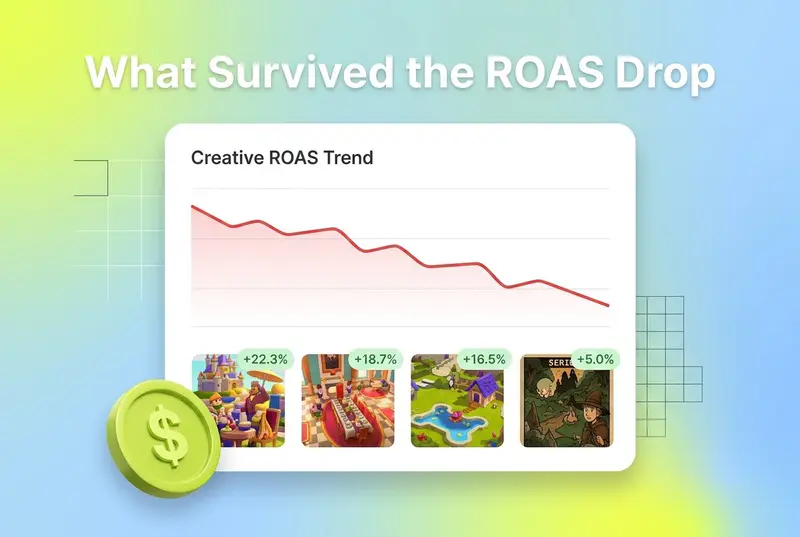
If your Meta reported ROAS slid sometime after early April and you cannot point to a single thing you changed, you are not imagining it and you are not alone. The Andromeda rollout is the biggest delivery change Meta has shipped since the iOS 14.5 privacy era, and it reshaped how spend, CPM, and conversions move through an account. The catch is that the headline number, reported ROAS in Ads Manager, is partly a reporting artifact and partly a real shift in how creative gets matched to people.
This post is built around one dataset: a cross-account look at roughly $1.8M/month in spend across 12 accounts through the April-onward window. It separates what actually collapsed from what only looked like it collapsed, names the creative types that held performance while older formats fell off a cliff, and ends with a recovery playbook indexed to how fast you can ship fresh creative. Where the cross-account numbers line up with public data from Foxwell Digital, Jon Loomer, Hyper, and Meta's own benchmarks, those sources are cited inline.
This is a different cut than the usual Andromeda fatigue-threshold coverage. The focus here is the ROAS-collapse curve, the survivor creatives, and the test-cadence cushion that decided which accounts kept their margins.
Also read AI Tools to Detect Ad Creative Fatigue and Flag Underperforming Creatives
Key Takeaways
Reported Meta ROAS dropped 15 to 40% on many accounts in 2026, but Hyper's operator data shows most of that gap is Andromeda's more conservative attribution, not lost revenue. Triangulate before you cut budget.
Across the 12-account dataset, ROAS fell 18 to 34%, CPM climbed 34% (from about $23 to $31), and conversion rate dropped 32% (from 2.8% to 1.9%) in the April-onward window.
Test cadence cushioned the hit. Accounts running 8 to 12 creative tests a month lost only 10 to 15% of ROAS; accounts at 2 to 4 tests a month lost 30 to 40%.
The survivors were not the polished legacy statics. AI-generated music-video lifestyle creatives held a 2.8% hook rate while older statics fell below 1%.
Recovery tracks cadence, not luck. Accounts that shipped 15 to 30 creative variants a month recovered to their pre-Andromeda baseline within 30 to 90 days, per Hyper's account data.
Andromeda treats creative as the targeting layer, so creative diversity, not audience tuning, is now the main lever you control.
What the Andromeda ROAS drop actually is
Andromeda is Meta's machine-learning system for ad ranking, retrieval, and personalization. It replaced the prior delivery infrastructure across Facebook, Instagram, Messenger, and Audience Network. Meta completed the global rollout in October 2025, and the migration into individual advertiser accounts ran from December 2025 through Q3 2026 in waves. The system is built on NVIDIA Grace Hopper hardware and carries roughly 10,000 times the model capacity of the system it replaced.
The mechanical change is simple to state. The old system asked which person in your audience was most likely to convert. Andromeda asks which creative, audience, and placement combination moves a specific user closest to a conversion. Foxwell Digital frames this as "creative is the targeting": the algorithm reads every element of your creative as a signal about who should see it, then finds that audience for you.
That shift produced three things that all look like a ROAS drop but are not the same problem.
The first is reporting. Andromeda's attribution is more conservative, so conversions that used to be credited to Meta now land under organic, direct, or other paid channels. Hyper's audits found this in roughly 7 of 10 accounts: Meta's reported number fell 15 to 40% while GA4 and total business revenue stayed close to flat. One DTC apparel account they documented showed reported ROAS down 36%, GA4-attributed revenue down only 11%, and blended revenue (total revenue over total spend) flat. The lesson is to triangulate Meta's number against an independent analytics source and against total business revenue before touching budget.
The second is real delivery change. CPMs rose and conversion rates moved as Andromeda re-priced and re-explored audiences. Advertisers across retail, lead generation, and e-commerce reported CPM increases of 15 to 40% in early March 2026, and week-over-week CPM swings of 30 to 60% were common during the rollout window.
The third is genuine performance loss for accounts that did not adapt their creative supply. This is where the cross-account dataset gets specific.
The cross-account dataset: what collapsed

Here is the core artifact, the part worth saving. Across roughly $1.8M/month of spend over 12 accounts, the April-onward Andromeda window produced a consistent collapse signature in 8 of the 12 accounts.
Andromeda ROAS collapse signature (12-account dataset, April-onward 2026):
ROAS decline: 18 to 34% across the 8 affected accounts
CPM: up 34%, from roughly $23 to $31
Conversion rate (CVR): down 32%, from 2.8% to 1.9%
Accounts affected: 8 of 12
The CPM move alone explains a large share of the headline ROAS drop. If you pay 34% more to reach the same thousand people and convert them at a third lower rate, ROAS falls hard even when nothing about the offer changed. This matches the public picture: Meta's reported ROAS regression of 15 to 40% and the documented CPM increases of 15 to 40% sit right on top of the 18 to 34% and +34% seen here.
What separated the 8 accounts that collapsed from the 4 that held was not budget size, vertical, or bid strategy. It was how much fresh creative each account fed the system every month.
The survivor analysis: what actually held

Two things survived the collapse, and both point in the same direction.
Survivor finding 1: creative type. The creatives that held performance were not the polished legacy statics that had carried these accounts for a year. They were AI-generated, music-video-style lifestyle creatives. In the dataset, these held a 2.8% hook rate while older static formats dropped below 1%. That tracks with how Andromeda reads creative. Meta's system now scores the first three seconds of video separately and favors distinct hooks, formats, and audio signals. Motion-led, sound-on creative gives Andromeda more to match against than a single static frame does.
Survivor finding 2: test cadence. This is the cushion. The accounts that lost the least were the ones shipping the most fresh, conceptually distinct creative.
Test-cadence cushion (12-account dataset):
8 to 12 creative tests per month: ROAS dropped only 10 to 15%
2 to 4 creative tests per month: ROAS dropped 30 to 40%
The accounts at 8 to 12 monthly tests did not avoid Andromeda. They absorbed it. A steady supply of new creative gave the retrieval model fresh combinations to explore, so when a winning creative fatigued, another was already in delivery to catch the spend. The 2 to 4 tests-per-month accounts had nothing in reserve. When their handful of winners decayed, there was no replacement, and the loss showed up as a full-account ROAS collapse.
Hyper's recovery data points the same way: accounts that moved to 15 to 30 creative variants a month, alongside clean Conversion API setup, recovered to their pre-Andromeda baseline within 30 to 90 days. Accounts that did not adapt kept underperforming.
Why test cadence cushioned the collapse
The reason is structural, not motivational. Andromeda fatigues creative faster than the old system because it aggressively matches winning ads to their most responsive audiences, burning through the best impressions quickly. A creative that used to last a month now often needs replacing every one to three weeks.
That speeds up the clock on every account. If your fresh-creative supply is slower than your fatigue rate, you fall behind a little more each week until the account looks broken. If your supply matches or beats the fatigue rate, you stay level.
Creative diversity matters more than raw volume here. Jon Loomer's read on creative diversification is that Andromeda groups near-identical creatives together and treats minor tweaks (a new background, a swapped headline) as the same ad. Foxwell makes the same point: testing "Save 20% Today" against "Get 20% Off Now" is largely pointless, because the algorithm needs conceptually different creatives to segment audiences. So the 8 to 12 tests that cushioned the collapse were not 8 to 12 color variants. They were distinct angles, formats, and hooks, each giving Andromeda a different signal to work with.
The practical version of the thesis: in 2026, your defense against the Andromeda ROAS drop is the rate at which you can ship genuinely different creative, not the precision of your audience settings.
The recovery playbook, indexed to creative-test cadence

This is a synthesized recovery sequence drawn from the cross-account pattern and corroborated by the cited sources. Run it in order.
Triangulate before cutting anything. Pull Meta reported ROAS, an independent analytics number (GA4 or server-side), and total business revenue for the last 30 days. If only Meta's number dropped, the loss is mostly reporting and cutting budget will remove real conversions. Hold steady.
Fix the signal layer first. Verify Conversion API is running with matching event IDs, and confirm your campaign attribution window did not silently reset during the rollout. No creative work compounds on top of a broken signal.
Measure your real cadence. Count how many conceptually distinct creatives you actually shipped to live ad sets in the last 30 days. If that number is under 8, your supply is the bottleneck, not your targeting.
Raise cadence to the cushion zone. Target 8 to 12 distinct creative tests a month at a minimum, and 15 to 30 if you are recovering a collapsed account. Use the 60/40 split: roughly 60% net-new concepts and 40% fresh variants of proven winners.
Bias toward motion and sound. Prioritize the formats that survived: AI-assisted, music-video-style lifestyle video with a strong first-three-seconds hook, not another polished static.
Consolidate structure so cadence can flow. Fewer ad sets with broad targeting and a deeper creative library give Andromeda the data density to use the volume you are now producing. Loomer notes you can now run 10 to 50 ads in a single ad set when they are genuinely diverse.
Refresh on a schedule, not on panic. Replace fatiguing creative every one to three weeks proactively. Waiting for the dashboard to turn red means you are already behind the fatigue curve.
How cross-account creative analytics catch this early
The accounts that collapsed did not lack effort. They lacked an early signal. A 32% CVR drop and a 34% CPM rise do not announce themselves on day one; they accumulate quietly across dozens of creatives until a monthly report makes them obvious, by which point the budget is already spent.
This is the gap Segwise's creative analytics close. Segwise connects to 15+ ad networks (Meta, Google, TikTok, Snapchat, YouTube, AppLovin, Unity Ads, Mintegral, IronSource) and MMPs (AppsFlyer, Adjust, Branch, Singular), then tracks ROAS, CPM, CTR, and CVR at the creative level rather than the campaign level. For agencies and studios running many accounts, Studio View puts that cross-account picture in one place, which is exactly where the test-cadence pattern in this dataset becomes visible.
Two capabilities map directly to the Andromeda problem. Segwise's fatigue tracking watches every creative for continuous performance decline and spend-share drop, with custom thresholds and email or Slack alerts, so you catch the decay that Andromeda accelerates before it crashes an account. And because the bottleneck is creative supply, Segwise's Creative Generation Agent produces net-new, data-backed creatives built on your winning patterns, which is how teams hit the 8-to-12 or 15-to-30 monthly cadence that cushioned the collapse without doubling their design hours. Segwise's multimodal tagging covers video, audio, image, and text, including playable ads, and on the time side teams report up to 20 hours saved per week on tagging and consolidation alone.
Conclusion
The Andromeda ROAS drop in 2026 was real for some accounts and mostly cosmetic for others, and the difference came down to one habit. Accounts that fed Meta a steady stream of distinct creative absorbed the change and recovered; accounts that relied on a few aging winners watched ROAS fall 30 to 40% with no cushion underneath. Reported numbers will keep settling as the rollout completes through Q3 2026, but the underlying rule is not going away: when creative is the targeting, your creative-test cadence is your performance floor.
The teams that come out of this window ahead are the ones who can see the collapse early and ship fast enough to outrun it. If you want creative-level visibility across all your accounts plus the generation capacity to hold a recovery cadence, Segwise gives you both in one platform. Book a demo to see the pattern on your own data.
Frequently Asked Questions
Why did my Meta ROAS drop in 2026?
Most likely the Andromeda rollout. Meta's new delivery system uses more conservative attribution, so reported ROAS can fall 15 to 40% even when real revenue is flat, according to Hyper's operator data. On top of that, CPMs rose 15 to 40% and conversion rates fell as audiences were re-priced. Triangulate Meta's reported number against GA4 and total business revenue before assuming the drop is real. Tools like Segwise and 1ClickReport surface the creative-level detail that tells you whether fatigue is the real cause.
Is the Meta Andromeda ROAS drop real or just a reporting problem?
It is usually both, in different proportions. Pull three numbers for the last 30 days: Meta reported revenue, an independent analytics number, and total business revenue. If only Meta's number dropped, it is mostly Andromeda's conservative attribution. If all three dropped together, you have real loss from CPM increases, conversion-rate decline, or creative fatigue. Segwise's creative-level analytics and platforms like Hyper help you separate reporting noise from genuine performance loss.
How many creative tests per month do I need to survive Andromeda?
In the 12-account dataset, accounts running 8 to 12 distinct creative tests a month lost only 10 to 15% of ROAS, while accounts at 2 to 4 a month lost 30 to 40%. For recovering a collapsed account, Hyper's data points to 15 to 30 variants a month. The tests have to be conceptually different, not minor tweaks. Segwise's Creative Generation Agent helps teams hit that cadence by producing data-backed creatives from winning patterns.
What creatives survived the Andromeda ROAS collapse?
AI-generated, music-video-style lifestyle creatives held up best, keeping a 2.8% hook rate while older static formats fell below 1%. Andromeda scores the first three seconds of video separately and rewards distinct hooks, motion, and audio. Polished legacy statics that worked for a year were the most common casualties. Segwise's multimodal tagging identifies which specific elements (hook, format, audio) are driving the survivors so you can produce more of them.
What is the difference between reported ROAS and real ROAS under Andromeda?
Reported ROAS is what Meta credits to your ads using its own attribution model. Real ROAS is the share of business revenue that genuinely came from Meta. Under Andromeda the two diverge by 15 to 40% on many accounts because the attribution model became more conservative, per Hyper. Comparing Meta's number against GA4 and total business revenue (MER) closes most of the gap. Creative intelligence tools like Segwise focus on the creative-level metrics that drive the real number.
my andromeda roas tanked, should I cut budget?
Almost never based on Meta's reported number alone. The most expensive mistake operators made in early 2026 was cutting budget on reported ROAS, then watching real revenue fall a month later because the cuts removed genuine conversions on top of reporting noise. Triangulate first, fix your Conversion API signal, then raise creative-test cadence before you touch spend. Segwise's fatigue alerts tell you whether the problem is real creative decay or just attribution drift.
How long until Andromeda ROAS recovers?
Per-account stabilization typically takes 4 to 6 weeks once Andromeda activates, and reported ROAS recovers most (though not always all) of the gap, according to Hyper. Accounts that raised creative cadence to 15 to 30 variants a month recovered to baseline within 30 to 90 days; accounts that did not adapt kept underperforming. The full rollout completes through Q3 2026. Segwise helps shorten the curve by catching fatigue early and feeding the recovery cadence.