
"Andromeda 2.0" is a practitioner label now applied to the next generation of Meta Andromeda, the ad retrieval system Meta described on October 28, 2026. It now scores every eligible ad with specialised "expert" models, at over one billion ads per second. It reached your account automatically, with nothing to switch on. Your lever is creative: give it distinct concepts, not near-copies.
The hard part is telling which of your ads are truly distinct and which are near-copies. Segwise is an AI creative analytics and creative generation platform that tags every element of your Meta ads, so you can see which ones are really one concept and which concepts Andromeda is giving spend to.
This post covers only the October 2026 release. For how Andromeda has shaped creative strategy since its 2024 launch, read our Meta Andromeda creative strategy playbook. Below, we keep three kinds of source apart: what Meta's engineering post on the next-generation Andromeda says, what Meta tells advertisers in its Help Centre and business news, and what practitioners claim. The third kind is always labelled.
TL;DR
If you buy the media: there is nothing to turn on. Meta says there is "no setting to switch on, no new campaign type to adopt, no migration to plan." Keep each ad set big enough to reach about 50 results a week, and keep budget changes small.
If you make the ads: more of your ads now get scored for each person, so a genuinely different concept has more chances to be matched to someone. Ten colour swaps of one ad add count, not options.
If your ROAS or CPA moved: Meta reports small, positive averages, such as 2.4% more conversions on Facebook since 2025. A big swing in your own account is more likely a learning reset, fatigue, budget pacing or the season. Check those first.
If you run app install campaigns: Meta's Advantage+ app campaigns page recommends up to 50 creatives and puts "creative diversification and differentiation" first.
What is Andromeda 2.0, and did Meta call it that?
No, Meta didn't. Its October 28, 2026 engineering post is titled "Meta Andromeda: Powering the Next Generation of Ads Retrieval Through Model-System Co-Design." It calls the system "the next generation of Meta Andromeda", "the latest iteration" and "the 2026 Meta Andromeda". The term "2.0" doesn't appear anywhere in it. Meta's advertiser summary published the same day, Inside the Three New AI Innovations in Ads Ranking, also says "the next generation of Andromeda".
"Andromeda 2.0" is a community label, and it predates Meta's post. A practitioner talk recorded in July 2026 already used it, three months before Meta published anything, and a Reddit thread in r/FacebookAds asks what it is. Since October, people often apply it to one of three things Meta published in October 2026:
The Andromeda engineering post (October 28), which this article is about.
Meta for Business's summary of the same date, which covers Andromeda, GEM and GenRecs together.
GenRecs feeding Andromeda. Meta says "GenRecs now enriches Andromeda": it generates a description of the ideal ad for a person, then matches it to the ads in the system. Meta reports this generative retrieval lifted conversions "by nearly +2% across targeted segments" on Facebook Feed in Q3 2026.
For GEM and GenRecs in depth, read our explainer on how Meta ranks a brand-new ad with GEM and GenRecs. The rest of this post sticks to Andromeda.
What Andromeda does, in plain English. Meta picks an ad in stages. Retrieval comes first: Meta's post says it "narrows a vast pool of eligible ads down to a small set of strong candidates in milliseconds." A heavier ranking stage then "scores those survivors in fine detail," and the auction decides what is shown. Andromeda is the retrieval stage. If your ad doesn't make the shortlist for a person, it can't win that impression, however good it is.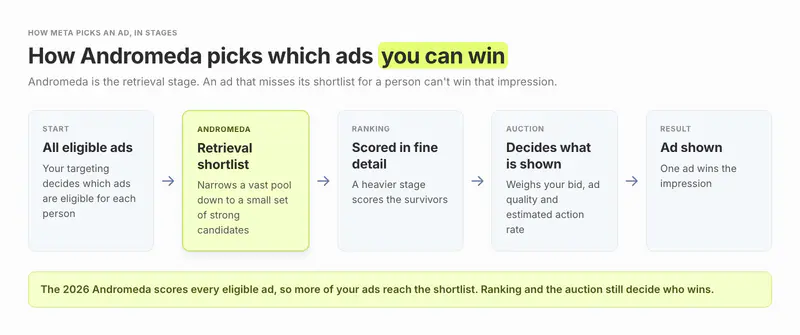
If you want the technical view, Meta's engineering post has its own architecture diagrams of the retrieval system.
What changed from the original Andromeda in 2024?
The 2024 Andromeda made retrieval deep. The 2026 version makes it broad. Meta's own summary puts it this way: in 2024 "Andromeda was about depth", while the next generation "is about smarter breadth." Here are the two versions side by side, using only what Meta says in its December 2024 launch post and the October 2026 post.
Four parts of that table matter to an advertiser. The rest is infrastructure.
"Every eligible ad" is the headline. The 2024 index skipped branches it judged less relevant, so not every eligible ad was scored for every person. Meta's analogy: the concierge used to "check the most popular shelves", and "now they read every product label on every shelf, in the same amount of time." Meta's advertiser summary says this means "more of your ads, creative variations and products are considered for each person."
Experts replace one generalist. Instead of one model judging every ad for everyone, Meta keeps a panel of specialists, each tuned to a different kind of user interest, and asks only the most relevant few about each ad. That's why it can afford to score everything.
The speed work is why it fits. Fusing the model into one GPU pass and moving targeting checks onto the same GPU are how Meta scores far more ads "within the same latency budget." You don't need to do anything about this part.
AI-made ads grew the pool it has to search. The 2026 post says generative AI tools "helped advertisers rapidly create hundreds of millions of new ads, growing Meta's ads candidate pool to an unprecedented scale," and that the architecture "scales to meet it." The 2024 post saw this coming, and also promised "a more diverse set of ad candidates," adding that "increased ad diversity can improve people's experience with ads and drive better advertiser outcomes."

One timing point is easy to miss: October 28 is when Meta described the system, not when it switched on. The post says "in production," and Meta's summary credits Q3 2026 changes ("we increased the complexity of Andromeda by 10X") with 1.37% more conversions on Facebook and 0.24% on Instagram Reels. So don't treat October 28 as a before-and-after line in your reports.
What does Andromeda 2.0 mean for your ads and creative strategy?
More of your ads get a fair look for each person, so how different your ads are from each other now matters more than how many you run. Here is what follows, with the source of each point.
More ads reach the shortlist (Meta). Every eligible ad gets scored. But a shortlist place is not an impression. The ranking models and the auction still decide, and Meta's Oct 28 auction explainer says the auction weighs your bid, ad quality and an estimated action rate. "The highest bid or the biggest budget doesn't automatically win."
Distinct concepts give the experts more to work with (our reading). The experts are built around different kinds of user interest. An ad with a different motivation behind it (price, a pain point, a proof story, a different person on screen, a different format) gives the router a new candidate to match to a different group of people. Ten resizes or colour swaps of one ad give it roughly the same candidate ten times. Meta doesn't publish how it treats near-duplicates, so treat this as inference, not Meta's statement.
Volume still has a ceiling (Meta). Meta's ad volume article says "too many ads can result in worse performance," because each ad delivers less and fewer leave the learning phase. Its fix: "Decrease ads per ad set, but maintain diverse creative assets per ad set. One ad can contain multiple (up to ten) creative assets."
Variety is Meta's own advice (Meta). In its Oct 28 tips, Meta asks advertisers to "supply more creative variety so the system has more to test and learn from."
A decision rule for each ad set this week
Use Meta's own thresholds where Meta gives them. Our rules of thumb are labelled as ours.
Remember that Meta counts "adding a new ad to your ad set" as a significant edit that restarts learning. Batch new concepts into one weekly drop rather than adding one a day. How many concepts? Meta gives no number per ad set. Our rule of thumb, not Meta's, is 3 to 6 distinct concepts per ad set, with variations of each concept kept inside one ad as assets. The GEM and GenRecs explainer linked above shows how we size it.
Check your ad set's real concepts: Segwise lets you tag every Meta ad by element, so you can spot ads in an ad set that are really one concept and see which concepts are taking the spend. Start a free trial.
Do you need to change campaign structure or budgets?
No change is required. Meta's advertiser summary says "every one of these improvements reaches your account automatically," with "no setting to switch on, no new campaign type to adopt, no migration to plan." What you should check is whether your structure was already working against Meta's guidance.
Targeting still applies. The 2026 post describes "index matching (i.e., enforcing advertisers' targeting rules)" as a step that runs before scoring, now on the GPU. Andromeda scores every eligible ad; your targeting decides which ads are eligible for which person. Narrow targeting doesn't break Andromeda, it just gives it a smaller pool.
Fragmented ad sets still cost you. Meta's combine ad sets article gives a dog-products example: three ad sets split by dogs, dog toys and dog collars "could decrease performance because your total audience size is split." Meta's Oct 28 tip goes further: "Adopt Meta Advantage+ rather than component by component."
Keep a split when it earns its place: a different goal or conversion value, a clean test with a holdout, or a split that still clears about 50 results a week on its own.
Budgets don't need to grow for Andromeda. But big changes can restart learning. Meta's example: going from USD 100 to USD 101 "isn't likely" to, while going from USD 100 to USD 1,000 "may." Meta publishes no safe percentage. The "scale 15 to 20% a day" advice in practitioner guides is a rule of thumb, not Meta's.
Daily swings are normal. Meta says it "may spend up to 75% over your daily budget on some days," but no more than "seven times your daily budget" in a week. A heavy-spend Tuesday is pacing, not Andromeda.
Is Andromeda 2.0 why your ROAS or CPA changed recently?
Probably not on its own. Every result Meta reports for Andromeda is an average gain, and a small one: "a 2.4% increase in conversions on Facebook" since 2025, and in Q3 2026 1.37% on Facebook and 0.24% on Instagram Reels. Meta publishes no account-level effects, no rollout date per account and no negative results. An average can hide winners and losers, but a swing many times larger than these figures in your own account usually has a closer cause.
Meta's own pages point to a few things to rule out first, in this order:
A learning reset. Add the "Last significant edit" column in Ads Manager. New ads, creative changes, targeting changes and big budget moves all restart learning, when Meta says ad sets "usually have a higher CPA."
Fatigue. Look for "Creative limited" or "Creative fatigue" in the Delivery column. Our guide on why Meta ads stop working after two weeks walks through the checks.
Pacing. Up to 75% over the daily budget on some days is allowed. Judge a full week.
The wrong metric. If you optimise for conversions, Meta says CPM "may not be a good indicator of performance." It asks you to judge on cost per result or ROAS, and to test incrementality with a Conversion Lift study.
The season and the auction. It's Q4. Meta's Oct 28 explainer also notes that better targeting "is one reason demand in the auction keeps growing," which means more competition for the same impressions.
If you've ruled those out and ROAS still fell across your account, our analysis of the Meta Andromeda ROAS drop covers what held up across accounts. Treat claims that "Andromeda 2.0 tanked ROAS" as practitioner reports: Meta has published nothing that says so.
What top Andromeda guides claim, and what Meta's posts actually say
Highly ranked guides, such as Social Masla's Andromeda update guide, mix sound advice with claims Meta never made. Here is how six common claims compare with Meta's own pages.
The core advice to diversify creative matches Meta's own guidance. The rest of the left column isn't Meta's: the 15-20% and 3-4 concept figures are the authors' rules of thumb, while the auction, Entity ID and 300 ms claims are statements Meta's posts don't support.
How Segwise helps you see what Andromeda is rewarding
Andromeda is a black box at the account level: Meta tells you an ad's results, not why it was shortlisted. What you can see is which creative elements keep winning spend. That's the gap Segwise fills.
Creative Tagging: the Creative Tagging Agent watches every ad and tags its hook, characters, setting, on-screen text, audio and format. You can then see whether five "different" ads are really one concept.
Creative Analytics: every tag maps to ROAS, CPA and spend across Meta and your other networks, so you can see which concepts Meta is giving spend to and which near-copies sit idle.
Fatigue Tracking:Fatigue Tracking warns you at the early signs of fatigue, by email and Slack, so you can line up a new concept in time.
Creative Generation: the Creative Generation Agent lets you make statics and videos up to 30 seconds, including AI UGC-style ads, from your own winning patterns. Each comes out network-ready for your team to review and launch.
You can use each agent on its own, or do it all in one place by chatting with the Segwise agent: ask how your ads are performing, see what competitors are running, and make new ads from your winners.
In one customer-reported result, the agency HiveMinds used Segwise on a refreshed Jio Financial Services credit card campaign and cut CPA 25% on Meta and 28% on Google.
Limits to know: Segwise shows which elements correlate with results; it can't see inside Meta's retrieval. A concept needs enough spend before its numbers mean much. And if your account runs only a handful of ads a month, Ads Manager's fatigue statuses and a spreadsheet may be all you need. Segwise starts at $499/month for advertisers spending up to $250K/month, with a special 50% discount for startups spending under $50K/month, and includes a 7-day free trial.
A one-week plan after the October 2026 Andromeda update
Day 1: mark the date, don't react to it. Note October 28 in your reports as the day Meta described the system, and remember that Q3 changes were already live.
Day 1: count results per ad set. Any ad set under about 50 results a week is a merge candidate.
Day 2: group your live ads into concepts. Describe each ad in one sentence without colour, font or button text. Ads with the same sentence are one concept. With hundreds of ads, Segwise's Creative Tagging Agent tags each ad's hook, characters and format, which speeds up the grouping.
Day 3: fold near-copies into assets. Move variations of one concept into a single ad (up to ten assets) instead of separate ads.
Day 4: brief new concepts where they're needed. Use the decision table above: fatigue status first, then the spend-share rule of thumb.
Day 5: launch in one batch. Adding ads restarts learning, so add the week's new concepts together.
Day 7: judge on cost per result or ROAS over the full week, not daily CPM.

If you want a longer testing system, our guide on how to beat Meta's Andromeda algorithm goes step by step.
What Andromeda 2.0 means for your next quarter
Andromeda 2.0 is not a switch you flip: it is Meta's next-generation retrieval system, already running in your account, and it now gives every eligible ad a look for each person. That moves the work away from campaign settings and toward creative, because distinct concepts give it more to match than near-copies do. Over the next quarter, keep ad sets large enough to leave learning, batch new concepts into weekly drops and read results over full weeks. Your single next step is the Day 2 exercise from the plan above: group your live ads into concepts and count how many genuinely different ones you actually run.