
Updated August 2026.
When Meta ads die after 3 days, the cause is almost never creative fatigue. A 72-hour collapse is a delivery signature, not a creative one, and it usually traces to one of three things: learning-phase collapse from a thin pixel signal, Advantage+ over-concentration burning a narrow audience, or, far more rarely, genuine creative decay. Diagnosing which one you have is the difference between relaunching the same ad and wasting another three days, versus fixing the actual constraint. Segwise's fatigue tracking separates true creative decay from delivery noise, so you stop blaming the creative for a problem the algorithm caused.
You launch a new ad. Days one and two look great. ROAS is strong, the cost per result is low, and you start planning how to scale it. Then day three hits and the whole thing falls off a cliff. Spend keeps flowing but results dry up. This exact pattern shows up again and again in operator threads on r/FacebookAds, usually phrased as "my ads work for 3 days then die." It is one of the most specific and most misdiagnosed problems in performance marketing right now.
The reflex is to call it creative fatigue and ship a new ad. That reflex is usually wrong. Creative fatigue is a slow decline that plays out over a week or more as an audience sees the same ad too many times. A three-day death is too fast to be fatigue in most accounts. Something in the delivery system changed, not the audience's feelings about your hook.
This guide is a diagnostic, not a pep talk. It explains why the 3-day pattern is a delivery fingerprint, branches the three real causes with clear yes/no checks, and gives you a threshold table plus an action-by-cause cheatsheet you can run in the first 72 hours. The goal is to read the symptoms correctly the first time so you stop relaunching ads that were never the problem.
Key Takeaways
A 3-day death is almost never creative fatigue. Genuine fatigue is a gradual decline that typically appears after 5 to 14 days of delivery, not 72 hours, according to Search Engine Land.
The most common cause is learning-phase collapse. An ad set needs about 50 optimization events in a rolling 7-day window to exit Learning, and accounts that miss that floor sit in Learning Limited with performance typically degraded 15 to 30 percent, per HyperFX.
The second cause is audience exhaustion from over-concentration. A sharp CPM rise of more than 25 percent inside 72 hours, paired with rising frequency, signals the algorithm has burned a narrow pocket of responders, not that your creative aged.
Confirm the death is real before you act. Roughly 20 percent of "my ROAS dropped" reports are measurement artifacts from mismatched comparison windows or attribution settings, according to HyperFX.
Under Meta's Andromeda system, audiences exhaust faster and minor edits reset Learning more often, which makes the 3-day pattern more frequent in 2026 than in prior years.
Hook-rate decay is the cleanest way to separate true creative fatigue from a delivery problem, because it measures whether people still respond to the first seconds of the ad independent of how the algorithm is spending.
First, Confirm the Ad Actually Died
Before you diagnose anything, rule out a false alarm. A meaningful share of "it died on day three" reports are reporting noise, not real performance loss.
Three checks catch most false positives. First, compare same-length windows. A 1-day result against a 3-day result will look like a collapse even when nothing changed. Second, check your attribution setting. Meta moved some accounts from 7-day click to 1-day click defaults through 2025 and 2026, which makes identical performance report a lower number, per HyperFX. Third, triangulate the platform number against your own data. If Meta shows a drop but your Shopify revenue or CRM stays flat, the death is in the reporting layer, not the delivery layer.
This matters more in 2026 because Meta's Andromeda rollout introduced reported ROAS swings of 15 to 40 percent that are mostly attribution conservatism rather than real loss, according to HyperFX. Cutting an ad based on a reporting artifact is how you kill a winner. Once you confirm the drop survives all three checks, move to the causes below.
The 3-Day Pattern Is a Delivery Signature, Not a Fatigue Signature
Here is the core insight: the speed of the collapse tells you the category of the problem. Creative fatigue and delivery problems leave different fingerprints, and 72 hours is too fast for fatigue.
Genuine creative fatigue happens because an audience sees the same ad repeatedly and stops responding. That takes time and impressions. Fatigue typically surfaces after 5 to 7 days at the earliest and more often around 10 to 14 days, and statics fatigue faster than video. A creative that was healthy on Monday and dead on Thursday has not been seen enough times by enough people to be worn out. The audience did not get tired of your ad in three days. The delivery system stopped feeding it.
What does change in three days is the algorithm's behavior. The first 48 to 72 hours of a new ad set are the exploration window, when Meta spends broadly to find responders. That early burst often looks like a strong winner. When the exploration window ends, the system narrows delivery based on what it learned. If it did not learn enough, or if it concentrated on a pocket too small to sustain, performance falls off exactly at the day-three mark. That is why this pattern is so consistent across accounts. It maps to the rhythm of the delivery system, not the lifespan of a creative.
The Three Causes Behind the 3-Day Death
Once you have confirmed the drop is real and recognized that the timing points to delivery, branch into three causes. Most 3-day deaths are cause one or cause two.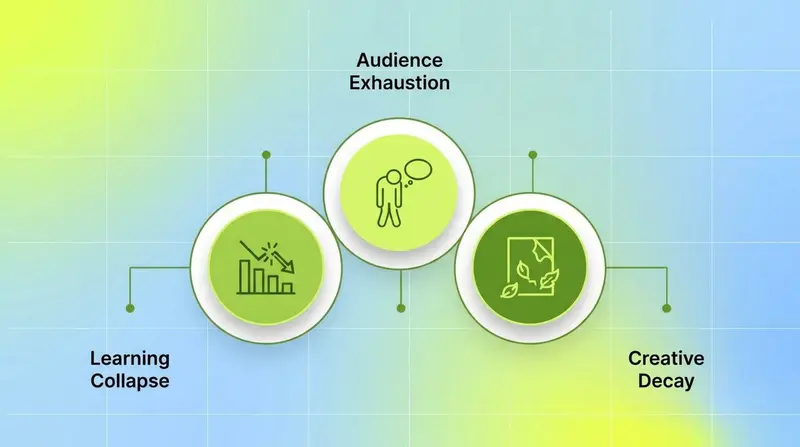
Cause 1: Learning-Phase Collapse (Thin Pixel Signal)
This is the most common cause. An ad set needs roughly 50 optimization events in a rolling 7-day window to exit the Learning phase, and that threshold is unchanged under Andromeda, per HyperFX. To hit it in seven days you need about 7 conversions per day. Many ad sets, especially those optimizing for a low-volume event like Purchase on a small budget, never get there.
When an ad set cannot reach the 50-event floor, it stays in Learning Limited, where delivery is less efficient and performance typically suffers 15 to 30 percent. The day-three death is the exploration burst ending without enough signal behind it. Meta spent broadly, found a few converters, then had no reliable pattern to scale into, so delivery degrades and your cost per result climbs.
A second trigger feeds this cause in 2026. Andromeda tightened what counts as a significant edit. Budget changes of 5 to 10 percent and even a single creative swap in a multi-creative ad set can now reset Learning, where it used to take a 20 percent budget change, according to HyperFX. If you tweaked the ad set on day two to scale the early winner, you may have reset the learning counter and caused the day-three collapse yourself.
Cause 2: Advantage+ Over-Concentration and Audience Exhaustion
The second cause looks like fatigue but is not. Advantage+ campaigns lean heavily on Meta's personalization layer, which is exactly what Andromeda re-architected, so they are the most disrupted campaign type during the 2026 rollout.
Andromeda is efficient at finding the exact pocket of users who respond to a specific creative. That efficiency has a cost. It exhausts that pocket faster than the old system did, because it found those people more precisely in the first place. A single concept can burn through its responsive audience in days when the pocket is small. The signature is a sharp CPM rise as the algorithm re-competes in the same narrow auction, paired with climbing frequency. Lookalike audiences below 2 to 3 million in major markets exhaust especially fast, since Andromeda's broader graph already covers similar users automatically, which makes narrow Lookalikes redundant.
The tell that separates this from creative fatigue is the CPM trajectory. Fatigue often shows CPM flat or slowly rising while CTR drifts down. Over-concentration shows CPM spiking hard and fast, because the system is paying more to keep reaching the same shrinking pool.
Cause 3: Genuine Creative Decay
Genuine creative decay is the least likely cause of a 3-day death, but it is not impossible. It happens when spend velocity is high enough or the audience is small enough that you actually saturate impressions inside 72 hours. Think of a tight retargeting pool getting hit with a large budget, where frequency climbs past 3 in two days.
The fingerprint of real fatigue is consistent across sources. CTR falls 20 to 30 percent from the creative's own baseline, frequency rises above 3 for prospecting, and CPM creeps up 15 to 25 percent over the period, according to operator diagnostics compiled by get-ryze and The Optimizer. Jon Loomer frames the threshold cleanly: an ad is in Creative Fatigue when its cost per result is at least twice what it has been historically, and Creative Limited when it is higher than before but less than double. If your numbers do not hit those marks and the death came at day three, look at causes one and two first.
The 3-Day Death Decision Tree
Run this tree top to bottom. It uses three observable signals: frequency, CPM trajectory over the first 72 hours, and CTR pattern. The first branch that matches is your most likely cause.
META ADS DIE AFTER 3 DAYS: DECISION TREE

START: Did the drop survive all 3 reality checks
(same-length window, attribution setting, third-party data)?
  NO  -> Reporting artifact. Do not touch the ad. Fix measurement.
  YES -> Continue.

Q1. Did the ad set get ~50 optimization events in the last 7 days?
  NO  -> Did you edit budget >5% or swap a creative in the first 48h?
           YES -> CAUSE 1: Learning reset. Learning-phase collapse.
           NO  -> CAUSE 1: Thin signal. Learning-phase collapse.
  YES -> Continue.

Q2. Did CPM rise more than 25% in the 72-hour window
    AND is frequency climbing?
  YES -> Is the audience a Lookalike or narrow saved audience
         under ~3M, or a tight retargeting pool?
           YES -> CAUSE 2: Audience exhaustion / over-concentration.
           NO  -> CAUSE 2 likely; check auction competition and seasonality.
  NO  -> Continue.

Q3. Is CTR down 20-30% from this creative's own baseline
    AND frequency above 3 AND cost per result near 2x its low?
  YES -> CAUSE 3: Genuine creative decay (rare at 3 days,
         usually high spend velocity or small audience).
  NO  -> Mixed or measurement signal. Re-run reality checks,
         widen the window, and watch hook rate before relaunching.
Threshold Table: What Each Number Means in the First 72 Hours
These thresholds are diagnostic shortcuts, not laws. Read them together, not in isolation. A single metric rarely confirms a cause on its own.

Action-by-Cause Cheatsheet
Once the decision tree points you to a cause, here is what to actually do. Matching the fix to the cause is the whole point, because the wrong fix wastes another three days.

How to Tell Creative Fatigue From a Delivery Problem
The hardest part of this diagnostic is that creative fatigue and delivery problems can produce similar surface symptoms. CPM and frequency live in the delivery layer and get noisy during the Andromeda rollout, where CPM can swing 30 to 60 percent week over week for reasons that have nothing to do with your creative. When the delivery metrics are unreliable, you need a signal that measures the creative directly.
Hook rate is that signal. It measures whether people still watch past the first few seconds, which reflects how the creative itself is performing independent of how the algorithm is spending. When hook rate holds steady but results drop, the creative is fine and your problem is delivery, which means cause one or cause two. When hook rate decays alongside results, you are looking at real creative fatigue.
This is where Segwise's creative fatigue tracking earns its place in the diagnostic. Segwise monitors creatives across all your networks for patterns of continuous performance decline and spend-share drop, and lets you set custom fatigue criteria such as a 20 percent ROAS decline over 7 days. Its hook-rate signals surface true creative decay separately from delivery issues, so a 3-day death gets attributed to the right cause instead of triggering a reflexive creative swap. Segwise also clusters creatives that share the same underlying assets, which isolates whether a specific hook or edit drove a performance difference or whether the delivery system was the variable the whole time.
Segwise connects to Meta, Google, TikTok, Snapchat, YouTube, AppLovin, Unity Ads, Mintegral, and IronSource, plus the MMPs AppsFlyer, Adjust, Branch, and Singular, so the fatigue picture is unified across every channel rather than stitched together from separate dashboards. Setup takes minutes and needs no engineering.
The Bottom Line
A Meta ad that dies after 3 days is sending you a delivery signal, not a creative one. The collapse is too fast to be fatigue, so the honest first move is to confirm the drop is real, then branch between learning-phase collapse, audience over-concentration, and the rarer case of genuine creative decay. The decision tree and threshold table above turn a vague "it stopped working" into a specific, fixable cause. Match the fix to the cause and you stop relaunching ads that were never the problem.
The teams that recover fastest in 2026 are the ones who can separate a creative problem from a delivery problem in minutes instead of days. That separation is exactly what creative intelligence is for. If you want to see hook-rate decay, fatigue patterns, and spend-share drops across all your networks in one place, so you always know whether the creative or the algorithm killed the ad, explore how Segwise gives teams that visibility and saves up to 20 hours per week of manual analysis.
Frequently Asked Questions
Why do my Meta ads die after 3 days?
A 3-day death is usually a delivery problem, not creative fatigue, because fatigue takes 5 to 14 days to set in. The most common causes are learning-phase collapse, where the ad set never gets the roughly 50 weekly conversions it needs to exit Learning, and audience over-concentration, where the algorithm burns a small pocket of responders in days. Confirm the drop is real first, then use a decision tree based on conversion volume, CPM trajectory, and frequency to identify the cause. Tools like Segwise help by tracking hook-rate decay, which shows whether the creative or the delivery system actually failed, something dashboards from Meta alone cannot isolate cleanly.
Is a 3-day ad death the same as creative fatigue?
No, and treating them as the same is the most common diagnostic mistake. Creative fatigue is a gradual decline that appears after roughly 5 to 14 days as an audience sees an ad too many times, while a 3-day death is too fast for an audience to wear out. A genuine fatigue fingerprint includes CTR falling 20 to 30 percent from baseline, frequency above 3, and cost per result near double its low. If those marks are not met at day three, the cause is almost always delivery, not the creative.
How do I know if my ad set is stuck in the learning phase?
Check whether the ad set is getting about 50 optimization events in a rolling 7-day window, which works out to roughly 7 conversions per day. If it is below that pace, it sits in Learning Limited, where delivery is less efficient and performance typically degrades 15 to 30 percent. Under Meta's Andromeda system, small edits like a 5 to 10 percent budget change or a single creative swap can also reset the learning counter, so an edit you made on day two can cause the day-three collapse.
What does a fast CPM spike in the first 72 hours mean?
A CPM rise greater than 25 percent inside 72 hours, paired with rising frequency, usually means audience exhaustion rather than creative fatigue. The algorithm found a narrow pocket of responders, spent into it efficiently, and is now paying more to keep reaching a shrinking pool. This is especially common with Lookalike or saved audiences under about 3 million in major markets. The fix is to broaden the audience and turn on Advantage+ expansion, not to swap the creative. Segwise can confirm this by showing whether hook rate held steady while CPM climbed, which points to delivery rather than the creative.
My ads worked for 3 days then died and I changed nothing, what happened?
If you genuinely changed nothing, the cause is usually structural rather than something you did. The exploration window most new ad sets get in their first 48 to 72 hours ended, and the ad set either lacked enough conversion signal to scale (learning-phase collapse) or concentrated on a pocket too small to sustain (audience exhaustion). In 2026 the Andromeda rollout makes both more frequent, since audiences exhaust faster and CPMs are more volatile. Run the reality checks, then the decision tree, before relaunching.
How many new creatives do I need to avoid this in 2026?
For accounts spending meaningfully on Meta, the 2026 guidance is 15 to 30 new creative variants per month, up from the 3 to 5 that worked under earlier algorithms, according to HyperFX. The higher volume feeds Meta's audience graph enough signal to keep delivery healthy and gives you replacements ready before fatigue sets in. Brand-aware AI creative generation, including Segwise's creative generation built on your winning patterns, makes that volume feasible without a proportional increase in production cost or time.
Can Segwise tell me which of the three causes killed my ad?
Segwise does not manage campaigns or bids, so it will not change delivery settings for you, but it isolates the creative variable so you can read the cause correctly. Its fatigue tracking and hook-rate signals show whether the creative itself declined or held steady, and its asset clustering compares creatives that share the same footage or audio to pinpoint what actually drove a performance difference. That lets you separate genuine creative decay from learning-phase collapse or audience exhaustion, which is the distinction the decision tree depends on.