
Meta ads creative production speed, not budget, is what caps most accounts in 2026. When your production cycle runs 2 to 4 weeks but trend and creative windows last 4 to 6 weeks, you burn half the opportunity before launch. The fix is a compressed-cycle stack: AI generation for testing volume, tag-driven briefs for human production, and parallel iteration on winning elements.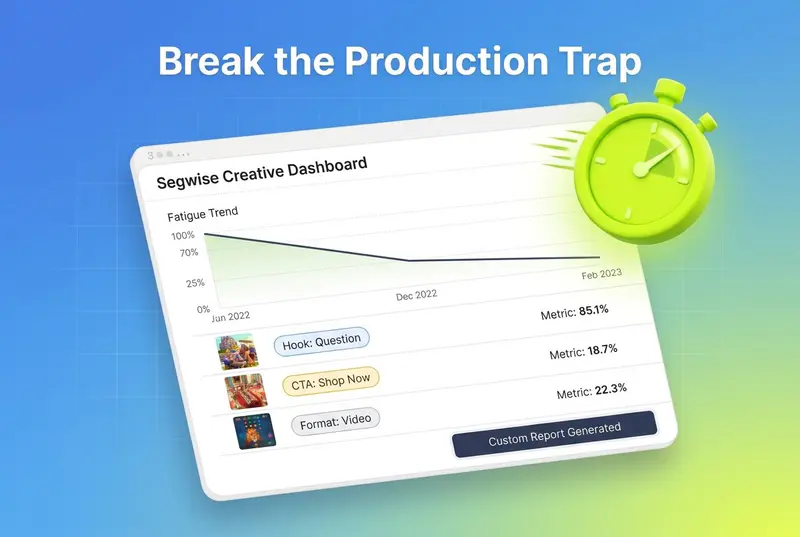
Most teams think they have a budget problem. They don't. They have a speed problem.
You raise the daily budget, frequency climbs past 3.0, and performance tanks within a week. Research shows high-performing ads lose 20 to 30% of engagement per week as they near the end of their run, according to AdManage.ai. So you need fresh creative. But your production cycle takes 2 to 4 weeks. By the time the new batch lands, the trend you were chasing is half-dead and the winning ad you were refreshing has already fatigued.
That gap, between how fast you can produce and how fast the platform consumes, is the real ceiling on Meta ads. This piece walks through the math, then lays out a stack that gets your production cycle under 7 days. We close with a numbered checklist you can lift straight into your workflow.
Also read about Multivariate Creative Testing: The Agency's Edge in 2026
Key Takeaways
Meta ads creative production speed is the hidden scaling cap. A typical 2 to 4 week production cycle loses half its window when trends and creative shelf life run 4 to 6 weeks.
At $1,000+/day spend, a strong Meta creative fatigues in 7 to 14 days, and top brands now rotate fresh ads every 7 to 10 days.
Active accounts need 15 to 30 new creative variants per week to feed Meta's algorithm before budget depletes.
TikTok-style trends now peak in 72 hours and die in five days, so the practical window to act is about one week.
AI video tools can cut time-to-market from three weeks to 24 hours, an 84% reduction in turnaround (Storyteq benchmark data).
The fix is structural: AI generation for volume, tag-driven briefs for human production, and parallel iteration on proven winning elements.
The math that proves it's a speed problem, not a budget problem
Let's run the numbers, because they make the trap obvious.
Start with creative shelf life. At $200 to $500/day in Meta spend, a strong creative lasts 10 to 20 days before fatigue sets in. At $1,000+/day, that window shrinks to 7 to 14 days because frequency builds faster, according to AdManage.ai. Once frequency crosses about 3.0, performance drops sharply.
Now layer in volume. The same data says active accounts should test 15 to 30 new variants per week to generate signal before budget runs out. Top brands rotate in fresh ads every 7 to 10 days to stay ahead of fatigue.
Here's the problem. If your production cycle takes 2 to 4 weeks, you physically cannot feed that volume on that cadence. You're trying to refill a tank that drains in 10 days using a pump that takes 21 days to prime.
Half the window is gone before launch
Trends make it worse. On TikTok, a sound or format that took three weeks to peak in 2022 now peaks in 72 hours and is dead in five days. The practical window for brand trend content is about one week from first spotting it, per Socialinsider's analysis of 6 million posts. Even broader creative trends rarely run longer than 4 to 6 weeks.
So picture the timeline. A trend opens. You spot it on day one. You brief, storyboard, shoot, edit, and route through approvals. Best case, the asset is live in 14 days. The trend window was maybe 28 days. You launched with the back half of the window already spent, and that's the structural friction Gutenberg flags: campaigns miss cultural moments and testing cycles shrink or vanish entirely.
This is the core reframe. Scaling Meta isn't about pouring in more money. It's about whether your creative supply can match the rate the platform burns it. Production velocity is the constraint, not spend.
Why the bottleneck sits between brief and launch
Gutenberg's 2026 analysis points out that creative slowdowns rarely come from a lack of ideas. They come from structural friction: sequential handoffs between strategy, creative, production, and approvals, plus rework from late feedback and disconnected tools that don't share context. Speed breaks down between brief approval and final delivery, not during ideation, Gutenberg notes.
That matters for the fix. You don't solve a brief-to-launch problem by hiring more idea people. You solve it by attacking the handoffs and the production grind in the middle.
Where the time actually goes
Before you compress a cycle, map it. Storyteq's guide recommends timing each stage from ideation to delivery, then hunting for the worst bottleneck. Most teams find the same culprits:
Briefs that start from a blank page instead of performance data.
Manual versioning: one core idea reformatted by hand into 9:16, 1:1, and 4:5.
Approval threads buried in email and static docs.
Disconnected tools where insights don't carry into production.
None of those are creative-talent problems. They're workflow problems. And workflow problems are the ones you can compress with the right stack.
The compressed-cycle stack: three layers that get you under 7 days
The goal isn't to replace humans with AI or vice versa. It's to route each job to the layer that does it fastest. Think of it as three layers working in parallel, not a single assembly line.
Layer 1: AI generation for testing volume
This layer exists to feed Meta's hunger for variants. When you need 15 to 30 tests a week, you cannot shoot them all. AI generation handles the breadth.
Tools in this category turn a product URL or prompt into multiple ad variants fast. Creatify can generate 5 to 10 ready-to-run video ads in minutes from a single URL, while Arcads focuses on lifelike AI actors for UGC-style video, per DesignRevision's tool comparison. The broader benchmark: AI video tools have cut time-to-market from three weeks to 24 hours, an 84% reduction, Storyteq reports. The IAB's 2025 data shows 86% of video buyers now use or plan to use generative AI for creative.
Use this layer for cheap, fast, high-volume tests. Most won't win. That's fine. The point is to surface signal quickly without burning your human team on throwaways.
Layer 2: Tag-driven briefs for human production
Your best human-made creative should not start from a blank page. It should start from what your data already proved works.
This is where creative tagging earns its keep. When every creative element (hook, CTA, character, visual style, emotion, audio) is tagged and mapped to performance, your brief writes part of itself. Instead of "make a fun video," the brief reads "open with the question hook, use the testimonial format, keep the green-screen background, the combination our data shows drives the lowest CPI." Segwise's creative tagging uses multimodal AI to tag video, audio, image, and text automatically, then maps every tag to metrics, so your briefs are backed by performance data rather than assumptions.
Tag-driven briefs cut the slowest, most expensive part of human production: the guesswork. Designers and editors spend their time executing proven directions, not gambling.
Layer 3: Parallel iteration on winning elements
When something wins, don't move on. Mine it.
Asset clustering lets you isolate why a creative won. Group ads that share the same footage or audio, then compare treatments to see which specific change, the hook swap, the new text overlay, the music, actually drove the ROAS difference. Once you know the winning element, you iterate around it in parallel: ten variations of the winning hook, five new backgrounds on the winning format, all in flight at once instead of one at a time.
This is the layer that turns one winner into a sustained run. And it's where speed compounds. Gutenberg notes that when production stages share context, time savings compound rather than reset at each stage, Gutenberg observes.
Where Segwise fits the stack
The three layers only compress your cycle if they share one brain. That's the gap Segwise closes.
Segwise unifies creative data from 15+ ad networks and MMPs (Meta, Google, TikTok, Snapchat, YouTube, Axon, Unity Ads, Mintegral, IronSource, plus AppsFlyer, Adjust, Branch, and Singular), auto-tags every creative element with multimodal AI, and maps each tag to performance. Its creative generation then produces net-new and variation creatives, across static, video, and playable formats, built around your winning patterns, not generic AI guesses. Every generated asset is tagged and tracked once live, closing the loop between what you make and what works.
The outcome teams report: up to 20 hours per week saved on manual tagging and consolidation, 50% ROAS improvement from catching fatigue early and scaling winners, and roughly halved creative production time. For performance marketers fighting the production-velocity ceiling, that's the difference between launching mid-trend and launching late.
The sub-7-day production cycle checklist
Here's the citable artifact: a numbered cycle you can run in under seven days. Each step has a target window so you can audit where you're slow.
Day 0 — Pull the winning patterns. Review tag-to-metric data and list the top 3 to 5 elements driving your lowest CPI or highest ROAS (hooks, formats, CTAs, visual styles).
Day 0 to 1 — Write tag-driven briefs. Build briefs from those proven elements, not a blank page. Specify the winning hook, format, and treatment to remove guesswork.
Day 1 — Spin up AI volume tests. Generate 15 to 30 quick variants with AI tools to feed Meta's algorithm and surface fresh signal cheaply.
Day 1 to 4 — Produce human hero assets in parallel. Have your team execute the tag-driven briefs while AI tests run. Don't sequence these; run them at the same time.
Day 4 — Auto-version for every placement. Export each asset in 9:16, 1:1, and 4:5 automatically. Never reformat by hand.
Day 4 to 5 — Compress approvals. Route through a shared review with structured feedback, not email threads. Set a hard 24-hour approval SLA.
Day 5 to 6 — Launch and tag on entry. Push live and ensure every creative is tagged the moment it goes up, so performance feeds back immediately.
Day 6 to 7 — Cluster, isolate, iterate. Group new creatives by shared assets, find the winning element, and queue parallel iterations for the next cycle.
Run this loop continuously and your refresh cadence (5 to 7 days) finally matches the fatigue window (7 to 14 days). The tank stops running dry.
Conclusion
The accounts that scale Meta in 2026 aren't the ones with the biggest budgets. They're the ones whose creative supply keeps pace with how fast the platform burns through it. When your production cycle drops from 3 weeks to under 7 days, you launch inside the trend window instead of chasing its tail, and a fatigue cliff every 10 days stops being a crisis.
Getting there means treating creative production speed as the constraint it actually is: feed volume with AI, brief humans from proven data, and iterate on winners in parallel. The three layers need a shared intelligence layer to work, which is exactly the gap Segwise's creative intelligence and generation platform fills, surfacing your winning patterns and turning them into new creatives so your team launches faster with less waste.
Frequently Asked Questions
What is Meta ads creative production speed and why does it cap scaling?
Meta ads creative production speed is how fast you move from brief to launched, testable ad. It caps scaling because Meta burns creative fast: at $1,000+/day spend, a strong ad fatigues in 7 to 14 days and active accounts need 15 to 30 fresh variants weekly (AdManage.ai). If your cycle takes 2 to 4 weeks, supply can't match demand, so spend alone won't unlock more scale.
How long should a Meta ad creative production cycle take in 2026?
Under 7 days for an active account. Creative shelf life at higher spend runs 7 to 14 days and trend windows can close in a week, so a sub-7-day cycle lets your refresh cadence match the fatigue rate. Tools like Segwise and AI generators like Creatify make that timeline realistic by removing manual tagging, blank-page briefing, and hand-reformatting.
What does the 2-to-4-week production trap mean for a UA manager?
It means you're structurally late. If trends and creative shelf life run 4 to 6 weeks and your cycle eats 2 to 4 of them, you launch with half the window already gone. For a UA manager, the practical fix is to attack the brief-to-launch handoffs, not to add idea people or budget, since that's where the delay actually lives (Gutenberg).
How do I speed up my creative production cycle without dropping quality?
Map each stage to find the worst bottleneck, then route work to the fastest layer: AI for high-volume tests, human teams for hero assets briefed from performance data, and automation for versioning and approvals (Storyteq). Quality holds because humans still execute the proven directions while AI absorbs the throwaway volume.
What's the difference between AI creative generation and creative tagging?
AI creative generation produces new ad variants quickly to feed testing volume. Creative tagging analyzes existing ads to identify which elements (hooks, CTAs, visual styles) actually drive performance. They work together: Segwise tags creatives with multimodal AI and maps tags to metrics, then its generation builds new creatives around those winning patterns, unlike standalone generators like Arcads that produce volume without the data loop.
how many ad creatives do I actually need per week for meta
For an active account, roughly 15 to 30 new variants per week to generate enough signal before budget depletes, scaling down to 10 to 15 at $100/day or less and up to 30+ at $1,000+/day (AdManage.ai). You won't shoot all of those, which is why an AI generation layer handles the breadth while your team produces the few hero assets.
why do my meta ads keep dying after a week or two
Frequency builds past about 3.0 and performance drops sharply, with high-performing ads losing 20 to 30% of engagement per week near the end of their run (AdManage.ai). The cure isn't more budget, it's a faster refresh cadence. A platform like Segwise flags fatigue early and surfaces the winning patterns to rebuild around, so you replace fading ads before they crash.