
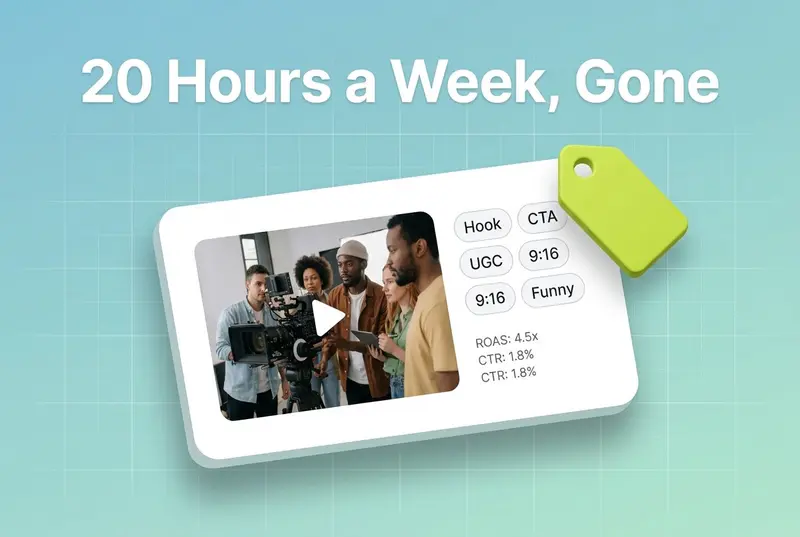
Manual creative tagging means a human watches every ad and types its elements into a spreadsheet by hand, while automated creative tagging uses multimodal AI to label those same elements across thousands of creatives in the background. The practical difference is time: rigorous manual tagging can eat 20 or more hours a week per app or brand, which is exactly why most teams quietly stop doing it. Segwise removes that cost by tagging every video, audio, image, text, and playable element automatically and mapping each tag to performance.
Here is the uncomfortable part. Almost every performance team agrees that knowing which creative elements drive results is the whole game. Nielsen has shown strong creative can account for up to 89% of a digital campaign's in-market success, and a 2024 analysis covered by Marketing Charts found creative is still the single biggest driver of sales. Yet the work that would tell you which creative elements actually matter, tagging them so you can group and compare, is the work teams skip first.
They skip it because doing it by hand is miserable. Someone has to open each ad, watch it, decide what the hook is, what the CTA is, what the visual style is, and write all of that into a sheet. Multiply by hundreds of creatives a month and you have a part-time job nobody wants. So the tagging either gets done badly, gets done by one overworked person, or does not get done at all.
This post breaks down manual versus AI creative tagging honestly: what each actually involves, where the real time goes, what consistency and scale do to your data, and how to decide which approach fits your team. The short version is that manual tagging is fine until volume catches up with you, and for most teams running paid social in 2026, volume already has.
Key takeaways
- Manual creative tagging means labeling every ad's elements by hand in a spreadsheet; automated creative tagging uses multimodal AI to do it continuously across all your creatives.
- Done rigorously, manual tagging can cost 20 or more hours a week per app or brand, which is why most teams either hire for it or stop doing it.
- Creative is the biggest driver of ad performance, with Nielsen attributing up to 89% of digital in-market success to strong creative, so the tagging that explains your creative is high-value work most teams underinvest in.
- The hidden cost of manual tagging is not just hours, it is inconsistency: two people tag the same hook differently, and the analysis quietly becomes unreliable.
- AI tagging scales without adding headcount, stays consistent across thousands of creatives, and is the only way Segwise tags playable ads at all.
- Manual tagging makes sense at very low volume; past a few hundred creatives, automated creative tagging is the only approach that holds up.
What is creative tagging, and why does it matter?
Creative tagging is the practice of labeling each ad by its component parts: the hook, the CTA, the characters, the visual style, the on-screen text, the audio, the format, the offer. Those labels, or tags, are what let you stop analyzing ads one at a time and start analyzing them as patterns.
Without tags, your reporting can only tell you that creative number 4,817 returned a 2.3x ROAS. With tags, you can ask a different question: do all my talking-head hooks beat my text-on-screen hooks, do discount CTAs convert worse than social-proof CTAs, is one visual style quietly carrying half my return. Tags turn a pile of individual ads into a readable map of what your audience responds to.
That map is worth a lot, because creative is where performance is won now. The platforms automated targeting and bidding, so the creative became the main variable a human still controls. Research backs this up repeatedly. Marketing Charts reports creative remains the biggest single contributor to ad effectiveness, and Nielsen's work points the same direction. If creative drives the result, then tagging, the thing that explains your creative, is the most leveraged reporting you can do. The problem has never been whether it is worth doing. The problem is how to do it without burning a person's entire week.
How manual creative tagging actually works
Manual tagging is exactly what it sounds like. A person opens an ad, watches or studies it, decides what each element is, and records it. Usually that lands in a spreadsheet or a naming convention, sometimes in a homegrown tool.
The workflow looks something like this. You export your creatives and their performance data from each ad network. You open each one. You watch the first three seconds and decide the hook type. You note the format, the CTA, the visual style, the offer, maybe the emotional tone. You type all of that into a row. You repeat for the next ad. Then you reconcile it against the performance export, because the network's creative IDs rarely match cleanly across tools.
For a handful of creatives, this is fine. A solo media buyer with ten ads can tag them in an afternoon and learn something real. The trouble starts when the workflow has to survive scale, and almost every paid social program scales.
Where the time actually goes
The hours are not in any single ad. They are in the repetition and the reconciliation. Watching one video and tagging it might take two or three minutes. Doing that for 300 creatives is 15 hours before you have done any analysis. Add the data consolidation across Meta, TikTok, Google, and your MMP, where every platform names and structures things differently, and the week is gone.
Teams that do this seriously report spending 20 or more hours a week per app or brand on tagging alone. That is half a full-time role, spent on data entry rather than strategy. As volume climbs, that number climbs with it, until the team either hires specifically for tagging or stops tagging entirely. Both are bad outcomes. One adds cost, the other blinds you to your own creative performance.
How AI creative tagging works
Automated creative tagging replaces the human-watching-every-ad step with multimodal AI. Instead of a person deciding what the hook is, a model analyzes the creative across every modality and tags the elements itself, continuously, as new creatives go live.
Multimodal matters here, because an ad is not one thing. Segwise's Creative Tagging Agent analyzes video, audio, image, and text together. On the video side it tags visual elements, character traits, scene changes, on-screen text, pacing, and visual styles. On audio it transcribes and tags spoken dialogue, hook lines, voiceover styles, and music. On images it tags colors, compositions, characters, products, and emotions. On text it pulls out headlines, CTAs, and benefit statements. Most tools handle one modality. Segwise handles all of them in one pass.
It also tags formats other tools cannot touch. Segwise is the only platform that tags playable (interactive) ads, which is a real gap for mobile gaming advertisers whose best-performing creatives are often the playables. And every tag is automatically mapped to performance metrics, so a tag like "UGC hook" arrives already connected to its ROAS, hook rate, and CVR across every creative that used it. That tag-to-metric mapping is the whole payoff. It is what turns labeling into insight without anyone building a pivot table.
Because it runs continuously across 15+ ad networks and MMPs, the analysis that took a team 20 hours a week happens in the background instead. The team's time goes back to deciding what to make, not recording what they already made.

Manual vs AI creative tagging: the real differences
Put the two side by side and the contrast is not subtle. The trade-offs cluster around four things: time, consistency, scale, and coverage.
Time. Manual tagging costs real human hours that grow linearly with creative volume. AI tagging costs roughly the same whether you run 50 creatives or 5,000, because the model does not get tired or fall behind. This is the heart of the 20-hours-a-week problem: manual effort scales with your output, automated effort does not.
Consistency. This is the cost people forget. Two humans tag the same creative differently. One calls it a "product demo," another calls it a "feature showcase." One tags the tone as "aspirational," another as "positive." Those small inconsistencies compound across thousands of rows until cross-creative analysis stops meaning anything. AI applies the same logic every time, so a "talking-head hook" is the same thing in January and in June, across every analyst on the team.
Scale. Manual tagging has a hard ceiling. Past a few hundred creatives, it is simply not sustainable for a human to keep current, especially across multiple platforms and apps. AI tagging has effectively no ceiling. Segwise handles thousands of creatives across a Studio View of multiple apps and brands without adding manual work.
Coverage. Humans can technically tag any format, but in practice they skip the hard ones, and playable ads are the hardest. They are interactive, so there is no single frame to look at. Automated tagging closes that gap, and Segwise is the only platform that tags playable ads.
The honest exception is the very small end. If you run a tiny number of creatives and rarely add new ones, manual tagging is genuinely fine, and standing up any tool is overkill. But that describes very few paid social programs in 2026.
The hidden cost: it is not just the hours
The easy way to frame this is hours saved, and the hours are real. But the deeper cost of manual tagging is what bad or missing tags do to every decision downstream.
When tagging is inconsistent, your analysis lies to you quietly. You group by a tag and the group is contaminated, so the pattern you think you found is partly an artifact of how two people labeled things on different Tuesdays. You scale a "winning element" that was never actually winning. That is worse than no tagging, because it carries false confidence.
When tagging gets skipped under deadline pressure, which is what usually happens, you fall back to gut feel. You brief the next creative round on instinct instead of data, in the one part of the funnel that research says drives the most performance. The platforms will happily spend your budget on whatever you give them. They will not tell you why the winners won.
And when one person owns tagging manually, the knowledge lives in their head and their spreadsheet. They go on vacation, or leave, and the institutional memory of what works walks out with them. Automated tagging keeps that knowledge in the platform, consistent and queryable, so the always-on Creative Strategy Agent can answer "which hook style drove the most installs last month" in plain language instead of someone rebuilding the analysis from scratch.

When does manual tagging still make sense?
It is not always wrong. Manual tagging holds up in a few specific situations, and it helps to be honest about them.
- Very low volume. A handful of creatives, rarely refreshed. The overhead of any tool is not worth it yet.
- A brand-new account. Before you have enough creatives or spend history for patterns to mean anything, hand-tagging your first dozen ads can build intuition.
- A highly specialized taxonomy. If your business needs a tag so unusual that no model is trained for it, a human in the loop may be required, though custom tags in a good platform cover most of this.
For nearly everyone else, the volume that makes tagging valuable is the same volume that makes manual tagging impossible. That is the trap. The accounts that would learn the most from creative tags are exactly the accounts producing too many creatives to tag by hand. Automated creative tagging is what resolves it.
How to move from manual to automated tagging
If you are tagging by hand today and want off that treadmill, the transition is not complicated.
- Audit what you tag now. List the elements you actually use in decisions: hook type, format, CTA, visual style, offer, audio. This becomes your taxonomy, and it is usually smaller than people expect.
- Unify your sources first. Connect every ad network and MMP into one view before you tag, so you are not tagging the same creative differently across platforms. With Segwise this is no-code and takes minutes, with historical data imported automatically (up to 14 days on the free trial, up to 3 months for paid customers).
- Let the AI tag automatically, then add custom tags. Multimodal tagging covers the standard elements out of the box. Layer your brand-specific custom tags on top for the variables unique to your business.
- Map tags to your real outcome. Connect each tag to creative-level ROAS or CPI through your MMP, not just clicks, so you are reading revenue and not vanity metrics.
- Review by element, then brief from it. In your weekly review, group performance by tag across the whole account, find what repeats in winners, and brief the next round from that. The point of getting the hours back is to spend them here.
Conclusion
The manual versus AI creative tagging decision comes down to a question every performance team eventually faces: is tagging worth a human's week, every week, forever. At low volume the answer can be yes. At the volume most paid social programs run in 2026, the honest answer is no, and the teams pretending otherwise are usually the ones who quietly stopped tagging months ago.
Creative is the biggest lever you have, and tags are how you pull it deliberately instead of by feel. The reason most teams underinvest in tagging is not that they doubt its value. It is that the manual version costs too much, in hours and in consistency, to sustain. Automating it removes the cost without removing the insight.
If you want the creative intelligence that tagging unlocks without the 20 hours a week it usually demands, Segwise unifies your creative data across 15+ networks and MMPs, tags every element with multimodal AI including playable ads, and maps it all to performance, saving teams up to 20 hours a week and helping them improve ROAS by up to 50%. It is the difference between tagging being a chore you skip and creative intelligence being something you actually have. This connects back to the broader creative tagging guide if you want the full picture, and to what creative tagging is if you are starting from scratch.
Frequently asked questions
What is the difference between manual and AI creative tagging?
Manual creative tagging is when a person watches each ad and records its elements, like the hook, CTA, and visual style, into a spreadsheet by hand. Automated creative tagging uses multimodal AI to label those same elements across all your creatives continuously, without a human reviewing each one. The core difference is that manual tagging costs human hours that grow with your creative volume, while AI tagging stays consistent and scales without adding headcount. Segwise's Creative Tagging Agent does this across video, audio, image, text, and playable ads, then maps each tag to performance.
How many hours does manual creative tagging actually take?
Tagging a single video by hand takes only a few minutes, but the cost is in the repetition and the data reconciliation across platforms. Teams that tag rigorously report spending 20 or more hours a week per app or brand, which is effectively half a full-time role spent on data entry instead of strategy. As creative volume grows, that number grows with it, which is why most teams either hire for tagging or stop doing it.
Is AI creative tagging accurate enough to trust?
For the standard creative elements, multimodal AI is both more consistent and more scalable than manual tagging, because it applies the same logic to every creative rather than relying on different people's judgment on different days. That consistency is often where it beats humans, since manual tagging drifts as two people categorize the same hook differently. For business-specific variables, platforms like Segwise let you define custom tags on top of the automated ones, so you get coverage without sacrificing accuracy.
Can AI tag playable ads and video, or only static images?
Multimodal AI tags across formats, not just static images. Segwise analyzes video (visual elements, scenes, on-screen text, pacing), audio (dialogue, hook lines, music), images, and text together in one pass. It is also the only platform that tags playable (interactive) ads, which matters for mobile gaming advertisers whose top creatives are often playables that manual tagging struggles to handle.
When should my team still tag creatives manually?
Manual tagging makes sense at very low volume, on a brand-new account with little spend history, or when you need a taxonomy so specialized that no model is trained for it. For everyone else, the volume that makes tagging valuable is usually the same volume that makes doing it by hand unsustainable. Past a few hundred creatives across multiple platforms, automated creative tagging is the only approach that stays current and consistent.
we keep skipping creative tagging because we dont have time, whats the fix?
That is the most common reason teams skip it, and it is exactly the problem automation solves. The fix is to stop tagging by hand and let multimodal AI tag every creative continuously in the background, so the analysis runs without anyone setting aside hours for it. Segwise connects to your ad networks and MMPs with no-code setup in minutes, tags everything automatically, and maps each tag to performance, so creative intelligence becomes something you have rather than a task you keep postponing.