
Updated August 2026.
Cutting your creative production cost per ad is not about choosing AI over human creators. It is about routing each job to the cheapest mode that can do it: AI generation and in-house phone footage for cold hook tests, human UGC for scaling proven winners, and AI-assisted edits for evergreen refreshes. Teams that mix modes this way report production costs dropping 60 to 77% while finding more winners per cycle. Segwise's creative tagging makes the mix tractable by mapping every winning creative element back to the production mode it came from.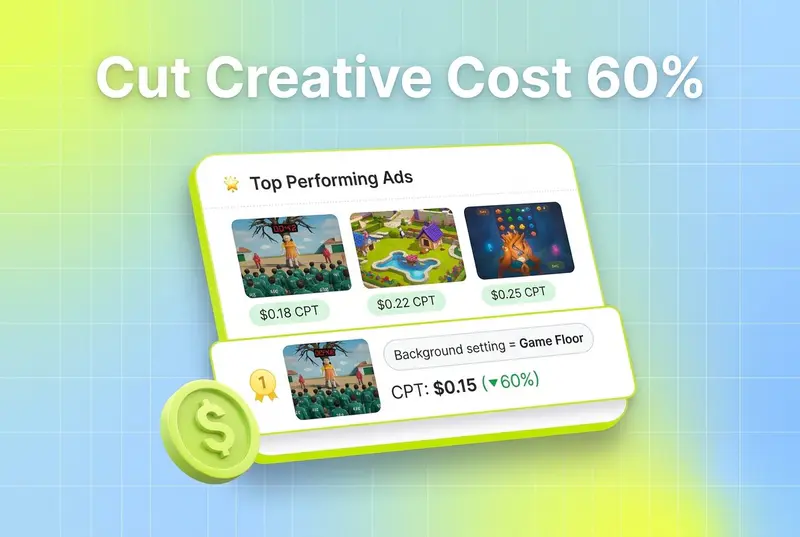
Most teams overpay for creative because they use one production mode for every job.
They commission a $300 to $400 human UGC video to test a hook that has a one-in-ten chance of working. Then they commission another one to refresh a winner that just needed a new opening line. The talent is fine. The math is broken. You are paying scaling-grade production prices for testing-grade work.
The fix is a hybrid stack. You match the production mode to the job, based on how much money rides on the creative and how much authenticity it actually needs. A cold hook test needs volume and speed, not a polished creator. A creative you are about to put $5,000 a day behind needs authenticity that AI cannot fully fake yet. Those are different jobs, so they should not cost the same.
This piece breaks down the real per-video creative production cost for ads by mode, gives you a decision matrix for which slot each mode fills, and lays out a 30-day production calendar that hits 15 to 20 tests a month without blowing the budget.
Also read about Seedance 2.5: What It Changes for Ad Creative Teams
Key Takeaways
Traditional human UGC runs $150 to $400 per video for the base fee, and $500 to $2,000 all-in once you add usage rights, revisions, and shipping
AI-generated UGC costs roughly $3 per video at scale, and $50 to $200 for higher-end output
A $100K, 220-video test cut monthly production cost from $9,600 to $2,200, a 77% drop, while lifting winners per cycle from 2-3 (human-only) to 5-7 (hybrid)
Human creative still wins on attention (2.4% CTR vs 1.9% for AI), but AI wins on ROAS (2.8x vs 2.3x) because each cheap video needs far less revenue to pay back
The market average for a UGC deliverable fell to about $198 in 2025/2026, down 44% from 2024
The lever that matters is cost per winning video, not cost per video. Spread your spend across modes by job, and track which mode produced each winning element.
Why per-video cost is the wrong number
Start with the number everyone quotes and why it misleads.
A single human UGC video looks like it costs $150 to $300. That is just the base creator fee, according to Superscale. The real all-in number is higher. Usage rights for paid ads add 30 to 50%. Whitelisting through the creator's handle adds about 30% per month. Raw footage access adds another 30 to 50%. Rush delivery adds 25 to 50%. Revisions beyond the first round run $25 to $75 each.
Superscale's own calculator for a 20-video month lands near $5,980 all-in before any agency or marketplace markup. DesignRevision puts the same picture in sharper terms. One realistic 15-variant test campaign with mid-tier creators and full add-ons comes to $13,860, per their breakdown.
Here is the deeper problem. Per-video cost is the wrong denominator. What you actually care about is cost per winning video.
APXlab frames it cleanly. Produce 3 traditional UGC videos for $4,500 and land 1 winner, and your cost per winner is $4,500. Produce 30 AI videos for the same $4,500 and land 5 winners, and your cost per winner drops to $900, according to APXlab. Same budget, five times the winners. The cheap video does not need to be as good. It needs to be good enough to generate signal, because you are running so many of them.
That reframe is the whole game. Cutting creative production cost for ads is not about finding a cheaper creator. It is about not spending scaling money on testing work.
The cost table by production mode
Here is what each production mode actually costs per video, all-in, and what you get for it. This is the table to bookmark.
A few notes on reading this table.
In-house phone-shot has no clean per-video dollar figure because the cost is your team's time, not cash out the door. That is exactly why it is useful for testing. A founder or an employee filming a 20-second hook on a phone costs nothing but an hour. For a cold test, that is often all you need.
AI generation splits into two tiers. Budget models produce talking-head video for under a dollar to about $5 per clip, according to inReels. Higher-end performance creative runs $50 to $200, per APXlab. For pure hook stress-testing, the budget tier is enough.
AI-assisted edits are the most underrated line. Once you own raw footage, whether from a phone shoot or a creator, cutting new variants costs almost nothing. You swap the hook, change the CTA, re-caption, and re-pace. You are testing variables, not reshooting videos.
The 50-ad reality check - testing 50 ad variants with human creators costs $5,000 to $15,000. The same 50 variants generated with AI cost $30 to $250, . At testing volume, the gap is not a discount. It is a different category of spend.
The decision matrix: which mode fills which slot
Cost is only half the decision. The other half is the job. Match the mode to the slot using how much spend rides on the creative and how much authenticity it needs.
Read it as three rules.
Test cold ideas with the cheapest mode that produces watchable video. That is AI generation, backed by in-house phone footage when you want a real face. You are buying information at a few dollars per data point, as APXlab puts it, not betting budget on an untested concept.
Scale winners with human creators. Once a hook proves itself, authenticity starts to matter, because frequency rises and viewers see the ad more often. This is where the $300 to $400 creator video earns its keep, per aubado's finding that human creative leads on click-through. You are no longer gambling. You are scaling a proven concept.
Refresh evergreens with edits. A winner that is starting to fatigue rarely needs a new concept. It needs a new opening line, a different first three seconds, a re-cut. AI-assisted edits on existing footage do this for almost nothing.
The AI clone shortcut between slots
There is a bridge between the testing slot and the scaling slot worth naming. aubado calls it the AI clone technique, and it was the turning point in their $100K test.
Take a human creative that performed well. Break it into parts: the hook, the narrative, the proof points, the CTA, the pacing. Recreate that exact structure with an AI avatar. Same hook, same arc, different face, as aubado describes it. If the AI clone performs nearly as well, the message is the winner and you scale variations cheaply. If it tanks, the human delivery was the key factor, and you know to invest in that specific creator.
This tests message versus messenger for a few dollars. It tells you whether you are paying for the script or the person, which is the most expensive thing to guess wrong.
What you actually save: the hybrid math
The savings are not theoretical. aubado ran 220 video creatives across three months on $100K of Meta spend: 134 AI-generated and 86 human UGC.
The headline is the cost line. Monthly production cost dropped from $9,600 to $2,200, a 77% reduction, according to aubado. Winners per cycle rose from 2 to 3 (human-only) up to 5 to 7 (hybrid). Human creative held a CTR edge at 2.4% versus 1.9%, but AI delivered higher ROAS at 2.8x versus 2.3x, because a $3 video needs far less revenue to pay back than a $300 one.
Note what did not happen. Quality did not collapse. The hybrid approach kept human authenticity exactly where it mattered, on the scaling creatives, and used cheap modes only for discovery. The documented savings range from about 60% at the conservative end to 77% in aubado's test. Either way, you did not make worse ads. You stopped buying expensive ads for cheap jobs. That is the cost cut without killing quality.
This is the reframe again, in case it slipped past. The teams winning on creative cost in 2026 are not the ones who picked a side. They are the ones who route each job to the right mode and measure cost per winner, not cost per video.
A 30-day production calendar that hits 15 to 20 tests
Knowing the modes is one thing. Running them on a cadence is another. Here is a template calendar that produces 15 to 20 tests a month. Adapt the volumes to your spend.
Week 1: Generate at volume. Produce 8 to 10 AI-generated hook tests, each testing a different angle or opening. Shoot 2 in-house phone concepts for a real-face variant. Launch all of them on modest budgets. The goal is signal, not scale. Running tally: about 10 tests.
Week 2: Kill fast, then iterate. Within 48 to 72 hours, cut everything not beating baseline, as aubado recommends. Take the 2 to 3 early signals and cut 4 to 5 AI-assisted edit variants from them: new hooks, new CTAs, re-pacing. Add 2 fresh AI hook tests. Running tally: about 16 tests.
Week 3: Clone and brief. Apply the AI clone technique to your top performers to separate message from messenger. Brief 2 to 3 human UGC creators on the proven winning structures, not on guesses. Launch 3 to 4 more AI variants while the human videos are in production. Running tally: about 19 tests.
Week 4: Scale and refresh. The human hero recreations land this week; put real budget behind them. Refresh your current evergreen winner with 3 to 4 AI-assisted edits to extend its life before fatigue. Plan next month's angle list from what you learned. Running tally: 15 to 20 quality tests for the month, with the expensive mode used only on validated concepts.
The cadence matters because creative fatigues fast. Ads start losing steam in 7 to 10 days on Meta and TikTok, according to inReels. A 1 to 3 week human-only production cycle leaves you permanently behind. The hybrid calendar keeps fresh tests flowing while reserving slow, expensive production for the few creatives that have earned it.
Where Segwise fits
The hard part of running a multi-mode stack is not the production. It is knowing which mode produced each winning element, so you know where to spend next month.
When your hooks come from AI generation, your scaling videos from human creators, and your refreshes from edits, the winning attributes get scattered across modes. Without a system, you cannot tell whether your best-performing hook style came from a $3 AI clip or a $400 creator. So you cannot route next month's budget intelligently.
This is what Segwise's creative tagging solves. Its multimodal AI automatically tags every creative element, hooks, CTAs, characters, visual styles, on-screen text, and audio, then maps each tag to performance metrics. Its asset clustering groups creatives that share underlying footage, so you can isolate which specific treatment drove a ROAS difference. You see, at the tag level, which production mode each winning attribute came from. That makes the mode-mixing tractable instead of a guessing game.
Segwise unifies creative data across 15+ ad networks and MMPs, including Meta, Google, TikTok, Snapchat, YouTube, AppLovin, Unity Ads, Mintegral, and IronSource, plus AppsFlyer, Adjust, Branch, and Singular. Teams using it report saving up to 20 hours per week on manual tagging and consolidation, and up to 50% ROAS improvement from catching what works early.
Conclusion
Cutting creative production cost for ads in 2026 comes down to one discipline: stop paying scaling prices for testing work. Route cold hook tests to AI generation and in-house footage, scale proven winners with human creators, and refresh evergreens with cheap edits. The $100K data shows this cuts production cost by up to 77% while finding more winners, because you are optimizing cost per winning video instead of cost per video.
The piece you cannot skip is measurement. A hybrid stack only pays off if you know which mode produced each win, so you can double down on what works. Segwise's creative intelligence platform tags every element across every mode and network, surfaces your winning patterns, and even generates new creatives grounded in them, so your production budget follows the data instead of habit.
Frequently Asked Questions
How much does creative production cost per ad in 2026?
A human UGC video costs $150 to $400 for the base fee and $500 to $2,000 all-in once you add usage rights, revisions, and shipping, according to APXlab. AI-generated video runs roughly $3 per clip at the budget tier and $50 to $200 at the premium tier. The market average for a single UGC deliverable is about $198, per DesignRevision. The right number to track is cost per winning video, not per video. Tools like Segwise tag each creative and map it to performance so you can see which spend actually produced winners.
What is hybrid creative production?
Hybrid creative production means using different production modes for different jobs instead of one mode for everything. You generate cold hook tests with AI and in-house phone footage, scale proven winners with human UGC creators, and refresh evergreens with AI-assisted edits. A $100K test by aubado found this hybrid approach cut production cost 77% and roughly doubled winners per cycle versus human-only production. Segwise supports the model by tracking which mode each winning creative element came from.
Is AI UGC cheaper than hiring creators?
Yes, dramatically, at testing volume. Testing 50 ad variants costs $5,000 to $15,000 with human creators versus $30 to $250 with AI, according to inReels. But human creators still lead on attention metrics, so the smart play is AI for discovery and humans for scaling proven winners. Segwise and analytics platforms like it help by showing whether your AI clips or human videos actually drove the wins, so you spend on the mode that performs.
How do I cut creative production cost without hurting quality?
Stop using expensive production for cheap jobs. Most teams overspend by commissioning $300 creator videos to test hooks that have a one-in-ten chance of working. Move that testing to AI and in-house footage, then reserve human production for the few concepts that prove themselves. The aubado test cut cost 77% this way without lowering quality, because authenticity stayed on the scaling creatives where it matters. Segwise's tagging tells you which concepts earned the expensive treatment.
Which production mode should I use for testing new hooks?
Use AI generation for cold hook tests, with in-house phone footage as a real-face backup. Hook tests have a low hit rate, so cost per test matters more than polish, and you can produce dozens of AI variations for a few dollars. Once a hook proves itself, recreate it with a human creator for scaling. Segwise's asset clustering then isolates which specific hook treatment drove the performance difference, so you know what to scale.
How many creative tests should I run per month?
Active Meta accounts should run 15 to 20 quality tests a month to feed the algorithm and stay ahead of fatigue, which sets in within 7 to 10 days, per inReels. A hybrid calendar hits that volume affordably: high-volume AI hook tests early in the month, AI-assisted edits mid-month, and human recreations of winners late in the month. Segwise tracks new-creative performance against your success criteria so you spot winners early and cut losers fast.