
Brands find UGC creators in four places: Meta's Creator Marketing Hub and TikTok One when they need the creator's own account for partnership ads, UGC marketplaces such as Billo, Insense, Collabstr and JoinBrands when they just need footage, and direct outreach. Beginner creators charge about $50 to $400 a video and mid-level ones $150 to $1,000, with paid usage rights on top.
Knowing which kind of creator and which opening actually sells, before you pay for ten more videos, is where budgets leak. Segwise is an AI creative analytics and creative generation platform that tags every UGC ad you run by who is on screen, the setting and the hook, ties those tags to your results on Meta, TikTok and your other networks, and lets you make AI UGC-style test ads from the winning pattern when a creator would take too long.
TL;DR
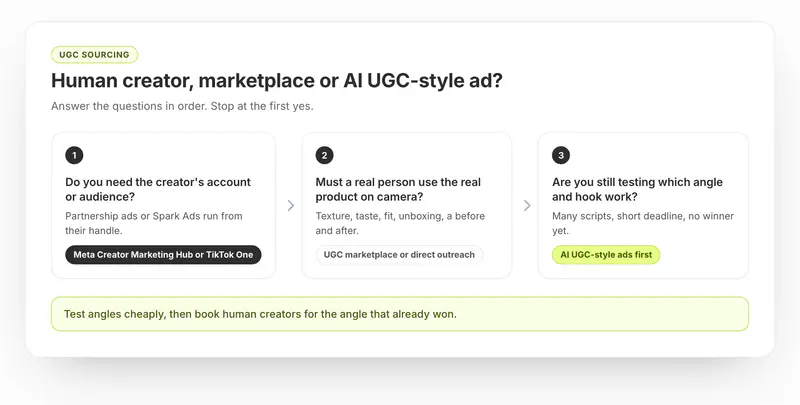
- If you need the creator's handle (partnership ads on Meta, Spark Ads on TikTok): start in Meta's Creator Marketing Hub or TikTok One, where the creator grants ad access inside the platform.
- If you need footage for your own ad account: use a UGC marketplace. Billo sells packs from $1,000 that cover up to 10 videos; Collabstr is free to join with a 10% hiring fee; Insense's Brand plan is from $500 a month billed quarterly ($400 billed annually), plus creator fees.
- If you are setting a budget: plan $100 to $300 per basic video, then add 15% to 25% of the base rate for every 30 days of paid usage.
- If you are still looking for a winning angle: test it with AI-generated UGC-style video first, then book human creators for the angle that already won.
Where do brands find UGC creators?
There are four routes, and the right one depends on a single question: do you need the creator's account, or only their video? Partnership ads and Spark Ads run from the creator's handle, so they need a platform tool that handles permission. Everything else can come from a marketplace or from people you contact yourself.
| Where | Best for | How you pay | Price, checked Nov 24, 2026 |
|---|---|---|---|
| Meta Creator Marketing Hub | Partnership ads on Facebook and Instagram | Creator fee agreed with each creator | No tool price listed by Meta |
| TikTok One Creator Marketplace | Spark Ads and TikTok-native creators | Creator fee agreed per project | No tool price found |
| Billo | Fast, low-cost test footage | Prepaid pack, per-video prices | Packs from $1,000 (up to 10 videos), videos from $99 |
| Insense | Ongoing creator programs with Meta Partnership Ads | Subscription plus creator fees | Brand plan from $500/mo billed quarterly, 10% marketplace fee |
| Collabstr | Browsing creators with public prices | Per order, optional subscription | Free plan with 10% hiring fee; Pro $249/mo billed annually |
| JoinBrands | Cheap single videos and images | Per piece plus platform fee | UGC videos from $25, 15% fee on pay-as-you-go |
| Direct outreach | Creators you already watch | Whatever you negotiate | No platform fee |
Meta Creator Marketing Hub for partnership ads
Meta's Creator Marketing Hub sits in Meta Business Suite and Ads Manager. Meta describes it as a tool that "helps brands discover and evaluate creators to partner with on branded content and partnership ads and find creator content to boost into partnership ads." Inside it you get personalised creator recommendations, send and receive partnership requests, check permission status, and find organic posts that Meta predicts may perform well as ads.
Use it when the ad should run from the creator's account. You still agree the fee and the brief with each creator yourself; the hub handles discovery and ad permissions. It is rolling out in stages, so Meta's help page warns that it "may not be available to you yet."
TikTok One Creator Marketplace for Spark Ads
TikTok's Creator Marketplace now lives inside TikTok One. Brands search with filters or by pasting a campaign description into Creator AI Search, invite creators to a project, then push the best videos to Ads Manager to run as Spark Ads, as Billo's walkthrough of TikTok One describes. If you don't have access, ask your TikTok account representative. For what to put in a TikTok-specific brief, see our guide to briefing UGC creators on TikTok.
UGC marketplaces: Billo, Insense, Collabstr and JoinBrands
Marketplaces are the fastest route when you only need the files. You post a brief, creators apply with a price, and you approve the work before payment releases. They differ mostly in how they charge.
- Billo sells prepaid packs. The Essential pack is $1,000 and "covers up to 10 videos," and videos "start at $99, which covers a 15-second video from a regular creator with basic editing." Longer videos, premium creators, captions and extra hooks cost more. The price covers the creator's fee, basic editing and Billo's platform and transaction fees, but not your product or shipping.
- Insense is a subscription. The Brand plan is from $500 a month billed quarterly ($1,500 a quarter), or from $400 a month billed annually, with a 10% marketplace fee, and "creator payments aren't included." It includes 10 Meta Partnership Ads connections, which suits brands running creator ads every month.
- Collabstr shows each creator's price on their profile. The Free plan lets you hire directly with a 10% hiring fee; Pro is $249 a month billed annually and adds campaigns, and Premium is $333 a month billed annually with a 5% hiring fee.
- JoinBrands prices per piece: UGC videos from $25 and UGC images from $10, with a 15% platform fee on the free pay-as-you-go plan and lower fees on paid plans ($99 a month for 12%, $299 for 10%).
Direct outreach on TikTok and Instagram
Search TikTok and Instagram for "UGC creator" plus your category, look for creators who already post brand work, and message them. You skip platform fees, but you also take on contracts, payment and the usage rights paperwork yourself. Direct outreach works best once you know exactly which creator type you want, which is what the next section helps you work out.
Which creator types win? Check your own ads before booking more
Before you pay for the next ten videos, look at which kind of creator already works in your account. Most teams can't answer this, because ad managers report results per ad, not per "creator talking to camera" or "phone selfie in the gym." You have to tag each ad by who is on screen, the setting and the hook, then add up results across every ad that shares a tag.

Segwise's creative tagging watches every video and tags the hook scene, the people on screen, the setting and the product, and you can add a custom tag such as "creator type." Each tag is joined to the results from the network and your MMP if you use one: spend, ROAS, CPA, CTR, IPM, installs or your own custom events. In the example above, one Pulse fitness app ad is tagged as a phone selfie creator in a gym, with a 2.1% CTR on Meta and 3.4x ROAS measured in AppsFlyer over the last 30 days. Meta reports the clicks, and the MMP reports the revenue behind ROAS.

Grouped by creator type, the picture gets clearer. Across 28 Pulse ads and $48.7K of Meta spend in this sample account, the eight phone selfie ads return 3.2x ROAS in AppsFlyer on $16.4K, about 34% of spend. Creators talking to camera come second at 2.7x. Produced studio statics sit at 2.1x, and the 3D character statics trail at 1.3x. That tells you what to brief next: phone selfie creators, filmed where the product gets used.
You can also ask the question in plain language. Through the Segwise MCP in Claude or ChatGPT, or the Creative Strategy Agent inside Segwise, ask "which creator type brought our cheapest trials on Meta and TikTok last month?" and get the answer from your own tagged ads.
Know which creators to rebook: Segwise lets you tag every UGC ad by creator type, setting and hook, see which ones win on ROAS or cost per trial, and brief your next creators from that. Book a demo.
How much do UGC creators charge in 2026?
A basic UGC video costs roughly $50 to $400 from a beginner creator and $150 to $1,000 from a mid-level one, by Insense's tiers; premium creators charge $500 to $3,000 or more. Platform fees, paid usage rights and whitelisting then add to that base. Compare offers on the total cost of a usable, licensed ad, not the headline rate.
Per-video UGC creator rates
| Source | What it reports |
|---|---|
| Collabstr's UGC price calculator | UGC creators "on average charge $205 for content," based on 1.4m+ creator rates |
| Insense's UGC rate guide (Sep 2026) | Beginner $50 to $400, mid-level $150 to $1,000, premium $500 to $3,000+ per video |
| Insense, by platform | TikTok and YouTube Shorts $125 to $300 (lower band) and $500 to $1,100 (higher band); Instagram Reels up to $1,250 |
| Billo pricing page | From $99 for a 15-second video, fees included |
| JoinBrands pricing page | UGC videos from $25 before the platform fee |
Both rate sources are marketplaces with an interest in the market, so treat the ranges as a guide. The low end buys a single take with basic edits. Raw footage, extra hooks and longer cuts are where prices climb.
What usage rights and whitelisting add to UGC creator rates
The base rate pays for making the video. Running it as a paid ad, and running it from the creator's handle, are usually priced on top. Influencer Marketing Hub's usage-rights clause library gives these benchmarks:
- Paid social usage: 15% to 25% of the creator's base rate per 30-day period.
- Whitelisting or Spark Ads access: 25% to 35% of the base rate per month.
- Perpetual rights: a flat fee of 200% to 300% of the base rate.
On a $205 video, 90 days of paid usage adds about $92 to $154, whitelisting adds about $51 to $72 a month, and buying the video outright adds $410 to $615. Some marketplaces include standard usage rights in their price (Insense says standard rights come with all UGC bought through it, and Billo says usage rights are "calculated into the price"), so check what "included" covers before you pay twice.
Worked cost: 10 test videos, four ways
| Route | How the math works | Cost for 10 videos |
|---|---|---|
| Billo Essential pack | $1,000 pack covers up to 10 videos; basic 15-second videos start at $99, fees included | About $1,000 |
| JoinBrands, pay-as-you-go | 10 x $25 starting price, plus 15% fee | From about $288 (starting price, not a typical one) |
| Collabstr Free plan | 10 x $205 average, plus 10% hiring fee | About $2,255 |
| Insense Brand plan | $1,500 quarter, plus 10 x $125 to $300 creator fees, plus 10% fee | About $2,875 to $4,800 for the first quarter |
Subscription plans only pay off with volume. Collabstr Premium cuts the hiring fee from 10% to 5%, which saves about $10 on a $205 video. At that rate, the fee saving covers the $333 monthly price only at around 33 videos a month, so you buy Premium for the campaigns and reporting, not the fee cut. Also note that none of these totals include paid usage, so add the usage math above before you compare a creator's rate with an AI UGC-style ad.
A rule of thumb for choosing a route (ours, not a published benchmark):
- You need the creator's handle for the ad: Meta's hub or TikTok One.
- You need fewer than about 10 videos a month: a pack or a per-video marketplace, with no subscription.
- You need 10 or more videos every month from several creators: a subscription marketplace, where campaign tools and lower fees start to pay back.
- You have no winning angle yet: test 5 to 10 angles with AI UGC tests, then book human creators for the one or two that beat your current best ad on cost per result.
How do you vet a UGC creator before booking?
Judge a creator on the ads they have made for other brands, not on their follower count. UGC for paid ads is bought for the footage, so a creator with a small following and clean, well-lit product demos can beat a large account that only posts vlogs.

Book one paid test video before you commit to a batch. It tells you how the creator takes direction, how fast they deliver and whether their hook holds attention once it runs as an ad.
What goes in a UGC brief?
A UGC brief tells the creator what the ad is for, who it speaks to, the one message to land, three hook directions to film, what must and must not appear, the exact files to deliver, and the usage rights and disclosure terms. Brief the structure and the message, not a word-for-word script. Our UGC creator brief template has a copy-and-paste version with filled examples for apps and games.
The part most briefs skip is the deliverables line. Ask for raw footage and at least two alternate opening shots in the same order, because the hook is the part you will test most, and the price for extras is lowest when it's agreed before filming.
When should you use AI UGC instead of human creators?
Use AI-generated UGC when you need to test many angles quickly and don't yet know which one wins. Use human creators when a real person must use the real product on camera, when you need the creator's account for partnership ads or Spark Ads, or when the angle has already proven itself and you want the strongest possible version of it.
What AI UGC-style video is good for
These are generated videos that look like a creator talking to camera. They cost less per variation, and you don't have to ship product, cast anyone or wait for a shoot. That makes them a good first filter: run five to ten angles, find the one that holds attention and converts, then spend creator budget on it. Our comparison of AI UGC vs human UGC for Meta ads covers the trade-off in more depth.
Segwise's Creative Generation Agent lets you make statics and videos up to 30 seconds, including AI UGC-style ads, from your own winning patterns. In practice, you take the winning tag from the report above, "phone selfie creator" in a gym mirror with the "this app told me to rest today" hook line, and ask for new UGC-style variations built on it. Each draft comes with a "Why this ad" note tying it to your data, and once it goes live, Segwise tags and tracks it like any other ad.

You can use each agent on its own, or do it all in one place by chatting with the Segwise agent: ask how your ads are performing, see what competitors are running, and make new ads from your winners.
Where AI-generated UGC falls short
Generated creators can't show a real person tasting, wearing or applying your product, and they can't run from a real creator's account, so they won't replace partnership ads or Spark Ads. Platform AI disclosure rules also apply to them. Segwise doesn't find, book or pay creators either: it isn't a creator marketplace, and its UGC-style video is AI-generated. It also needs your ad history to tell you which creator types win, so a brand with no live ads yet should start with a small creator test.
How to find UGC creators who pay off
Find UGC creators through Meta's hub or TikTok One when the ad must run from their account, and in a marketplace such as Billo, Insense, Collabstr or JoinBrands when you only need the footage. Budget $100 to $300 a basic video, then add paid usage at 15% to 25% of the base rate per 30 days. Your next step: tag the UGC ads you already run by creator type and hook, and book more of the creator type that wins. For how creator ads fit a wider production plan, see our guide to scaling ad creative production, and for the basics of UGC ads and Facebook ad creative, start there.