
Learning how to find your next ad angle is not a creativity problem. It is a research problem. Your next winning angle already exists in the language your customers use across four places: product reviews, support tickets, sales-call transcripts, and the competitor ads that have been running for months. Mine those four sources, score what you find against weekly demand and customer LTV, and you stop guessing which angle to test next.
Most teams hit the same wall. A winning creative carries the account for a few weeks, then ROAS slides, and the brief turns into a whiteboard session where everyone throws out adjectives. That session feels productive. It rarely produces an angle that beats the incumbent, because a room full of marketers is not the same as a room full of customers.
The angles that win are usually the ones your customers have already handed you. They wrote them in a five-star review. They typed them into a support chat at 11pm. They said them out loud on a sales call while explaining why they almost did not buy. The work is not inventing language. The work is collecting it, tagging it, and deciding what to test first.
This guide lays out a 4-source customer-language mining framework, then a decision tree for picking which angle to test next. It is built for SaaS and DTC marketers who keep stalling on the same step, and who want a repeatable system instead of another brainstorm.
Also lear more about the Creative Tag Analytics Framework: Variables That Drove ROAS to 3.1x (2026)
Key takeaways
An ad angle is the underlying reason a customer buys, not the format or the hook. Finding your next ad angle means finding a new reason, not a new layout.
Customer reviews are a goldmine of pain points, motivations, desires, and objections you can lift straight into copy.
Support tickets are the rawest, most honest feedback you get, and they read like free market research once you cluster them by theme.
Sales-call transcripts are a direct window into customer pain points, objections, and the exact phrases buyers use, and LLMs can summarize them at scale.
A competitor ad that has run unchanged for months is a market-validated angle, so the teardown tells you what to borrow and what is already saturated.
Pick your next test by scoring each angle on two axes: how often the language shows up week to week, and whether it speaks to high-LTV customers or just first-time buyers.
What an ad angle actually is (and why brainstorms miss it)
An angle is the reason a person buys. The hook is how you open. The format is how you package it. People mix these up constantly, which is why "we need a new angle" so often turns into "we need a new hook" and the account keeps testing the same idea in different fonts.
Here is the distinction that matters. "Save 3 hours a week" is an angle. A founder talking to camera is a format. "Stop me if this sounds familiar" is a hook. You can run the same angle through ten formats and twenty hooks. If the angle is tired, none of that saves it.
Brainstorms miss angles because they start from the product team's view of the product. As the team behind Supersede puts it, copywriters get lost crafting copy around what they want to focus on rather than what customers actually value, because no matter how much you know about your audience, you are not your customer. A team might be convinced the angle is "beginner-friendly" when buyers actually care about free shipping.
So the better question is not "what angle should we try?" It is "what reasons do our customers already give for buying, and which one have we not put into an ad yet?" That reframes angle discovery from invention to mining. The next four sections are the four places worth mining.
The 4-source customer-language mining framework
Treat angle discovery as a weekly intake process, not a one-off. Each source surfaces a different slice of customer language. Reviews give you the after-the-fact verdict. Support tickets give you the friction. Sales calls give you the objections and the buying logic. Competitor ads give you the angles the market has already paid to validate. Run all four and the same phrases start showing up in more than one place. Those repeats are your strongest candidates.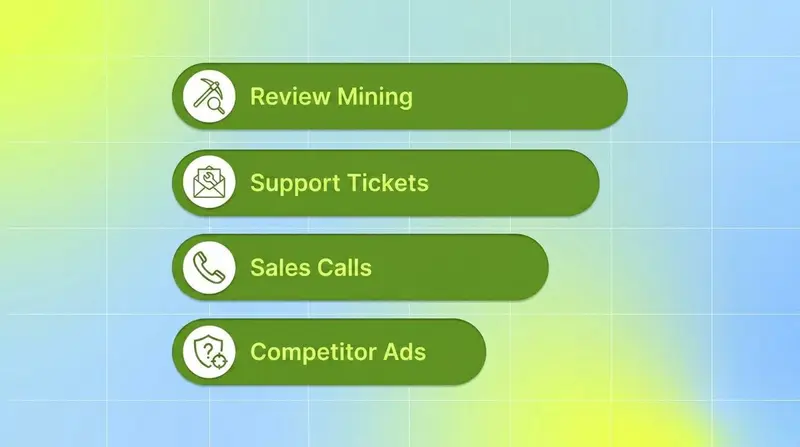
The 4 sources at a glance - Review mining (what customers say after buying), support-ticket clustering (where they get stuck), sales-call transcript tagging (why they almost did not buy), and competitor-ad teardown (which angles rivals are scaling). An angle that appears in two or more sources is a priority test.
Source 1: Review mining
Reviews are the easiest place to start because the language is public and unfiltered. Review mining means analyzing customer reviews, not only of your product but across your category, to surface the problems, motivations, desires, and anxieties behind a purchase. Six things worth pulling: the problem people had, what they tried before you, what motivated them to look, the desire that drove the purchase, the specific feature they loved, and the hesitation that almost stopped them.
You do not need your own reviews to start. If you are early, mine competitor reviews on Trustpilot, Amazon, Google, and the app stores. You will not quote them directly, but you will learn what the category cares about.
A fast tactic: search Google with a formula like site:amazon.com inurl:"product-reviews" "tired of" yourkeyword, then swap "tired of" for "frustrated by" or "wanting." Each phrase surfaces a cluster of reviews built around a specific emotion, which maps cleanly to an angle. "Tired of" reviews become problem-aware angles. "Wanting" reviews become aspiration angles.
Source 2: Support-ticket clustering
Support tickets are where customers tell you the truth, because something is broken and they are annoyed. They are the rawest, most honest feedback you get, and they work like free market research once you read them in bulk. The trick is to stop reading them one at a time and start clustering them by theme.
Export a month of tickets and group them by the underlying job the customer was trying to do. Setup confusion, a missing feature they assumed existed, a comparison they were making against a competitor, a fear about switching. Each cluster is a candidate angle, usually a reassurance angle. If forty people open tickets worried about migrating their data, "switch in an afternoon, we move your data for you" is an angle waiting to be tested.
Support language is also blunt in a useful way. Customers do not write marketing copy in a ticket. They write "I can't figure out how to," which is exactly the kind of plain phrasing that stops a scroll.
Source 3: Sales-call transcript tagging
If you have a sales team, your call recordings are the densest source of all. Sales conversations are full of real questions, objections, goals, and desires, which makes them a goldmine for messaging. The problem has always been volume. Nobody has time to read hundreds of transcripts.
LLMs fix the volume problem. Marin lays out a workable process: export transcripts from a tool like Gong or your meeting recorder, anonymize them to stay compliant, then prompt a model to extract patterns. Their suggested prompt is direct: "Analyze these transcripts and summarize the top 3 pain points, 3 objections, and 3 motivators customers mentioned. Highlight recurring phrases." Tag each call by segment and stage first, so you can see whether enterprise buyers raise different objections than self-serve users.
The objections matter most for angles. Every objection a prospect raises on a call is an angle you can pre-empt in an ad. If three callers in a row hesitate on price, a value-reframe angle is worth testing before the next batch of creatives ships.
Source 4: Competitor-ad teardown
The first three sources tell you what customers say. The fourth tells you what the market has already paid to validate. When a competitor ad runs unchanged for months, that is a reasonable signal the angle is working well enough to keep funding it. Save those long-runners with their launch dates. They are validated angles you can adapt rather than copy.
The teardown also tells you what to avoid. When many advertisers crowd the same angle, it is saturated, and a fresh entrant rarely wins a head-to-head on a tired idea. The useful move is to map which angles are oversaturated and which are underexplored, then aim your test at the gap. The hard part of competitor analysis is not collecting ads. It is turning the pile into a decision.
This is where element-level tagging earns its keep. Reading competitor ads by eye, you notice the obvious hooks. Tagging them by element, the hook style, the CTA, the emotion, the visual format, shows you which specific elements competitors are scaling, not just which ads exist. Segwise runs its multimodal AI over competitor ads the same way it tags your own, so its Competitor Tracking Agent surfaces white space, the angles and messaging themes rivals are not leveraging, and flags oversaturated approaches before you burn a test on them. That keeps the teardown from becoming a folder of screenshots nobody acts on.
How to pick which ad angle to test next
Mining produces a list. The list is useless if you test angles in a random order, because you will spend your budget on the loud ones instead of the valuable ones. Score each candidate angle on two axes before you write a single script.
The first axis is weekly demand volume. How often does this angle's language show up across your four sources in a given week? An objection raised on one call is a weak signal. The same objection in reviews, tickets, and three calls is a strong one. Frequency is your proxy for how many people the angle reaches.
The second axis is LTV match. Does the angle speak to customers who stick around and spend again, or only to one-time bargain hunters? A discount angle can drive volume and still wreck your blended margin if it pulls in low-LTV buyers. For DTC and ecommerce brands especially, mapping an angle to repeat customers and lifetime value matters more than first-purchase ROAS. Tag each angle with the segment it serves and what that segment is worth.
Plot the two axes and you get a simple decision tree:
High demand, high LTV match. Test first. This is the angle that reaches many people and pulls in customers worth keeping. Give it real budget and your best format.
High demand, low LTV match. Test, but cap the budget and watch blended LTV, not just ROAS. Useful for top-of-funnel reach, dangerous if it becomes your whole account.
Low demand, high LTV match. Run a small validation test. Niche language, but the customers it attracts are valuable, so a narrow win can still pay off.
Low demand, low LTV match. Park it. Revisit only if the same language starts showing up more often across sources.

The point of the tree is restraint. You will always have more angle ideas than test budget. Sorting by demand and LTV keeps you from spending three weeks proving that a clever angle nobody asked for does not work.
From angle to live test
A scored angle is still just a sentence. Turning it into a test is its own short loop, and it is worth keeping fast so the angle is still fresh when it launches. A practical rhythm: spend thirty minutes pulling the supporting customer language, sixty minutes writing two or three scripts that carry the angle, then launch those variants on equal budget and let the platform sort them.
Two 2026 realities shape how the test should look. First, authenticity beats polish. Real imagery and human-sounding copy outperform generic AI content, and audiences are increasingly wary of anything that feels machine-made. A mined angle helps here, because copy built from a real review sounds like a person, not a prompt.
Second, let the platform test combinations for you. Meta's dynamic creative now outpaces most manual ad testing by mixing headlines and descriptions per viewer. Feed it three to five headline variants of the same angle rather than building separate ad sets by hand. Your job is to bring the right angle and clean variants. The algorithm handles the permutations.
Once an angle wins, the loop closes. The winning language becomes a tag you can track, and the next refresh starts from evidence instead of a blank page. That is the difference between rediscovering luck every quarter and building an angle engine that compounds.
The bottom line
You will never run out of ad angles if you stop trying to invent them. Finding your next ad angle in 2026 is a mining job: pull customer language from reviews, support tickets, and sales calls, read it against the competitor ads the market has already validated, then test the angle that reaches the most people worth keeping. The brainstorm gets replaced by a weekly intake habit and a two-axis decision tree.
The teardown step is where most teams leak value, because a folder of competitor screenshots is not a decision. If you want that step automated, Segwise handles element-level creative tagging across both your creatives and your competitors' ads, maps each tag to performance, and points its always-on Creative Strategy Agent at the gaps, so the angle you test next is backed by data rather than a hunch.
Frequently asked questions
How do I find my next ad angle when my winning creative starts to fatigue?
Do not start from a brainstorm. Pull customer language from four sources: product reviews, support tickets, sales-call transcripts, and long-running competitor ads. Look for a buying reason you have not turned into an ad yet, then score it on weekly demand and LTV match before testing. Tools like Segwise speed up the competitor step by tagging rival ads at the element level so you can spot the angles they are scaling and the gaps they are missing.
What is the difference between an ad angle, a hook, and a format?
The angle is the reason someone buys, like saving time or avoiding a risk. The hook is how you open the ad, like a question or a bold claim. The format is the packaging, like a founder talking to camera or a product demo. One angle can run through many hooks and formats, so a tired account often needs a new angle, not just a new hook.
Can I use AI to mine sales calls and reviews for ad angles?
Yes, and it is the fastest way to handle volume. Marin Software recommends exporting and anonymizing transcripts, then prompting an LLM to extract the top pain points, objections, and motivators along with recurring phrases. The same approach works on reviews and support tickets. Segwise applies multimodal AI to the competitor side, tagging hooks, CTAs, and visual styles across rival ads so the analysis is not manual.
How do I know which ad angle to test first?
Score each candidate on two axes. First, how often the language shows up across your four sources each week, which proxies demand. Second, whether the angle attracts high-LTV repeat customers or only one-time buyers. Test high-demand, high-LTV angles first, cap budget on low-LTV ones, and park angles that are both rare and low value.
How can I tell if a competitor's ad angle is worth borrowing or already saturated?
Check how long it has run. An ad live and unchanged for months is usually a validated angle worth adapting. If many competitors crowd the same angle, treat it as saturated and look for the underexplored gap instead. Segwise's Competitor Tracking Agent makes this readable by tagging competitor ads, flagging oversaturated approaches, and surfacing the white space competitors are not using.
Do support tickets really help with ad creative?
They are one of the most honest sources you have, because customers write them when something is wrong. Cluster a month of tickets by theme and each cluster becomes a reassurance angle, like easy setup or simple migration. The plain, frustrated phrasing in tickets also tends to stop the scroll better than polished marketing language.