
There is no single right answer to how often to refresh ad creative. A practical starting point is every 2 to 4 weeks on Meta and every few days to a week on TikTok, but those are guesses until your own data confirms them. The real answer is to refresh on fatigue signals, not the calendar, because the right creative refresh rate depends on your budget, audience size, platform, and format. The job is to catch decline early and act, which is exactly what automated fatigue detection is built to do.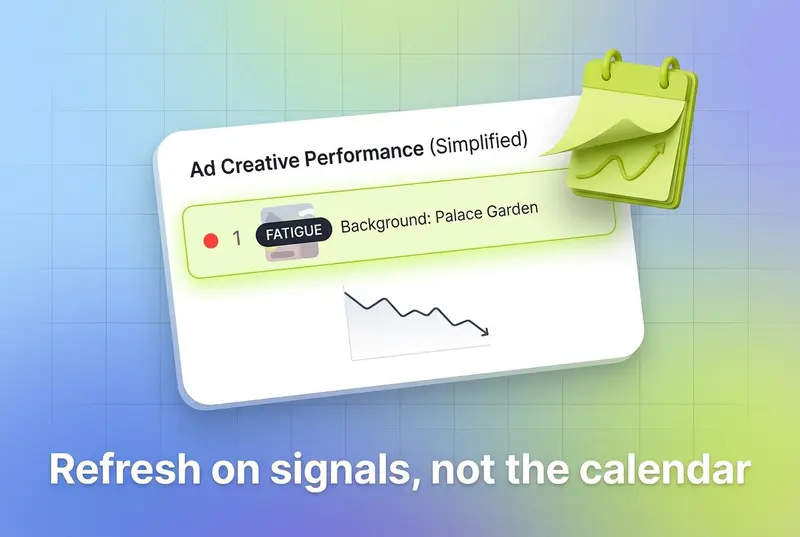
Ask ten performance marketers how often they refresh creatives and you will get ten different answers. As Singular puts it, some refresh weekly, some monthly, and both can be right depending on context. That is frustrating if you wanted a number to put in a calendar. It is also the most honest answer anyone can give you, and once you accept it, the question gets a lot easier to manage.
The teams that struggle with creative fatigue are usually the ones still treating refresh as a scheduling problem. They set a quarterly rotation, ship new ads on the first of the month, and wonder why performance still sags in week three. Meanwhile their best creative might have a week left in it or three weeks, and a fixed calendar has no way of knowing which.
This guide covers why the calendar is the wrong unit, what creative fatigue actually looks like in the data, the rough cadence benchmarks worth using as a baseline, the signals that should actually trigger a refresh, and how to run the whole thing without manually scanning hundreds of ads every Monday.
Key takeaways
There is no fixed creative refresh rate. Refresh on fatigue signals, not the calendar, because the right cadence depends on budget, audience, platform, and format.
As a baseline, practitioners refresh Meta creative every 2 to 4 weeks for higher-spend campaigns, while TikTok creative can fatigue in just a few days, especially at high budgets.
Budget changes the math directly. The same asset can stay fresh for 30 days at a $10,000 budget but lose effectiveness within a week at $100,000.
The real trigger is a cluster of signals: rising frequency, falling CTR and hook rate, and rising CPM or CPA. Watch the signals, not the date.
Repeated exposure has a measurable cost. People who see the same ad 6 to 10 times are 4.1% less likely to purchase than those who saw it 2 to 5 times.
Monitoring fatigue by hand across hundreds of creatives and several platforms is the part that breaks. Segwise's automated fatigue detection watches every creative across all networks and alerts you before performance crashes.
Why the calendar is the wrong unit
The instinct to refresh creative on a schedule comes from a reasonable place. Schedules are easy to plan, easy to staff, and easy to report on. The problem is that creative fatigue does not run on a schedule. It runs on exposure.
A creative fatigues when enough of your audience has seen it enough times that the next impression does less work than the last. That tipping point arrives at wildly different speeds depending on how fast you are spending, how big your audience is, and which platform you are on. A fixed monthly rotation either pulls winning creative too early or rides losing creative too long. Usually both, on different ads, at the same time.
This is the core idea worth repeating: the right time to refresh a creative is set by its performance curve, not by a date on a calendar. Two ads launched the same day can hit fatigue two weeks apart. A calendar treats them identically. The data does not.
The clearest illustration is budget. According to Socium Media, a creative asset can stay fresh for 30 days on a $10,000 budget, but that same asset might lose effectiveness within a week at $100,000. Nothing about the creative changed. The spend did, which means more people saw it more times, faster. Scale a winner and you shorten its life. That is the snowball effect every team scaling spend runs into, and no calendar accounts for it.
What creative fatigue actually looks like
Before you can decide when to refresh, you need to recognize fatigue when it shows up. It rarely announces itself with one dramatic number. It builds.
The earliest signal is usually hook rate, the share of impressions that turn into 3-second video views. Practitioners consistently flag hook rate as the leading indicator, because it moves before CTR and before cost metrics. When people stop stopping for your ad, the rest of the funnel follows.
CTR comes next. As frequency climbs, click-through rate decays from its week-one baseline. The decline tends to be gradual, then sharp, which is exactly why a weekly manual check misses it. By the time CTR has visibly dropped, you have already paid for the impressions that taught you.
Then the cost metrics confirm it. CPM rises as the platform works harder to keep delivering a tiring ad, and CPA rises as conversions thin out. Rising CPA is usually the final confirmation, the point at which the ad is no longer worth its spend.
There is a real cost to letting this run. Repeated exposure does not just stop helping, it actively hurts. People who see the same ad 6 to 10 times are 4.1% less likely to purchase than those who saw it only 2 to 5 times. Frequency is not a vanity number. Past a point, every extra impression is working against you.
Baseline cadence benchmarks worth knowing
None of this means benchmarks are useless. They are a sane starting point, a hypothesis you then confirm or correct with your own data. Here is where practitioner consensus lands in 2026, by platform.
Meta (Facebook and Instagram). For cold prospecting at meaningful spend, most teams refresh creative every 2 to 4 weeks. Meta's own guidance is to let ads clear the learning phase first, then rotate creative once frequency climbs into the 2.5 to 3x range or CTR drops off. Higher spend pushes you toward the faster end of that window.
TikTok. Creative half-life on TikTok is measured in days, not weeks. Socium Media notes fatigue can hit in just a few days, especially on high-budget campaigns. The platform's own automation is designed to detect and rotate fatigued ads as early as 3 to 5 days in. The practical response is volume: TikTok recommends running three to five ad groups per campaign, each with three to five different creatives.
Longer-lived placements. Not everything burns fast. Search and Pinterest-style evergreen content can hold up for months rather than weeks, which makes them friendlier for teams with limited creative capacity.
Treat these as defaults, not rules. A 2-week Meta cadence is a reasonable place to start if you have no data yet. The moment you do have data, let it overrule the benchmark. The benchmark does not know your audience size; your fatigue signals do.
The signals that should actually trigger a refresh
If the calendar is the wrong trigger, what is the right one? A cluster of signals moving together. Any one of them alone can be noise. Together they are a clear call to act.
The reliable combination is three compound signals inside a 7-day window:
Frequency rising past your threshold. Performance stays stable below roughly 2.5, and measurable drops in CTR and conversion show up once frequency pushes above 3.0. Pick a threshold that fits your audience size and watch for it.
CTR decaying from baseline. A meaningful drop from your week-one CTR, often cited around 25% or more, signals the creative is losing its grip. Watch hook rate as the early version of this.
CPM or CPA climbing. Rising delivery cost and rising acquisition cost confirm the platform is straining to place an ad people are tired of.
When two or three of these line up on the same creative, that is your refresh trigger, regardless of whether it has been three days or three weeks. This is the whole shift in one sentence: stop asking how old the creative is and start asking what its signals are doing.
The catch is that this is genuinely hard to do by hand. One creative on one platform, sure. But a real account has hundreds of creatives across Meta, TikTok, Google, and more, each with its own curve. Manually tracking frequency, hook rate, CTR, CPM, and CPA per creative per platform every few days is not a Monday-morning task, it is a full-time job nobody has time for. Which is why most teams catch fatigue late, after the budget is already gone.
How Segwise detects the moment to refresh
This is exactly the gap automated fatigue detection closes. Instead of you scanning dashboards, the system watches the signals continuously and tells you when a specific creative crosses the line.
Segwise's fatigue tracking monitors every creative across all your platforms at once for patterns of continuous performance decline and spend-share drop. Because it works across 15+ ad networks and MMPs, including Meta, Google, TikTok, Snapchat, YouTube, AppLovin, Unity Ads, Mintegral, and IronSource, alongside AppsFlyer, Adjust, Branch, and Singular, you are not stitching together a separate fatigue check per platform. It is one view of every creative's health.
The part that makes it actually usable is custom thresholds. You set fatigue criteria around your own business logic, for example a 20% ROAS decline over 7 days, so the system flags fatigue the way your team defines it, not by a generic rule. When a creative crosses your threshold, the early warning system alerts you over email or Slack before performance crashes, so you refresh in time to save the budget rather than mourn it after.
That is the difference between a calendar and a signal. A calendar tells you it is the first of the month. Fatigue detection tells you that this specific creative, on this specific platform, is declining right now and needs to be replaced. One is a schedule. The other is the answer to the question this whole guide is about.
What to do when a creative does fatigue
Detecting fatigue is half the loop. The other half is having something ready to ship when the alert fires. A refresh trigger is only useful if you can act on it quickly.
This is where refresh cadence connects to creative production. If you can only produce a handful of new ads a month, even perfect fatigue detection leaves you stuck pausing winners with nothing to replace them. The teams that handle fatigue well keep a steady pipeline of variations, so a refresh is a swap, not a scramble.
The smart version is not random new creative. It is new creative grounded in what already works for you. When you know which hooks, formats, and elements drive your best performance, refreshing means iterating on proven patterns rather than starting from a blank brief. That is what keeps a refresh from being a coin flip. To go deeper on the underlying mechanics, our ad creative fatigue guide covers the full picture, and what creative fatigue is and how to measure creative fatigue go deeper on diagnosis.
Conclusion
So, how often should you refresh ad creatives? Often enough to stay ahead of fatigue, which is not a fixed number and never will be. The benchmarks give you a starting cadence, every couple of weeks on Meta, every few days on TikTok, but your data sets the real schedule. Refresh on the signals, not the date, and let budget, audience, and platform tell you how fast that clock runs.
The reason most teams get this wrong is not strategy, it is monitoring. Watching frequency, hook rate, CTR, and cost across hundreds of creatives and several platforms by hand is too much manual work to keep current, so fatigue gets caught late. That is precisely the work an automated system should own.
If you want to stop refreshing on a calendar and start refreshing on signals, Segwise tracks fatigue across 15+ networks and MMPs, flags decline on your own custom thresholds, and alerts you before budget burns, helping teams catch the moment to refresh instead of guessing at it.
Frequently asked questions
How often should you refresh ad creatives?
There is no fixed answer, because creative fatigue runs on exposure, not time. As a starting baseline, many teams refresh Meta creative every 2 to 4 weeks and TikTok creative every few days to a week, but the right rate depends on your budget, audience size, platform, and format. The better approach is to refresh when fatigue signals appear, rising frequency, falling CTR and hook rate, and rising cost, rather than on a fixed schedule. Tools like Segwise automate this by detecting decline per creative and alerting you when it is time.
What is a good creative refresh rate for Meta ads?
For higher-spend cold prospecting on Meta, a common baseline is refreshing every 2 to 4 weeks, with Meta itself suggesting you rotate once frequency climbs into the 2.5 to 3x range or CTR drops meaningfully. Higher daily budgets shorten that window because the same audience sees your ad more often, faster. Use the 2-to-4-week range as a default, then let your own frequency and CTR data move it earlier or later.
Why do creatives fatigue faster when I increase the budget?
Higher spend reaches more people more frequently, so the same audience hits saturation sooner. Socium Media's example is stark: a creative that stays fresh for 30 days at a $10,000 budget can lose effectiveness within a week at $100,000, with nothing about the creative itself changing. This is why scaling a winning creative often shortens its useful life, and why high-budget accounts need to monitor fatigue continuously rather than on a calendar.
What are the signs that a creative is fatiguing?
The earliest sign is usually a drop in hook rate, the share of impressions that become 3-second views, because attention fades before clicks do. Next, CTR decays from its week-one baseline while frequency rises above roughly 2.5 to 3x. Finally, CPM and CPA climb as the platform strains to deliver an ad people are tired of. When two or three of these move together on the same creative, it is time to refresh.
How do I know when to refresh creative without checking dashboards every day?
Manually tracking frequency, hook rate, CTR, and cost across hundreds of creatives and multiple platforms is not realistic, which is why most teams catch fatigue late. Automated fatigue detection solves this by monitoring every creative continuously and alerting you when one crosses your thresholds. Segwise watches creatives across 15+ networks and MMPs, lets you set custom fatigue criteria like a 20% ROAS decline over 7 days, and sends an early warning over email or Slack before performance crashes.
Should I refresh all my creatives at the same time?
No. Refreshing everything on one date pulls winning creatives too early and rides losing ones too long, because two ads launched together can fatigue weeks apart. Refresh each creative on its own signals instead of in a single scheduled batch. Per-creative fatigue detection lets you replace only the ads that are actually declining while letting your winners keep running until their own signals turn.