
You should hire a creative strategist for Meta ads when three things happen at once: your one winning creative has fatigued, your variants stopped beating it, and you can no longer tell which element made the winner work. For brands roughly in the €50K to €500K per month revenue range, that decision is really about ad spend and creative velocity, not headcount. Below about €10K a month in Meta spend, a productized creative analytics layer like Segwise's tag-to-metric mapping usually buys you more iteration speed per euro than a €4,000 to €8,000 a month hire.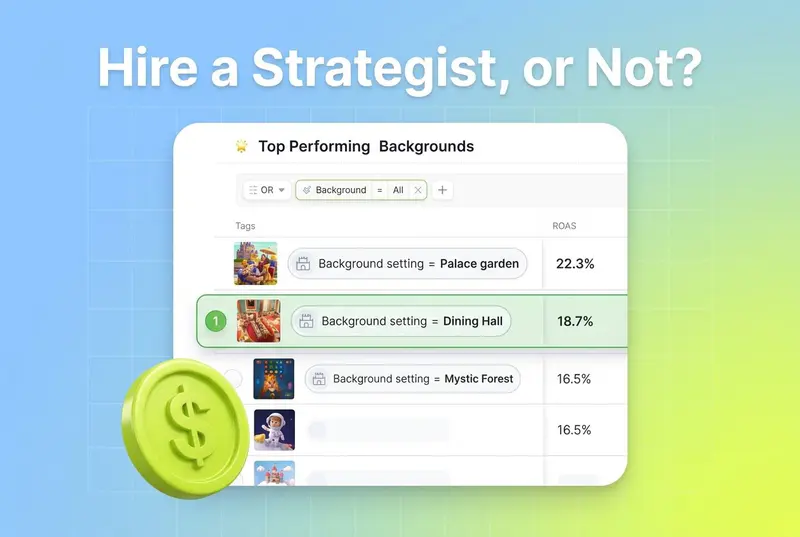
Introduction
If you run Meta ads solo, you already know the feeling. One creative carried the account for two months. Then it started slipping. You cut three variants off the winner, none of them held, and now you are staring at a flat ROAS chart wondering whether the fix is a person or a process.
This is the moment founders start asking whether to hire a creative strategist for Meta ads. It is an expensive question. The cost of being wrong runs in two directions: hire too early and you burn €50,000 a year on someone your spend cannot justify, hire too late and you cap your own growth while a competitor out-iterates you.
The math has gotten harder since 2023. Ecommerce customer acquisition cost has climbed roughly 40% and now sits between $45 and $175 depending on category, according to Constant Hire's 2026 analysis. Paid platforms are saturated, creative fatigue arrives faster, and you need more volume just to hold position. At the same time, Meta has automated most of the button-pushing. As one agency operator put it, the manual work inside Ads Manager is now "maybe a fifth of the job". What moves an account is creative volume and creative quality.
So the real decision is not "do I need help running ads." It is "where is my creative bottleneck, and what is the cheapest thing that removes it." This guide gives you three trigger conditions to diagnose that, a head-to-head on a strategist versus a tool, a decision tree, and a 90-day ROI projection for each path.
Also read Why are Meta CPMs High in 2026? Pixel vs Creative Testing Diagnostic
Key Takeaways
Hire a creative strategist when all three triggers fire together: a fatigued winner, flat variants, and no tag-level read on why the winner worked. One trigger alone is not enough.
A full-time creative strategist in the US runs about $113,000 base on average and over $150,000 fully loaded; a freelancer charges $75 to $150 an hour or $3,000 to $10,000+ a month.
A productized creative analytics tool costs a fraction of a hire and removes the read-and-iterate bottleneck first, which is usually the real constraint below €10K a month in spend.
Hiring math typically tips toward a full-time strategist once Meta spend is consistent and rising past the €10K a month mark, and toward in-house ownership well above that.
Segwise positions as the bridge: it automates the tagging, fatigue detection, and tag-to-metric read that a junior strategist would otherwise do by hand, letting solo operators delay the hire until spend genuinely justifies it.
What a Creative Strategist Actually Does (and What They Don't)
A creative strategist owns the performance logic behind your ads. They turn customer research, performance data, and testing results into a messaging system: angles, hooks, briefs, and a testing roadmap. The standard workflow runs research, concept development, briefs, testing, iteration, then scaling, per Constant Hire's breakdown of the role.
They are not a designer, not a media buyer, and not an editor. A common and expensive mistake is hiring a creative director when you need a performance creative strategist. You get beautiful ads that do not scale. The strategist's job is deciding what to test and why, then reading the result well enough to know what to do next.
That last part matters for your decision. A big chunk of a junior strategist's week is mechanical: tagging creatives, pulling performance by element, spotting fatigue, and mapping which hook or format drove the win. That work is real, but it is also the part a tool can now do automatically. Hold that thought, because it is the hinge of the whole hire-or-tool question.
The Three Trigger Conditions for Hiring
Do not hire on vibes or on a single bad week. Hire when you can check all three of these boxes. Any one alone has a cheaper fix.
Trigger 1: Your winner fatigued, variants went flat, and you cannot decompose why
This is the diagnostic core. You had a creative that worked. It fatigued, which is normal. You spun up variants and none of them recovered the performance. Critically, you cannot say which element, the hook, the format, the opening three seconds, the offer framing, actually drove the original win. Without that tag-level decomposition you are guessing, and guessing does not scale. Creative fatigue plus flat variants plus no element-level read is the clearest signal that your iteration process, not your luck, has hit a ceiling.
Trigger 2: Meta spend is ramping consistently past €5K a month
A single great creative can carry a small account. As spend rises, that stops being true. High-spend accounts increasingly need 50 to 100+ new creative assets per week to maintain positive signal velocity inside Meta and TikTok. Once you are consistently spending past €5K a month and climbing, the volume and discipline required outgrow what most founders can produce between everything else they own. Spend that ramps rather than spikes is the signal, because it means the pressure is structural, not seasonal.
Trigger 3: Your testing cadence has dropped below 4 fresh hooks a week
Cadence is the honest measure of whether you are actually iterating or just maintaining. A productive setup at this spend level lands around 5 to 10 fresh concepts a week done with real intent, per Pigeon Digital. If you have slipped below roughly 4 fresh hooks a week because you are out of time or out of ideas, your account is decaying in slow motion. That cadence collapse, sustained over a month, is the third box.
When all three are checked, you have a structural creative bottleneck. The next question is whether a person or a tool is the right thing to throw at it.
The one-trigger trap - a fatigued winner alone calls for iteration, not a hire. Rising spend alone calls for budget structure, not a hire. A slow week alone calls for rest. Only the combination of all three signals a real, structural bottleneck worth spending money to fix.
Strategist vs Tool: The Real Comparison
Once you have a genuine bottleneck, you have two levers, and most guides pretend you must pick a person. You do not. Here is the honest head-to-head.
The strategist path: €4,000 to €8,000 a month
A freelance or fractional creative strategist in this band charges $3,000 to $10,000+ a month, or $75 to $150 an hour. A full-time hire is heavier: around $113,000 base on average, rising to $183,000 for senior roles, and over $150,000 fully loaded once you add benefits, payroll tax, and tools. Madgicx pegs in-house Meta specialists at $80,000 to $141,000 a year plus 25 to 30% in benefits and another $200 to $500 a month in software.
What you unlock: human judgment, original angle development, customer research depth, and someone accountable for the testing roadmap. What you also take on: a 30 to 60 day hire cycle, onboarding ramp, management time, and key-person risk. The day a solo senior leaves, a big chunk of your account knowledge walks out with them.
The tool path: productized creative analytics
A productized creative analytics layer costs a fraction of a hire and attacks a narrower but often more urgent problem: the read-and-iterate layer. This is exactly the mechanical work that eats a strategist's week. The tool automatically tags every creative element, maps each tag to performance, flags fatigue before ROAS craters, and tells you which hook or format actually drove the win.
What you unlock: instant element-level decomposition, fatigue alerts, and a data-backed answer to "what do I test next," available the day you connect your accounts. What you do not get: a human to brief original concepts or own strategy end to end. A tool reads and recommends; it does not replace a senior's creative instinct at the top of the funnel.
The honest framing: below roughly €10K a month in spend, the read-and-iterate bottleneck is usually your real constraint, and a tool removes it for far less than a hire. Above that, you start needing a human to own concept development and the tool becomes the strategist's force multiplier rather than their substitute.
The Hire-or-Tool Decision Tree
Walk this top to bottom. Stop at the first honest "yes."
Are all three trigger conditions firing at once (fatigued winner, flat variants, no tag-level read)? If no, fix the single issue you actually have and stop here. Do not hire.
If yes, is your Meta spend consistently above roughly €10K a month? If no, add a creative analytics tool first. Use it to automate tagging, fatigue detection, and tag-to-metric mapping, and push your testing cadence back above 4 hooks a week before you commit to a salary.
If spend is above €10K a month and rising, do you need original concept and angle development, or mainly faster, better-read iteration? If mainly iteration, the tool still does the heavy lifting; add fractional human help only for overflow.
If you genuinely need original strategy and your spend supports it, hire fractional first ($3,000 to $10,000 a month), keep the analytics layer so the new hire starts from data instead of guesswork, and only convert to full-time once spend and creative volume clearly justify a $150,000+ fully loaded commitment.
The pattern underneath the tree is simple. The bottleneck below €10K a month is almost always reading and iterating, which is automatable. The bottleneck above it shifts toward originating, which is human. Spend decides which problem you actually have.
A 90-Day ROI Projection for Each Path
Numbers beat instinct. Here is a rough 90-day projection for a brand spending €8,000 a month on Meta, modeled on the cost benchmarks above. Treat these as planning estimates, not guarantees, since outcomes depend on your starting ROAS and creative quality.
Path A: Hire a fractional creative strategist
Cost over 90 days: about €15,000 to €24,000 at a €5,000 to €8,000 monthly retainer.
Ramp: the first 30 to 60 days are largely onboarding and context-building, so meaningful lift typically lands in month two or three.
Upside: original angles and a structured testing roadmap. To break even on a €6,000 month against €8,000 spend, the strategist needs to lift blended ROAS by roughly 75%, which is a real ask inside one quarter on a small account.
Risk: if the engagement ends, much of the institutional learning leaves with them.
Path B: Add a productized creative analytics layer
Cost over 90 days: a fraction of Path A, in the low hundreds to low thousands of euros depending on plan.
Ramp: near immediate. Historical data imports on connection (up to 14 days on the free trial and up to 3 months for paid customers), so you get element-level reads in the first week.
Upside: Segwise reports up to 20 hours per week saved per brand on manual tagging and data consolidation, up to 50% ROAS improvement from catching fatigue early and doubling down on winning patterns, and roughly halved creative production time by iterating on proven elements instead of guessing.
Risk: it will not invent a net-new brand angle for you. For pure iteration and fatigue management, that is rarely the binding constraint at this spend.
For most €50K to €500K a month brands spending under €10K on Meta, Path B clears the bottleneck faster and cheaper, and it makes Path A far more effective if and when you do hire. The two are sequential, not opposed.
How Segwise Bridges the Gap Until You Hire
Segwise is an AI-powered creative intelligence and generation platform. You plug in your ad networks and it analyzes everything, then generates winning creatives based on your winning patterns. For a solo Meta operator, it does the specific work that would otherwise justify your first strategist hire.
Its Creative Tagging Agent uses multimodal AI to tag every element across video, audio, image, and text, hooks, CTAs, characters, visual styles, on-screen text, and audio tone, then maps each tag to performance metrics. That is your tag-level decomposition, automated. Its fatigue tracking monitors every creative for performance decline and spend-share drop and alerts you before ROAS craters, so you act early instead of reactively pausing. The always-on Creative Strategy Agent lets you ask, in plain language, which hook style drove the most installs or what separates your top five creatives from your bottom five, and answers instantly with full account context.
Segwise connects to Meta, Google, TikTok, Snapchat, YouTube, AppLovin, Unity Ads, Mintegral, and IronSource, plus the MMPs AppsFlyer, Adjust, Branch, and Singular, with no-code setup in minutes. That is the read-and-iterate layer a junior strategist would build by hand, running automatically from day one.
The Bottom Line
The decision to hire a creative strategist for Meta ads is not really a hiring question until your spend makes it one. It is a bottleneck question. When a fatigued winner, flat variants, and no element-level read all hit at once, you have a structural problem worth money. Below roughly €10K a month in spend, the cheapest fix is almost always to automate the read-and-iterate layer, push your cadence back up, and prove the bottleneck before you commit to a salary. Above that, a strategist earns their keep, and a tool makes them sharper. The smart play for a growing brand is sequence, not either-or: automate first, hire when spend demands it, and never let a new strategist start from a blank spreadsheet.
Frequently Asked Questions
When should I hire a creative strategist for Meta ads?
Hire when three conditions hit together: your winning creative has fatigued, your variants stopped beating it, and you cannot identify which element drove the original win. Tie that to spend. Below about €10K a month in Meta spend, a creative analytics tool like Segwise usually removes the bottleneck for less than a hire by automating tagging and fatigue detection. Above that, with spend rising, a strategist starts to pay for themselves.
How much does a creative strategist cost in 2026?
A freelance or fractional creative strategist charges roughly $75 to $150 an hour or $3,000 to $10,000+ a month, according to Constant Hire. A full-time US hire averages about $113,000 base, rises to $183,000 for senior roles, and exceeds $150,000 fully loaded once you add benefits and tools. For comparison, a productized analytics layer like Segwise costs a fraction of any of those and is available immediately.
Should I use a tool or hire a person to fix creative fatigue?
For fatigue specifically, a tool is usually the faster and cheaper first move. Fatigue is a detection-and-iteration problem, and platforms like Segwise flag declining creatives before ROAS drops and show which winning elements to double down on. Hire a person when you need original concepts and angle development that a tool cannot originate, which typically becomes the binding constraint only at higher spend.
What is the difference between a creative strategist and a media buyer?
A creative strategist owns the messaging system: research, angles, briefs, and the testing roadmap that decides what to test and why. A media buyer owns platform execution: budgets, bidding, and pacing inside Ads Manager. In 2026, with Meta automating most buying, creative strategy is the higher-leverage role. Segwise supports the strategist side by turning raw creative performance into element-level insight.
Can I stay solo on Meta ads and still scale?
Yes, up to a point, if you remove the read-and-iterate bottleneck. Most solo operators stall not because they lack ideas but because they cannot tell which creative element worked and cannot keep cadence above 4 hooks a week. A tool like Segwise automates the tagging, decomposition, and fatigue alerts, which is what lets a solo operator behave like a small creative team and delay the first hire until spend genuinely justifies it.
what's the cheapest way to figure out which ad element is actually working
Connect your ad accounts to a creative analytics platform that tags elements automatically and maps each to performance. Segwise does this with multimodal AI across video, audio, image, and text, then maps every tag to metrics like ROAS and CPI, so you see which hook, format, or CTA drove the win without manually tagging hundreds of creatives. It is far cheaper than paying a strategist to do the same decomposition by hand.