
Key Takeaways
Scale Personalization: Dynamic creative optimization lets you test and deliver personalized ad variations automatically, eliminating the need to manually create hundreds of ads.
Segwise is an AI creative-analytics and generation platform that auto-tags every element of your ad creatives across 15+ networks, ties each to performance, and generates new variations from the elements already winning.
Faster Testing: Instead of slow A/B tests, DCO runs multivariate combinations in near real-time, helping you find winning ads faster.
Continuous Learning: DCO doesn’t just launch ads; it learns from performance data, shifts budget to winners.
Insight Gap: While DCO optimizes combinations and delivery, it doesn’t always show which specific creative elements are actually driving ROAS.
Creative Intelligence: To truly scale in 2026, you need both optimization and clarity. Creative intelligence platforms like Segwise help you identify winning patterns, detect fatigue early, and scale high-performing creatives with confidence.
How do you deliver personalized creative experiences at scale without manually creating and testing hundreds of ad variations?
As a creative strategist, you’re expected to scale winners and continuously bring new high-performing ads. But most of the time, you don’t know which message resonated, which visual drove conversions, or which angle you should scale next. This makes it harder to brief your team, harder to repeat success, and easier to waste time producing creative combinations that don’t improve performance or connect with the right audience.
This guide will show you how dynamic creative optimization works in 2026, how it helps you automatically test and deliver personalized creative variations based on each user’s unique preferences and behavior, and how you can use those insights to identify winning creative patterns and build a scalable system for producing high-impact ads.
What Is Dynamic Creative Optimization (DCO)?
Dynamic creative optimization (DCO) is an ad technology that enables you to run and personalize multiple ad variations, automatically showing the most relevant version to each user based on their behavior and near real-time performance data.
As a creative strategist, this means you no longer have to rely on one generic creative for all users. Think of dynamic creative optimization like building blocks for your ads.
Creative elements: hooks, headlines, primary text, visuals, CTAs, offers, product shots, or gameplay scenes.
Rules: which elements can appear together, which messages require specific visuals, or which offers match certain audiences.
Learning loop: the system automatically tests different combinations, measures performance, and prioritizes the variations that drive the best results.
The result is clear: you can test more creative ideas faster, deliver more personalized ad experiences to each user, and reduce the manual effort required to find winning creative concepts.
Understanding what DCO is becomes clearer when you compare it to static ads.
Also Read: Top Creative Optimization Tools for 2025
How DCO Ads Differ From Static Ads
DCO ads automatically test and deliver personalized creative variations, while static ads show the same fixed creative to every user. This allows you to scale creative testing, improve relevance, and continuously optimize performance without manual intervention.
Here are the key differences between DCO ads and static ads:
The shift from static to dynamic creative isn’t just about automation — it changes how efficiently you drive results.
What Are the Benefits of Dynamic Creative Optimization?
Dynamic creative optimization helps you deliver more relevant ads, test creatives faster, and continuously improve performance without increasing manual workload. It allows you to scale personalization, improve efficiency, and drive stronger returns from your ad budget.
Here are the key benefits for you: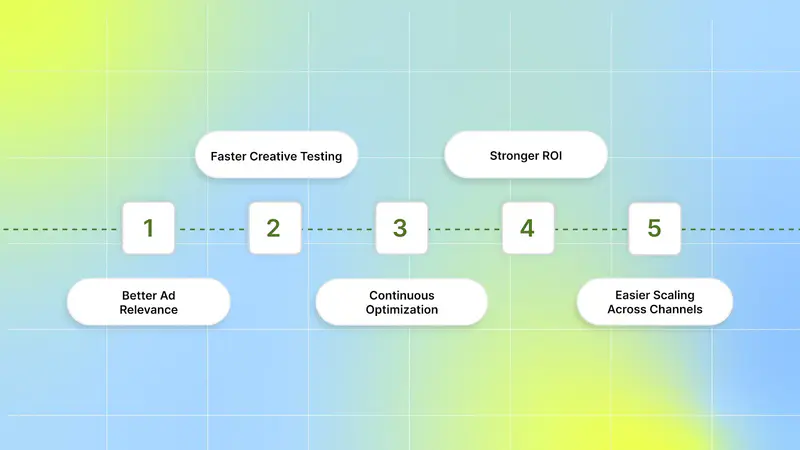
1. Better Ad Relevance
As a creative strategist for mobile games, DTC brands, or subscription apps, relevance is everything. Players, shoppers, and potential subscribers respond to ads that feel made for them. Research shows that 75% of marketers believe personalized experiences drive sales and repeat business. But manually creating personalized ads for different audiences is almost impossible when you are running paid video at scale.
Dynamic creative optimization helps you show the right message to the right person at the right time. Instead of a single generic creative, the system adjusts hooks, visuals, offers, and CTAs based on signals such as location, interests, device, and behavior. When your ads feel more personal and aligned with user intent, engagement increases.
2. Faster Creative Testing
You are constantly under pressure to test new hooks, new angles, and new visuals. Traditional A/B testing takes time, manual setup, and constant monitoring. With dynamic creative optimization, testing happens automatically. The system rotates different headlines, visuals, and CTAs and learns which combinations perform best.
Instead of waiting weeks for clear results, you get faster feedback. Winning combinations get more exposure, while weaker ones are deprioritized. This saves you time and reduces manual analysis.
3. Continuous Optimization
Static ads lose performance over time. Creative fatigue hits, engagement drops, and you have to rush to produce replacements. DCO keeps optimizing in the background. It learns from data and keeps adjusting delivery toward higher-performing combinations.
For you, this means less reactive firefighting and a more proactive strategy. Your creatives stay relevant longer, and performance doesn’t depend only on constant redesigns.
4. Stronger ROI
As a creative strategist, your ideas directly impact revenue. But without structured optimization, the budget often gets wasted on underperforming combinations. DCO reduces wasted impressions by prioritizing creative variations that actually convert. It shifts exposure toward stronger-performing hooks, visuals, and offers.
Over time, this leads to better return on ad spend and clearer insight into which creative patterns drive installs, purchases, subscriptions, and long-term value.
5. Easier Scaling Across Channels
You rarely run ads on just one platform. Mobile games test across Meta, TikTok, and display. DTC brands run paid social and video. Subscription apps experiment across multiple networks. DCO lets you use a single, structured set of creative elements and adapt them across platforms. The system adjusts combinations based on audience and placement.
This makes cross-channel scaling easier. You can focus on creative direction and storytelling, while your campaigns adjust automatically to each channel’s context and audience behavior.
For you as a creative strategist, dynamic creative optimization is not just about automation. It gives you clearer insights, faster iteration, and a more structured way to build and scale winning creative strategies.
Next, let’s look at why dynamic creative optimization is quickly becoming essential in 2026.
Why Dynamic Creative Optimization Is Becoming Essential in 2026
Dynamic creative optimization is no longer an experimental tactic. It is becoming a core part of modern advertising strategy. The DCO market has grown rapidly in recent years and continues to accelerate as brands demand better personalization, faster testing, and stronger ROI.
The global DCO market is projected to grow from $1.02 billion in 2025 to $1.16 billion in 2026, reflecting a compound annual growth rate (CAGR) of 13.7%. Looking ahead, the market is expected to reach $1.92 billion by 2030.
This growth is being driven by major shifts in how creative teams and performance marketers operate.
What Is Driving This Growth?
Several factors are pushing DCO into the mainstream:
Growth in digital advertising spend.
Advancements in near real-time data processing.
Expansion of mobile and social media platforms.
Increased demand for personalized ads.
Rise of programmatic advertising.
Greater availability of user behavior data.
Privacy-first creative targeting.
Growth of omnichannel marketing
For creative strategists, this means personalization and scalable testing are no longer optional. They are becoming the industry standard.
To understand why dynamic creative optimization is becoming essential, you need to see how it actually operates.
How Does Dynamic Creative Optimization Work?
Dynamic creative optimization follows a structured process that combines creative strategy, automation, and continuous learning. Each step helps you move from manual creative testing to a scalable, data-led system that adapts as performance changes.
Here’s how it works in practice:
1. Creative Asset Structuring
First, you add all your ad elements to the AI system. Basically, you feed AI the building blocks for your ads.
These include:
Hooks and first scenes.
Headlines and primary text.
Gameplay clips or product visuals.
Offers and incentives.
CTAs.
The AI system then:
Group assets by type and theme.
Flags repetitive angles or weak CTAs.
Creates a structured framework that allows multiple combinations without breaking brand consistency.
For you, this means cleaner creative testing and better organization before campaigns even launch.
2. Audience Data Collection
Next, the platform pulls audience and performance signals from:
Ad platforms.
Attribution tools.
CRM systems.
Website or in-app behavior.
This data helps you understand:
Who is engaging?
Who is converting?
Which segments drive higher value?
Instead of guessing which creative fits which audience, the system continuously updates audience segments based on real behavior. For DTC brands, it could mean distinguishing discount-driven buyers from full-price loyalists.
3. Creative Assembly and Variation Building
Now the platform starts creating ad variations by mixing the assets you uploaded. It can build dozens or even hundreds of versions in minutes.
It mixes:
Different hooks with different visuals.
Offers with specific CTAs.
Emotional angles with audience segments.
Instead of manually launching dozens of A/B tests, the system builds variations in minutes.
It ensures:
Brand-safe combinations.
Layout consistency.
Message alignment.
For you, this removes the manual pressure of building every variation yourself.
4. Near real-time Ad Delivery
Once variations are ready, the system delivers different versions to different users. Instead of showing one generic creative to everyone, it adjusts based on:
Location.
Device.
Engagement behavior.
Past interactions.
This keeps your campaigns relevant without constant manual adjustments.
You don’t have to decide which variation to serve to which audience. The system learns and adjusts the distribution based on performance signals.
5. Continuous Performance Learning
Every time the system runs an ad, it also records the subsequent actions, including clicks, conversions, and engagement. The system continuously analyzes:
AI reviews this data constantly to see which creatives get the best response.
Identifies patterns you might overlook, such as how tone and image style affect performance.
Predicts when engagement might drop and starts testing new variations early.
This turns creative testing into structured insight.
6. Automated Scaling and Optimization
As performance data accumulates, the system shifts exposure toward stronger-performing combinations.
It:
AI Prioritizes winning variations.
Reduces delivery for weaker ones.
Continues testing new combinations in the background.
You keep improving results daily without needing to rebuild campaigns from scratch.
As a Creative Strategist You move from static, manually tested ads to a dynamic system that:
Tests at scale.
Personalizes delivery.
Learns continuously.
Protects performance.
Helps you identify repeatable creative patterns.
Dynamic creative optimization isn’t just automation. It becomes the foundation of a modern creative testing system.
Next, implementing dynamic creative optimization successfully depends on following clear best practices.
What Are the Best Practices for Dynamic Creative Optimization?
Dynamic creative optimization works best when you treat it as a structured creative testing system, not just an automation feature. The quality of your inputs, audience structure, and testing approach directly determine how much insight and performance improvement you gain.
Here’s how you can make sure your DCO campaigns deliver meaningful creative insights and scalable results:
1. Start With Strong, Structured Creative Variations
DCO is only as effective as the creative elements you provide. Instead of uploading just a few complete ads, break your creatives into multiple variations of each element.
Include variations such as:
Different hooks (problem-focused, benefit-focused, emotional, or curiosity-driven).
Multiple visuals (gameplay scenes, product demos, lifestyle shots, UGC).
Different headlines and primary text.
Multiple offers and CTAs.
This gives the system enough diversity to test and identify winning combinations.
Pro tip: Label your assets clearly based on theme, audience, or angle. For example: “UGC_Testimonial,” “Gameplay_Level_Fail,” or “Discount_Offer.” This makes it easier to understand which creative patterns drive results.
2. Continuously Test and Learn From Creative Performance
Run multiple ad variations and monitor real-time performance. Pause low-performing combinations and scale high-performing ones. Test one variable at a time when possible, such as the headline and image. This makes it easier to identify what drives results.
Keep a performance log and document which variations worked for which segments and during what time periods. This helps with planning future campaigns. However, the right tool will do it automatically.
DCO helps you optimize delivery, test combinations, and personalize ads at scale, but what if you want to know which specific creative elements are driving performance?
This is where a creative intelligence platform like Segwise comes in. With tag-level creative element mapping, you can see which specific creative elements drive performance. You can also discover patterns like "this hook appears in 80% of top-performing creatives" with complete MMP attribution integration.
3. Segment Your Audience for Better Creative Matching
Different audiences respond to different creative angles. If you treat your entire audience as one group, you limit the effectiveness of DCO.
Instead, create clear audience segments based on:
Behavior (new users vs returning users).
Purchase history.
Engagement level.
Platform or device.
For example, mobile game teams can segment casual players vs competitive users. This allows the system to match the right creative variation to the right audience.
Pro tip: Update your audience segments regularly so your creative delivery stays aligned with current user behavior.
4. Define Clear Campaign Goals Before Testing
Before launching your campaign, decide what success looks like. Your creative strategy should align with your campaign objective.
Your goal may be:
Increasing installs.
Driving purchases.
Improving subscription sign-ups.
Increasing ROAS.
Clear goals help you identify which creative combinations are actually driving meaningful results, not just clicks.
Pro tip: If your goal is conversion, prioritize creatives that clearly communicate value, trust, and urgency.
5. Set Up Accurate Tracking
DCO depends on performance data to learn and optimize. Without proper tracking, you won’t get reliable insights.
Make sure your system is connected to the DCO system, analytics, CRM, and ad platforms. Accurate tracking lets you see which creative combinations and audience segments perform best.
6. Refresh Creatives
Even strong creatives lose effectiveness over time. Creative fatigue reduces engagement and performance.
Regularly rotate creatives such as:
New hooks.
Updated visuals.
New offers.
Different messaging angles.
But how do you know exactly which creatives are starting to fatigue before performance drops significantly? This is where a creative intelligence platform like Segwise comes in.
With our fatigue tracking, you can detect a continuous decline in performance metrics and spend share using internal logic. You can catch fatigue before it impacts your budget allocation and campaign results. You can also set custom fatigue criteria and monitor creative performance across Facebook, Google, TikTok, and all major ad networks, to catch fatigue before it impacts your ROAS.
When implemented correctly, DCO helps you move from guesswork to a structured, data-backed creative strategy.
Even with the right structure and strategy in place, DCO campaigns can still underperform if certain foundational mistakes slip through.
Common DCO Mistakes and How to Overcome Them
Even with the right setup, dynamic creative optimization can underperform if you make avoidable mistakes. As a creative strategist, knowing these common pitfalls helps you protect performance and extract better insights from your campaigns.
Mistake 1: Too Few Creative Elements
Problem: Limited combinations reduce optimization potential.
Solution: Provide at least 5+ variations for each major element type. More structured diversity leads to stronger optimization and better performance signals.
Mistake 2: Ignoring Feed Quality
Problem: Bad data leads to bad ads.
Solution: Audit your data feeds and tracking weekly. Fix broken links, incorrect pricing, missing fields, and tagging issues immediately. Clean data improves creative performance and audience matching.
Mistake 3: Over-Segmentation
Problem: Too many rules result in not enough data per segment. When you create too many micro-segments, each segment may not receive enough volume for the system to learn properly.
Solution: Start with broader audience segments. Narrow them gradually based on performance volume and clear trends. Let data guide segmentation decisions instead of assumptions.
Mistake 4: Set and Forget
Problem: Performance degrades over time.
Solution: Review performance monthly and refresh creatives regularly. Introduce new hooks, visuals, and offers to maintain engagement and protect results.
Avoiding these mistakes ensures your DCO campaigns remain structured, scalable, and aligned with your creative strategy goals.
Also Read: Creative Optimization in 2025: Actionable Insights Report
Conclusion
In 2026, scaling paid campaigns is no longer about launching a few variations and hoping one works. It’s about building a structured system that personalizes ad delivery automatically, and continuously learns from real performance data. When implemented correctly, DCO helps you move from manual guesswork to a repeatable, data-led creative testing process that improves relevance, protects ROAS, and reduces creative fatigue across channels.
However, while DCO automates combinations and optimizes ad delivery, creative strategists still need clarity on why certain creatives perform better. This is where a creative intelligence platform like Segwise becomes critical.
Segwise helps bridge that gap by unifying creative data, automatically tagging creative elements using AI-powered creative tagging, mapping performance directly to ROAS, and identifying winning creative patterns across platforms. It connects creative elements (hooks, dialogs, visuals, formats, etc.) directly to business outcomes (ROAS, CPA/CPI, LTV, IPM, conversion rates), so teams stop guessing what works and start scaling creatives with data-backed confidence.
Moreover, with tag-level performance optimization, you can instantly see exactly which creative elements, themes, and formats drive results across all your campaigns and apps. Also, our fatigue detection catches performance decline before it impacts budget allocation and campaign results.
So, if you’re ready to turn creative testing into a true growth engine, start your free trial today and see exactly which creative elements are driving your results!