
To generate playable ads with AI, you describe the interactive mechanic and end card you want, let an AI tool build the HTML5 mini-game and its assets, then test variations against real performance data. For mobile gaming user acquisition, the part that matters is not just making the playable. It is knowing which playable elements actually drive installs. Segwise generates data-backed playable ads from your winning creative patterns, and it is the only platform that tags and analyzes playable ads, so generation and measurement run as one loop.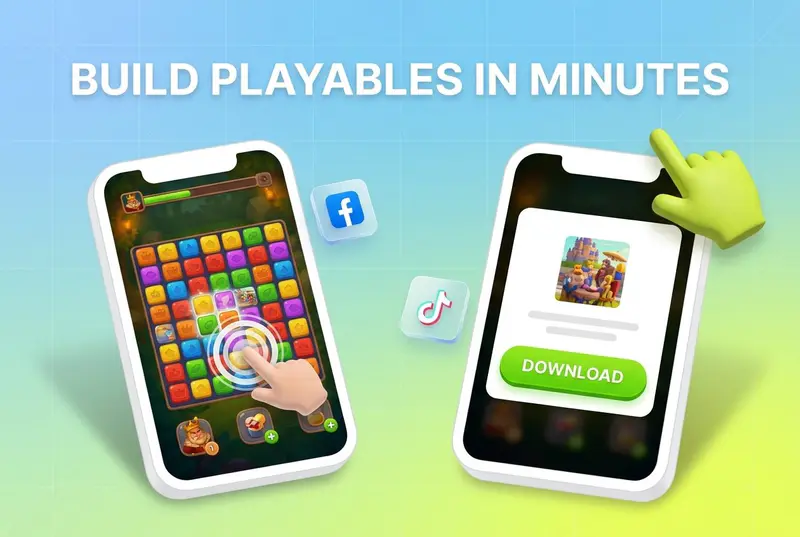
I have sat in enough creative reviews to know how the playable conversation usually goes. Someone pulls up a competitor's playable that is clearly printing installs, the team agrees you need one like it, and then the brief sits for three weeks while a studio builds it. By the time it ships, the angle has moved on. AI changes that timeline. You can now generate a working playable in minutes instead of weeks, which is genuinely useful, but it also creates a new problem: when you can make a hundred playables, you need to know which hundred are worth making.
That second half is where most teams are still flying blind. Generating playable ads with AI is easy to start and hard to do well, because the format is the toughest creative type to measure. A playable is interactive code, not a flat video, and almost no analytics tool can read what is inside it. So teams generate fast and learn slow, which defeats the point.
This guide covers what playable ads are, why they work so well for mobile games, how to generate them with AI, and the part everyone skips: how to close the loop between generating playables and actually understanding which ones win.
Key takeaways
Playable ads are interactive mini-games inside an ad. They drive installs at 16 times the impression-to-install rate of non-playable formats for emerging gaming apps and 8 times for top advertisers, per Liftoff's 2025 Mobile Ad Creative Index.
AI cuts playable production from weeks to minutes. You describe the mechanic and end card, the tool builds the HTML5 game, and you iterate on variations instead of waiting on a studio.
Volume without measurement is noise. When you can generate a hundred playables, the bottleneck moves from production to knowing which elements drive results.
Playables are the hardest format to measure because they are interactive code, not flat video. Most analytics tools cannot read what happens inside them.
The closed loop matters more than the generator. Generating playable ads with AI only compounds when each playable is tagged, tracked, and fed back into the next round.
Segwise generates data-backed playable ads from your winning patterns and is the only platform that tags and analyzes playable ads, so the generate-and-measure loop stays connected.
What is a playable ad?
A playable ad is a short, interactive ad unit that lets a user try a slice of your game before they install it. Instead of watching a video, the user taps, swipes, or solves a quick challenge, usually for 10 to 25 seconds, then lands on an end card with a download button.
The format works because it removes a guess. A video tells someone your game is fun. A playable lets them feel it. That try-before-you-buy experience is why playables consistently beat passive formats on install quality, not just install volume.
Most playables share the same anatomy. There is a lead-in (often a few seconds of video to set context), the interactive core (one simple mechanic the user controls), and the end card (the call to action). By mid-2025, 82.5% of interactive playables started with a lead-in video, and the best of them tied that video directly to the gameplay that followed.
The catch is that all three parts are interactive code. That is exactly what makes them powerful for users and painful for measurement, which I will come back to.
Why playable ads work for mobile games
For mobile UA specifically, playables are not a nice-to-have anymore. They are a core part of how serious game advertisers acquire users, and the performance data explains why.
Liftoff's 2025 Mobile Ad Creative Index, built on over 4.7 trillion impressions and 1.1 billion installs, found playables convert at roughly 16 times the impression-to-install rate of non-playable formats for emerging gaming apps, and 8 times for top spenders. The earlier 2024 index put it more bluntly: playables drive 20 times more installs than banner ads.
The quality holds up after the install too. Industry analysis points to higher retention and lifetime value from players acquired through playables, because someone who already enjoyed the mechanic is closer to your actual product than someone who watched a flashy trailer. Rovio reported a 40% lower customer acquisition cost and a 70% lift in day-seven ROAS from interactive creative.
Adoption has followed the results. By mid-2025, daily playable creatives exceeded 30,000 and made up over 8% of all mobile game ad creatives worldwide. The teams winning UA right now are not asking whether to run playables. They are asking how to make more of them, faster, without losing the thread on what is working.
How to generate playable ads with AI
The old playable pipeline was slow and expensive: a brief, a specialist studio, two to three weeks of build, then a round of revisions. AI compresses that to a single sitting. Playables are one format in a broader shift toward AI ad creative generation, but they have their own quirks. Here is how generating playable ads with AI actually runs.
1. Define the mechanic and end card
Start with the one thing the user will do. Tap to match, swipe to dodge, drag to build. A playable should have a single mechanic that is understandable in the first three seconds, so your prompt to an AI tool should be just as specific: describe the action, the win state, the lose state, and the end card with its download CTA. Vague prompts make vague games.
2. Generate the interactive build and assets
A modern AI generator turns that description into a working HTML5 playable, including the sprites, animations, UI, and interaction logic. The assets, like character art, backgrounds, and the end card, can be generated too, ideally in a style that matches your actual game. What used to take a studio weeks can now produce a testable build in minutes.
3. Ground the concept in what already works
This is the step most people skip, and it is the difference between AI as a toy and AI as a UA engine. Do not generate a random playable. Generate one built around the hooks, characters, and mechanics your existing creatives prove convert. If your top videos all open on a near-miss puzzle moment, your playable should put the user in that moment. This is the same principle behind generating ad creatives from winning patterns: generation grounded in your own performance data beats generic AI output every time.
4. Produce variations and export per network
Once you have a winning concept, the real advantage of AI is volume. Spin up variations that change one element at a time: a different hook, a different difficulty curve, a different end card. Export them in the aspect ratios each network needs, since Meta, TikTok, Google, and AppLovin all have their own playable specs.
5. Test, measure, iterate
Ship the variations, then read which ones actually drove installs and which elements caused the difference. This is the loop. Without it, you are generating in the dark.
The measurement problem nobody talks about
Here is the uncomfortable truth about generating playable ads with AI at volume. The easy part is making them. The hard part, the part that decides whether any of this improves your ROAS, is understanding them.
A playable is interactive code. It is not a 30-second video you can transcribe and tag. The mechanic, the difficulty, the end-card timing, the lead-in hook, all of it lives inside an HTML5 build that standard creative analytics tools simply cannot read. So most teams measure playables the only way they can: at the campaign level. They know a playable spent and returned a number. They do not know that the swipe mechanic beat the tap mechanic, or that the three-second lead-in held users while the seven-second one lost them.
That gap is fatal when you are generating at scale. If you ship fifty AI-generated playables this month and cannot tell which elements inside them worked, you have fifty data points you cannot learn from. You will scale on gut feel, which is exactly the manual guesswork AI was supposed to replace.
This is the specific gap Segwise was built to close, and it is worth being precise about why. Segwise is the only platform that tags and analyzes playable ads. The same multimodal AI that tags your video and image creatives reads inside your playables too, mapping their elements to performance the way it does every other format. So when you generate a playable, you also get to see which mechanic, hook, or end card actually drove installs.
Closing the loop: generate and measure as one system
The reason generating playable ads with AI usually disappoints is that teams treat generation and measurement as two separate tools. You generate in one place and measure in another, and the playable format breaks the second step entirely. The fix is to run them as one loop.
That loop has three moves. Analytics surfaces the winning patterns across all your creatives, including playables. Generation builds new playables grounded in those patterns. Then every new playable gets tagged and tracked the moment it goes live, which sharpens the next round. The output of measurement becomes the input to the next generation.
Segwise's Creative Generation Agent is built around this. It produces net-new and variation creatives across image, video, and playable formats, all grounded in your tag-to-metric mapping rather than generic prompts. It can remix winning elements from across your top creatives into new playables, and it generates video storyboards when you need to map a concept before building. Because Segwise also tags and analyzes playables, every generated playable is automatically tagged and tracked once live, so its performance feeds straight back into the intelligence that produced it. That is a genuinely closed loop, and for playables specifically, no other platform offers both halves of it.
Underneath the generation sits the analytics layer that makes it work. Segwise unifies creative data across 15+ ad networks, including Meta, Google, TikTok, Snapchat, YouTube, AppLovin, Unity Ads, Mintegral, and IronSource, alongside MMPs AppsFlyer, Adjust, Branch, and Singular. Setup is no-code and takes minutes. For game studios running UA across half a dozen networks, that unified view is what turns scattered playable data into a single readable map of what works.
Playable ad best practices for AI generation
A few rules hold up whether you build by hand or generate with AI. Most of these come straight from how the best-performing playables behave in market.
Lead with the interaction. Make it obvious what to do in the first three seconds. Most users decide whether to engage almost immediately, so do not bury the mechanic behind a long intro.
One mechanic, done well. A playable is not a demo of your whole game. Pick the single most compelling action and let the user do it. Confusing playables get skipped.
Keep it short. Aim for 10 to 25 seconds of interaction. Playables running over 25 seconds see an 80% higher churn rate, so longer is not better.
Handle both win and lose states. Whether the user succeeds or fails, route them to a clear end card with a download CTA. Never leave a dead end.
Match the playable to your real game. The fastest way to tank retention is to advertise a mechanic your game does not actually have. AI generation makes it easy to spin up a slick but dishonest playable, so keep the experience true to the product.
Vary one element at a time. When you generate variations, change the hook or the mechanic or the end card, not all three. That is the only way to learn which element moved the number.
Conclusion
Generating playable ads with AI has flipped the old constraint. Production used to be the bottleneck, so the question was how to get a playable built at all. Now you can build dozens in an afternoon, and the bottleneck has moved to understanding: which of these actually work, and why. The teams that win the next phase of mobile UA will not be the ones who generate the most playables. They will be the ones who close the loop between generating playables and measuring them at the element level.
That loop is hard precisely because playables are interactive code that almost nothing can read. Generate in one tool and measure in another, and the format breaks the measurement step. Run generation and analysis as one system, and every playable you make teaches you how to make the next one better.
That is what an AI-powered creative intelligence platform is for. Segwise generates data-backed playables from your winning patterns and is the only platform that tags and analyzes playable ads, mapping each element to performance, helping teams save up to 20 hours a week and improve ROAS by up to 50%. If you want to stop guessing which playables work, that is the gap it closes.
Frequently asked questions
How do you generate playable ads with AI?
You describe the interactive mechanic, the win and lose states, and the end card, then an AI tool builds the HTML5 playable along with its assets like sprites, backgrounds, and UI. From there you generate variations that change one element at a time and test them across networks. The most effective approach grounds the playable in your existing winning creative patterns rather than starting from a blank prompt, which is how platforms like Segwise generate data-backed playables instead of generic ones.
What is a playable ad in mobile gaming?
A playable ad is a short interactive ad unit, usually 10 to 25 seconds, that lets a user try a slice of a game before installing it. Instead of watching a video, the user taps, swipes, or solves a quick challenge, then lands on an end card with a download button. The format works because it lets users feel the gameplay rather than just see it, which is why playables drive higher-quality installs.
Why do playable ads convert better than video ads?
Playables convert better because they give users a try-before-you-buy experience instead of a passive one. Liftoff's 2025 data found playables drive installs at roughly 16 times the impression-to-install rate of non-playable formats for emerging gaming apps. Players acquired through playables also tend to retain better, since they have already engaged with the actual mechanic before installing.
What does AI playable ad generation mean for a mobile UA team?
It means production stops being the bottleneck. Instead of waiting two to three weeks for a studio to build one playable, a UA team can generate working builds in minutes and test many variations in the time it used to take to ship one. The new challenge becomes measurement: with that much volume, the team needs to know which playables and which elements inside them actually drive installs, or the speed advantage is wasted.
Can you measure which elements inside a playable ad drive performance?
Usually no, because a playable is interactive HTML5 code rather than a flat video, so most analytics tools can only measure it at the campaign level. Segwise is the only platform that tags and analyzes playable (interactive) ads, reading the elements inside them and mapping each to performance the same way it does for video and image creatives. That is what lets teams see whether the mechanic, the hook, or the end card actually drove the result.
how do I make a good playable ad without it failing in testing
Lead with the interaction in the first three seconds, use one simple mechanic, keep it under 25 seconds, and route both win and lose states to a clear download CTA. The most common failure is advertising a mechanic your game does not actually have, which tanks retention even if the playable converts. Vary one element at a time when you test, so you can tell which change moved the number rather than guessing.
Which networks support playable ads?
Most major mobile ad networks support playables, including Meta, TikTok, Google, AppLovin, Unity Ads, IronSource, and Mintegral, though each has its own format and file-size specs. When you generate playables with AI, you should export each variation in the aspect ratios the target network requires. Segwise unifies creative data across 15+ networks and MMPs including AppsFlyer, Adjust, Branch, and Singular, so playable performance across all of them lands in one view.
Meta Title: Generating Playable Ads With AI: Mobile Gaming Guide
Meta Description: Generating playable ads with AI lets mobile UA teams ship interactive creatives fast and tie each one to performance. A practical guide for game studios.