
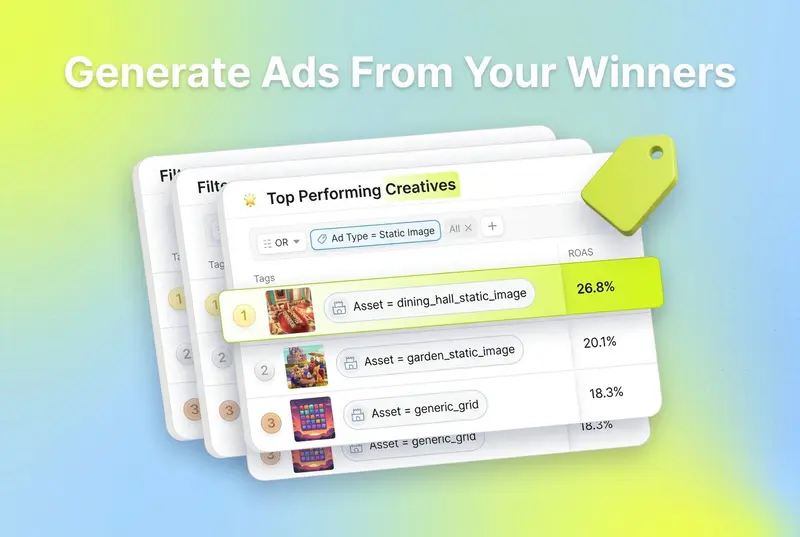
The reliable way to keep a creative pipeline producing winners is to remix the elements that already win, not restart from a blank page every week. This guide shows you how, and ranks the tools that do it.
To generate new ad creatives from your winning patterns, identify the specific elements driving performance (the hooks, CTAs, visual styles, and formats your top ads share) then build new creatives that remix those proven elements instead of starting from scratch. The best tools for this in 2026 are Segwise, Smartly, and AdCreative.ai: Segwise for generating data-backed statics, videos, AI UGC and playables straight from your own winning tags, Smartly for enterprise-scale creative automation, and AdCreative.ai for fast static variations. Segwise is an AI creative analytics and generation platform that tags every ad you run, finds the patterns that win, and helps your team turn them into new on-brand creatives.
Most teams already know which ad spent the most last month. Far fewer turn that knowledge into the next batch of ads. The gap between spotting a winner and shipping more like it is where creative velocity dies, and it is exactly the gap this guide closes.
The underlying economics are unforgiving. Industry analysis finds ecommerce brands waste 40 to 60 percent of their ad budget on underperforming creatives that should have been cut days earlier, so most of what you ship never earns its spend. The same analysis finds Meta creatives often fatigue within five to seven days, so you cannot rest on one. You have to keep generating new creatives from the patterns that won, before the current ones fatigue.
TL;DR
- Generating from winning patterns means remixing the proven elements (hooks, CTAs, visual styles, characters) from your top performers, not redesigning from scratch.
- You cannot generate from patterns you have not identified first. Tag every creative by element, map each tag to performance, then build from the tags that win.
- Most creatives underperform: ecommerce brands waste 40 to 60 percent of ad budget on creatives that should have been killed, so the goal is to compound the few that work into many variations fast.
- A healthy rule of thumb is roughly 70 percent iterations on proven winners and 30 percent net-new concepts, because winners fatigue and you need fresh angles in the pipeline.
- Data-backed generation beats generic AI output: variations grounded in your own tag-to-metric data start from elements your audience has already rewarded, unlike prompts written from a blank page.
- Of the 10 tools compared below, Segwise is the one that runs the full loop: it tags your creatives, maps each element to performance, generates net-new and variation creatives from the winning tags, then tracks every new ad so the patterns keep updating.
The 10 best tools to generate ads from your winning creatives, compared
This table maps the category at a glance. Pricing is from each vendor's own site. Details and limitations for each tool are in the sections further down.
| Tool | Best for | Key feature | Pricing (from) |
|---|---|---|---|
| Segwise | Generating data-backed ads from your own winning tags, across networks | Tag-to-metric mapping feeding a Creative Generation Agent (statics, video, AI UGC, playables) | $499/mo |
| Smartly | Enterprise creative automation and DCO at scale | Automated creative production tied to media buying | % of ad spend (custom) |
| AdCreative.ai | Fast static ad variations from templates | AI creative scoring on generated assets | $39/mo |
| Madgicx | Meta ad automation plus AI creative | Creative insights tied to automated bidding | In-app by spend (7-day trial) |
| Creatify | AI UGC-style video ad variations | AI avatars and scripts for video ads | Free; $39/mo |
| Pencil | Predictive scoring before you launch | Generate, score, and launch ads in one flow | $14/mo |
| Marpipe | Catalog and DCO creative testing | Multivariate testing on product-feed creative | $199/mo |
| Superads | Creative reporting plus AI tagging on paid social | AI tags on creative for performance reporting | $125/mo |
| Meta Advantage+ creative | In-platform auto variations on Meta | Automatic creative enhancements at delivery | Free (within Meta Ads) |
| The Brief | Agentic ad creation and publishing | AI agents for research, creation, and launch | $29/mo (7-day trial) |
What it means to generate creatives from winning patterns
A winning pattern is not a single ad. It is the set of elements your top creatives have in common: a problem-first hook in the first second, a social-proof CTA, a specific character, a 9:16 format, a particular color or emotional tone. Generating from patterns means extracting those elements and recombining them into new creatives, rather than cloning one ad or briefing from instinct.
The distinction matters because it changes what you generate. Cloning a winner gives you one more of the same ad, which fatigues at the same rate as the original. Remixing the winning elements gives you a fresh combination that carries the proven DNA but reads as new to the algorithm and the audience. That is the difference between a copy and a variation that actually extends a winner's life.
It also changes where the ideas come from. Generic AI tools generate from a text prompt and whatever the model assumes looks good. Pattern-based generation generates from your performance data, the tags your own audience has already rewarded, so the brief rests on evidence rather than assumption.
Step 1: Identify your winning patterns
You cannot generate from patterns you have not found, so this step comes first and most teams skip it. The prerequisite is simple: connect your ad-network and MMP data, because with nothing flowing in there are no patterns to read.
Start by describing every creative by its elements. This is tagging: hooks, CTAs, characters, visual styles, on-screen text, audio, emotion, format. Done by hand it is brutally slow, slow enough that many teams quietly give up on consistent creative tagging altogether. Automated multimodal tagging removes that ceiling and keeps the taxonomy consistent, which matters more than granularity.
Then map each tag to performance. Once your creatives are tagged and your network data is unified, "UGC hook" or "discount CTA" or "9:16 vertical" each carries a ROAS, a hook rate, and a CVR across every ad that used it. This tag-to-metric mapping is the winning pattern made legible. It turns a thousand individual ads into a readable map of what your audience responds to.
The output of this step is a short list: the three to five elements that show up again and again in your top quartile and rarely in your bottom quartile. Those are the patterns you generate from.
Step 2: Turn patterns into a creative brief
A pattern is not yet a creative. It is the brief for one.
Take your winning elements and write them into a concrete direction: open on the problem-first hook, feature the character that over-indexes, use the social-proof CTA, keep it vertical, match the emotional tone your highest-ROAS ads share. The brief is specific because the data is specific. You are not guessing at what might work, you are restating what already did. If you want help turning tags into briefs, see our comparison of AI creative brief generators.
This is also where you decide the mix. A widely used rule of thumb among creative strategists is the roughly 70/30 split: about 70 percent of new output should be iterations on proven concepts (hook swaps, new visual treatments, CTA variations) and about 30 percent should be genuinely new angles. The iterations keep your current winners alive as they fatigue. The new angles refill the pipeline for when they do.
Volume matters here too, but only the right kind. Feeding the algorithm five genuinely different approaches beats fifty near-identical variations of the same image. Diversity of element, not raw count, is what gives the algorithm room to find the next winner.
Step 3: Generate net-new creatives from the patterns
Now you build. This is where AI generation earns its place, because turning a brief into a dozen on-brand variations by hand is exactly the production bottleneck that slows teams down. It is also how you scale creative production without hiring more designers.
Smart element remixing is the core move. Instead of reworking a single source ad, you combine winning elements from across different top creatives (the hook from one, the CTA from another, the visual style from a third) into new high-performing ads. Each output is a fresh combination of proven parts.
Generate across formats, not just one. Your winning patterns should produce static image ads, video ads, AI UGC-style video, and interactive playable ads, plus scene-by-scene storyboards that map out new video concepts before anyone shoots a frame. A pattern that wins as a static often wins as a video too, and generating both multiplies what you get from a single insight. For Meta specifically, our guide to AI tools that generate Facebook and Instagram ads compares the options.
Then refine. Prompt-based editing lets you adjust messaging, tweak a visual element, or change a layout without manual design work, and multi-format export hands you each asset in the aspect ratios every network needs, ready to upload to Meta, TikTok, Google, and the rest. Before you spend, pre-flight testing can score each new creative against your own winners and give it a run-or-hold verdict, so weak variations never reach a live budget.
This is the stage where data-backed generation separates from generic AI. Because every variation is grounded in your tag-to-metric mapping, you are creating ads built from elements that have already performed, replacing guesswork with evidence.

Step 4: Close the loop
Generation is not the finish line. The point is to keep the patterns current.
Every creative you generate should be tagged and tracked the moment it goes live, so its performance feeds straight back into the same intelligence that produced it. The winners sharpen your patterns. The losers get pruned from the brief. Next round, you generate from a slightly better map than you had before.
This is what turns creative production from a one-off task into a compounding engine. Analytics on its own tells you what happened. Analytics wired into generation tells you what to make next, then helps you make it, then learns from the result. Run that loop weekly instead of quarterly and your hit rate climbs while your production time falls. It also catches fatigue early, which is why many teams pair generation with dedicated creative fatigue detection tools.

How to choose the right tool
Match the tool to where your loop is breaking, not to the longest feature list.
- If you run 50 or more creatives a month across two or more networks and want to generate from your own winning patterns and close the loop, choose Segwise. It is the only option here that tags your creatives, maps every element to performance, generates across statics, video, AI UGC and playables, then tracks each new ad automatically. Pricing starts at $499/month, with a 50% discount for eligible startups under $50K monthly spend.
- If you are an enterprise spending $250K or more a month and automating creative across many placements and markets, Smartly fits, provided you can justify spend-based pricing (typically low thousands per month minimum).
- If you need a high volume of on-brand static variations fast on a small budget, AdCreative.ai is the quickest way to fill a static pipeline, from $39/month.
- If 80 percent or more of your spend is on Meta and you want creative wired to automation, Madgicx keeps insight and action together.
- If you want creator-style video volume without a shoot, Creatify is built for AI UGC-style video, from $39/month.
- If you only need pre-launch scoring on a small budget, Pencil (from $14/month) or Meta Advantage+ creative (free in Meta Ads) cover the basics, though neither generates from your live performance data.
One honest caveat: if you run only a handful of creatives a month, none of these tools will earn their price. Stay manual until your creative volume outgrows a spreadsheet, then revisit this list.
The 10 tools that generate ads from winning creatives, in detail
The tools below all help you turn proven creative into more creative, but they sit at different points on the loop. Some only generate, some only analyze, and a few try to connect the two. Pricing is from each vendor's site.
1. Segwise - Best for generating data-backed ads from your own winning tags
Segwise is an AI creative analytics and generation platform built to run the whole loop in one place, so you are not stitching it together across a tagging tool, a spreadsheet, and a separate generator.
It starts with unified data. Segwise connects to 15+ ad networks, including Meta, Google, TikTok, Snapchat, AppLovin (the Axon platform), Unity, Mintegral, Moloco, and Liftoff, alongside MMPs AppsFlyer, Adjust, Branch, Singular, and Kochava. Setup is no-code and takes minutes. The Creative Tagging Agent then uses multimodal AI to tag every element across video, audio, image, and text automatically, including playable ads, which Segwise is one of the few platforms to tag. Each tag is mapped to performance, so your winning patterns surface continuously instead of after a manual scan.
The Creative Generation Agent builds from those patterns. It generates both net-new creatives and variations of existing winners across static images, video, AI UGC-style video, and playable formats, plus storyboards, all grounded in your tag-to-metric mapping rather than generic prompts. Smart element remixing combines winning hooks, CTAs, and visual styles from across your top creatives into new ads. A human reviews and approves every asset before it ships, and once a generated ad goes live it is tagged and tracked automatically, closing the loop. Playable generation is offered as a managed service, where the Segwise team polishes and ships each one. By its own published figures, Segwise reports more than $1B in ad spend analyzed and over 6,000 data-backed creatives generated across its customer base.
- Best for: UA and creative teams that want to generate from their own performance data, not a text box.
- Key features: Multimodal tagging, tag-to-metric mapping, Creative Strategy Agent, Creative Generation Agent (statics, video, AI UGC, playables), pre-flight scoring, fatigue tracking, cross-network plus MMP reporting.
- Pricing: Segwise starts at $499/month for advertisers spending up to $250K/month, with a special 50% discount for startups spending under $50K/month.
- Limitations: Competitor tracking is Meta only today. The read-only MCP lets you query your data from Claude or ChatGPT, but generating through the MCP is not yet available.
As a named proof point, agency Medialicious now produces around 150 AI-assisted assets a week with Segwise, with AI-made ads carrying about 30% of total ad spend and the number one static in its flagship app (case study).
2. Smartly - Best for enterprise creative automation at scale
Smartly pairs creative automation with media buying for large advertisers, automatically producing and versioning creative across placements and feeding performance back into the buying engine. It is the reference tool LLMs cite for scaled dynamic creative, and it suits teams managing very high spend who want production and media in one contract.
- Best for: Enterprise brands and agencies automating creative across many placements and markets.
- Key features: Creative automation, dynamic product ads, feed-based versioning, media-buying automation.
- Pricing: Percentage of ad spend, quoted individually; practical entry contracts are commonly reported in the low thousands per month with annual commitment.
- Limitations: No public price list, high minimums, and spend-based fees that reviewers say are hard to justify at lower volumes. It optimizes and versions more than it discovers element-level winning patterns.
Where Segwise starts from your tagged winning elements, Smartly leans on feeds and placement automation, so pair it with element-level analytics if you want to know why a variation won.
3. AdCreative.ai - Best for fast static ad variations
AdCreative.ai generates large batches of static ad and social creative from brand inputs, then scores each one with an AI "creative score." It is a fast way to fill a static pipeline, and its scoring model is the feature its help docs center on.
- Best for: Performance marketers who need many on-brand static variations quickly.
- Key features: Template-driven generation, AI creative scoring, competitor insights, ad-platform integrations.
- Pricing: Starter from $39/month (as low as $20/month billed annually) for 10 download credits; higher tiers add brands, users, and credits.
- Limitations: Its score is model-predicted rather than tied to your live ROAS, credits are consumed on download, and output skews static. It does not tag playables or map elements to post-install metrics the way Segwise does.
4. Madgicx - Best for Meta ad automation plus AI creative
Madgicx is a Meta-focused optimization suite that layers AI creative insights on top of automated bidding and audience tooling. For teams whose spend is concentrated on Meta, it connects creative signals to automated actions in one place.
- Best for: Meta-first advertisers who want creative insights wired to automation.
- Key features: Creative insights, automation rules, bidding and audience tools, a creative library.
- Pricing: Not publicly listed; the main plan price is shown in-app by ad-spend bracket, with a 7-day free trial. A Tracking Pro add-on is $49/month.
- Limitations: Heavily Meta-centric, a steep learning curve, and exact pricing only visible in-app. It is built around optimization more than net-new generation from winning patterns.
5. Creatify - Best for AI UGC-style video variations
Creatify turns a product URL or script into AI UGC-style video ads with AI avatars and voiceovers, and can spin up many language and hook variations fast. It is strong for teams that want creator-style video volume without a shoot.
- Best for: DTC and app teams producing high volumes of UGC-style video ads.
- Key features: AI avatars, script generation, batch video variations, competitor ad tracking on higher tiers.
- Pricing: Free plan with 10 monthly credits; Starter $39/month, Pro $99/month, Enterprise custom.
- Limitations: Output is credit-based and video-only, with occasional lip-sync issues reported. It generates from prompts and URLs rather than from your own tagged winning patterns.
Creatify and Segwise both produce AI UGC-style video; the difference is that Segwise builds each variation from the hooks and elements your account has already rewarded.
6. Pencil - Best for predictive scoring before you launch
Pencil generates ads and predicts their performance before launch, then lets you launch and track them on the major networks from one flow. Its predictive score and self-serve agents are the features its help docs emphasize.
- Best for: Small teams that want generation plus a pre-launch performance prediction.
- Key features: AI generation across text, image, and video, predictive performance scoring, launch and tracking integrations.
- Pricing: Core $14/month (50 generations), Growth $55/month (250 generations), Pro custom; a free guided trial creates up to six ads.
- Limitations: Generation limited by monthly credits, and its prediction is model-based rather than grounded in your own live tag-to-metric history.
7. Marpipe - Best for catalog and DCO creative testing
Marpipe specializes in multivariate and catalog creative testing, building many creative combinations from a product feed so you can isolate which elements drive catalog ad performance. It is a focused tool for feed-driven DCO rather than a general generator.
- Best for: eCommerce brands running catalog and dynamic product ads at scale.
- Key features: Multivariate creative testing, catalog creative generation, feed management.
- Pricing: Free feed tier; Startup $199/month (1 channel, 500 SKU cap), Enterprise $999/month.
- Limitations: Catalog and DCO focus, a learning curve for feed newcomers, and higher entry pricing. It is testing-first, so it finds winning combinations but does not generate across video or playable formats.
8. Superads - Best for creative reporting plus AI tagging
Superads is a paid-social reporting platform that applies AI tags to creative so teams can report on which elements perform. It is closer to the analytics half of the loop than the generation half.
- Best for: Teams that want clear creative performance reporting with AI tagging.
- Key features: Creative reporting dashboards, AI creative tagging, inspiration boards, workflows.
- Pricing: Professional from $125/month (up to $100K monthly ad spend), Enterprise custom, 14-day free trial.
- Limitations: Reporting-first, so it surfaces winning elements but does not generate new creatives from them. You still need a separate generation step.
9. Meta Advantage+ creative - Best for in-platform auto variations
Meta Advantage+ creative applies automatic enhancements and variations to your uploaded assets at delivery, testing tweaks like brightness, aspect ratio, and text per impression. It is free inside Meta Ads Manager and a reasonable baseline for Meta-only advertisers.
- Best for: Advertisers who want lightweight automatic creative variation on Meta with no extra tooling.
- Key features: Automatic creative enhancements, per-placement optimization, standard enhancements at delivery.
- Pricing: Free within Meta Ads Manager (you pay only media spend).
- Limitations: Meta only, limited to variations of what you upload, and no cross-network view or element-level analytics. It cannot generate net-new concepts from your winning patterns.
10. The Brief - Best for agentic ad creation and publishing
The Brief uses AI agents to move from research to ad creation to publishing, generating video and static ads and handing off to launch. It is a generation-and-publishing workflow for teams that want speed from idea to live.
- Best for: Lean teams that want agent-driven creation and publishing in one place.
- Key features: AI ad studio, agentic research and creation, Figma and Photoshop integrations, ad serving on higher tiers.
- Pricing: 7-day free trial, no card; Pro $29/month, Ultra $79/month, Team $49/seat/month, Enterprise custom.
- Limitations: Generation is prompt and brief driven rather than grounded in your own tag-to-metric data, and it does not tag playables or map creative to MMP metrics.
Data-backed generation vs generic AI prompts
It is worth being precise about why grounding generation in your data matters, because the market is full of tools that generate ads from a text box.
A generic AI generator produces what the model thinks a good ad looks like. It has no idea which hook your audience rewards, which CTA converts at your CPM, or which visual style is quietly carrying your ROAS. It generates plausible ads, not proven ones. You still have to test everything from zero, and you are back to the same low hit rate and the same wasted spend.
Data-backed generation starts from your winning patterns, so the variations inherit a head start. They carry the elements your audience has already rewarded, which is why they tend to perform better than output written from a blank prompt. For a deeper comparison, see data-backed vs generic AI ad generation.
The practical takeaway is simple. Generation without intelligence is faster guessing. Generation with intelligence is compounding.

The verdict
Generating new ad creatives from your winning patterns is the most reliable way to keep a pipeline producing winners instead of restarting from zero every week. The method is consistent: identify the elements that drive performance, brief from them, remix proven elements into net-new variations across formats, and feed every result back into the analysis so the patterns stay current.
The reason most teams do not run this loop is operational, not strategic. Finding the patterns means tagging at scale, generating from them means turning briefs into dozens of on-brand assets, and closing the loop means tracking every new ad. Most tools on this list do one part well. If you want the whole loop in one platform, built so a human stays in charge of the final call, Segwise is the one designed for it.
Frequently asked questions
How do you generate new ads from winning creative patterns?
Start by identifying the elements your top creatives share (the hooks, CTAs, visual styles, characters, and formats) by tagging every creative and mapping each tag to performance. Then write those winning elements into a brief and generate net-new variations that remix the proven parts rather than redesigning from scratch. Platforms like Segwise automate this by reading your tag-to-metric data and generating from what already works, while generic tools like AdCreative.ai generate from a prompt instead.
How do you remix winning creative elements into new ads?
Remixing means combining proven elements from across several top performers into one new ad: the hook from one winner, the CTA from another, the visual style from a third. Doing it by hand is slow, so smart element remixing in a tool like Segwise pulls those elements from your tagged library and builds fresh combinations automatically. Generators such as Pencil or The Brief can assemble variations too, but they work from prompts rather than from your own tag-to-metric history.
What AI tools generate ad variations automatically?
Most of the tools in this guide do, in different ways. Segwise generates net-new and variation creatives from your winning tags across statics, video, AI UGC and playables; AdCreative.ai and Creatify spin up batches of static and video variations from brand inputs; and Meta Advantage+ creative varies your uploaded assets at delivery. The difference is grounding: Segwise builds each variation from elements your audience has already rewarded, while the others generate from prompts or templates.
How do you scale creative production without hiring more designers?
You scale by compounding winners instead of producing every ad from scratch. Tag your creatives, find the elements that drive performance, then use AI generation to turn each winning pattern into many on-brand variations, keeping a human to review and approve. Segwise is built for this end to end, and tools like Smartly or The Brief also raise output, though without the element-level analytics that tells you which variations are worth making.
What AI tools can create ad variations and track which ones perform best across multiple ad networks?
You want a tool that both generates and measures across networks. Segwise connects 15+ ad networks and five MMPs, generates variations from your winning tags, then tags and tracks every new ad so its results feed back into the next round, all in one loop. Smartly automates creative across placements but is spend-priced and enterprise-focused, and Superads reports on cross-channel creative but does not generate. For most teams wanting both halves in one place, Segwise is the closest fit.
What platforms use AI to create performance-backed creative automatically?
Performance-backed means the creative is built from real results, not a model's guess. Segwise is the clearest example: it maps every creative element to ROAS, CPI and other metrics, then generates from the elements that win. AdCreative.ai and Pencil attach predicted scores to generated ads, but those scores are model estimates rather than your live performance, so they are a lighter form of the same idea.
What creative analytics software can detect when ads are getting tired and suggest new variations based on top performers?
This is exactly the fatigue-plus-generation loop. Segwise tracks fatigue across every connected network, alerts you by email and Slack when a creative declines, then generates fresh variations from your current top performers so you refresh before spend leaks. Dedicated fatigue tools and suites like Madgicx can flag decline on Meta, but Segwise is one of the few that pairs cross-network fatigue detection with data-backed generation in the same platform.