
Key Takeaways
Fatigue Reality: Ad fatigue occurs when audiences repeatedly see the same ad and stop engaging. This leads to declining CTR, rising CPC, and weakening ROAS even if the campaign initially performed well.
Early Signals: Watch for warning signs like rising frequency, falling engagement, lower conversion rates, and negative feedback. These signals usually appear before performance drops significantly.
Platform Differences: Ad fatigue appears at different speeds across platforms. Fast-scrolling feeds like Meta and TikTok fatigue quicker, while search and display campaigns decline more gradually.
Smart Prevention: Prevent fatigue by rotating formats, adjusting audiences, refreshing key creative elements, controlling frequency, and sequencing messages instead of repeating the same ad.
Creative Impact: Ad fatigue isn’t just about how often ads appear; it’s about the creative elements audiences repeatedly see. Platforms like Segwise help you monitor creative performance across networks so you can identify fatigue early and refresh ads before performance declines.
Are your best-performing ads suddenly slowing down?
You launch a winning campaign, scale it with confidence, and then performance quietly starts to slip. Engagement fades. CTR drops. ROAS weakens. When people see the same ad for the fifth or sixth time, they stop noticing it. What once felt fresh now feels repetitive. And by the time you finally react, your revenue trend is already moving in the wrong direction.
According to research, people who saw an ad 6–10 times were 4.1% less likely to buy the product than those who saw it 2–5 times, showing that repeated exposure can directly reduce effectiveness.
As a creative strategist, you’re expected to know what to refresh, what to pause, and what to scale before performance collapses. This blog covers how to detect ad fatigue early, diagnose and fix it fast, so your campaigns stay profitable.
What Is Ad Fatigue?
Ad fatigue happens when your audience sees the same ad too many times and stops responding to it. The message feels repetitive; engagement drops, and performance metrics decline. This simply means the more your audience sees the same ad, the less effective it becomes.
The psychological principle behind this is called habituation. When people see the same thing repeatedly, their brains automatically tune it out. This isn’t a conscious decision; it’s natural filtering that helps them ignore noise and focus on what feels new.
For you as a creative strategist, habituation is a silent budget killer. Your creative might be strong and your targeting precise, but if someone has already seen the ad five times, their brain may have dismissed it three impressions ago. If you don’t catch repetition early, you risk burning the budget on an audience that has already stopped listening.
Now that you understand what ad fatigue is, it’s important to look at why it happens.
Also Read: AI Ad Analysis Tools in 2025: Find What Drives Creative Success
Why Does Ad Fatigue Happen?
Ad fatigue happens because repetition reduces impact over time. When your campaign doesn’t evolve as quickly as audience exposure increases, performance naturally declines.
Here are the 6 main causes of advertising fatigue and why they hurt your campaigns: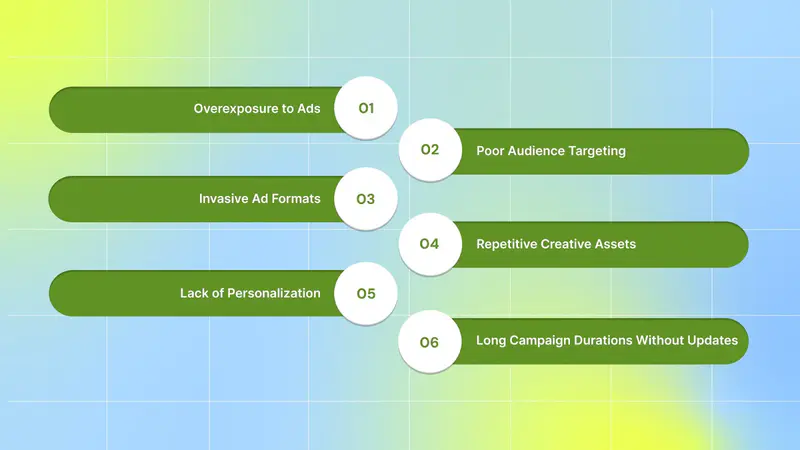
Overexposure to Ads: When users see the same ad too many times, they start tuning it out. What once grabbed attention now feels repetitive. High frequency increases ad blindness, which means you keep paying for impressions that no longer drive clicks.
Poor Audience Targeting: If your ads are shown to people who are not a strong fit, engagement drops quickly. As a creative strategist, you may build a strong concept, but weak targeting reduces relevance. Low relevance leads to lower CTR and faster fatigue.
Invasive Ad Formats: Unskippable videos or overly aggressive placements may increase visibility, but they can also create frustration. When users feel interrupted instead of interested, they disengage faster. This speeds up fatigue and can hurt overall performance.
Repetitive Creative Assets: Running the same video, headline, hook, or CTA for too long makes your campaign predictable. When nothing changes visually or emotionally, curiosity disappears. Without fresh variation, users stop reacting.
Lack of Personalization: Generic, one-size-fits-all messaging doesn’t hold attention for long. If your ad doesn’t reflect user intent or behavior, it feels irrelevant. Irrelevance reduces engagement and accelerates fatigue.
Long Campaign Durations Without Updates: Even strong campaigns lose impact over time. If you leave ads running on autopilot without testing, performance declines over time. What worked during launch won’t work forever at scale.
Whatever the cause, one thing is clear: if you don’t address ad fatigue early, it quietly drains your budget and weakens your campaign results before you fully notice it.
Once you understand what causes ad fatigue, the next step is recognizing when it starts affecting your campaigns.
Signs Your Ads Are Suffering From Ad Fatigue
Ad fatigue doesn’t appear overnight; it builds gradually. If you watch your performance metrics closely, the warning signs are usually visible before results fully decline.
One analysis found that 49% of consumers won’t buy from a brand if they see its ads too often, as repetition can cause annoyance and reduced engagement.
Here are the key signals you should monitor:
While the warning signs are similar, ad fatigue often differs across platforms.
How Ad Fatigue Differs Across Platforms
Ad fatigue doesn’t happen at the same speed everywhere. Each platform has different user behavior, content consumption patterns, and algorithm rules. As a creative strategist, you need to adjust refresh cycles and tactics based on where your ads are running.
But how can you tell when an ad is fatiguing when your data is scattered across multiple platforms? This is where a creative intelligence platform like Segwise comes in.
In many cases, fatigue isn’t just about exposure but about the repeated hooks, visuals, and messages inside the ad. Segwise brings cross-network creative and performance data into one unified view. This means you don't need to jump between Facebook Ads Manager, Google Ads, TikTok, and your MMP dashboard. Moreover, with cross-platform performance reports, you can track your creatives across platforms in unified reports. You can track performance for individual platforms or get consolidated cross-network insights.
Once you understand creative performance clearly, you can refresh ads more effectively, keep engagement high, and reduce ad fatigue across platforms.
Here’s how fatigue shows up and how you should respond:
1. Meta Ads (Facebook & Instagram)
Feed-based platforms create faster fatigue because users scroll constantly and see high ad volume. Engagement typically declines within 7–14 days. Smaller audiences can fatigue even faster.
What to watch
Frequency rising above 3, combined with falling CTR.
What to do
Use Dynamic Creative Optimization (DCO) to automatically rotate different images, headlines, and CTAs.
Use Carousel and Collection formats to introduce variation within a single ad unit.
Set frequency caps to prevent the same users from seeing your ad too often.
2. TikTok
TikTok users expect constant freshness. Content moves fast, and repetition feels obvious. Ad fatigue can appear within 5–7 days, especially when you scale aggressively.
What to watch
Drop in watch time and thumb-stop rate before CTR declines.
What to do
Create ads that match native TikTok trends, music, and editing styles.
Produce multiple ad variations for every concept.
Encourage user participation through branded hashtag challenges, fostering interaction and reducing traditional ad fatigue.
3. Google Ads (Search & Display)
Search fatigue is slower but driven by message repetition. Display fatigue happens faster due to banner blindness.
What to watch
Rising CPC with stable impressions in search. Declining engagement in display placements.
What to do
Use Responsive Search Ads (RSAs) to test multiple headline and description combinations automatically.
Enable ad rotation settings to distribute variations evenly.
Refresh messaging angles regularly to avoid repetition.
The next step is applying strategies that keep your campaigns fresh and effective.
8 Proven Strategies for Fighting Ad Fatigue
Fighting ad fatigue is not about reacting when performance collapses. It’s about controlling exposure, increasing variation, and adjusting distribution before your audience tunes out. As a creative strategist, you are responsible for protecting both attention and efficiency.
Here are 8 proven strategies you can use to prevent repetition from eroding performance and profitability:
1. Test New Ad Formats
When you use the same format repeatedly, your audience recognizes the structure instantly. Even if the message changes, the visual rhythm feels familiar. Over time, that familiarity reduces impact.
Test different formats intentionally. Rotate between short-form and long-form video, static images, carousels, collections, or playables depending on the platform. A format change can reset attention without forcing you to rebuild the entire campaign. This is especially useful when performance starts softening but hasn’t collapsed yet.
2. Expand or Narrow Audiences Intelligently
Audience size directly affects how fast ad fatigue builds. When frequency rises, it usually means your budget is moving faster than your audience pool. If frequency is climbing and your audience is small, expand targeting. Broaden interests, test adjacent segments, or build lookalikes from your best converters. Expansion brings fresh exposure and slows repetition.
If your audience is already broad and engagement is declining, the issue is relevance, not saturation. Narrow your targeting and tailor creative to specific segments. Higher relevance improves response and reduces fatigue.
Also, monitor audience overlap across campaigns. Showing the same users multiple ads from different ad sets accelerates fatigue and wastes budget.
3. Revisit Your Ad Schedule
Sometimes the issue isn’t the ad itself, it’s when your ads are being shown. If your audience sees the same ad repeatedly within short time windows, fatigue builds faster. Exposure timing can influence how quickly engagement drops, especially when campaigns run continuously without review.
Test different days and time slots to identify when your audience responds best. Consumer-focused campaigns often perform better during evenings or weekends, while certain high-intent segments engage more during working hours. Adjusting your schedule based on real engagement patterns reduces repeated exposure and slows down fatigue.
4. Set Dynamic Frequency Caps
Frequency is one of the earliest and clearest indicators of ad fatigue. As a starting point, keep prospecting campaigns around three impressions per person per week, then adjust based on performance data. The key is to make your caps flexible. For example, you might temporarily increase frequency during a flash sale or product launch, but keep it tighter for always-on awareness campaigns.
Go a step further by setting automated rules. Instead of manually checking frequency every day, create rules that pause ads when exposure rises too high, or engagement drops below a defined threshold. For instance, pause an ad if frequency exceeds five and CTR falls below your acceptable benchmark.
5. Use Sequential Messaging to Reduce Repetition
Instead of showing the same ad repeatedly, design a sequence that evolves over time. Sequential messaging accepts that users may see multiple ads from you and turns that exposure into a structured journey. Rather than repeating one message, you guide them through different value points step by step.
Start with a broad introduction in the first touch. If they don’t convert, follow up with a second ad that highlights a different benefit, feature, or proof point. This works especially well in retargeting, where users already know your brand. Showing something new keeps attention alive and reduces the feeling of repetition that leads to ad fatigue.
6. Rotate Your Offer
Even a strong offer can lose impact when it’s shown too many times. If your audience keeps seeing the same discount, benefit, or feature highlight, the urgency fades. What once felt compelling starts to feel predictable, and response rates slowly decline.
Instead of relying on one angle, rotate your value proposition. Test different benefits, bundles, pricing messages, or feature-led hooks. Sometimes shifting the offer or positioning is enough to reset attention and extend campaign performance.
7. Refresh High-Impact Elements Instead of Rebuilding Entire Ads
You don’t need to rebuild an entire ad every time fatigue appears. Instead, create modular templates that allow you to swap key elements quickly. This approach helps you preserve what’s already working while refreshing the parts your audience notices first. It saves production time and keeps your creative pipeline efficient.
Start with high-impact elements. Update primary visuals or opening video frames first, since they control scroll-stopping power. Next, adjust headlines and value propositions to shift the message slightly. Then refine CTAs or supporting copy if needed. By building a library of interchangeable components, you can assemble fresh variations in minutes instead of starting from scratch every time fatigue shows up.
8. Diversify Across Platforms to Slow Down Ad Fatigue
Ad fatigue can build faster when most of your budget is concentrated on a single platform. As spend increases, the algorithm repeatedly serves your ads to the same users within that platform. Over time, exposure becomes concentrated, and performance begins to soften.
Instead of scaling aggressively in one channel, distribute your budget across multiple platforms. Running campaigns across Meta, TikTok, Google, or other relevant networks spreads impressions across different users and behaviors. This reduces repeated exposure within any one platform and helps extend the performance life of your campaigns.
As a creative strategist, fighting ad fatigue is about managing attention like a limited resource. If you control exposure and rotate intelligently, you protect both performance and profitability.
Also Read: How to Use Google Ads Lookalike Audiences to Reach High-Intent Users
Conclusion
Fighting ad fatigue is not about constantly chasing new ideas; it’s about managing exposure intelligently. When the same audience sees the same ad too often, engagement weakens, costs rise, and profitability slowly erodes. By understanding the causes, watching the right early signals, and adjusting distribution before performance collapses, you stay in control.
But how do you track ad fatigue accurately when your data is scattered across Meta, TikTok, Google, and your MMP dashboards? This is where a creative intelligence platform like Segwise comes in.
In many cases, the issue isn’t the ad placement itself, but the creative elements within the ad. When the same hooks, visuals, and messages appear repeatedly, audiences quickly recognize the pattern and stop responding.
Segwise creative analytics unifies data through direct integration with Facebook Ads Manager, Google Ads, TikTok, and your MMP dashboard. You can now bring all your creative and performance data into one platform. Moreover, our multimodal AI creative tagging automatically tags every creative element (hook dialogs, characters, products, CTAs, emotions, and more) and maps them to performance metrics so you can see exactly what's working across all ad networks.
With Segwise fatigue tracking, you can monitor all creatives across platforms for performance decline patterns, so you catch fatigue before burning budget. Also, you can set custom success criteria for fatigue and get alerts when ads need attention. Moreover with cross-network
visibility, you can monitor creative performance across all platforms in unified tracking reports.
In short, when creative performance is monitored and improved using performance data, ads stay effective for longer. This leads to better engagement and more efficient ad spend. In the long run, better creative performance directly strengthens ad performance and helps reduce ad fatigue.
So, why wait? Start your free trial and uncover which creative elements keep engagement high, ultimately preventing ad fatigue from draining your budget.