AI-generated ad creative measurably performs, but only when it is grounded in your own performance data. The proof below comes from four user acquisition teams running real budgets on Segwise: Medialicious now runs about 30% of its total ad spend on Segwise-generated creatives, and Influence Mobile saw a 10% D7 ROAS lift on creatives built from Segwise insights. Generation alone is not the win. Generation tied to what your winning ads are already doing is.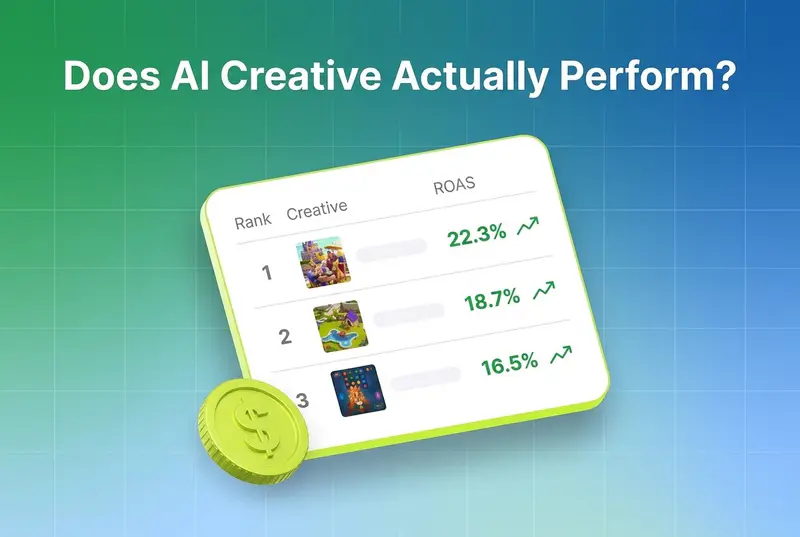
The honest version of the question
Every UA team is being sold the same promise right now: point an AI at a brief, get a stack of ads, watch performance climb. Some of that is real. A lot of it is a demo that never survives contact with a live account.
So we stopped arguing about it in the abstract and looked at what actually happened inside four accounts using Segwise to generate and analyze creative. Two of them have public performance numbers. Two of them do not, so we keep those qualitative instead of inventing figures. We also pulled in three pieces of outside research, because four accounts is a story, not a law.
Here is the short answer: the teams that got a lift did not treat AI as a creative vending machine. They fed it their own tag-to-metric data, generated from proven winning elements, and killed fatiguing creatives early. The generation and the analysis were the same loop. That distinction turns out to be the whole game.
Key takeaways
Creative is the single biggest driver of ad sales, responsible for roughly half of incremental sales (about 49%) according to NCSolutions research. AI that improves creative is pulling the biggest lever there is.
In a 2026 NYU and Emory field experiment on the Google Display Network, ads built from scratch by AI drove a 19% higher click-through rate than human-made ads, while ads where AI only edited existing human designs showed no lift. How the AI is used matters more than whether AI is used.
Medialicious runs about 30% of its total ad spend on Segwise-generated creatives, downloads roughly 150 assets a week across four apps, and the number one static in its flagship app is a Segwise creative.
Influence Mobile recorded a 10% D7 ROAS lift and a 9% D1 ROAS lift on creatives built from Segwise insights, now sends about 30% of monthly spend to those creatives, and saved four to five hours a week on manual tracking.
Mode Mobile and Namma Yatri use Segwise to catch breakout winners and creative fatigue early. Namma Yatri's early AI image tests were mixed, which is the honest result and a useful caution.
The common thread across all four is not generation. It is data-grounded generation plus early fatigue and winner detection, working as one closed loop.
The four teams at a glance
What the research says before we get to the accounts

Two things are worth holding in your head before reading the customer stories, because they explain why the results look the way they do.
First, creative is where the leverage is. NCSolutions analyzed hundreds of sales-effect studies and found creative quality and messaging drives about 49% of a brand's incremental sales, the largest single factor, ahead of media, targeting, and brand. Meta's own work with the research firm Nepa, folded into Nielsen marketing mix models, found that following creative best practices can drive a 1.2 to 2.7 times increase in long-term sales. If AI touches creative and gets it even slightly more right, it is moving the biggest number on the board.
Second, and this is the part most AI-creative pitches skip: not all AI creative is equal. In the 2026 NYU and Emory field experiment, fully AI-created ads beat the human control group on click-through rate by 19%. But ads where AI only modified existing human designs, swapping a background or a face, showed no improvement and sometimes performed worse. The researchers linked the difference to creative freedom versus working inside rigid constraints. Read another way: AI wins when it generates something coherent from real direction, not when it patches a human ad it does not understand.
That is the exact seam the four teams below are working. Their AI creative is grounded in what their own data says wins, then generated fresh. Now the accounts.
Medialicious: 30% of ad spend, on schedule
Medialicious is a digital ad agency running user acquisition across multiple brands and apps. Their problem was not ideas. It was throughput. Producing enough on-brand creative, fast enough, across four apps at once, without the team drowning in briefs and revisions.
They wired Segwise into three jobs at once. The Creative Tagging Agent tags every ad automatically, building the data layer. The Creative Strategy Agent reads that performance data and flags which patterns are winning and which are fatiguing. The Creative Generation Agent then produces fresh static, video, and playable creatives every week from those winning patterns, sized for each network and kept on-brand with the agency's own brand decks and style guides. The generation is grounded in the analysis, not separate from it.
The result is the most concrete answer in this piece. About 30% of Medialicious's total ad spend now runs on Segwise-generated creatives. The team downloads roughly 150 assets a week across four apps. And the single best-performing static in their flagship app is a Segwise creative, not a hand-made one.
"Segwise changed how our team operates," says Chris Aust, Head of Marketing Operations at Medialicious. "It reads our performance data, spots the winning patterns, and turns them into fresh on-brand creative across every brand we run, all on schedule."
The takeaway: when generation is fed by live performance data and constrained by real brand guidelines, an agency can put a third of its budget behind machine-made ads and trust them to hold the top spot.
Influence Mobile: a real ROAS lift, not a vibe
Influence Mobile runs Rewarded Play, a rewards app, and this is the account with the cleanest performance read because they moved off manual tracking to get it.
Before Segwise, their creative testing lived on a Monday.com board and their creative lead's judgment. When he said something would work, the team mostly had to take his word for it. Segwise automatically tagged every creative, tied each tag to performance metrics, and surfaced which specific elements drove results. In their case, particular background elements turned out to be moving day-one ROAS.
The numbers: creatives built from those Segwise insights delivered a 10% lift in D7 ROAS and a 9% lift in D1 ROAS. About 30% of monthly spend now goes to these creatives, and the team saved four to five hours a week that used to go into manual tracking.
"Before, if our creative lead said something would work, we kind of just had to trust him," says Daniel Todd, CEO of Influence Mobile. "Now he can show you exactly what's driving it, and our briefs are a lot clearer."
That last line is the quiet point. The ROAS lift is nice, but the durable win is that briefs got clearer. The AI did not replace the creative lead. It gave him evidence, and evidence compounds.
Mode Mobile: speed as the whole point
Mode Mobile acquires and operates consumer apps, including the Mode Earn App, NGL, Trimbox, and Applock Pro. At their scale, no team can afford to sit on a creative decision for a week. This account has no public performance metrics, so we will not invent any. What it shows is a different kind of value: tempo.
Mode Mobile uses Segwise creative tagging to define what a winning creative even means for their ads, tracking performance at the element level by hook, format, and concept rather than judging whole ads. The Creative Strategy Agent flags breakout creatives earlier in their lifecycle, so the team scales winners while the momentum is still there instead of noticing them after the window closed. Fatigue detection catches decline before the budget is gone, which kills the post-mortem on already-wasted spend. And Slack reporting replaced the manual cross-network compila tion that used to eat mornings.
Then the loop closes: the team generates new static assets directly from the top-performing elements Segwise identifies, so new concepts start from proven winners rather than a blank page.
"For any UA or growth team trying to scale creative output without scaling headcount, Segwise is the tool I'd point them to," says Nick Cullen, Director of UA and Growth at Mode Mobile. Their Ad Creative Lead, Gianne Denise Roque, singled out the automated Slack reporting as a big time save that lets the team spend its hours on strategy instead of data pulls.
The takeaway: AI creative performance is not only measured in ROAS points. Catching a winner three days earlier, or a fatiguing ad before it burns another week of budget, is performance too. It just shows up as spend you did not waste.
Namma Yatri: the honest, mixed result
Namma Yatri is a ride-hailing app operating across Indian cities, and we are including it partly because it is the least tidy story. That is the point.
The clear wins are analytical. The team identifies winning creative themes across campaigns, objectives, and cities, then hands designers data-backed direction instead of intuition. They query performance in plain language through Segwise's in-app Creative Strategy Agent rather than digging through dashboards, asking questions in everyday words and getting answers pulled straight from their own ad data. Weekly campaign-health alerts flag declining creative before it burns real budget. And a region-split account structure keeps each city's data isolated, which matters a lot when a creative that works in one city flops in another.
"We've been able to identify patterns across campaigns, objectives, and cities, which has helped us give our design team much clearer direction on what's actually working instead of relying on intuition," says Aswin, Performance Marketing Lead at Namma Yatri.
Here is the honest part. Their early tests of AI-generated images were mixed, not a runaway win, though promising enough to keep testing. We are leaving that in on purpose. Anyone telling you AI creative is an unbroken series of victories is selling something. For Namma Yatri, the analytical layer paid off immediately and the generation layer is still earning its place. Both things are true.
What actually made the AI creative work

Line the four accounts up and the pattern is obvious, and it is not the pattern the market advertises.
The teams that got a measurable lift did not win because they generated ads with AI. They won because generation and analysis were the same system. Segwise tags every creative, maps tags to metrics, finds the winning elements, and then generates new creatives from those specific winners. The NYU and Emory finding predicted this: AI that creates from real direction outperforms AI that blindly edits. Data-grounded generation is the from-scratch, high-freedom version. It works.
The second ingredient is timing. Every one of these teams uses Segwise to catch fatigue and breakouts early. A winning creative you scale three days sooner and a fatiguing one you pause a week earlier both improve blended ROAS without a single new asset. Generation gets the headlines. Detection quietly protects the budget.
So the real if-then reads like this. If you have enough creative volume to give an AI real patterns to learn from, grounded generation plus early detection will move your numbers, as it did for Medialicious and Influence Mobile. If you run a portfolio at speed, the same loop buys you tempo, as it does for Mode Mobile. If you operate across fragmented markets, the analytical layer pays off first and generation earns in over time, which is Namma Yatri's path. And if you have almost no creative history yet, AI generation has little to ground itself in, and you should expect mixed results until you do.
Where AI-generated creative does not help yet

A fair piece names the limits. Based on these accounts and the outside research, here is where AI creative underdelivers.
It struggles without data to stand on. Grounded generation needs a body of tagged, performance-mapped creative to learn from. New apps and tiny accounts do not have that yet, which is a large part of why Namma Yatri's early image tests came back mixed.
Blind editing is a trap. The NYU and Emory experiment is blunt: AI that only modifies existing human ads showed no lift and sometimes did worse. If your workflow is "AI, swap the background," do not expect the created-from-scratch numbers.
Disclosure carries a cost. The same study found that labeling an ad as AI-generated cut clicks by about 31.5% versus an unlabeled human ad. That is a real tension between transparency rules and performance, and it is not solved yet.
Brand nuance still needs a human. Medialicious got machine creative to hold the top spot, but only by feeding Segwise brand decks and style guides. The judgment about what "on-brand" means did not disappear. It moved upstream into the constraints.
None of this makes AI creative a gimmick. It makes it a tool with a shape. Point it at the jobs it is good at, ground it in your data, and keep a human on brand and on strategy.
Bottom line
AI-generated ad creative works when it is grounded in your own performance data and paired with early fatigue and winner detection. That is what separates Medialicious running 30% of spend on generated creatives, and Influence Mobile's 10% D7 ROAS lift, from the demos that fizzle in a live account. Generation alone is a coin flip. Generation wired into analysis, on the biggest lever in advertising, is a system. If you want the same loop of grounded generation, creative tagging, and fatigue detection in one place, that is what Segwise is built to do.
FAQ
Does AI-generated ad creative actually beat human-made ads?
Sometimes, and it depends entirely on how the AI is used. A 2026 NYU and Emory field experiment found AI-created ads earned a 19% higher click-through rate than human-made ads, while AI-modified ads showed no lift. In practice, teams like Medialicious and Influence Mobile see gains when AI generates from their own winning creative patterns rather than editing blind. Tools like Segwise ground generation in tagged performance data, which is the version that tends to win.
What ROAS lift can AI creatives deliver?
There is no universal number, but real accounts give a range. Influence Mobile recorded a 10% D7 ROAS lift and a 9% D1 ROAS lift on creatives built from Segwise insights. Medialicious now runs about 30% of total ad spend on Segwise-generated creatives with the top static being a machine-made one. Lifts like these come from grounding creative in performance data, not from generic AI generation, and results vary with how much creative history the AI has to learn from.
Is AI-generated creative worth it for small ad budgets?
It is weakest exactly where data is thinnest. AI generation grounded in your winning patterns needs a body of tagged, performance-mapped creative to learn from, which small or new accounts often lack. Namma Yatri's early AI image tests came back mixed for related reasons. A platform like Segwise still adds value on small budgets through creative tagging and fatigue detection, but expect the generation upside to grow as your creative history does.
What is the difference between AI-generated and AI-edited ads?
AI-generated ads are built from scratch based on a brief or a set of winning elements. AI-edited ads take an existing human creative and change parts of it, like a background or a face. The NYU and Emory study found the from-scratch version drove a 19% CTR lift while editing existing ads did not. Segwise's generation works from your top-performing elements rather than patching one source ad, which mirrors the approach that performed better.
Does AI creative cause faster creative fatigue?
Higher creative volume can fatigue audiences faster if you flood them with near-identical variations. The teams here avoid that by pairing generation with detection: Mode Mobile and Namma Yatri use Segwise fatigue tracking to catch decline before budget is wasted, and Medialicious rotates fresh on-brand assets on a schedule. The fix is not less AI creative, it is watching spend-share and performance decline closely and pausing early.
Can Segwise generate video and UGC-style ads, or only static images?
Segwise generates across every format: static images, video ads, interactive playable ads, and AI UGC-style video ads. These are AI-generated, not filmed human creators. Medialicious, for example, produces static, video, and playable creatives weekly, all grounded in their winning creative patterns and sized for each network.
How do teams keep AI-generated creative on-brand?
By moving brand judgment upstream into the constraints the AI works within. Medialicious feeds Segwise its brand decks and style guides so generated creatives come out correctly sized and on-brand across networks. The AI handles throughput and grounding in performance data, while humans own what on-brand means. That division is why an agency can trust machine creative with a third of its budget.