# What Is an Ad Intelligence Solution and Why It Matters
Author: Brijesh Bharadwaj
Author URL: https://segwise.ai/blog/author/brijesh-bharadwaj
Published: 2026-02-19
Category: Creative Analytics
Category URL: https://segwise.ai/blog/category/creative-analytics
Meta Title: What Is an Ad Intelligence Solution and Why It Matters
Meta Description: Understand digital ad intelligence to track competitors, optimize budgets, and boost ROI by avoiding risks. Click to enhance your strategy!
Tags: creative analytics, creative intelligence, Performance Marketing
Tag URLs: creative analytics (https://segwise.ai/blog/tag/creative-analytics), creative intelligence (https://segwise.ai/blog/tag/creative-intelligence), Performance Marketing (https://segwise.ai/blog/tag/performance-marketing)
URL: https://segwise.ai/blog/digital-ad-intelligence-solution-importance
**_Are you spending thousands on ads across Meta, TikTok, and Google, but still don’t know which creative is actually driving results?_**
You launch new videos, test new hooks, but performance still feels unpredictable. Some creatives scale fast, while others die without a clear reason. Meanwhile, competitors keep launching winning ads, and you don’t know what they’re doing differently. Without clear insight into what works and why, you risk wasting budget, scaling the wrong [creatives](https://segwise.ai/blog/successful-ai-ad-creatives), and falling behind teams that iterate faster than you.
If you’re a creative strategist in mobile games, DTC, subscription apps, or a growth agency, this guide will help you fix that.. This blog covers what a digital ad intelligence solution is, how it helps you analyze creatives, track competitor strategies, and build a winning creative strategy based on data.
## **What is a Digital Ad Intelligence Solution?**
A digital ad intelligence solution gathers, aggregates, and analyzes data from your [ad campaigns](https://segwise.ai/blog/ad-creative-testing-strategies-guide) and competitors across all digital channels so that you can make data-informed decisions to improve your advertising and overall ad performance.
As a creative strategist, this gives you visibility into what actually drives results. You can see what works best, not just in your ads, but across your competitors and the broader market.
**Here’s how digital ad intelligence works:**
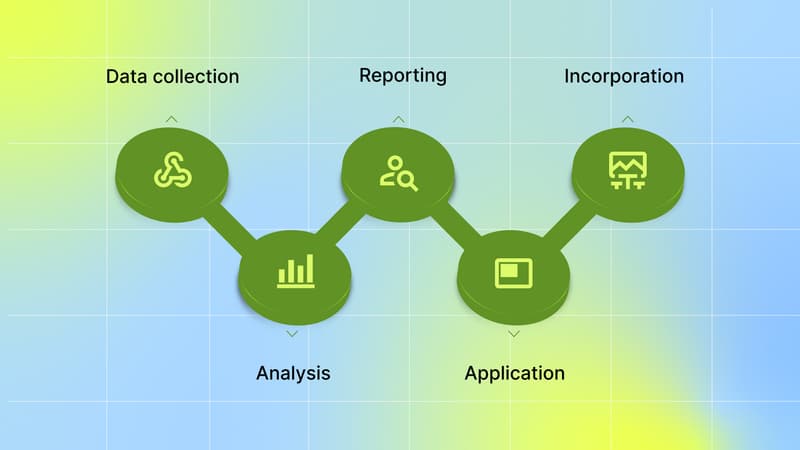
- **Data collection:** Ad intelligence tools collect data from ad platforms, tracking placements, audience targeting, creative variations, and competitor campaign activity.
- **Analysis:** AI analyzes this data to identify trends, estimate competitor spend, measure share of voice, and benchmark creative and campaign performance.
- **Reporting:** Dashboards present insights in clear visual reports, showing competitor creatives, strategies, and emerging market trends.
- **Application:** You use these insights to improve creatives, refine [targeting](https://segwise.ai/blog/mobile-targeting-best-practices), and optimize budget allocation based on real performance data.
- **Incorporation:** Over time, these insights become part of your ongoing strategy, helping you continuously improve creative performance and long-term growth.
Now that you understand what a digital ad intelligence solution is, the real question is how these insights translate into better campaign performance.
## **Why Ad Intelligence Solutions Matter?**
Ad intelligence solutions help you make smarter creative and campaign decisions by showing what works in your market. They give you clear visibility into competitor strategies, creative performance patterns, and budget trends so you can scale winning creatives faster.
**Here are the key reasons why ad intelligence solutions matter:**
- **Building data-driven advertising strategies:** When you don’t have market benchmarks, your strategy depends on internal testing alone, which slows learning. By analyzing which channels, formats, and creatives consistently drive competitors visibility, you can design campaigns.
- **Optimizing ad spend for higher ROI:** Spend estimates and performance benchmarks show which channels and creative formats deliver the strongest returns in your category. This helps you allocate your creative production and budget toward opportunities that are more likely to scale.
- **Identifying new market opportunities:** Without market visibility, you may miss opportunities that competitors haven’t fully explored. Ad intelligence helps you spot new creative trends and untapped audience segments early. This allows you to test new creative concepts before they become crowded, helping your team scale faster.
- **Improving campaign creative and messaging:** Access to competitor creative libraries shows which narratives, hooks, CTAs, and formats are being tested and scaled. This helps you refine your [creative briefs](https://segwise.ai/blog/crafting-winning-creative-brief), avoid saturated messaging, and consistently produce creatives that stay relevant and perform better.
Next, it’s important to understand the specific types of data digital ad intelligence tracks.
**_Also Read:_** [**_Understanding Creative Intelligence: Examples and Insights_**](https://segwise.ai/blog/understanding-creative-intelligence-examples-insights)
## **What Data Does Digital Ad Intelligence Track?**
Digital ad intelligence platforms track multiple types of data to help you understand competitor strategies, creative performance, and audience targeting. This data helps you improve and scale winning [campaigns](https://segwise.ai/blog/enhancing-creative-campaigns-ai-performance-marketing-strategies) faster.
**Here are the four key types of data that digital ad intelligence tracks:**
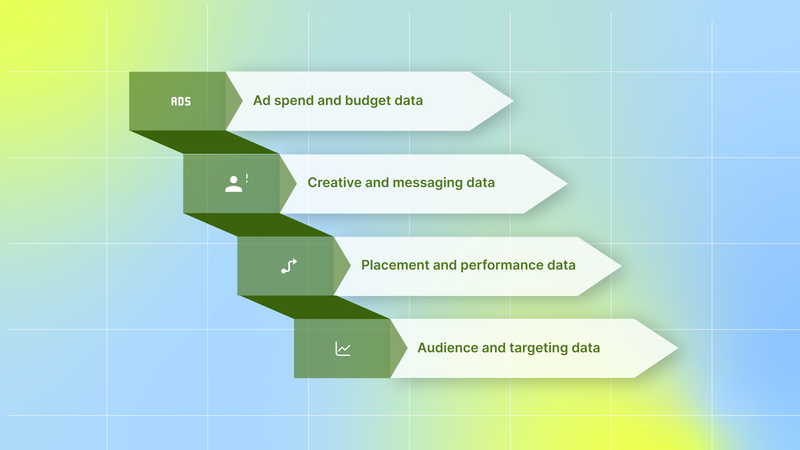
- **Ad spend and budget data:** Digital ad intelligence estimates how much competitors spend across platforms like Meta, TikTok, Google, display, and video. This helps you identify scaling patterns, seasonal trends, and where competitors focus their budget.
- **Creative and messaging data:** It tracks competitor creatives, including videos, images, hooks, headlines, CTAs, and messaging variations. This helps you understand which creative formats and messaging strategies competitors test and scale.
- **Placement and performance data:** It shows where competitor ads appear, including platforms, publishers, formats, and targeting. It also provides estimated performance insights like impressions, reach, and [engagement](https://segwise.ai/blog/interactive-ads-maximizing-audience-engagement).
- **Audience and targeting data:** It helps you understand which audience segments competitors target, including demographics, interests, and behavioral groups. This allows you to align your creative messaging with the right audience and identify new targeting opportunities.
Next, let’s see how digital ad intelligence helps you analyze competitor strategies across different advertising channels.
## **Ad Intelligence Across Different Channels**
A strong ad intelligence solution helps you understand competitor strategies across every channel where your ads run. As a creative strategist, this gives you the ability to build smarter, channel-specific creative strategies.
**Here are the key channels where ad intelligence helps you understand competitor strategy:**
### **1\. Social Media (Meta, TikTok, LinkedIn)**
Ad intelligence in social channels helps you track competitor video ads, reels, stories, and sponsored posts across platforms like Meta, TikTok, and LinkedIn. This helps you understand what creative approaches work best in fast-moving social feeds. With social ad intelligence, you can:
- Analyze which creative formats, hooks, and messaging competitors use and scale.
- Understand audience targeting patterns based on demographics, interests, and behaviors.
- Identify which creative styles and video formats drive the most engagement and attention.
This helps you design social creatives that align with proven performance patterns instead of testing blindly.
### **2\. Search Ads (Google)**
Search ad intelligence shows how competitors position themselves at the keyword and messaging level. With search ad intelligence, you can:
- Monitor competitor keyword focus and estimated spend priorities.
- Analyze competitor ad copy, messaging angles, and value propositions.
- Identify [keyword](https://segwise.ai/blog/prevent-keyword-cannibalization-google-ads) gaps that competitors haven’t fully captured.
This helps you create ad messaging that attracts high-intent users more effectively.
### **3\. Display & Video Ads**
Display and video ad intelligence helps you understand competitor strategies across apps, websites, and programmatic networks. With display and video ad intelligence, you can:
- See where competitors place their video and display ads across publisher networks.
- Analyze banner formats, video styles, and creative variations they use.
- Insights into video engagement and performance benchmarks.
This helps you improve your video creative strategy and scale formats that work.
### **4\. Connected TV (CTV) & Over-the-Top (OTT)**
CTV and OTT intelligence helps you track competitor ad activity across streaming platforms like YouTube TV, Roku, and Hulu. These channels are growing fast and require different creative strategies compared to social platforms. With CTV and OTT intelligence, you can:
- Monitor competitor ad placements across streaming platforms.
- Understand how competitors invest in high-growth video channels.
- Identify storytelling styles used in long-form video ads.
This helps you adapt your creative strategy for premium video environments.
### **5\. E-commerce & Marketplace Ads (Amazon)**
If you work with [DTC brands](https://segwise.ai/blog/best-ad-creative-management-tools-dtc-brands), marketplace ad intelligence helps you understand how competitors promote products within retail platforms. With marketplace ad intelligence, you can:
- Track competitor-sponsored product ads and display campaigns.
- Analyze creative messaging and positioning within product categories.
- Understand how competitors optimize creatives to drive product sales.
This helps you create product-focused creatives that convert better within marketplace environments.
By understanding competitor [creative strategies](https://segwise.ai/blog/winning-creative-strategy-guide) across all channels, you can build a stronger creative system. Instead of guessing what to produce next, you can focus on creatives that are more likely to perform and scale.
Next, you need a structured creative strategy that helps you identify, prioritize, and scale winning creatives with confidence.
## **How to Develop Your Ad Creative Strategy Using Ad Intelligence**
Ad intelligence only creates value when you use it to improve your creative and campaign decisions. As a creative strategist, a structured process helps you turn competitor insights into better creatives, smarter targeting, and more efficient budget allocation.
**Here are the key steps to use digital ad intelligence to build and scale a winning creative strategy:**
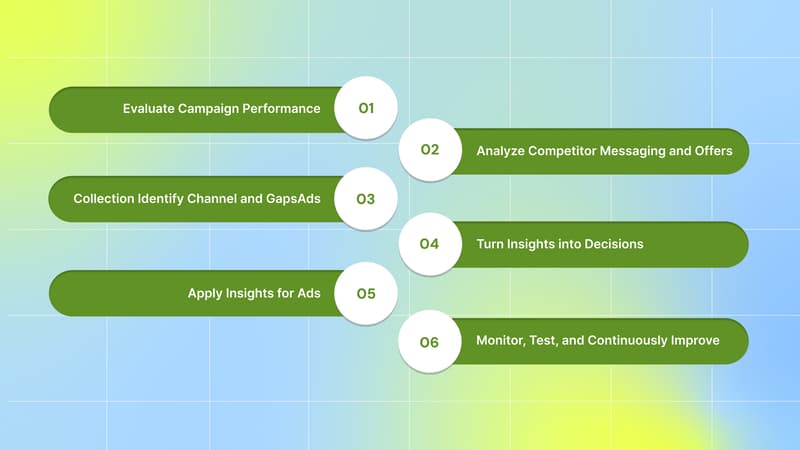
### **Step 1: Benchmark Your Current Campaign Performance**
Before analyzing competitors, establish a detailed view of your own performance. Document spend by channel, campaign objectives, and audience mix. Break this down by campaign type, funnel stage, and creative format.
Define the core KPIs you will use to compare yourself against competitors, typically cost per acquisition (CPA), [return on ad spend (ROAS)](https://segwise.ai/blog/roas-benchmarks-industry-standards), and impression share. These metrics create the context needed to evaluate whether competitor strategies are outperforming yours or whether observed tactics are actually less efficient than they appear.
Without this internal benchmark, competitive insights risk being misinterpreted as best practices rather than hypotheses to be validated.
### **Step 2: Analyze Competitor Messaging and Offers**
Select 3–5 direct competitors and study their active creatives across platforms. Track their creative formats, messaging angles, hooks, CTAs, and visual styles to understand what they consistently test and scale.
Pay attention to how they position their product or offer, whether they focus on price, product features, emotional storytelling, or urgency. This helps you identify patterns and messaging strategies that resonate with your shared audience.
### **Step 3: Identify Channel and Gaps**
Look for areas where competitors are less active or relying on similar creative approaches. These gaps may exist in certain platforms, creative formats, messaging angles, or audience segments.
Look deeper into audience coverage:
- Are competitors heavily invested in Gen Z social platforms but less present on professional networks?
- Do they target metro geographies while leaving suburban or secondary markets open?
These absences often indicate low-priority segments or resource constraints. Capturing share in these overlooked areas can deliver efficient wins before competitors redirect budget. You can use these opportunities to test new creative concepts, reach untapped audiences, and stand out from competitors.
### **Step 4: Turn Insights into Decisions**
Use competitor insights to improve your creative production and testing strategy. If competitors consistently scale certain hooks, formats, or storytelling styles, test similar approaches with your own creative variations.
At the same time, look for ways to differentiate your creative messaging to stand out. The goal is not to copy competitors, but to use insights to create stronger, more effective creatives.
### **Step 5: Apply Insights to Prioritize What to Create and Scale Next**
Digital ad intelligence helps you understand which creative concepts competitors scale and which ones they stop using. This allows you to prioritize high-potential creative ideas and avoid wasting effort on low-performing concepts.
You can also adapt creatives for each platform by understanding which formats and messaging styles work best on Meta, TikTok, YouTube, and other channels.
**_But how do you collect and analyze creative performance data from Meta, TikTok, Google, and other ad networks without manually switching between multiple dashboards?_**
**_This is where_** [**_Segwise_**](https://segwise.ai/) **_comes in. Segwise automatically integrates with your ad networks and MMPs to collect and unify creative performance data in one place. With_** [**_Segwise creative analytics_**](https://segwise.ai/features/creative-analytics) **_, you don't need to jump between Facebook Ads Manager, Google Ads, TikTok, and your MMP dashboard. This unified view lets you see creative-level ROAS, CPA, LTV, and conversion metrics from all sources in one_** [**_unified view_**](https://segwise.ai/features/creative-analytics) **_._**
All Your Creative Data and Teams in One Place for Smarter Decisions
Segwise unifies data from ad networks, MMPs, and CDPs so that teams can analyze and act on insights instantly.
[Explore Segwise](https://segwise.ai/) [Start for Free](https://auth.segwise.ai/en/login)
### **Step 6: Monitor, Test, and Continuously Improve**
Competitive intelligence is perishable. Ad spend shifts, creatives rotate, and audience targeting evolves in weeks, not quarters. Creative performance and competitor strategies change quickly, so review insights regularly. Monitor competitor creatives, test new ideas, and refine your strategy based on performance data.
Establish a weekly or monthly cadence to refresh competitor data, update your benchmarks, and validate the impact of your changes. Over time, this creates a continuous learning loop where your team produces better creatives, scales winners faster, and builds a stronger, data-driven creative system.
Once you have a structured process, the next step is to use a digital ad intelligence solution consistently and effectively to drive long-term creative performance and scalable growth.
## **Best Practices for Leveraging Digital Ad Intelligence**
Digital ad intelligence creates real impact when you use it to guide creative and campaign decisions, not when it sits unused in dashboards. As a creative strategist, following the right practices helps you turn insights into better performance.
**Here are the best practices to leverage digital ad intelligence effectively:**
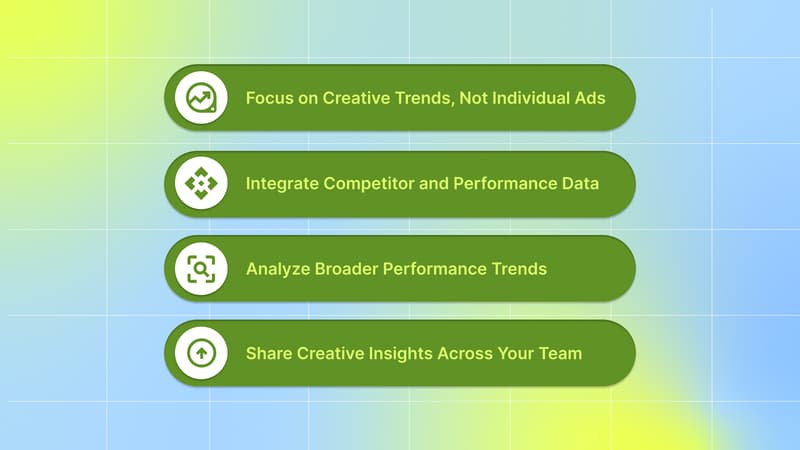
- **Focus on Creative Trends, Not Individual Ads:** Avoid reacting to every single creative competitor's launch. Instead, analyze patterns over time, such as recurring creative styles that consistently scale. These trends help you understand where competitors are investing and which creative approaches are likely driving results.
- **Combine Competitor Insights with Your Own Performance Data:** Competitor insights are most valuable when combined with your internal performance metrics. This helps you prioritize creative concepts that align with both market trends and your proven performance.
- **Analyze Performance Beyond Your Direct Competitors:** Don’t limit your analysis to direct competitors. Study strategies from adjacent industries, fast-growing brands, and top-performing advertisers across platforms like Meta and TikTok. This helps you discover new ideas that can differentiate your strategy.
- **Share Creative Insights Across Your Team:** Creative insights shouldn’t stay limited to one team. Share competitor creative patterns, messaging trends, and performance [insights](https://segwise.ai/blog/build-competitor-dashboard-insights) with creative strategists, designers, and marketing teams. This ensures everyone aligns on what works and produces creatives based on real market intelligence.
**_Also Read:_** [**_A Comprehensive Guide to Creative and Audience Intelligence_**](https://segwise.ai/blog/creative-audience-intelligence-guide)
## **Conclusion**
Digital ad intelligence helps you move from guesswork to data-driven decision-making. By analyzing competitor creatives, tracking performance trends, and understanding audience and channel patterns, you can identify which formats and messaging actually drive results. This allows you to produce stronger creatives, allocate budget more efficiently, and scale campaigns with confidence.
**_But how do you take digital ad intelligence further by connecting creative elements directly to performance outcomes and identifying which elements truly drive ROAS? This is where_** [**_Segwise_**](https://segwise.ai/) **_comes in._**
[Segwise](https://segwise.ai/) is a creative intelligence platform that automatically analyzes your creative data from 10+ ad networks and MMPs, automatically tags creative elements using multimodal [AI creative tagging](https://segwise.ai/features/creative-tagging), and provides actionable insights that improve creative ROAS. It connects creative elements (hooks, dialogs, visuals, formats, etc.) directly to business outcomes (ROAS, CPA/CPI, LTV, IPM, conversion rates), so teams stop guessing what works and start scaling creatives with data-backed confidence.
With [tag-level performance optimization](https://segwise.ai/features/creative-analytics), you can instantly see which creative elements, themes, and formats drive results across all your campaigns and apps. And with [fatigue tracking](https://segwise.ai/features/fatigue-tracking), you can catch performance decline before it impacts budget allocation and campaign results. Moreover, with [creative analytics](https://segwise.ai/features/creative-analytics), you don't need to jump between Facebook Ads Manager, Google Ads, TikTok, and your MMP dashboard. You can see creative-level ROAS, CPA, LTV, and conversion rates across all sources in a single unified view.
**_So, why wait?_** [**_Start your free trial_**](https://segwise.ai/) **_to turn creative data into a scalable competitive advantage to analyze your creatives, uncover winning patterns, and build a stronger creative strategy faster!_**
## FAQs
Q: How is ad intelligence different from traditional ad analytics?
A: Traditional ad analytics focuses on your own campaign performance, such as impressions, clicks, and conversions. Ad intelligence goes further by analyzing competitor ads, spend patterns, creative strategies, and market trends to help you benchmark and improve your advertising strategy.
Q: Who uses digital ad intelligence tools?
A: Ad intelligence tools are used by marketing teams, creative strategists, media buyers, and growth teams. These teams use insights to benchmark competitors, optimize creative performance, and improve campaign planning and budget allocation.
Q: How does ad intelligence help improve advertising ROI?
A: Ad intelligence helps improve ROI by identifying high-performing creative formats, optimizing channel allocation, and providing competitor benchmarks. These insights allow teams to allocate budget more efficiently and focus on strategies with the highest performance potential.
---
This blog is powered by Superblog. Visit https://superblog.ai to know more.
---