
The difference between data-backed and generic AI ad generation is the input. Generic AI generation works from a text prompt and a foundation model, producing creatives that look plausible but are disconnected from how your audience actually behaves. Data-backed generation is grounded in your own performance data, so every output is built from the creative elements your account has already proven drive results.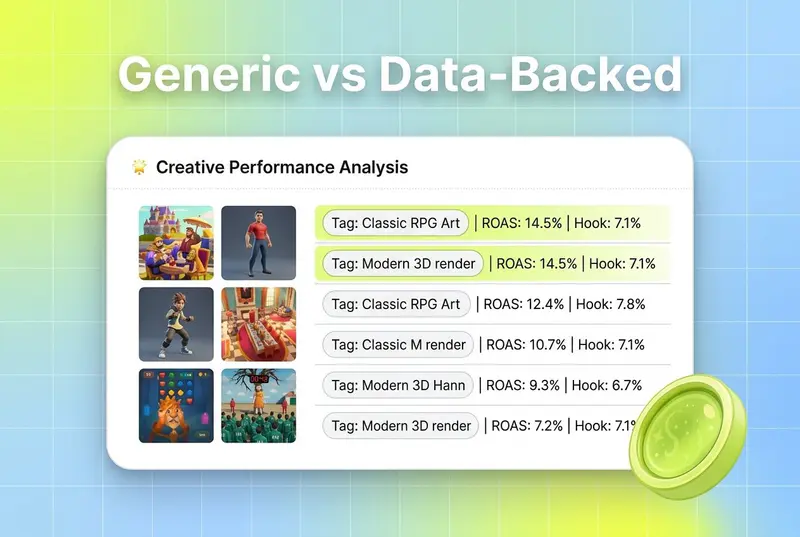
Almost every advertiser is about to generate ads with AI. Half of buyers already use generative AI to build video creative, and that number is climbing fast. The question is no longer whether you use AI to make ads. It is whether the AI making your ads knows anything about what works for you, or whether it is guessing from the same model everyone else is prompting.
That distinction sounds academic until you see it in spend. A generic AI ad generator gives you something fast and cheap. It also gives you something interchangeable, because it has no idea which hook held your viewers last quarter or which CTA converted at half the cost. Data-backed generation closes that gap by feeding the generator your tag-to-metric mapping and winning creative patterns first, so the output starts from evidence instead of a blank prompt.
This post breaks down what each approach actually is, why generic generation underperforms in practice, how grounding generation in performance data changes the outcome, and what the closed loop between analytics and generation looks like in real life.
Key takeaways
Generic AI ad generation produces creatives from a prompt and a foundation model with no link to your performance data, so output is plausible but interchangeable.
Data-backed generation is grounded in your tag-to-metric mapping and winning creative patterns, so each ad is built from elements already proven to work in your account.
Creative is the largest driver of sales, accounting for 49% of incremental sales, roughly 2.5 times what marketers assume, which is exactly why what you feed a generator matters.
AI generation is now mainstream: 30% of digital video ads are already built or enhanced with gen AI, projected to reach 39% in 2026, so the differentiator is the data behind the model, not the model itself.
Because most teams prompt the same foundation models, generic output converges toward sameness. One study found content became 15% more lexically diverse once a shared AI tool was removed.
The strongest setup is a closed loop: analytics finds your winning patterns, generation builds from them, and each new creative is tracked back in so the next round gets sharper.
What generic AI ad generation actually is
Generic AI ad generation starts and ends with a prompt. You describe what you want, a foundation model interprets it, and you get an image, a video, or a script back. The model draws on its general training, not on your account. It does not know your audience, your past tests, or your numbers.
This is useful for speed. You can spin up a dozen concepts in the time it used to take to write one brief. The catch is that speed without grounding just produces more guesses, faster. The model has no feedback loop. It cannot tell you which of those dozen concepts resembles last month's top performer, because it never saw last month's performance.
Generic tools also tend to converge. Most run on a handful of the same foundation models, so when everyone prompts the same way, the outputs start to look alike. Researchers studying this homogenization effect found that when a shared AI writing tool was removed from a market, the content people produced became 15% more lexically diverse and 12% more syntactically varied. For advertising, sameness is a real cost. If your ads look like everyone else's, you lose the one durable edge you still control.
What data-backed AI ad generation actually is
Data-backed generation flips the starting point. Instead of beginning with a prompt, it begins with your performance data. The system already knows which hooks, CTAs, characters, formats, and visual styles drove results in your account, and it builds new creatives from those proven elements.
The mechanism that makes this possible is tag-to-metric mapping. Every creative you have run is broken down into its elements and each element is mapped to the metrics it produced: ROAS, hook rate, CVR, CPI. Once you have that map, generation is no longer a guess. It is an instruction. Build more of what works, recombine the elements that win, and avoid the ones that do not.
This is the core of Segwise's Creative Generation Agent. It produces net-new and variation creatives across image, video, and playable formats, plus AI video storyboards, all grounded in your winning creative patterns rather than a generic prompt. It can remix winning elements from across your top performers into new ads, and it tracks every generated creative once live so its performance feeds straight back into the same intelligence that produced it.
Why generic generation underperforms
The case against generic generation is not that the output looks bad. Modern models produce clean, professional creatives. The problem is that visual polish has almost nothing to do with whether an ad sells.
Creative quality is the biggest lever in performance, but quality here means effectiveness, not aesthetics. NCSolutions analyzed nearly 450 sales-effect studies and found creative drives 49% of incremental sales, about 2.5 times what marketers assume, while targeting drives only 11%. If creative is that decisive, then a generator that ignores which of your creatives actually worked is optimizing for the wrong thing. It makes attractive ads, not effective ones.
A generic generator also cannot learn. Each prompt is a fresh start. There is no memory of which of your last hundred ads earned attention past the first three seconds, so there is no way to bias the next batch toward winners. You end up testing in the dark, paying media costs to discover things your own historical data could have told you for free.
And generic output is hard to differentiate. With AI generation now mainstream, 30% of digital video ads are already built or enhanced with gen AI and that is projected to reach 39% in 2026. When a third of the market is generating from the same tools, prompt-only ads blend in. The signal that cuts through is the part the model cannot invent: your evidence about your audience.
How grounding generation in performance data changes the outcome
Grounding does three things a prompt cannot.
It raises the floor. When generation starts from elements that already perform in your account, the average new creative is statistically more likely to work, because it inherits the traits of past winners instead of starting from zero. You are not guaranteed a hit, but you stop shipping obvious misses. This is what it means in practice to generate ad creatives from winning patterns rather than from a blank prompt.
It compounds learning. Every grounded creative is tagged and tracked once live, so each round teaches the next. The map of what works gets richer with every test rather than resetting with every prompt. This is the difference between a tool you re-explain each time and a system that gets smarter the longer you use it.
It keeps the creative yours. Because the inputs are your tag-to-metric mapping and your winning creative patterns, the output reflects your audience and your brand, not the statistical center of a foundation model. That is how you avoid the sameness trap while still moving at AI speed.
To restate the contrast plainly: generic generation asks a model what a good ad looks like in general, while data-backed generation asks your own data what a good ad looks like for you. Same technology underneath. Completely different odds on the result.
A concrete example of the difference
Picture a mobile game studio shipping new video ads each week.
The generic path: a UA manager prompts an AI tool for "energetic gameplay ad with a strong hook." The tool returns three slick videos. They look fine. Nobody knows which hook style, pacing, or CTA tends to win for this game, so all three go live as a test. Two underperform. Budget is spent learning what the studio's own past data already contained.
The data-backed path: the studio's analytics has already tagged every past creative and mapped each element to performance. It knows that first-person gameplay hooks hold viewers far longer than logo intros, and that a "play now" CTA on a dark background outperforms the bright variant. Generation starts there. The new videos are built from those winning elements and remix them in fresh combinations. More of them clear the bar on the first try, and the ones that do are automatically tracked so the next batch is sharper still.
Same generator quality in both cases. The difference is entirely in what the generator was told before it started.
How the closed loop works
Data-backed generation is one half of a loop, and the loop is what makes it durable.
First, analytics unifies creative data across your ad networks and MMPs and tags every element with multimodal AI, then maps each tag to the metrics it drives. That is where winning creative patterns come from. Then the Creative Generation Agent builds net-new and variation creatives from those patterns across image, video, and playable formats. Finally, each generated creative is automatically tagged and tracked once it goes live, so its performance feeds back into the same analytics layer, closing the loop and informing the next round.
This is the same idea explored in the creative analytics complete guide: understanding what works only pays off if it changes what you make next. Generic generation breaks that loop because the output never connects back to performance. Data-backed generation keeps it intact, and a closed loop is what separates a creative engine from a creative gamble. For the wider category, the AI ad generation guide walks through how these pieces fit together end to end.
Conclusion
Generic and data-backed AI generation use the same underlying technology, but they answer different questions. Generic generation produces a plausible ad from a prompt. Data-backed generation produces an evidence-led ad from your performance history. Given that creative is the single largest driver of sales and that AI generation is becoming the default, the input you feed the model is now the real competitive variable.
If you want generation grounded in your tag-to-metric mapping and winning creative patterns rather than a generic prompt, that is exactly what Segwise is built for. Plug in your ad networks, let it unify and tag your creative data, and generate net-new and variation creatives across image, video, and playable formats that are tracked automatically once live, closing the loop between what works and what you make next.
Frequently asked questions
What is the difference between data-backed and generic AI ad generation?
Generic AI ad generation creates creatives from a text prompt and a general foundation model, with no connection to your account's performance. Data-backed generation is grounded in your own tag-to-metric mapping and winning creative patterns, so each output is built from elements already proven to drive results for your audience. The technology is similar, but data-backed generation starts from evidence while generic generation starts from a guess.
Why does generic AI ad generation underperform?
Generic generation optimizes for plausible-looking creatives, not effective ones, because it has no link to which of your ads actually worked. It cannot learn from your past tests, so each prompt starts from scratch. And since most tools run on the same foundation models, prompt-only output tends to converge toward sameness, which makes differentiation harder in an increasingly AI-generated feed.
How does data-backed generation use performance data?
It relies on tag-to-metric mapping, where every past creative is broken into its elements (hooks, CTAs, formats, visual styles) and each element is mapped to the metrics it produced. Generation then builds new creatives from the elements that win and recombines them in fresh ways. Because the inputs are your proven patterns, the average new creative is statistically more likely to perform than a prompt-only equivalent.
Is AI-generated advertising actually mainstream yet?
Yes. Roughly 30% of digital video ads are already built or enhanced with generative AI, and that share is projected to reach 39% in 2026, according to IAB research. With AI generation becoming the default, the differentiator is shifting from whether you use AI to what data the model is grounded in when it generates your ads.
Does grounding generation in my data limit creativity?
No, it changes what the creativity is anchored to. Instead of inventing concepts in a vacuum, the generator recombines elements that have proven they resonate with your audience, often in combinations a human would not have tested. You still get net-new creatives across image, video, and playable formats, but they start from your evidence rather than the statistical average of a foundation model.
How is data-backed generation connected to creative analytics?
They form a closed loop. Analytics unifies and tags your creative data, then maps each tag to performance to surface winning patterns. Generation builds new creatives from those patterns, and each one is automatically tracked once live so its results feed back into analytics. That feedback is what sharpens the next round, turning generation into a system that compounds rather than a one-off tool.