
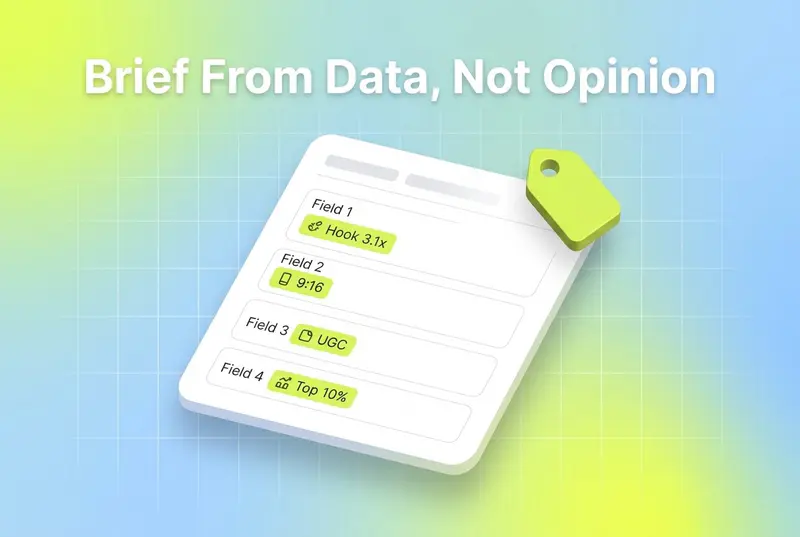
To write a data-backed creative brief, you start from performance data instead of opinion: pull the creative elements that are actually driving results, like which hooks, formats, and CTAs win, then write the brief around those proven patterns rather than a hunch. A data-driven creative brief replaces "make something fresh" with "make more of what your tag-to-metric data shows is working." Segwise builds this kind of brief directly from tag-level performance across your ad accounts, so the brief arrives grounded in evidence.
Most briefs fail before a designer opens them. The single-minded proposition is a guess, the references are whatever the team liked last quarter, and the success metric is "engagement." Then everyone wonders why the round comes back wrong. The fix is not a better template, although you need one. The fix is feeding the template with data about what your audience already responds to.
That gap is expensive. Research from the IPA and BetterBriefs, surveying over 1,700 marketers and agencies across 70+ countries, found that 33% of marketing budget is wasted on poor briefs and misdirected work. The same study exposed a brutal perception gap: 80% of marketers think they write good briefs, while only 10% of agencies agree, and on strategic direction the gap is wider still at 78% versus 5%.
This guide gives you a usable creative brief template, shows you how to turn each section data-backed, and walks through filled examples. The thesis stays the same throughout: a creative brief is only as good as the evidence behind it, and the fastest way to get that evidence is creative-level performance data.
Key takeaways
- A data-backed creative brief is built from creative-level performance data, not opinion. You brief the hooks, formats, and CTAs your tag-to-metric data shows are winning, not the ones the team liked last.
- Poor briefs are a budget problem, not a style problem. The IPA found 33% of marketing spend is wasted on weak briefs and the rebriefing they cause.
- Creative is the biggest lever you control. Nielsen attributes up to 89% of a digital campaign's in-market success to strong creative, so the brief that directs it deserves data.
- A complete brief has eight sections: objective, audience, single-minded proposition, proven creative elements, deliverables and formats, mandatories, success metrics, and references. The data-backed version anchors each one in evidence.
- The hard part is the evidence, not the format. Tagging thousands of creatives by hand to find winning patterns can eat 20+ hours a week per app or brand, which is why most teams brief on memory instead.
- Segwise's Creative Strategy Agent turns tag-level performance into the brief itself, so the proven-elements section writes itself from data rather than from last quarter's favorites.
What is a data-backed creative brief?
A creative brief is the document that tells whoever makes the ad what to make and why. A data-backed creative brief is the same document with one difference that changes everything: the inputs come from creative performance data, not from internal preference. Instead of "we think UGC works for us," the brief says "UGC hooks return 3.1x ROAS across 40 creatives this quarter, problem-first openers hold 35% more viewers than logo openers, so brief three UGC concepts that open on the problem."
The distinction is not cosmetic. A traditional brief encodes the team's beliefs about the audience. A data-driven creative brief encodes the audience's demonstrated behavior. One is a hypothesis dressed as a directive. The other is a directive backed by what already happened in-market.
This matters because creative is the part of performance marketing you still control. The platforms automated targeting and bidding, so the creative became the main variable a human sets. Nielsen found that when creative is strong it can drive up to 89% of a digital campaign's in-market success, and separate analysis covered by Marketing Charts shows creative quality remains the single biggest contributor to ad effectiveness. If creative is the biggest lever, the brief that aims it is worth grounding in evidence rather than instinct.
Data-backed brief vs traditional brief
The cleanest way to see the difference is side by side.
A traditional brief answers "what do we want to say?" It pulls from the brand deck, the last campaign everyone remembers fondly, and whatever the stakeholder mentioned in the kickoff. Its proof is internal consensus.
A data-backed brief answers "what does our audience respond to, and how do we make more of it?" It pulls from creative-level performance: which tagged elements correlate with high ROAS, which hooks earn attention, which formats convert, which creatives are fatiguing and need replacing. Its proof is in-market results.
The traditional brief produces creative that satisfies the room. The data-backed brief produces creative that has a measurable reason to work. That is the whole thesis of this piece: a brief is only as good as the evidence behind it.

Why most creative briefs fail
Before fixing the brief, it helps to know why briefs break, because the data-backed approach is a direct answer to each failure.
The first failure is that briefs are guesses. The single-minded proposition is what the team assumes resonates, not what the data shows. When the assumption is wrong, the whole round is wrong, and nobody finds out until the creatives underperform.
The second failure is the perception gap. The IPA and BetterBriefs research is blunt here: 80% of marketers believe they brief well, but only 10% of agencies agree, and 83% of marketers think their briefs use clear language while just 7% of agencies do. Marketers cannot see their own briefs the way the people executing them do.
The third failure is cost. Weak briefs trigger rebriefs and revision spirals. The IPA pegs the waste at 33% of marketing budget, and 69% of marketers admit rebriefs happen too often. Every rebrief is time the creative team spends redoing instead of doing.
The common thread is the absence of evidence. A brief built on opinion is a brief that can be wrong without anyone noticing until the spend is gone. A brief built on performance data carries its own justification, which is exactly why this guide pushes you toward a data-driven creative brief.
The data-backed creative brief template
Here is a complete template. It works as a traditional brief on its own, but each section has a data-backed version that anchors it in evidence. Use the eight sections below as your standing structure.
1. Objective
State the business outcome the creative has to produce, in numbers. Not "raise awareness" but "lift D7 ROAS on the prospecting campaign from 1.8x to 2.4x with three new video concepts."
Data-backed version: set the target against your actual baseline. Pull current creative-level ROAS, CPI, or CVR so the objective is calibrated to where you really are, not to a round number.
2. Audience
Define who the creative is for, beyond demographics. What do they care about, what stops their scroll, what objection blocks the conversion.
Data-backed version: describe the audience by what they respond to in your creatives. If problem-first hooks outperform aspirational ones, that tells you more about your audience than an age range does.
3. Single-minded proposition
The one thing the creative must land. If the viewer remembers nothing else, this is it.
Data-backed version: derive the proposition from the messaging tags that correlate with conversion. The angle that already wins is a stronger proposition than the one that sounds good in the room.
4. Proven creative elements
This is the section a traditional brief does not have, and it is the heart of the data-backed brief. List the specific elements your performance data shows are working: hook types, opening formats, CTA styles, visual treatments, characters, audio, pacing. These are the building blocks the creative should be assembled from.
Data-backed version: this section is the data. Each element comes with its performance attached, so the creative team is remixing proven winners rather than starting from a blank page.
5. Deliverables and formats
What gets produced, in which aspect ratios, for which platforms. Be exact: three 9:16 videos for TikTok, two 1:1 statics for Meta, one playable for the gaming networks.
6. Mandatories and constraints
Legal lines, brand guidelines, logo treatment, claims that must or must not appear. The non-negotiables that prevent a rebrief.
7. Success metrics
How you will judge the output, defined before production. Hook rate above a threshold, hold rate, creative-level ROAS, spend share. Tie this back to the objective so success is measurable, not vibes.
8. References and winning examples
Show, do not just tell. Attach the actual top-performing creatives the new work should learn from.
Data-backed version: pull references by performance, not by taste. The references should be your highest-ROAS creatives carrying the elements from section 4, so the team sees exactly what good looks like in your account.

How to make each section data-backed
A template is a container. The value is in filling it with evidence, and that requires creative-level performance data: every creative described by its elements, and every element mapped to the metrics it drives.
That mapping is the hard part. Raw numbers from your ad accounts tell you a creative spent money and returned a number. They do not tell you the creative opened on a UGC hook with a discount CTA in 9:16. To brief from data, you first have to tag every creative by its elements, then connect each tag to performance. Done by hand, this is brutal. Teams that tag manually can spend 20+ hours a week per app or brand on it, which is why most skip it and brief from memory instead.
This is the gap Segwise closes. Segwise unifies creative and performance data from 15+ ad networks, including Meta, Google, TikTok, Snapchat, YouTube, Axon, Unity Ads, Mintegral, and IronSource, alongside MMPs AppsFlyer, Adjust, Branch, and Singular. Its Creative Tagging Agent uses multimodal AI to tag every element across video, audio, image, and text automatically, including playable ads, which it is the only platform to tag. Each tag is mapped to performance, so "UGC hook" or "problem-first opener" or "discount CTA" carries a real ROAS, hook rate, and CVR across every creative that used it.
That tag-to-metric mapping is the raw material for every data-backed section of the brief. Your proven-elements section is the list of high-performing tags. Your audience section is what those tags reveal about behavior. Your references are the top-ROAS creatives carrying those tags. The brief stops being an opinion and becomes a readout of what works.
The always-on Creative Strategy Agent takes it one step further. You ask, in plain language, which hook style drove the most installs last quarter or what separates your top five creatives from your bottom five, and it answers with full context across your account. It generates creative briefs and storyboards grounded in your tag-to-metric data, so the brief is built from evidence rather than assembled from memory. For the bigger strategic picture this fits into, see our guide to AI creative strategy.
A filled data-backed brief example
Theory is cheap. Here is the template filled for a hypothetical subscription fitness app running UA on Meta and TikTok, with each section grounded in performance data.
Objective. Lift D7 ROAS on the TikTok prospecting campaign from 1.9x to 2.5x using four new video concepts over the next sprint.
Audience. Lapsed and first-time fitness app users who distrust "transformation" promises. In our creatives, problem-first hooks ("can't stay consistent?") hold 34% more viewers than aspirational hooks, so the audience responds to honesty about the struggle, not the result.
Single-minded proposition. Consistency is the product, not the six-pack. This angle carries the highest CVR across our messaging tags.
Proven creative elements. Open on a problem-first talking-head hook in the first second (top-quartile hook rate). Use a 9:16 vertical format (outperforms 1:1 by a wide margin on TikTok). Close on a social-proof CTA ("join 2M people") rather than a discount CTA, which converts worse at the same CPM. Keep pacing fast with on-screen captions.
Deliverables and formats. Four 9:16 videos, 15 to 20 seconds, for TikTok. Export a 1:1 cutdown of the top performer for Meta retargeting.
Mandatories. No before/after body imagery. Include the standard subscription disclosure. Lead with the app UI within the first three seconds.
Success metrics. Hook rate above the account's top-quartile threshold, hold rate stronger than the current TikTok average, and creative-level D7 ROAS at 2.5x or better within the sprint.
References. The three highest-ROAS creatives from last quarter that used the problem-first hook plus social-proof CTA, attached as the pattern to extend.
Notice that every line has a reason behind it. Nobody is guessing. That is what separates a data-driven creative brief from a wish list, and it is why the next round has a real shot at hitting the objective.
From brief to closed loop
A brief is not the end of the process, it is one turn in a loop. The strongest version of this workflow runs continuously: performance data surfaces the winning elements, the brief directs new creative built from those elements, the new creatives ship and get tracked, and their results sharpen the next brief.
This is where data-backed briefing connects to creative generation. The same tag-to-metric mapping that fills your proven-elements section can feed an AI generation step directly. Segwise's Creative Generation Agent produces net-new and variation creatives across image, video, and playable formats, all built around your winning tags, and automatically tags and tracks each one once it goes live so the loop stays closed. Briefs grounded in performance data, paired with generation grounded in the same data, is how teams halve creative production time and keep the pipeline moving.
The point is that briefing is not a one-off document you write and forget. It is the steering wheel of a loop that compounds. Each round you brief from better data, because the last round added to it.
How to write a data-backed creative brief: the workflow
Pulling it together, here is the order of operations.
- Unify your creative data first. Get every creative from every network and MMP into one view with consistent metrics. You cannot brief from data that lives in six dashboards.
- Tag every creative by its elements. Hooks, formats, CTAs, visual styles, audio. This is what lets you brief by element instead of by ad. Automated tagging makes this practical at scale.
- Map tags to your real outcome. Connect each element to creative-level ROAS or CPI, not just clicks, so the brief points at revenue.
- Fill the template from the data. Use the eight-section template above, and populate the objective, audience, proposition, proven elements, and references from your tag-to-metric mapping rather than from memory.
- Brief, ship, track, repeat. Hand the brief to your team or your generation tool, ship the creatives, track them, and feed the results back into the next brief. The loop is the point.
The teams that do this continuously, not quarterly, are the ones whose briefs keep getting sharper. The faster the loop runs, the faster opinion gives way to evidence.
Conclusion
A creative brief is only as good as the evidence behind it. The format matters, and the eight-section template above is a solid one, but the format is the easy part. The hard part is filling it with proof: knowing which hooks, formats, and CTAs your audience actually responds to, and briefing the next round from that instead of from last quarter's favorites.
That gap between knowing and guessing is expensive. The IPA puts it at 33% of marketing budget wasted on poor briefs, and the perception gap means most teams cannot see their own weak briefs. The way out is creative-level performance data, and the reason most teams do not have it is that producing it by hand takes 20+ hours a week per brand.
If you want briefs built from evidence instead of opinion, Segwise unifies your creative data across 15+ networks and MMPs, tags every element with multimodal AI, and maps it all to performance, saving teams up to 20 hours a week and helping them improve ROAS by up to 50%. Its Creative Strategy Agent turns that data into ready briefs, and its Creative Generation Agent closes the loop by building new creatives from your winning patterns. To understand the role behind all this, read about what a creative strategist does.
Frequently asked questions
What is a data-backed creative brief?
A data-backed creative brief is a creative brief whose inputs come from creative-level performance data rather than internal opinion. Instead of briefing the hooks, formats, and CTAs the team likes, you brief the ones your tag-to-metric data shows are actually driving ROAS and attention. The format is the same as a traditional brief, but each section, especially the proven-elements section, is anchored in what has already worked in-market. Tools like Segwise build this kind of brief automatically by tagging every creative and mapping each element to performance.
How do I write a data-driven creative brief?
Start by unifying your creative data across every ad network and MMP, then tag each creative by its elements and map those tags to outcome metrics like creative-level ROAS. Once you have that mapping, fill a standard eight-section brief template, objective, audience, single-minded proposition, proven creative elements, deliverables, mandatories, success metrics, and references, using the data rather than memory. The proven-elements section and the references should come straight from your highest-performing tagged creatives. Segwise's Creative Strategy Agent can generate this brief directly from your tag-level performance data.
What should a creative brief include?
A complete creative brief includes a clear objective tied to a business number, the target audience, the single-minded proposition, deliverables and formats, mandatories and constraints, success metrics defined upfront, and references. A data-backed brief adds one more section that traditional briefs lack: proven creative elements, the specific hooks, formats, and CTAs your performance data shows are winning. That section is what turns a brief from a list of wishes into a set of evidence-based instructions.
Why do so many creative briefs fail?
Most briefs fail because they are built on opinion instead of evidence, and because marketers cannot see their own briefs the way the people executing them do. The IPA and BetterBriefs research found that 80% of marketers think they brief well while only 10% of agencies agree, and that poor briefs waste 33% of marketing budget through rebriefs and revision spirals. The fix is to anchor each section of the brief in creative-level performance data so the directions carry their own justification.
How is a creative brief connected to creative performance data?
The connection runs through tag-to-metric mapping. When every creative is tagged by its elements and each tag is mapped to performance, you can see exactly which hooks, formats, and CTAs drive results. That mapping becomes the raw material for the brief: the proven-elements section is your list of winning tags, the references are your top-ROAS creatives, and the audience insight comes from what those tags reveal about behavior. Segwise produces this mapping automatically and can turn it into a ready brief through its Creative Strategy Agent.
Can AI write a creative brief from performance data?
Yes. An AI creative strategist with access to your full creative dataset can generate a brief grounded in your tag-to-metric performance rather than generic best practices. Segwise's always-on Creative Strategy Agent does this: you ask which elements are winning in plain language, and it returns briefs and storyboards built from your account's actual data. Because the same data can feed the Creative Generation Agent, the brief and the creatives it produces stay grounded in the same evidence, closing the loop between analysis and production.