
The best CreativeX alternative depends on the question you need answered. For element-level performance across many ad networks and an MMP, pick Segwise. For enterprise governance like CreativeX's, pick Vidmob. For attention or emotion pre-testing, pick Neurons, Dragonfly AI or System1. For cheaper Meta and TikTok reporting, pick Superads or Foreplay.
CreativeX tells you whether an ad follows brand and platform guidelines. The hard part for a performance team is knowing which hooks, scenes and end cards actually earn installs and ROAS on the networks you buy. Segwise is an AI creative analytics and creative generation platform that tags every element of your video, static and playable ads and joins those tags to ad network and MMP data, so you can see which elements earn the installs, not only which ads pass a checklist.
TL;DR: which CreativeX alternative fits which team?
- Mobile games, apps and multi-network UA teams: Segwise, because it connects gaming networks such as AppLovin, Unity and Mintegral plus five MMPs, and tags playables.
- Global brands that want CreativeX-style governance: Vidmob scores ads against brand and platform rules across 13 channels.
- Teams that want to predict attention or emotion before launch: Neurons and Dragonfly AI predict attention with AI models, and Dragonfly says it needs no panels; System1 tests emotion with real people; AdSkate uses synthetic audiences.
- DTC brands on Meta and TikTok with smaller budgets: Superads starts at $125 a month and Foreplay at $49 a month on yearly billing; Motion starts at $999.
CreativeX alternatives compared at a glance
Prices below were read on each vendor's own site on 6 November 2026.
| Tool | Best for | Key strength | Price |
|---|---|---|---|
| Segwise | Mobile UA, gaming, apps, DTC and agencies on several networks | Element tagging (incl. playables) joined to 17 ad channels and 5 MMPs | From $999/mo ($499 for startups under $50K spend) |
| CreativeX (baseline) | Global brands policing creative quality | Creative Quality Score, Creative Salience, Datalink partner data | Not published, demo only |
| Vidmob | Enterprise brands that want scoring plus analytics | Pre-flight scoring, Maddie AI assistant, 13 channels | Three packages priced per brand, no dollar figures |
| Motion | DTC brands and agencies on Meta, TikTok, YouTube, LinkedIn | Runneth AI agent included in paid plans | $999/mo Starter up to $50K spend; Pro and Growth not published |
| Superads | Small paid social teams wanting low-cost reporting | Reports across Meta, TikTok, LinkedIn and Google Ads | From $125/mo billed yearly, up to $100K spend |
| Foreplay | DTC teams that pair research with reporting | Ad library, Spyder tracking and Lens analytics | $49 to $389/mo yearly, $59 to $459 monthly |
| AdSkate | Agencies pre-testing with synthetic audiences | Computer-vision attributes plus AdSkate GPT | Subscription tiers, contact sales |
| Neurons | Brand and creative teams pre-testing attention | Attention, emotion, cognition and memory scores | Starter, Pro and Scale packages, quote only |
| Dragonfly AI | CPG and retail brands testing ads, packs and shelves | Patented attention algorithm, no panel needed | Not published, demo only |
| System1 | Brands testing TV and social ads on emotion | Star, Spike and Fluency ratings from real viewers | Not published, contact sales |
What is CreativeX, and where does it fall short for performance teams?
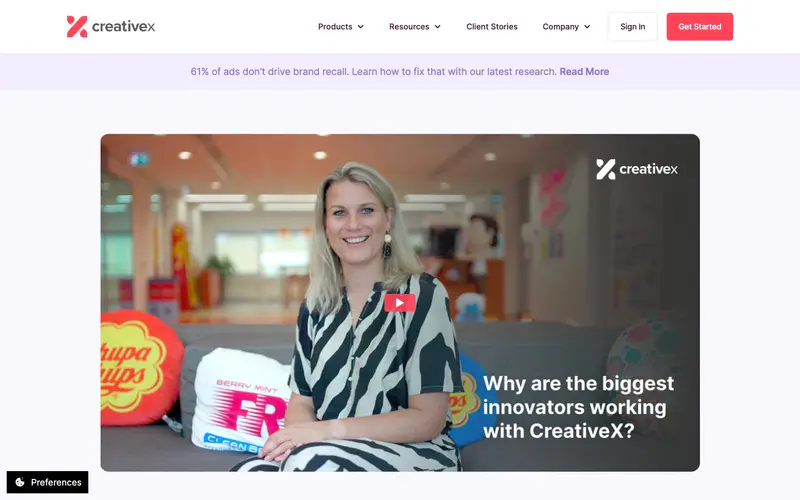
CreativeX calls itself "the system to scale creative excellence" and sells to marketers at global scale. Its client stories name Nestlé, Bayer and Mars. It is a measurement and governance platform: it checks whether ads are fit for each platform and on brand, and tracks how core assets get reused.
What CreativeX does well
- Creative Quality Score (CQS): guideline checks such as aspect ratio, brand early, safe zones, sound on, supers and video length, plus your own custom guidelines, rolled into one score. It runs pre-flight on new content and in-flight on live ads.
- Creative Salience: launched on 1 April 2026, it detects logos, taglines, packshots, colors, mascots, icons and sonic cues, and scores each ad from 1 to 100 before media runs.
- Creative Lifecycle: uses AI to match core assets against live ads on Meta, YouTube, DV360, TikTok and more, then reports Activation, Reusage and Repurposed Rates.
- Benchmarks: compare your creative quality with your industry or global average.
- Datalink: announced on 3 December 2025, it sends ads to partners for attention, emotion and predictive data and brings the results back into CreativeX. Launch partners named by CreativeX are Kantar, Dragonfly, DAIVID, Realeyes and Neurons.
Where performance teams find gaps
These are gaps in what CreativeX documents, not claims that it cannot do something.
- No mobile ad networks or MMPs listed. CreativeX's platform partners are Adform, Amazon, DV360, Facebook, Instagram, Pinterest, Snapchat, TikTok, YouTube and X. AppLovin, Unity, Mintegral and Moloco are not among them, and no CreativeX page we read names an MMP such as AppsFlyer or Adjust. For an app team, that means install and post-install outcomes are hard to tie to creative. Our guide to mobile measurement partners explains why that join matters.
- Scores grade guidelines, not your own winners. CQS and Creative Salience compare ads with best practice and brand rules. CreativeX does link high CQS to ROAS in its client stories, but it does not document finding which hook or scene wins in your own account.
- No playable ad analysis documented. We found no CreativeX page that mentions playable ads.
- No ad generation of its own. CreativeX lists Pencil as a GenAI partner and Celtra, Smartly.io and others as production partners, so acting on its findings means another tool or an agency.
- Sales-led buying. creativex.com/pricing returns a 404, and the only routes in are "Get a demo" and contact forms. There is no self-serve trial.
What should a creative performance analytics tool do?
A creative performance analytics tool shows which parts of your ads, such as the hook, the offer, the voiceover or the end card, drive results like installs, CPA and ROAS. Use it to judge a shortlist on five jobs:
- Tag elements, not just ads. Ad-level reports tell you an ad won. Element tags tell you why, so the next brief can repeat it.
- Cover the networks you actually buy. A tool that reads only Meta misses half the story for a game buying on AppLovin and Unity.
- Join MMP data when you have it. Network-reported conversions differ from MMP installs and revenue. App teams need the MMP view.
- Catch fatigue early. Strong ads decay. Alerts on a ROAS or spend-share drop save budget; our guide on catching creative fatigue shows the early signs.
- Turn findings into the next ad. Insight that sits in a dashboard does not ship. Briefs or generation from your winners close that gap.
CreativeX is strong on governance at global scale. Most of the tools below are stronger on one or more of these five jobs.
Top 9 CreativeX alternatives in 2026
1. Segwise
Segwise is built for teams that need to know which creative elements drive installs, CPA and ROAS across many networks. It connects 17 usable ad channels, including Meta, Google Ads, TikTok, Snapchat, AppLovin (Axon), Unity, Mintegral, Moloco, Liftoff, LinkedIn and Reddit, plus five MMPs: AppsFlyer, Adjust, Branch, Singular and Kochava. An MMP is optional.

Best for: mobile game studios, subscription and utility apps, DTC brands and agencies that buy on more than one network.
Key features
- Element-level analytics:creative analytics maps every tag to ROAS, CPA, IPM and CTR in one view across networks and your MMP.
- Multimodal tagging: the Creative Tagging Agent watches video, listens to audio, reads text and images, and plays playables, then tags hooks, characters, CTAs and end cards. You can add custom tags and pull tags from your naming conventions. Segwise is the only platform that tags playable ad elements; see our playable ads guide for why that matters.
- Fatigue alerts:fatigue tracking flags a sustained drop in performance or spend share and warns you by email and Slack, with custom success criteria for new creatives.
- Pre-flight testing:Pre-flight Testing scores up to 10 new creatives out of 100 against the ads already winning in your account. This is a different basis from CreativeX's CQS, which scores against guidelines.
- Competitor tracking:competitor tracking tags rivals' ads from the Meta, TikTok, LinkedIn and Google ad libraries.
- Generation from your winners: The Creative Generation Agent lets you make statics and videos up to 30 seconds, including AI UGC-style ads, from your own winning patterns. Playable generation and CTV spots run as managed services.
- AI chat: the Creative Strategy Agent answers plain-language questions such as "which hooks drove the most installs last month?" with charts and rankings. You can use each agent on its own, or do it all in one place by chatting with the Segwise agent: ask how your ads are performing, see what competitors are running, and make new ads from your winners.

How it compares with CreativeX: CreativeX asks "does this ad meet our standard?" Segwise asks "which parts of our ads earn installs, and what should we make next?" If you need to enforce brand rules across many markets, CreativeX is built for that. If you need to grow installs on AppLovin and Meta with AppsFlyer as the source of truth, Segwise is.
Limitations: Segwise does not score brand-cue presence or representation the way Creative Salience and Inclusive Representation do. Playables and CTV are managed services rather than self-serve builders. Setup is no-code, but some networks (AppLovin, Mintegral, Unity, Moloco) need an API key pasted from the network's dashboard.
Pricing: Segwise starts at $999/month for advertisers spending up to $250K/month; startups spending under $50K/month pay $499/month (limited eligibility). Segwise imports up to 3 months of history.
See your own element data first: Connect one network and your MMP, and Segwise lets you see which hooks and end cards earn installs. Book a demo.
2. Vidmob
Vidmob calls itself "the creative data company" and is the closest like-for-like CreativeX competitor. It scores creative against brand and platform best practices before and after launch, and links creative attributes to media results.

Best for: enterprise brands and agencies that want governance and performance analytics in one contract.
Key features
- Pre-flight quality checks and brand guideline deviation tracking across markets.
- Performance Intelligence that identifies which creative factors drive media outcomes.
- Maddie, an in-platform AI assistant, plus Vidmob360 access through an MCP server and REST API.
- 13 channels: Meta, Amazon Sponsored Ads, Amazon DSP, Google Ads, DV360, Pinterest, LinkedIn, TikTok, X, Snapchat, Reddit, The Trade Desk and Yahoo DSP.
Limitations: none of the 13 channels is a mobile gaming network such as AppLovin or Unity, and we found no MMP connector on Vidmob's site. Vidmob lists playable ads as a supported ad type on Meta and TikTok but does not document tagging what happens inside them. Its creative production is human, through Creative Studio.
Pricing: Vidmob publishes three packages priced per brand by annual impressions: Slate (up to 1B), Portfolio (1B to 10B) and Premier (10B+). No dollar prices are shown; you request a quote.
3. Motion
Motion is an AI creative analytics tool that says it is "trusted by 2,100 teams." Every paid plan includes Runneth, Motion's always-on AI agent on a dedicated VM, which answers in Slack, ships briefs and hooks, and runs scheduled reports and alerts.

Best for: DTC and ecommerce brands and their agencies on Meta, TikTok, YouTube and LinkedIn.
Key features
- Ad leaderboard, creative analytics and AI tags.
- Inspo for competitor research and benchmarks.
- Read-only MCP access and Slack-native requests.
- Attribution integrations with Northbeam and Google Analytics on Pro.
Limitations: Motion's help center says AI Tagging is available for Meta creatives only. It connects Meta, TikTok, YouTube and LinkedIn, and lists no mobile gaming networks and no MMP integration. It is a DTC tool, not a mobile game UA tool.
Pricing: Starter is $999/month for up to $50K monthly ad spend. Pro (over $50K) and Growth (over $125K) show "Let's chat". There is a free trial with no credit card.
4. Superads
Superads is a creative analytics and ad reporting tool built by Superside. It reports across Meta, TikTok, LinkedIn and Google Ads, with AI tagging and Superads AI, an assistant that reasons over your live ad data.

Best for: small paid social teams and agencies that want clean reports for little money.
Key features
- Unlimited reports, boards and workflows, with unlimited users.
- AI tagging, Superads AI chat, and Workflows that send scheduled AI performance summaries by Slack or email.
- Inspiration, which follows any brand's Meta ads.
Limitations: Superads says it does not generate ad creatives. No Superads page we checked lists a mobile gaming network or an MMP, and the free plan is closed to new signups.
Pricing: Professional starts at $125/month billed $1,500 yearly, for up to $100K in monthly spend, plus $100/month for each extra $100K. It comes with a 14-day free trial. Enterprise is custom.
5. Foreplay
Foreplay started as a swipe file and is still research-first. It now bundles Discovery (an ad library), Spyder (competitor tracking), Lens (analytics on your own ads) and Briefs (AI scripts and storyboards).

Best for: DTC brands and agencies that want inspiration, briefing and basic reporting in one place.
Key features
- Lens connects Meta and TikTok ad accounts, with AI metadata, hook transcription and shareable reports.
- Spyder tracks competitors' Meta ads.
- Briefs writes scripts and storyboards; an MCP server and API are live.
Limitations: Lens is not on the Basic plan, covers Meta and TikTok only, and Foreplay names no MMP. Foreplay does not list finished ad generation.
Pricing: Basic $59/month ($49 billed yearly), Workflow $175 ($149), Agency $459 ($389), Enterprise custom. Each paid plan has a 7-day free trial, and Foreplay says there is "no variable pricing based on your ad spend."
6. AdSkate
AdSkate is an AI creative analytics platform that uses computer vision to break ads into attributes such as tone, objects, colors and copy. Its homepage says AdSkate has joined Brunner, the agency.

Best for: agencies that want pre-campaign testing plus post-launch attribute analysis.
Key features
- Pre-campaign testing against 1,000+ synthetic audiences.
- AdSkate GPT for plain-language questions such as "which image tone has the highest CTR?"
- Integrations with Google Ads, Meta Ads, TikTok Ads, a DSP and an MCP connection.
Limitations: AdSkate lists no MMP integration and no mobile gaming networks. The Brunner move may change how it is sold, so ask about product roadmap and contract terms.
Pricing: not published. AdSkate's FAQ says pricing is "a subscription model with different tiers" and asks you to contact them.
7. Neurons
Neurons uses consumer neuroscience data to predict how people will respond to an ad before it runs. It is a Datalink partner of CreativeX, so some teams use both.

Best for: brand and creative teams that want a fast attention and memory read on every asset before launch.
Key features
- Scores attention, emotion, cognition and memory on any asset, with heatmaps.
- Visual recommendations shown on the creative; make a change, rescore and see the impact.
- Frame-by-frame analysis for video and animated banners, plus campaign brand metrics after launch.
Limitations: Neurons is built to predict response before launch. After launch it reports brand metrics next to clicks, CTR and cost, but we found no Neurons page describing an MMP connection or analysis of which ad element drives installs.
Pricing: Starter, Pro and Scale packages with unlimited analysis, 500 to 2,000 visual recommendations and up to 5 users on the smaller tiers. Every package says "Get my quote", so no dollar price is published.
8. Dragonfly AI
Dragonfly AI predicts where people will look, using a patented biological algorithm built with Queen Mary University London. It tests ads, packaging, shelves, landing pages and retail displays.

Best for: CPG and retail brands that test ads alongside packs and in-store creative.
Key features
- Instant attention predictions for static and motion ads, with no panel.
- Studio3 creative insights platform and a creative data API (Connect).
- A CreativeX Datalink partner.
Limitations: Dragonfly predicts attention rather than measuring live results. It sells a creative data API (Connect), but we found no Dragonfly page describing a connection to ad network or MMP results, or install and ROAS analysis by creative element.
Pricing: not published. dragonflyai.co/pricing returns a 404 and every route leads to "Book a Demo".
9. System1
System1 calls itself "the creative effectiveness platform". Test Your Ad measures how real people feel about an ad and predicts long-term brand growth and short-term sales from that response.
Best for: brands with TV, video and social budgets that need an emotional pre-test.
Key features
- Star (long-term growth), Spike (short-term sales) and Fluency (branding) ratings, with second-by-second FaceTrace.
- Results from 24 hours; Test Your Ad Screen gives an AI read in minutes for finished long-form video in the US and UK.
- Competitive Edge benchmarks against 120,000+ ads.
Limitations: System1 tests an ad's likely effect before launch. We found no System1 page describing tagging or tracking your live ads across ad networks. Panel tests cost time per ad, which suits a few big ads more than hundreds of social variants.
Pricing: not published. System1's FAQ answers "How much does Test Your Ad cost?" with "Please contact us."
Where do Dragonfly AI, Neurons, System1 and Vizit fit against CreativeX?
People often search these names together because they all score creative before or around launch. They are not the same job:
- CreativeX grades ads against brand and platform guidelines, and pulls partner data in through Datalink. Dragonfly and Neurons are Datalink launch partners, so you can use them with CreativeX, not only instead of it.
- Neurons and Dragonfly AI predict attention with AI models. Neurons gives each asset "a clear impact score in seconds", and Dragonfly says there is "no need for panels."
- System1 measures emotion with real viewers, and adds an AI screen for finished long-form video.
- Vizit now positions itself around ecommerce product pages; its homepage says it "scores, optimizes, and generates content to maximize revenue with every shopper that lands on your page." That makes it a product content tool rather than an ad analytics one, so it is not in our list.
CreativeX client stories link high quality scores to ROAS, and Neurons reports brand metrics next to CTR and cost. But we found no page from these vendors that joins MMP installs and revenue to individual creative elements. If that is the question you need answered, look at Segwise.
How do you pick the right CreativeX alternative?

A decision rule you can use this quarter
Treat these as rules of thumb, not hard cut-offs:
- Choose a performance tool such as Segwise when 2 of these 5 are true: you buy on 3 or more ad networks; you use an MMP; you launch 20 or more new creatives a month; you run playable ads; you want new ads made from your winners.
- Stay with CreativeX, or look at Vidmob, when your main risk is brand consistency across many markets and agencies, and each brand serves around 1B impressions a year or more (Vidmob's smallest band runs up to 1B).
- Add Neurons, Dragonfly AI or System1 when you make a few expensive ads, such as TV or hero video, and want a read before you spend.
- Pick Superads or Foreplay when you spend under $100K a month on Meta and TikTok only and mostly need reports.
What each option costs at two spend levels
| Monthly ad spend | Segwise | Motion | Superads (yearly billing) | Foreplay Workflow (yearly) | CreativeX, Vidmob, Neurons, Dragonfly AI, System1, AdSkate |
|---|---|---|---|---|---|
| $40K | $499 if eligible for startup pricing, otherwise from $999 | $999 | $125 | $149 | Quote only |
| $200K | From $999 | Not published | $225 ($125 plus one $100 step) | $149 | Quote only |
Foreplay's price ignores spend, but Lens covers one brand on Workflow and only Meta and TikTok. Superads' figure follows its published "+$100/mo per extra 100k" rule; confirm the exact amount at checkout. Our roundup of creative analytics tools covers a wider field if none of these fits.
How do you switch from CreativeX to Segwise?

Before the renewal date
Check your CreativeX contract for the renewal and notice dates, because it is sold on annual enterprise terms through sales. Export the scorecards, custom guidelines and brand cue lists you rely on while you still have access.
The first week in Segwise
Connect your ad networks and your MMP. Most connect with OAuth; AppLovin, Mintegral, Unity and Moloco need an API key from their dashboards. History imports and gets tagged automatically: up to 3 months. Rebuild any guideline you still care about, such as "logo in the first two seconds", as a custom tag so you can see whether it actually moves ROAS.
Running both side by side
Keep CreativeX for one full creative cycle. Compare its guideline scores with Segwise's element performance on the same ads. Where they disagree, you learn which rules matter for your results. Then move the weekly creative review to element data and brief from your winners. Our Segwise and CreativeX comparison goes deeper on the feature differences.
Which CreativeX alternative should you shortlist first?
If you run ads on several networks and judge success by installs, CPA or ROAS, shortlist Segwise first, because it joins element-level tags to your network and MMP data. If brand governance is the real job, Vidmob is the closest match to CreativeX, and Neurons, Dragonfly AI or System1 add a pre-launch read. Small Meta and TikTok teams can start cheaply with Superads or Foreplay. Your next step: connect one network to your shortlisted tool and compare what it tells you with your last CreativeX scorecard.