
Updated August 2026.
Creative volume to scale Meta ads is not a fixed number, it is a ratio: the amount of fresh creative you ship has to rise in step with your daily spend, or your ROAS collapses within days. As a rough 2026 benchmark, a $100/day budget needs about 4 fresh creative tests per week, $1,000/day needs around 15, and $5,000/day needs 30 to 40. Tools like Segwise close the gap by generating new winning creatives from your proven patterns, so production keeps pace with spend instead of capping it.
Also read Seedance 2.5: What It Changes for Ad Creative Teams
The wall almost nobody talks about
If you have ever been stuck at $100/day, watched a winner die after two weeks, or sat in "0.7 to 0.8 ROAS purgatory" for months, the problem usually is not your targeting, your bid strategy, or even your hooks. It is throughput. You are feeding the algorithm too little new creative for the spend you are asking it to deliver.
This is the single most common scaling failure on Meta in 2026. Brands push the budget up and keep the creative flat, then blame the algorithm when performance tanks. The uncomfortable truth, repeated across agency playbooks, is that spend and creative volume are linked. When one scales without the other, ROAS pays the price.
The good news is that the relationship is predictable enough to plan around. Once you know your rough win rate and your cost per meaningful test, you can work out how much creative volume you need to scale Meta ads at any spend level. This post gives you the volume-to-spend ratio, the math behind it, why AI-generated ads make the problem worse, and how to actually produce that much creative without burning out your team.
Key Takeaways
Creative volume must scale with spend. A $100/day ad set and a $5,000/day ad set are not the same testing problem, because higher spend burns through impressions and fatigues creative in days, not weeks, according to Foxwell Digital.
The working benchmark for 2026: roughly 4 fresh creative tests per week at $100/day, about 15 at $1,000/day, and 30 to 40 at $5,000/day.
Win rates sit around 1 in 10. AdMake AI cites Foxwell's ~10% and Barry Hott's "one in eight to one in twelve," so testing only 2 ads is a coin flip, not a test.
Meta's Andromeda algorithm rewards volume directly. It matches individual users to specific ads, so more diverse creative gives it more to choose from, per Jon Loomer.
AI-generated ads saturate faster because outputs homogenize, which raises, not lowers, the volume you need to stay fresh.
Use a percent-of-spend testing budget (10 to 20 percent is a common range) once you pass roughly $100k/month, rather than a flat creative count, per Scalability School.
The 2026 Volume-to-Spend Ratio
Here is the core artifact, a simple ratio you can bring to your creative team. It maps daily ad spend to the number of fresh creative tests you should launch each week, plus the rough number of distinct ads you want active at once. Treat it as a starting benchmark, then adjust for your hit rate and how fast your account fatigues.
Two things to read from this table. First, the count of fresh tests per week climbs faster than linearly with spend, because higher daily budgets fatigue creative more quickly. Second, the number of distinct ads you keep active rises alongside it. Foxwell Digital frames the concurrent side directly: a $100/day ad set can run about 15 distinct ads, while a $1,000/day ad set needs 40 to 50, because the algorithm burns through impressions at that spend.
A note on the per-week column: it leans aggressive, in line with the post-Andromeda "ship more" reality. Some agencies frame lower spend more conservatively. Foxwell Digital, for example, suggests a $0 to $10k/month account can run on roughly 1 new creative a month if it fatigues slowly and the win rate is high. If your account behaves that way, sit at the lower end. If you are actively pushing budget up, use the table as written.
Past roughly $100,000/month, stop counting individual creatives and start budgeting by percent of spend. Foxwell and Scalability School both land in the 10 to 20 percent range for ongoing creative testing, with some accounts going as high as 40 to 50 percent at scale.
How to read this ratio: These are benchmarks, not laws. If your win rate is high, you can run fewer tests. If your account fatigues fast or you are scaling aggressively, push higher. The point is the direction: volume rises with spend.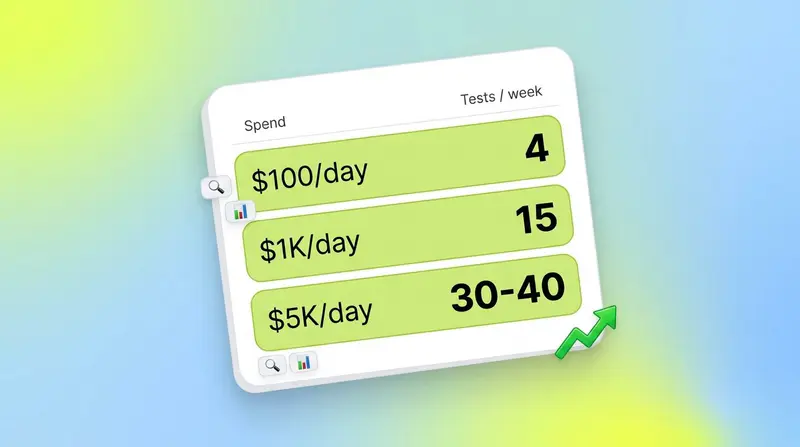
Why volume has to scale with spend
The mechanism is simple once you see it. Every creative has a finite pool of impressions before the audience that responds to it has already seen it. At $100/day, that pool drains slowly, so a single winner can carry an ad set for weeks. At $1,000/day, the same creative burns through the same responsive audience ten times faster, so it fatigues in days.
Foxwell Digital puts hard ranges on it: brands running 40 or more ads per ad set see average creative lifespans of 45 days or more, while brands running 5 ads per ad set see lifespans of just 10 to 14 days. More creative does not cause fatigue, it spreads frequency so each individual user sees a different ad instead of the same one eight times in a week.
This is why scaling budget without scaling creative is the number one reason brands hit a wall. As AdMake AI puts it, brands "try to scale spend without scaling creative," CPAs rise within 7 to 14 days, and the account stalls.
The win-rate math
Volume also solves a sample-size problem. Across agencies, the consensus win rate for ad creative sits around 1 in 10. AdMake AI cites Foxwell's published ~10% and Barry Hott's "one in eight to one in twelve."
Run the arithmetic and the ratio table explains itself:
Test 5 ads a month at a 10% hit rate, and you expect 0.5 winners. Half the time you get nothing.
Test 10, and you expect 1 winner. You scale it, it fatigues in two weeks, you are back to zero.
Test 50, and you expect 5 winners. Now there is always a fresh one ready when another dies.
Testing 2 ads and scaling the "winner" is not a test, it is a coin flip. You found an outlier and assumed it was a pattern. This is exactly the trap behind the "it tanked when I scaled it" story that fills performance marketing forums.
Why Andromeda makes volume non-negotiable
Meta's Andromeda algorithm, which rolled out globally in early 2026, changed the job. It is a personalized ad retrieval model that picks which specific ad to show each individual user, based on that user's behavior rather than your targeting cluster.
Jon Loomer describes the practical consequence: top advertisers now run 15 to 50 ads per ad set, and the point is not 15 versions of one idea, it is 15 genuinely different approaches. Creative diversification means building ads for different people and contexts, which is why diversity, not just quantity, matters.
The logic is direct. If you give Andromeda 3 ads, it has 3 options to match against a user. Give it 300, and it has 300. The buyer who ships more diverse creative gives the algorithm more ways to win. This is the shift from audience targeting to creative throughput that defines Meta media buying in 2026.
Diversity beats duplication.Fifteen near-identical variants of one hook do not feed Andromeda the way fifteen distinct angles, formats, and tribes do. Count distinct concepts, not file exports.
Why AI ads need even more throughput
Here is the twist most volume guides miss. Generative AI made it trivial to produce 50 ads in an afternoon, which sounds like the whole problem solved. It is not, for two reasons.
First, homogenization. When everyone prompts similar models with similar briefs, outputs converge. Ads start to look and sound alike, both within your account and across your category. Sameness accelerates audience fatigue, because the responsive audience has effectively already seen your "new" ad in a competitor's feed.
Second, faster saturation. Cheap production means you and your competitors flood the same placements faster, compressing the useful life of any single concept. The result is a treadmill: AI lets you ship more, but more is exactly what is now required just to stay even.
The way out is not raw volume, it is data-backed volume. Creatives generated from what is actually winning in your account, with distinct angles rather than cosmetic variations, fatigue slower and hit more often. This is where the production bottleneck and the diversity requirement meet.
How to actually hit these ratios
Knowing the ratio is easy. Producing 15 to 40 distinct tests a week is the hard part. These frameworks, drawn from published agency playbooks, make it operational.
Use a per-test budget, then back into the count
Work out how much spend one creative needs to give a meaningful read, then divide your testing budget by it. Scalability School and others land around $50 to $100 of spend for an early directional read, and 7 to 10 days or roughly 100 conversions per variant for a confident winner call. Foxwell suggests budgeting 2 to 3 times your CPA per creative to know if it is a winner. Avoid budget fragmentation: cramming 20 creatives into one underfunded campaign starves each of the impressions it needs to mean anything.
The 3-3-3 testing batch
A clean way to generate distinct volume fast: 3 concepts, 3 hooks per concept, 3 formats per hook. That is 27 ads per batch, and one batch a week keeps a $50k/month account well supplied. The structure forces diversity instead of 27 near-copies.
The 70/20/10 split
Allocate spend, not just effort: 70 percent to proven winners, 20 percent to iterative variations of those winners, and 10 percent to genuinely experimental swings. The 10 percent slot is how you always have the next winner half-tested before the current one fatigues.
Test angles as statics first
Before you invest in a polished UGC video, validate the message as a cheap static. If the angle does not work as a static under roughly $100 of spend, it will not work as a $5,000 video. Cheap validation protects your production budget for the concepts that earn it.
Where Segwise fits
The constraint behind every row of the ratio table is production. You cannot brief a designer or an agency fast enough to ship 30 to 40 distinct tests a week, and raw AI generation gives you volume without the diversity or the data backing that makes volume work.
This is the gap Segwise is built to close. Its Creative Generation Agent produces net-new, data-backed creatives grounded in your winning creative patterns, not generic AI guesses. It remixes winning elements, hooks, CTAs, visual styles, and characters, from across your top creatives into new high-performing ads, generates across static, video, and playable formats, and exports in every aspect ratio Meta needs. Every generated creative is automatically tagged and tracked once live, so its performance feeds straight back into the same intelligence that produced it.
That closed loop matters for volume. Segwise's creative fatigue tracking flags decline before performance crashes, so you know exactly when to pull a tiring creative and which fresh one to scale. Teams report saving up to 20 hours per week per app or brand on manual tagging and data work, and Segwise can halve creative production time, which is what makes hitting the higher ratios realistic rather than aspirational. It connects across Meta, Google, TikTok, Snapchat, YouTube, AppLovin, Unity Ads, Mintegral, and IronSource, plus the MMPs AppsFlyer, Adjust, Branch, and Singular.
The bottom line
Scaling past $100/day on Meta is rarely a targeting or bidding problem. It is a creative volume problem, and the fix is to treat volume as a ratio that climbs with spend rather than a number you set once and forget. Around 4 fresh tests a week at $100/day, roughly 15 at $1,000/day, and 30 to 40 at $5,000/day is the rhythm that keeps a winner always ready when the current one fades.
The brands winning on Meta in 2026 are not better strategists, they ship more diverse creative and let Andromeda sort it. The only sustainable way to produce that much at the quality the algorithm rewards is to generate from what is already working, track fatigue in real time, and feed performance back into the next batch.
Frequently Asked Questions
How much creative volume do I need to scale Meta ads?
Volume scales with spend. As a 2026 benchmark, plan for about 4 fresh creative tests per week at $100/day, around 15 at $1,000/day, and 30 to 40 at $5,000/day, with 15 to 50 distinct ads active per ad set depending on spend. Adjust for your win rate and how fast your account fatigues. Past roughly $100k/month, budget creative testing as 10 to 20 percent of spend instead of a fixed count.
Why does my winning Meta ad die after two weeks when I scale it?
Higher spend drains a creative's responsive audience much faster, so a winner that lasted weeks at $100/day can fatigue in days at $1,000/day. The fix is a pipeline of fresh tests so a new winner is ready before the current one fades. Tools like Segwise and Motion track creative fatigue so you see the decline early instead of after the budget is wasted.
How many ads should I run per ad set on Meta in 2026?
Most agency guidance, including Foxwell Digital and Jon Loomer, points to 15 to 50 distinct ads per ad set, scaled to spend. A $100/day ad set can run around 15, while a $1,000/day ad set needs 40 to 50. The emphasis is on distinct concepts, not minor variations, because Meta's Andromeda algorithm rewards genuine creative diversity.
What is the difference between creative volume and creative diversification?
Volume is how many ads you run. Diversification is how different they are. Fifteen variations of one hook is high volume but low diversity, and Andromeda gains little from it. Fifteen different angles, formats, and audience framings is volume plus diversity, which gives the algorithm real options to match to users. You need both.
Does AI-generated creative reduce how much volume I need?
No, it usually increases it. AI makes production cheap, but outputs homogenize and placements saturate faster, so concepts fatigue sooner. The advantage comes from data-backed generation: creatives built from your actual winning patterns, like those Segwise produces, fatigue slower and hit more often than generic AI output.
how do i test creatives on a small budget without wasting money
Validate each angle as a cheap static first, around $50 to $100 of spend, before producing expensive video. Keep tests in properly funded ad sets so each creative gets enough impressions to read, rather than cramming 20 ads into one starved campaign. Use a 70/20/10 split so most spend backs proven winners while a small slice keeps testing the next one.
What budget should go toward creative testing?
A common starting range is 10 to 20 percent of paid social spend on ongoing creative testing, rising toward 40 to 50 percent at very high spend levels. Work out the spend one creative needs for a meaningful read, often 2 to 3 times your CPA, then divide your testing budget by that to get how many tests you can run at once.