
Creative tagging is the practice of labeling every element inside an ad, the hook, the CTA, the format, the character, the color, the audio, so performance can be read by element instead of by ad ID. For performance teams, that is the difference between knowing an ad spent money and knowing which creative choice made it work. AI does this automatically across video, audio, image, and text, which is the only way it scales past a few dozen ads.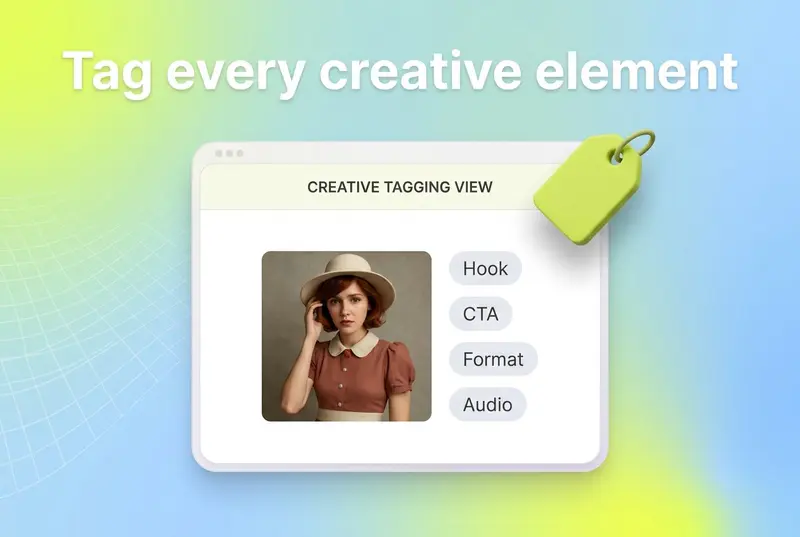
Here is the uncomfortable truth about most creative reporting: you can see which ad won, but you cannot say why. The why lives in the creative itself, in the first three seconds, the offer, the voiceover, the visual style. None of that shows up in a campaign report. It only shows up when every creative is described by its parts, and that description is what tagging produces.
The catch is that tagging by hand is miserable. Someone has to watch each ad, decide what is in it, and type those attributes into a spreadsheet, ad after ad, week after week. Most teams either burn an analyst on it or, more often, quietly give up. That is the bottleneck this post is about, and it is the reason AI creative tagging has gone from a nice-to-have to the foundation serious advertisers build on.
This guide covers what creative tagging is, why manual tagging breaks down, how multimodal AI tagging actually works, the tag types that matter, and how to think about building this layer without drowning your team in spreadsheets.
Key takeaways
Creative tagging labels the individual elements inside an ad (hook, CTA, format, character, color, audio) so you can analyze performance by element, not just by ad ID.
Manual tagging is the bottleneck. It means watching every ad and typing attributes into a spreadsheet, work that runs 8 to 15 hours a week for a typical performance team and breaks past a handful of ads a month.
The reason tagging matters is that creative is the biggest driver of results. Nielsen found strong creative can account for up to 89% of a digital campaign's in-market success.
Manual tagging is also inconsistent. Tag quality hinges entirely on the individual logging the footage, so two people tag the same hook differently and the data quietly stops being trustworthy.
Multimodal AI tags across video, audio, image, and text together, which is what lets it describe a creative the way a human would, only in seconds and at any volume.
Tagging is only useful if every tag is tied to a metric. Tag-to-metric mapping turns thousands of ads into a readable map of what your audience responds to.
Segwise's Creative Tagging Agent automates this across 15+ networks, is the only platform that tags playable ads, and is the foundational data layer that powers the rest of its creative intelligence.
What is creative tagging?
Creative tagging is the process of attaching structured labels to the elements inside an ad creative so its performance can be analyzed by attribute. Instead of a row that says "Ad 4471 spent $3,200 at 2.1x ROAS," tagging gives you "this ad opens on a problem-first hook, uses a UGC talking-head format, runs a discount CTA, and features a specific character," each of those tags now attached to the performance number.
That sounds small. It is not. A tag is the unit that makes creative analysis possible at all. Without tags, every ad is an island. You can rank ads, but you cannot find the pattern that connects your winners, because the thing they share lives inside the creative and nothing in your report describes it.
With tags, you can group across the whole account. All ads with a UGC hook. All 9:16 vertical videos. All ads featuring a particular offer. Now you can ask which hook style holds attention longest, which CTA converts best at the same CPM, which visual style is quietly carrying half your ROAS. The tag is what makes the question answerable.
This is why creative tagging sits underneath everything else in creative analytics. It is the data layer. Fatigue tracking, asset clustering, competitor analysis, and creative generation all read from the same tagged foundation. If the tagging is weak or inconsistent, everything built on top of it inherits the weakness.
Tags versus campaign metadata
It helps to separate creative tags from the metadata you already have. Your ad platform gives you campaign names, ad set IDs, placements, and spend. That is structural metadata about where and how an ad ran. It tells you nothing about what is in the ad.
Creative tags describe the content: the hook, the dialogue, the on-screen text, the emotional tone, the products shown. The two are complementary. Structural metadata tells you the context; creative tags tell you the substance. You need both to explain a result, and most teams only have the first.
Why manual creative tagging breaks down
If tagging is so valuable, why doesn't everyone do it? Because the manual version is one of the most thankless jobs in performance marketing, and it gets worse exactly when it matters most.
The time cost
Manual tagging means a person watches each ad, decides what is in it, and records those attributes by hand. For a typical performance team, that work runs 8 to 15 hours a week, and that is before the account scales. Teams running heavy creative testing routinely spend 20+ hours a week per app or brand on tagging alone.
That math falls apart fast. Manual tagging works when you ship five ads a month. When you are testing 50 or more variations across several platforms, categorizing every element, hook, and CTA by hand becomes a full-time job nobody signed up for. So it gets deprioritized, then dropped.
The inconsistency problem
Even when teams push through the volume, the data quality is shaky. Manual tag quality hinges entirely on the individual logging the footage, which produces widely different vocabularies and tagging styles across people and projects.
One analyst calls it a "talking-head hook." Another calls it a "UGC opener." A third writes "person speaking to camera." Those are the same thing, but to your analysis they are three different tags, and the pattern that should be obvious gets split three ways and disappears. Inconsistent tagging is arguably worse than no tagging, because it gives you confident-looking data you cannot trust.
The skip
Faced with the time cost and the consistency problem, the most common outcome is the worst one: teams skip creative tagging entirely. They run the ads, they watch the spend, and they never build the layer that would tell them why anything worked. The insight is sitting in the creatives the whole time, locked up because nobody has the hours to extract it by hand.
Why creative tagging matters more in 2026
Three things have turned creative tagging from optional to foundational.
First, creative is now the main lever. The platforms automated targeting and bidding, so the algorithm decides who sees your ad. What you still control is the creative. Research keeps confirming this matters: analysis covered by Marketing Charts shows creative quality remains the biggest single contributor to ad effectiveness, and NCSolutions found marketers vastly understate the sales effect of creative and overestimate the impact of targeting. If creative drives the result, the data that explains your creative is the data that explains your performance.
Second, creative volume exploded. AI generation means teams ship dozens of variations a week instead of a handful a month. That volume is only an advantage if you can learn from it, and you can only learn from it if every creative is tagged. Untagged, a hundred new ads a week is just noise.
Third, the data is fragmented. Every network reports differently, and each platform defines its own metrics and attributes conversions its own way, so none of the stories line up until you unify them. Tagging is what lets you compare creatives on equal footing across that fragmented landscape, because the tag means the same thing whether the ad ran on Meta or TikTok.
The teams winning right now treat the creative as the unit of analysis, and tagging is how they get there. They know which elements drive performance, they brief from data instead of opinion, and they do it at a volume that would be impossible by hand.
How AI tags ad creatives
AI creative tagging replaces the analyst-with-a-spreadsheet with a model that watches, listens, reads, and labels automatically. The good versions are multimodal, meaning they analyze video, audio, image, and text together rather than handling one at a time. That matters because an ad is multimodal: the hook is spoken, the offer is on-screen text, the emotion is in the music, the format is in the footage. You need all four modalities to describe it properly.
Multimodal models in 2026 understand text, images, audio, and video together rather than as separate inputs, which is exactly the capability creative tagging needs. Here is how that breaks down across the modalities.
Video analysis
The model watches the footage and tags visual elements: characters and their traits, scene changes, on-screen text, background settings, product shots, pacing, and visual styles. This is the layer that catches what a creative looks like, frame by frame, the way an editor would but at machine speed.
Audio analysis
The model transcribes and tags the soundtrack: spoken dialogue, hook lines, voiceover styles, background music types, and the emotional tone of the audio. So much of what makes a video ad work is in the first spoken line and the energy of the music, and audio tagging is what makes that searchable.
Image analysis
For static creatives, the model tags colors, compositions, characters, products, emotions, concepts, influencer traits, and visual styles. This is what lets a DTC brand ask which product shot, headline treatment, or color palette is driving conversions across hundreds of static ads.
Text analysis
The model extracts and categorizes on-screen text, headlines, CTAs, and benefit statements. The actual words in the ad become structured data you can group and compare, so "discount CTA" and "social-proof CTA" become things you can measure against each other.
Playable ads
Playable (interactive) ads are the hardest format to tag because the creative is essentially a tiny interactive app, not a linear video. Most tools cannot read them at all. Segwise is the only platform that tags playable ads, which is a critical capability for mobile gaming advertisers whose best-performing creatives are often playables.
The tag types that actually matter
Not all tags are equal, and the systems that work go beyond a flat list of labels. There are a few categories worth understanding.
Standard tags
These are the common creative variables every advertiser cares about: hooks, CTAs, formats, characters, emotions, visual styles, audio types. A good tagging system ships with 20+ standard creative tags out of the box, so you are not building a taxonomy from scratch before you can analyze anything.
Custom tags
Standard tags cover the universal stuff. Custom tags cover what is specific to your business or brand. A mobile game might want a tag for a particular character or game mode. A DTC brand might want one for a specific product line or seasonal offer. Going beyond 20+ standard tags with custom tags for your own variables is what makes the analysis fit your actual creative strategy instead of a generic template.
Nomenclature tagging
Most teams already encode information in their file names. Something like "UGC_holidaysale_9x16_v3" carries the format, the offer, the aspect ratio, and the version. Nomenclature tagging automatically extracts tags from the naming conventions you already use, so your existing creative discipline becomes structured data without extra work.
Tag enrichment and tag-to-metric mapping
Tags on their own are just labels. Two things turn them into analysis. Tag enrichment groups related tags into logical categories, so all your hook variants sit under "hooks" and you can analyze at the right altitude. Tag-to-metric mapping connects every tag to performance, so "UGC hook" or "discount CTA" has a ROAS, a hook rate, and a CVR attached to it across every creative that used it. This mapping is the whole point. It is what turns a pile of labeled ads into a map of what your audience responds to.
How creative tagging fits the bigger picture
Tagging is not the destination. It is the foundation. The reason to do it well is that everything else in creative analytics reads from it.
This is the thesis worth restating: creative tagging is the data layer that makes creative-level analysis possible, and getting it automated and consistent is what unlocks everything built on top. Fatigue tracking watches tagged creatives for performance decline. Asset clustering groups ads that share underlying assets so you can isolate which treatment drove a difference. Competitor analysis applies the same tagging to competitor ads so you can read their strategy the way you read your own. And creative generation uses your tag-to-metric mapping as the brief for the next batch, producing variations grounded in what actually works rather than generic AI output.
In Segwise, this is explicit. The Creative Tagging Agent provides the foundational data layer, and the always-on Creative Strategy Agent, fatigue tracking, asset clustering, and Creative Generation Agent all build on the tags it produces. The tagging connects to unified data from 15+ ad networks, including Meta, Google, TikTok, Snapchat, YouTube, AppLovin, Unity Ads, Mintegral, and IronSource, plus the MMPs AppsFlyer, Adjust, Branch, and Singular, so a tag means the same thing across every platform you run on.
The practical upshot is that the analysis that takes a team 20+ hours a week to do by hand runs continuously in the background. Setup is no-code and takes minutes, with historical data imported automatically (up to 14 days on the free trial and up to 3 months for paid customers). The tags are consistent because a model applies them the same way every time, and they are mapped to metrics the moment they are applied.
How to think about building a creative tagging workflow
If you are starting from no tagging, or from a spreadsheet that has quietly fallen out of date, here is a sane order of operations.
Unify your creative data first. Get every creative from every network and MMP into one place with consistent metric definitions. Tagging fragmented data just spreads the inconsistency around. This connects up to the broader creative analytics workflow that tagging feeds into.
Decide on a taxonomy, then automate it. Pick the elements you care about: hook type, format, offer, CTA, visual style, audio. Keep it small enough to stay consistent and rich enough to be useful. Automated tagging makes a richer taxonomy practical because consistency is no longer a function of who is doing the work.
Use your existing nomenclature. If your file names already encode useful attributes, let nomenclature tagging extract them. You have been creating structured data without realizing it.
Map every tag to a real outcome metric. Connect tags to creative-level ROAS or CPI through your MMP, not just clicks. Attention metrics are leading indicators; revenue is the scoreboard.
Review by element, not by ad. In your weekly review, group performance by tag across the whole account. The patterns that repeat in winners are your next brief.
The teams that get value from tagging do this continuously, not once. The point of automating it is that the loop never stops running, so your map of what works stays current as your creative does.
Conclusion
Creative tagging is the unglamorous foundation under every smart creative decision. It is the thing that turns "Ad 4471 did well" into "problem-first hooks with social-proof CTAs are your winning pattern, here is the next brief." The reason most teams don't have that clarity is not that they don't want it. It is that tagging by hand costs too many hours and drifts too easily to trust, so it gets skipped, and the insight stays locked in the creatives.
That is exactly what multimodal AI tagging solves. Done well, creative tagging is the data layer that makes creative analysis possible, and automating it consistently across every modality is what unlocks fatigue tracking, clustering, competitor analysis, and data-backed generation on top.
If you want to stop tagging by hand and start reading your creatives by element, Segwise tags every element across video, audio, image, text, and playable ads automatically, maps each tag to performance, and uses that foundation to save teams up to 20 hours a week and improve ROAS by up to 50%. It is the data layer the rest of your creative intelligence is built on.
Explore the creative tagging cluster
Tagging is a deep topic, and these guides go further into the pieces this post introduced:
What is creative tagging for a ground-up explainer of the concept and where it fits.
Manual vs AI creative tagging for a head-to-head on cost, speed, and consistency.
How to tag playable ads, the format most tools cannot read.
Building a creative tag taxonomy that stays consistent as you scale.
Once your tagging layer is solid, it feeds the wider creative program: turning tag-to-metric data into an AI creative strategy, and applying the same tagging to rivals for competitor ad tracking.
Frequently asked questions
What is creative tagging?
Creative tagging is the practice of attaching structured labels to the individual elements inside an ad, such as the hook, CTA, format, character, color, and audio, so performance can be analyzed by element rather than just by ad ID. It turns a creative from an unreadable island into a set of attributes you can group and compare across your whole account. AI tagging tools apply these labels automatically across video, audio, image, and text, and map each tag to performance metrics like ROAS.
How does AI tag ad creatives?
AI creative tagging uses multimodal models that analyze video, audio, image, and text together. The model watches the footage to tag visual elements and characters, transcribes the audio to tag dialogue, hooks, and music, reads on-screen text to tag headlines and CTAs, and identifies colors, products, and emotions in static images. Because it processes all four modalities at once, it can describe a creative the way a human would, but in seconds and at any volume.
How long does manual creative tagging take?
Manual tagging runs 8 to 15 hours a week for a typical performance team, and teams running heavy creative testing can spend 20 or more hours a week per app or brand. It involves watching each ad, deciding what is in it, and recording those attributes by hand. That is why manual tagging breaks down past a handful of ads a month and why most teams either skip it or let it fall out of date.
What is the difference between standard tags and custom tags?
Standard tags cover the universal creative variables every advertiser cares about, like hooks, CTAs, formats, and emotions, and a good system ships with 20+ of them. Custom tags cover what is specific to your business, such as a particular game character, product line, or seasonal offer. You use standard tags to analyze the fundamentals and custom tags to make the analysis fit your own creative strategy rather than a generic template.
Why is consistency such a problem with manual tagging?
With manual tagging, tag quality hinges entirely on the individual doing the logging, so different people use different vocabularies for the same thing. One analyst's "talking-head hook" is another's "UGC opener," which splits a single pattern into several tags and hides it. AI tagging fixes this because a model applies the same label the same way every time, keeping the data trustworthy enough to act on.
can AI tag playable ads or just video and images?
Most tagging tools cannot read playable ads because a playable is effectively a small interactive app rather than a linear video. Segwise is the only platform that tags playable ads, in addition to video, audio, image, and text. That matters most for mobile gaming advertisers, whose highest-performing creatives are often playables that would otherwise be a blind spot in their analysis.
how do I actually use creative tags once the ads are tagged?
The value comes from tag-to-metric mapping, which connects every tag to performance so a tag like "UGC hook" has a ROAS, hook rate, and CVR attached across every creative that used it. You group performance by tag across the whole account in your weekly review, find the elements that repeat in your winners, and brief your next round of creatives from those patterns. Tagging is the input; the decision about what to make next is the output.