A creative research operating system for Meta ads is the repeatable loop that turns creative from guesswork into a system: research, hypothesize, tag, test, learn. The stack that runs it in 2026 pairs Segwise for cross-network creative intelligence and auto-tagging (including AI tagging inside playable ads) with Foreplay for ad research and swipe files, and Marpipe for structured multivariate testing.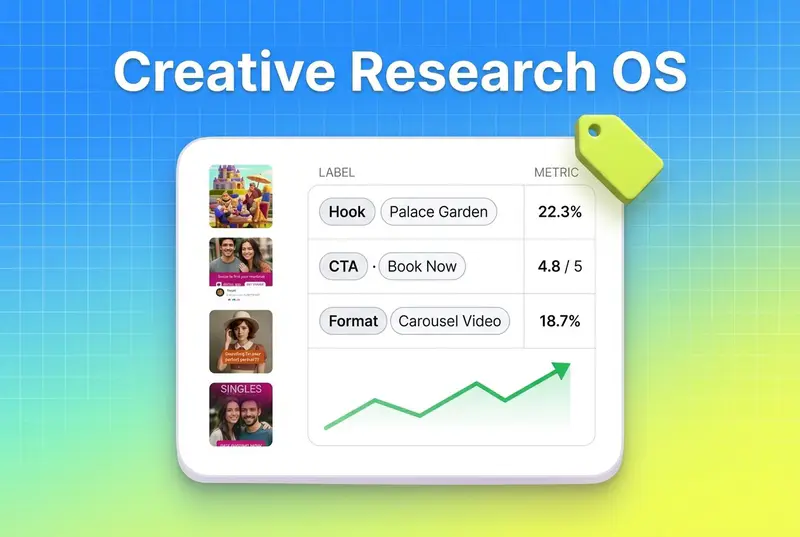
The best tools for running a creative research OS on Meta ads in 2026 are Segwise, Foreplay, and Marpipe: Segwise for creative intelligence and automatic tagging, Foreplay for research and inspiration, and Marpipe for disciplined testing. But the tools are secondary. The real unlock is the operating system underneath them, the process that connects what you learn from one test to what you brief for the next.
Here is the problem most teams have. Under Meta's Advantage+ automation, targeting, bidding, and placement are increasingly handled by the algorithm. Creative is now the primary lever you actually control. Nielsen's long-running work on ad effectiveness found that strong creative drives up to 89% of the sales lift in digital advertising, and that creative quality contributes as much to in-market success as all other factors combined (Nielsen). Yet most creative strategy still runs on vibes: a designer's hunch, last week's winner, whatever a competitor just posted.
A research OS fixes that. It gives creative the same rigor a good UA team already applies to bids and budgets: a hypothesis, a structured test, a tagged result, and a learning that feeds the next brief. This guide lays out the five-stage loop and the tool stack that supports each stage, so your creative program compounds instead of resetting every month.
Key Takeaways
Creative is the lever, not targeting. In the Advantage+ era, Meta automates delivery, so creative quality is the main variable you influence. Nielsen puts strong creative's contribution to digital sales lift at up to 89%.
A research OS is a five-stage loop: research, hypothesize, tag, test, learn. The learn stage feeds back into research, so insight compounds instead of evaporating.
Structured tagging is the hinge. Without a consistent creative taxonomy, test results are anecdotes. With one, every ad becomes a labeled data point tied to a metric.
Velocity beats perfectionism. Admetrics found brands that raised creative velocity from 0.8 to 2.0 new creatives per $10k weekly spend cut CAC 20 to 35% in four to six weeks, holding spend flat.
No single tool runs the whole OS. Segwise anchors intelligence, tagging, fatigue detection, and generation; Foreplay covers research; Marpipe and Smartly cover testing at scale.
Segwise also AI-tags what happens inside playable ads, which matters for gaming teams whose interactive creatives most analytics tools cannot read.
The creative research OS stack at a glance
Pricing is current as of August 2026.
What a creative research OS actually is

A creative research operating system is a repeatable process for producing, testing, and learning from ad creative, so that every test makes the next one smarter. It is the strategy layer that sits above testing tactics. Where a testing best-practices guide tells you how to structure an experiment, a research OS tells you what to test, why, and what to do with the answer.
It is not a single piece of software, and it is not a one-off "creative sprint." It is a loop with five stages:
Research the demand, competitors, and cultural context to source real angles.
Hypothesize by writing each brief as a testable claim, not a vague ask.
Tag every creative with a consistent taxonomy before it goes live.
Test at a velocity your spend can support, isolating variables cleanly.
Learn by mapping tags to metrics, catching fatigue, and feeding insight back into research.
The stages are not optional or reorderable. Skip research and you test random ideas. Skip tagging and your results are anecdotes you cannot aggregate. Skip the learn loop and you rediscover the same insight every quarter. The OS is what connects them.
The five-stage framework in practice
Stage 1: Research (source angles, do not invent them)
Great creative strategy starts with demand that already exists, not a brainstorm in a vacuum. The research stage mines three inputs: what your customers actually say (reviews, support tickets, social comments), what competitors are running right now, and what is shifting culturally in your category.
For competitor and market research, an ad-inspiration library is the workhorse. Foreplay lets you save, tag, and organize competitor ads into swipe files your whole team can brief from, then hand those references straight into a brief. On the analytics side, Segwise's competitor tracking applies the same multimodal AI it uses on your own ads to competitor creatives on Meta, tagging their hooks, CTAs, and visual styles so you can see the patterns they are leaning on and the white space they are ignoring. Competitor tracking in Segwise is currently Meta-only, which fits a Meta-first creative strategy well.
The output of this stage is not "ideas." It is a ranked list of angles, each tied to evidence: a recurring customer complaint, a saturated competitor hook worth subverting, an emerging format worth testing first.
Stage 2: Hypothesize (a brief is a bet, write it like one)
Most creative briefs are wish lists. A research OS reframes each brief as a falsifiable hypothesis: "We believe a problem-agitation hook will beat our current benefit-led hook for cold audiences, because reviews show pain-point language resonates more than feature language."
This does two things. It forces a single clear variable per test, and it defines in advance what result would prove you wrong. The principle worth holding onto: small swings give small learnings and big swings give big learnings, so your hypothesis backlog should mix bold concept bets with tighter iteration bets, not only safe tweaks.
Write the hypothesis, the variable, and the success metric into the brief before any design work starts. This is also where you decide which tags the finished creative will carry, so tagging in Stage 3 is a formality, not a scramble.
Stage 3: Tag (structure is what makes results learnable)
This is the stage teams skip, and it is the one that makes or breaks the whole OS. If two ads are labeled only "video 1" and "video 2," a performance gap tells you nothing you can reuse. If they are tagged by hook type, CTA, visual style, character, emotion, and format, the gap becomes a portable lesson.
Manual tagging is where this breaks down. Teams spend hours per week tagging creatives by hand, tagging gets inconsistent across people, and at scale it simply stops happening. Segwise's creative tagging removes that bottleneck: its multimodal AI automatically tags every element across video, audio, image, and text, from hooks and on-screen copy to characters, pacing, and audio tone. It also AI-tags what happens inside playable (interactive) ads, which matters if you run gaming creatives that most analytics tools cannot read. Every tag is mapped to performance metrics automatically, which is what turns Stage 5 from a manual export into an instant query.
Define your taxonomy once, then automate it Agree on the tag dimensions that matter to your business (hook, format, offer, emotion) up front, so automatic tagging enriches a schema your team already trusts.
Stage 4: Test (velocity your spend can support)
Testing is where the hypothesis meets the auction. Two principles govern this stage. First, isolate the variable: change one meaningful thing at a time so the result is attributable. Structured testing tools like Marpipe build this in, generating modular test matrices where each creative differs on a controlled dimension. Smartly does the same at enterprise scale, tying creative production to media buying.
Second, respect velocity. Creative fatigue now hits far faster than it used to; Admetrics reports CTR typically drops 30 to 50% by days eight to ten of a creative's life, and that the same analysis found brands lifting creative velocity from 0.8 to 2.0 new creatives per $10,000 of weekly spend cut CAC by 20 to 35% within four to six weeks, with spend held flat (Admetrics). Velocity is not about volume for its own sake. It is about keeping enough fresh, hypothesis-backed creatives in the pipeline that you never scale a dying ad.
When production is the bottleneck, generation tools fill the gap. AdCreative.ai spins up static variations quickly, and Segwise's creative generation produces net-new creatives across formats, static, video, AI UGC-style video, and playable, grounded in your own winning tag patterns rather than generic prompts.
Stage 5: Learn (close the loop or start over every month)
The learn stage is what separates an OS from a checklist. Here you answer three questions on repeat: which tags are driving results, which creatives are fatiguing, and what should the next round of research target.
Because Segwise maps every tag to metrics automatically, "which hook style drove the most installs last month" is a question you ask in plain language rather than a spreadsheet you rebuild. Its fatigue tracking watches every creative across networks for sustained performance decline and spend-share drop, and alerts you before budget burns, not after. Asset clustering groups ads that share the same underlying footage so you can isolate which specific treatment, a new hook, a different CTA, changed performance.
The critical move is feeding these learnings back into Stage 1. A winning tag pattern becomes a research prompt. A fatiguing cluster becomes a brief for a fresh angle. That feedback loop is the whole point: your creative program should get smarter every cycle, not start from zero.
The tools that power each stage
1. Segwise - Best for cross-network creative intelligence and the tag, learn, and generate layers
Segwise is a fully agentic creative intelligence and generation platform. It unifies creative data from 15+ ad networks and MMPs, automatically tags every creative element with multimodal AI, maps those tags to performance, and generates net-new creatives from your winning patterns. In a research OS, it spans the most stages: research (competitor tracking), tag, learn (tag-to-metric, fatigue detection, asset clustering), and generate.
Best for: Teams that want one system for tagging, learning, and generating, especially mobile gaming and DTC teams running high creative volume.
Key features: Automatic multimodal tagging (video, audio, image, text), the only tagging of playable ads, tag-to-metric mapping, native fatigue detection, asset clustering, Meta competitor tracking, and data-backed generation across static, video, AI UGC-style video, and playable formats.
Pricing: Segwise starts at $499/month for advertisers spending up to $250K/month, with a special 50% discount for startups spending under $50K/month. 7-day free trial.
Limitations: Competitor tracking is Meta-only today. Built for creative intelligence, not campaign or bid management.
2. Foreplay - Best for ad research and swipe files
Foreplay is the research-stage workhorse: a browser-based tool for saving competitor and inspiration ads into organized, taggable swipe files your whole team can brief from.
Best for: Sourcing and organizing creative inspiration at the research stage.
Key features: Ad saving from Meta and TikTok libraries, swipe-file organization, briefing, and boards for collaboration.
Pricing: From $49/mo (Basic, billed annually; $59/mo month to month), rising to Agency and custom Enterprise tiers.
Limitations: Focused on inspiration and briefing; it does not tag or analyze your own live performance data.
3. VidMob - Best for enterprise creative scoring
VidMob is a creative data platform that scores creative elements against performance, aimed at large brands with governance and reporting needs.
Best for: Enterprise brands needing element-level creative scoring and reporting.
Key features: Creative scoring, platform partnerships, and analytics dashboards.
Pricing: Custom / on request (no public pricing; contact sales).
Limitations: Enterprise-oriented; heavier to deploy than tools built for lean growth teams.
4. CreativeX - Best for creative quality and brand compliance at scale
CreativeX scores creatives against brand and quality guidelines across markets, useful for large advertisers enforcing creative standards.
Best for: Global brands enforcing creative-quality guidelines at scale.
Key features: Creative guideline scoring, cross-market benchmarking, and compliance reporting.
Pricing: Custom / on request (demo only).
Limitations: Compliance and quality focus rather than testing or generation.
5. Marpipe - Best for structured multivariate testing
Marpipe builds modular, multivariate creative tests so each variant differs on a single controlled dimension, the discipline the test stage depends on.
Best for: Teams that want clean, controlled multivariate creative experiments.
Key features: Modular creative matrices, multivariate testing, and catalog ad management.
Pricing: Free feed-management tier; paid Startup plan from $199/mo; Enterprise from $999/mo.
Limitations: Testing and catalog-centric; not a research, tagging, or fatigue-monitoring tool.
6. Madgicx - Best for Meta-focused automation and creative insights
Madgicx combines Meta ad automation with a creative workspace, popular with DTC teams that want optimization and creative insight together.
Best for: DTC teams wanting Meta automation plus creative reporting.
Key features: Ad automation, creative performance workspace, audience tools, and AI recommendations.
Pricing: Ad-spend tiered, from around $45/mo on the lowest spend band; optional Tracking Pro add-on at $49/mo.
Limitations: Meta and paid-social centric; less focused on multimodal creative tagging depth.
7. Superads - Best for creative reporting dashboards
Superads builds visual creative reporting dashboards across channels, giving strategists a fast read on which creatives are working.
Best for: Teams that want clean, shareable creative reporting.
Key features: Creative reporting dashboards, cross-channel views, and shareable reports.
Pricing: From $150/mo (Professional, billed annually); custom Enterprise.
Limitations: Reporting-focused; not a testing or generation tool.
8. AdCreative.ai - Best for fast AI static generation
AdCreative.ai generates ad variations and copy quickly, useful when the production stage is the bottleneck and you need volume fast.
Best for: Rapidly producing static ad variations and copy.
Key features: AI-generated creatives, copy generation, and creative scoring.
Pricing: From $39/mo month to month (Starter, 10 credits), dropping with annual billing; higher credit tiers up to $999/mo.
Limitations: Generation is prompt-driven rather than grounded in your own performance data; lighter on analytics.
9. Smartly - Best for enterprise creative and media at scale
Smartly ties creative production to media buying for large advertisers running high volumes across platforms.
Best for: Enterprise teams unifying creative production and media buying.
Key features: Creative automation, media buying, and cross-platform scale.
Pricing: Custom / on request (enterprise, demo only).
Limitations: Enterprise pricing and scope; heavier than most growth teams need.
10. Hawky - Best for agentic media buying with creative analysis
Hawky is now an agentic platform: AI agents that buy media and make creatives, plus element-level creative analysis. It publishes no price and targets teams spending $50K to $5M+ a month.
Best for: Teams that want AI agents to run spend and make creatives, alongside element-level analysis.
Key features: AI creative analysis, recommendations, and reporting.
Pricing: Custom / on request (no public dollar figures published).
Limitations: A younger company. It names Meta, Google, TikTok, HubSpot, Salesforce, AppsFlyer and GA4 among its integrations.
How to choose the right stack for your research OS

If you want one system for tagging, learning, and generating, Segwise is the anchor, because it spans research, tagging, tag-to-metric learning, fatigue detection, and generation, and it also AI-tags what happens inside playable ads.
If your gap is research and inspiration, start with Foreplay to build swipe files and briefs, then feed those angles into your testing loop.
If your gap is clean experimentation, Marpipe (or Smartly at enterprise scale) enforces the single-variable discipline the test stage needs.
If you are a global brand policing creative quality, CreativeX and VidMob handle compliance and element scoring across markets.
If you are a DTC team living inside Meta, Madgicx pairs automation with creative reporting, and Segwise adds the tagging and fatigue layer underneath it.
If you are a lean team on a budget, AdCreative.ai covers generation cheaply, though with less depth than Segwise on multimodal tagging. Hawky does not publish a price.
Bottom line
Creative is the lever that decides Meta performance now that the algorithm owns delivery, and treating it as a system rather than a series of one-off bets is what makes results compound. Different tools own different stages: Foreplay for research, Marpipe and Smartly for testing, CreativeX and VidMob for quality at scale. Segwise is the one platform that spans the tag, learn, and generate stages in a single loop, auto-tagging every creative (playables included), mapping tags to metrics, flagging fatigue early, and generating net-new winners from your own patterns. Build the loop first, then pick the tools that fill your gaps. See how Segwise runs the loop.
FAQs
What is a creative research OS for Meta ads?
A creative research operating system is a repeatable five-stage loop, research, hypothesize, tag, test, learn, that turns creative strategy into a system where every test informs the next. It sits above testing tactics as the strategy layer. Tools map to stages: Foreplay for research, Marpipe for testing, and Segwise for tagging, learning, and generation, so insight compounds instead of resetting each month.
Why does creative matter more than targeting on Meta now?
Under Advantage+ automation, Meta's algorithm handles targeting, bidding, and placement, which leaves creative as the main variable you control. Nielsen's research found strong creative drives up to 89% of digital ad sales lift and contributes as much as all other factors combined. This is why creative intelligence tools like Segwise, alongside testing tools like Marpipe, have become central to paid-social strategy rather than nice-to-haves.
How many creatives should I test per month on Meta?
There is no universal number, but velocity should scale with spend. Admetrics found brands lifting creative velocity from 0.8 to 2.0 new creatives per $10,000 of weekly spend cut CAC 20 to 35% in four to six weeks. The practical rule is to keep enough fresh, hypothesis-backed creatives in the pipeline that you never scale a fatiguing ad. Tools like Marpipe help structure the tests and Segwise flags fatigue so you know when to refresh.
What is the difference between creative analytics and a creative research OS?
Creative analytics tells you which creatives and elements performed; a creative research OS is the wider process that decides what to test, tags it consistently, and feeds the result back into the next brief. Analytics is one stage (learn); the OS is all five. Platforms like Segwise provide the analytics and tagging engine, while research tools like Foreplay and testing tools like Marpipe cover the other stages.
Which creative strategy tool is best for mobile gaming teams?
Segwise is the strongest fit for gaming because it automatically AI-tags what happens inside playable (interactive) ads, which most analytics tools cannot read, alongside video, audio, image, and text. Gaming teams often pair it with Foreplay for competitor research. This matters because playable ads are a core UA format that stays invisible in tools like VidMob or Madgicx.
Can AI generate Meta ad creatives that actually perform?
Yes, but grounding matters. Generic prompt-based tools like AdCreative.ai produce volume fast, while Segwise generates net-new creatives, including static, video, AI UGC-style video, and playable formats, grounded in your own winning tag patterns rather than generic prompts. Because Segwise auto-tags and tracks every generated creative once live, performance feeds straight back into the same intelligence that produced it, closing the research loop.
Do I need a separate tool for every stage of the loop?
No. Some tools span multiple stages, which reduces stack sprawl. Segwise covers research (Meta competitor tracking), tagging, learning, and generation in one platform, so many teams only add a dedicated research tool like Foreplay and a structured testing tool like Marpipe. Enterprise brands with compliance needs may also layer in CreativeX or VidMob.