
A creative marketing strategist turns performance data into winning ad creative. In 2026 the role runs on an AI toolkit led by Segwise for cross-network creative intelligence, Foreplay for ad research and briefs, and VidMob for enterprise creative data, alongside a handful of generation and testing tools. The strategist owns the full loop: research, briefs, production direction, testing, iteration, and scaling across paid channels.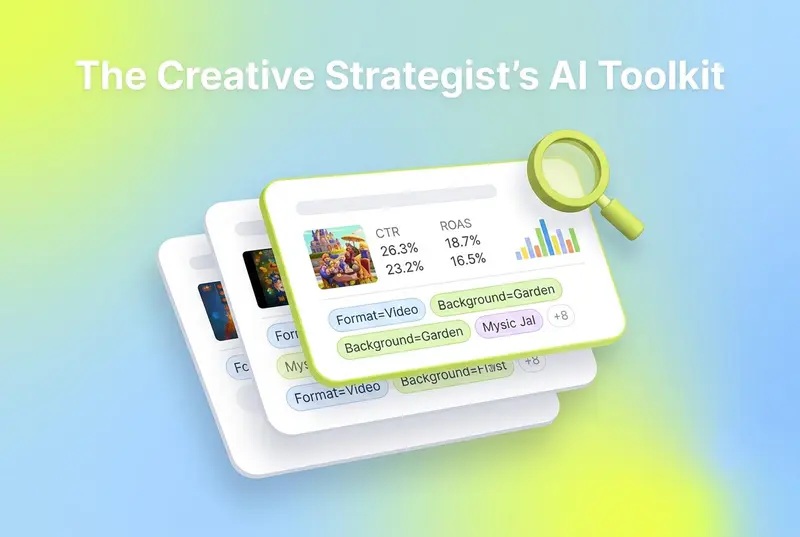
Five years ago "creative strategist" was a title a few agencies used. Today it is one of the most in-demand roles in performance marketing, because the bottleneck moved. Media buying got automated by Meta Advantage+ and Google Performance Max. Creative did not. Someone has to decide what to make, why, and whether it worked. That someone is the creative marketing strategist.
This guide defines the role as it exists now: what a creative strategist actually does, the skills that separate good ones from great ones, the day to day workflow, the career path and pay, and the AI stack that runs underneath all of it. The toolkit section covers 11 tools with pricing, so you can build a stack that fits your team.
AI is not optional context here, it is the job. According to a 2026 roundup of adoption data citing Salesforce and HubSpot research, 87% of marketers now use generative AI in at least one workflow, up from 51% in 2024, and 71% specifically use it to produce ad copy and creative variants. The strategist is the person who keeps that output honest, on brand, and tied to results.
Key takeaways
A creative marketing strategist owns the full creative loop: research, briefs, production direction, testing, and scaling. They bridge the performance team and the creative team.
The role pays well. US salaries run roughly $68,500 to $103,000 per ZipRecruiter 2026 data, with top earners above $135,000 and a higher average near $130,000 once bonuses are included, per Glassdoor.
Data literacy is now the core skill. Taste still matters, but a strategist who cannot read tag-level performance gets outvoted by one who can.
The AI toolkit splits into five jobs: intelligence, research, testing, generation, and reporting. No single tool covers all five well.
Segwise anchors the intelligence layer with multimodal tagging across 15+ networks and MMPs plus an in-app Creative Strategy Agent that answers performance questions in plain language.
Responsible AI use is a 2026 job requirement, not a nice-to-have. The EU AI Act's transparency rules for AI-generated content took effect August 2, 2026.
The 2026 creative strategist's AI toolkit at a glance
Here is the full stack covered in this guide.
What a creative marketing strategist actually does
A creative marketing strategist is responsible for the ads a brand runs and the reasons behind them. They are not a designer, though they direct design. They are not a media buyer, though they speak that language fluently. They sit in the gap between the two and make sure creative decisions are driven by evidence instead of opinion.
The clearest way to understand the role is by the loop it owns:
Research. Study what is working, for you and for competitors. Pull hooks, formats, and angles worth testing.
Brief. Translate research into a concrete brief a designer or video editor can execute without guessing.
Direct production. Guide the make, in house or with an agency, keeping variants tight enough to read cleanly.
Test. Ship variations, isolate variables, and let data decide instead of the loudest person in the room.
Analyze and iterate. Find the elements that drove performance, then feed them back into the next round of briefs.

That loop never stops. The best strategists treat every ad as a test rather than a masterpiece. As one common refrain in the field puts it, you get the reward for growing the business, and that usually means the unglamorous work of iterating on a proven format rather than chasing something new. Comfort with most of your ideas failing is part of the job description.
The role also changes shape by company. At a small DTC brand, the creative strategist might run the whole loop alone, from Foreplay swipe file to final Meta upload. At a large studio or agency, they lead a pod of designers and buyers and spend more time on strategy, brand governance, and reporting to leadership. The loop is the same. The scale is not.
Core skills for 2026
Job posts ask for creativity and communication, and those still matter. But the skills that actually separate strategists in 2026 are more specific.
Data literacy. You do not need to be an analyst, but you need to read creative performance at the element level. Which hook held viewers past three seconds? Which CTA drove installs, not just clicks? A strategist who can answer that from tag-level data will outvote one running on gut feel every time. This is exactly why the intelligence layer of the toolkit exists.
Briefing. A brief is where strategy becomes real. Vague briefs produce vague ads. A strong strategist writes briefs so specific that two different editors would produce recognizably similar ads from them. This skill does not automate away; AI just makes good briefs more valuable, because you can produce against them faster.
Platform fluency. Meta, TikTok, YouTube, and Snapchat reward different creative shapes. Knowing that a TikTok needs a native, sound-on hook while a YouTube pre-roll has five seconds to earn the skip is table stakes. Our own breakdown of video ad hooks that drive conversions gets into the specifics of what a scroll-stopping opener looks like across platforms.
AI direction. The 2026 strategist does not fear generative tools, they direct them. That means writing prompts, curating output, and knowing when an AI-made variant is genuinely good versus merely fast. It also means judgment about when not to use AI, which we cover below.
Taste, still. Data tells you what worked. It does not tell you what to try next. The generative part of the role, spotting an angle nobody has run yet, remains human. The tools handle volume and analysis so the strategist can spend more of their time here.
The day to day workflow
A creative strategist's week tends to move in a cycle rather than a straight line. A realistic version looks like this.
Monday, review. Open the intelligence layer and see what happened over the weekend. Which new creatives hit their targets? Which are fatiguing? This is where a tool like Segwise or Superads replaces a morning of spreadsheet building. Instead of exporting from four ad accounts and reconciling them, you ask what changed and get an answer.
Tuesday, research and brief. Dig into winners and competitor activity. Save references in Foreplay, cluster the patterns, and write two or three briefs for the next test round. Good research compounds; a strategist with a year of organized swipe files moves faster than one starting cold.
Wednesday and Thursday, production and generation. Hand briefs to the creative team, or generate first drafts with a tool like Pencil or AdCreative.ai to give editors a starting point. AI drafts are rarely ship-ready, but they cut the blank-page time. HubSpot's 2026 research found marketers recover an average of 6.1 hours a week with AI, and creative production is where much of that shows up.
Friday, ship and set up tests. Launch the new batch, tag it, and define what success looks like before the numbers come in. Then it starts over.
The unifying thread is that the strategist spends less time doing manual work and more time deciding. That shift is the entire point of the modern toolkit.
Career path and salary
The creative strategist role has a real ladder now, which was not true a few years ago.
Most people arrive from one of two directions. Media buyers who got tired of watching great creative fix mediocre targeting move toward creative. Designers and video editors who wanted their work tied to results move toward strategy. Both paths work, and the best strategists usually have a foot in each world.
The progression tends to run: junior or associate creative strategist, creative strategist, senior creative strategist, then creative strategy lead or head of creative. From there some move into growth leadership or found their own creative agencies.
Pay reflects the demand. US creative strategist salaries average roughly $93,000 per year according to ZipRecruiter's 2026 data, with a typical range from about $68,500 to $103,000 and top earners above $135,000. Glassdoor reports a higher average near $130,000 once bonuses and equity are included. Senior and lead roles push well past that, especially at venture-backed DTC brands and gaming studios where creative volume is enormous.
Using AI responsibly
Here is the part most role guides skip, and it is increasingly the part that gets strategists in trouble. If your job is now to direct AI, then knowing the rules around AI-generated content is part of the job.
The regulatory picture got concrete in 2026. The EU AI Act's Article 50 transparency obligations took effect August 2, 2026, requiring AI-generated content to be marked in a machine-readable format and made recognizable to the people who see it. If you run ads in the EU, this affects you directly.
Beyond compliance, a few working principles keep AI use honest. The team at Sprints & Sneakers frames ethical AI content creation around a simple idea: AI is a tool, not a publisher, so a human stays accountable for every output. In practice that means fact-checking generated claims, since hallucinations are still real, and reviewing for the subtle biases that scale quietly across a whole content library.
For a creative strategist, the practical takeaways are short. Keep a human in the loop before anything goes live. Disclose AI involvement where required and increasingly where it just builds trust. Do not let generation volume outrun review capacity. The strategists who treat this as a craft skill rather than a legal chore will be the ones brands trust with their voice.
The AI toolkit: 11 tools creative strategists actually use
The stack breaks into five jobs: intelligence (what worked and why), research (what to try), testing (which variant wins), generation (making the variants), and reporting (telling the story). Few teams run all 11. Most pick one or two per job. Here is how the leading tools map.
1. Segwise - Best for cross-network creative intelligence
Segwise is a creative intelligence and generation platform built for teams that need to understand creative performance across every channel at once. It plugs into your ad networks and does the analysis a strategist would otherwise spend hours on manually.
The core is a multimodal Creative Tagging Agent that watches your creatives and tags every element: hooks, CTAs, characters, on-screen text, background music, emotion, and pacing across video, audio, image, and text. It is the only platform that also tags playable (interactive) ads, which matters for mobile gaming teams. Every tag maps to performance, so you can see which specific elements drive installs or ROAS.
On top of that sits the Creative Strategy Agent, an always-on AI chat inside the app that holds full context on your account. You ask questions in plain language, like which hook style drove the most installs last month or what separates your top five creatives from your bottom five, and it answers instantly. No report building. Its creative analytics unifies data from 15+ networks and MMPs including Meta, TikTok, Google, Snapchat, Axon (AppLovin), Unity, and Mintegral, alongside AppsFlyer, Adjust, Branch, and Singular.
Segwise also closes the loop. Its Creative Generation Agent produces net-new creatives across static, video, and playable formats, plus video storyboards, grounded in your winning patterns rather than generic prompts. Native fatigue detection flags declining creatives before budget burns.
Key features: multimodal AI tagging including playable ads, in-app Creative Strategy Agent (AI chat), fatigue detection, asset clustering, and data-backed creative generation across formats.
When to try it: you run 50+ creatives across two or more networks and want element-level intelligence plus generation in one place. Strong fit for mobile gaming, DTC, and subscription apps.
Limitations: competitor tracking currently covers Meta (Facebook and Instagram) only, not every network. It is built for paid creative, not organic social scheduling.
Pricing: Segwise starts at $499/month for advertisers spending up to $250K/month, with a special 50% discount for startups spending under $50K/month. A free trial is available.
2. Foreplay - Best for ad research and creative briefs
Foreplay is the swipe file that most creative strategists actually keep open. It lets you save competitor and inspiration ads, organize them into boards, and turn them into briefs your team can build from.
The research-to-brief pipeline is what sets it apart. You clip an ad, tag it, cluster the patterns you see, and Foreplay's brief builder helps you turn that into a structured brief. It is a research and workflow tool, not an analytics platform, so it pairs naturally with an intelligence layer like Segwise that tells you which of those saved ideas actually performed.
Key features: ad swipe file, discovery search, board organization, and a brief builder.
When to try it: you spend real time researching competitor creative and want briefs to stop living in scattered docs.
Limitations: it organizes inspiration and briefs, it does not measure your own creative performance.
Pricing: Basic from $59/mo, Workflow $175/mo, Agency $459/mo, with a 7-day trial.
3. VidMob - Best for enterprise creative data
VidMob is a creative data platform aimed at large brands and agencies. It uses AI to score creative performance and feed those insights back into creative decisions across markets and teams.
VidMob sits at the enterprise end of the same job Segwise does: understanding what in the creative drives results. It is built for organizations with big media budgets and a need to standardize creative intelligence across many brands or regions, and it recently launched Vidmob360 to push that data into existing AI and media workflows.
Key features: AI creative scoring, cross-market analysis, and integrations into enterprise media workflows.
When to try it: you are a large brand or agency that needs creative intelligence standardized across many accounts.
Limitations: enterprise-only footprint and demo-gated pricing make it heavy for smaller teams.
Pricing: custom / on request.
4. Marpipe - Best for multivariate creative testing
Marpipe is built around one strong idea: test creative variables systematically instead of guessing. It automates multivariate testing so you can isolate which specific element, a headline, an image, a color, actually moved performance.
For a strategist who wants rigor in the testing phase of the loop, Marpipe brings a scientific approach that most native ad platforms lack. It has also expanded into catalog and dynamic product ad automation for DTC brands.
Key features: automated multivariate creative testing and catalog/DPA ad automation.
When to try it: you want to prove which creative element caused a lift rather than eyeball it.
Limitations: the testing focus is narrower than a full intelligence platform.
Pricing: a free feed-management tier, Startup at $199/mo, Enterprise from $999/mo.
5. CreativeX - Best for brand governance at scale
CreativeX measures whether creative follows best practices and brand guidelines across everything a large advertiser runs. Its Creative Quality Score grades assets against defined standards at scale.
This is a governance job more than a discovery job. Where Segwise tells you which elements drive performance, CreativeX tells a global brand whether its thousands of assets are on brand and following platform best practices. Big advertisers use the two together.
Key features: Creative Quality Score, brand and platform compliance checks, and cross-market reporting.
When to try it: you are a large advertiser managing creative consistency across many markets and agencies.
Limitations: enterprise focus and custom pricing put it out of reach for smaller teams.
Pricing: custom / on request.
6. Smartly - Best for creative automation across channels
Smartly combines creative automation with media buying across social channels. It is built to produce and optimize large volumes of creative variations programmatically.
For strategists at scale, Smartly automates the mechanical side of variation and delivery so the team can focus on strategy. It leans more toward automation and media execution than element-level creative analysis, which is where an intelligence tool complements it.
Key features: creative automation, dynamic templates, and cross-channel media optimization.
When to try it: you produce and run high volumes of creative variations and want automation across channels.
Limitations: priced as a percentage of media spend and demo-gated, so it suits larger budgets.
Pricing: custom / on request.
7. Madgicx - Best for Meta ad optimization
Madgicx is an AI-driven platform for managing and optimizing Meta ads. It automates media buying, audience targeting, and reporting, and has added generative creative features.
For a strategist whose world is mostly Meta, Madgicx bundles optimization and creative into one place. It is Meta-centric by design, so teams running heavily across TikTok, Google, and other networks will want broader coverage from their intelligence layer.
Key features: AI media buying, audience automation, creative insights, and Meta reporting.
When to try it: Meta is your primary channel and you want automation plus creative in one tool.
Limitations: built around Meta, and its core plan pricing shows only after you enter ad spend in-app.
Pricing: spend-based, with third-party trackers reporting entry plans around $99/mo, plus a $49/mo tracking add-on that is now effectively required.
8. AdCreative.ai - Best for high-volume ad generation
AdCreative.ai generates conversion-focused ad creatives and copy at volume. You feed it brand inputs and it produces batches of ad variations scored for likely performance.
It is a generation workhorse for the production phase. The output is a starting point rather than a finished campaign, so strategists typically use it to fill the top of the funnel with variants, then refine and test the promising ones.
Key features: bulk ad creative and copy generation, conversion scoring, and brand asset management.
When to try it: you need many ad variations fast and want a scored starting point.
Limitations: volume over polish. Its pricing page 404s, with pricing on the homepage.
Pricing: Starter from $39/mo, Professional $249/mo, Ultimate $999/mo, with a 7-day trial.
9. Superads - Best for creative reporting dashboards
Superads consolidates ad performance into clean creative reports and dashboards across Meta, TikTok, and LinkedIn. It is built to make creative reporting fast and shareable.
For strategists who spend Monday mornings building decks, Superads automates the reporting layer. It overlaps with the reporting side of an intelligence platform, so the choice often comes down to whether you also need deep tagging and generation, which is where Segwise goes further.
Key features: cross-channel creative dashboards, AI tagging, and shareable reports.
When to try it: your main pain is reporting and you want creative-level dashboards without manual exports.
Limitations: reporting-focused, so it is lighter on generation and deep creative intelligence.
Pricing: Professional from $150/mo, Enterprise custom, with a 14-day trial.
10. Pencil - Best for AI video ad generation
Pencil turns a brief into video ad creatives using generative AI, with performance prediction built in. It is aimed at DTC teams that need video output quickly.
Video is the format most teams struggle to produce at volume, and Pencil attacks that directly. As with other generators, the output is a fast first draft that a strategist directs and refines, not a hands-off campaign.
Key features: brief-to-video generation, performance prediction, and quick variation.
When to try it: you need video ad drafts fast and want a starting point for editors.
Limitations: generated video still needs human direction to ship, and generation counts are capped by tier.
Pricing: Core from $14/mo, Growth $55/mo, Pro custom.
11. Hawky.ai - Best for AI creative scoring
Hawky.ai analyzes ad creative and competitor activity, then scores and suggests creatives, with autonomous agents for media buying at the top tier.
It plays in the same creative-intelligence space as Segwise and VidMob, with a lean toward pre-launch scoring and automation. It is a newer entrant.
Key features: creative analysis, competitor insights, scoring, and generation.
When to try it: you want AI creative scoring and are comfortable with a newer, evolving platform.
Limitations: pricing is undisclosed.
Pricing: custom / on request.
Match the tool to the job, not the hype. Most strong stacks pair one intelligence tool (Segwise, VidMob, or Hawky.ai) with one research tool (Foreplay) and one generation tool. Adding a fourth rarely helps until the first three are used well.
How to choose the right tools
The stack you build depends on what your loop is missing. Use these scenarios to find your gap.
If you need element-level intelligence across multiple networks, Segwise is the right anchor, because it tags every creative element and lets you query performance in plain language across 15+ networks and MMPs in one place. This is the intelligence layer most teams are missing.
If your gap is research and briefing, Foreplay is the fit, since it turns scattered inspiration into organized boards and structured briefs faster than any doc-based process.
If you are an enterprise standardizing creative data across many brands, VidMob or CreativeX handle scale and governance that lighter tools do not.
If your world is mostly Meta, Madgicx bundles optimization and creative into one Meta-native platform, and pairs well with a broader intelligence layer for your other channels.
If your bottleneck is producing variations, a generator like AdCreative.ai or Pencil fills the top of the funnel fast, as long as a strategist directs and tests the output.
If your main pain is reporting, Superads or Smartly automate the dashboard and delivery work so you spend Mondays deciding instead of exporting.
The pattern underneath all of these: intelligence tells you what worked, research tells you what to try, and generation makes it, but the strategist still owns the judgment that ties them together.
Bottom line
The creative marketing strategist exists because creative became the last real lever in performance marketing, and someone has to pull it with evidence rather than opinion. Different tools solve different pieces of that job: research, testing, generation, and reporting each have specialists. The one piece that ties them together is intelligence, knowing which creative elements actually drive results, and that is where Segwise anchors a modern strategist's stack with multimodal tagging, an in-app strategy agent, and data-backed generation. If you want to see what element-level creative intelligence looks like for your own accounts, explore Segwise.
Frequently asked questions
What is a creative marketing strategist?
A creative marketing strategist owns the loop that turns performance data into winning ad creative: research, briefing, production direction, testing, and iteration. They bridge the media buying and creative teams. In 2026 the role runs on an AI stack, with an intelligence tool like Segwise or VidMob at its center to show which creative elements actually drive results, and a research tool like Foreplay feeding the brief.
What skills does a creative marketing strategist need?
The core skills are data literacy, briefing, platform fluency, and AI direction, on top of creative taste. Data literacy is the biggest differentiator now: a strategist who can read tag-level creative performance in a tool like Segwise will out-argue one running on gut feel. Tools like Foreplay sharpen research and briefing, but the judgment stays human.
How is a creative strategist different from a media buyer?
A media buyer optimizes targeting, bids, and budget, while a creative strategist decides what the ads should be and why. As platforms like Meta automated the buying side, the creative side became the real lever, which is why the strategist role grew. Buyers often use tools like Madgicx for optimization, while strategists lean on intelligence platforms like Segwise to connect creative elements to performance.
What AI tools do creative marketing strategists use in 2026?
Most strategists run a small stack across five jobs: intelligence (Segwise, VidMob, Hawky.ai), research (Foreplay), testing (Marpipe), generation (AdCreative.ai, Pencil), and reporting (Superads, Smartly). Segwise is common at the center because it combines multimodal creative tagging, an in-app strategy agent, and generation, where single-purpose tools cover only one job.
What is the best tool for creative analytics across networks?
For cross-network creative analytics, Segwise is a strong pick because it unifies data from 15+ ad networks and MMPs and tags every creative element, including playable ads. VidMob covers similar ground for enterprises, and Superads focuses on reporting dashboards. The difference is depth: Segwise ties individual creative elements to metrics and can generate new creative from what wins.
How much does a creative marketing strategist earn?
US creative strategist salaries average roughly $93,000 per year per ZipRecruiter's 2026 data, with a common range around $68,500 to $103,000 and top earners above $135,000; Glassdoor reports a higher average near $130,000 with bonuses included. Pay rises fast at senior and lead levels, especially at DTC brands and gaming studios where creative volume, and the value of intelligence tools like Segwise or VidMob, is highest.
Do creative strategists need to worry about AI content rules?
Yes. The EU AI Act's transparency obligations for AI-generated content took effect August 2, 2026, requiring machine-readable marking and clear disclosure. Any strategist directing generative tools should keep a human reviewing output, fact-check generated claims, and disclose AI involvement. Intelligence platforms like Segwise and VidMob focus on analyzing and generating from your own performance data, but the accountability for what ships stays with the strategist.