
Creative insights mean understanding why an ad works, not just whether it worked, by connecting specific creative elements like hooks, CTAs, and visual styles to performance outcomes. For UA managers, creative strategists, and growth leaders, that shift turns creative from a guessing game into a measurable, repeatable input. Platforms like Segwise now put this creative-level intelligence in every team's hands, no data team or enterprise services contract required.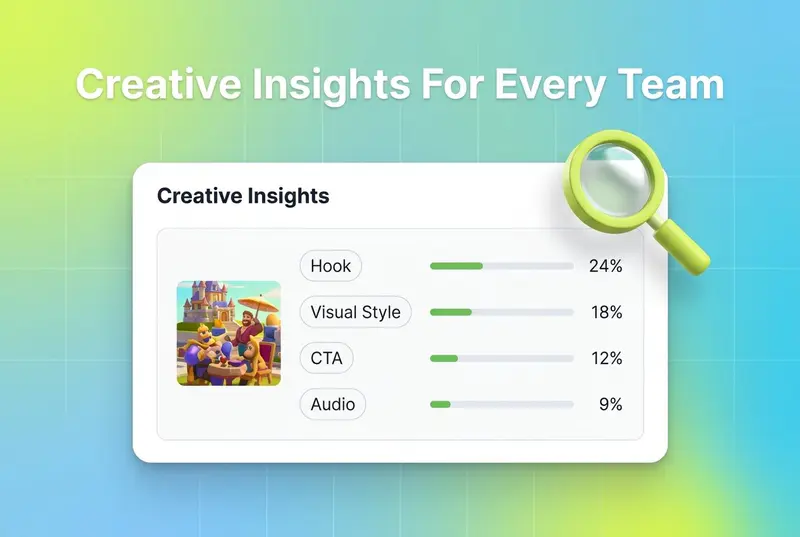
For years, creative-level analytics was a luxury good. If you wanted to know which hook drove installs or which visual style was fatiguing fastest, you either paid for an enterprise managed service, hired an analyst to tag thousands of ads by hand, or simply guessed. Most teams guessed.
That is changing fast. Vendors across the industry are repackaging what used to be high-touch, services-heavy creative analytics into self-serve software any marketer can switch on. VidMob, for example, announced its "Creative Insights and Performance for All" SaaS offering to put creative data directly in the hands of demand, growth, media, and creative teams. The direction of travel is clear: creative insights are going from boardroom dashboards to everyday tooling.
This guide explains what creative insights actually are, why the timing matters now, and how to evaluate the wave of tools promising to democratize them. The goal is simple. By the end, you should know what "creative insights for every team" really requires under the hood, and how to spot the difference between a tool that delivers it and one that just markets it.
Also read about AI-Powered Creative Testing in Programmatic Campaigns: A 2026 Guide
Key Takeaways
Creative is the single biggest lever in ad performance. NCSolutions and Nielsen analysis of nearly 450 studies found creative drives 49% of incremental sales, more than targeting, reach, or recency.
Marketers know this but cannot act on it. A Google, Kantar, and Marketing Week survey found 8 in 10 marketers see creative quality as a key driver, yet fewer than half measure its impact.
The bottleneck is measurement, not belief. Most teams still evaluate creative through blunt business outcomes, and most say creative optimization is not automated at their organization.
AI is what makes creative insights self-serve. Multimodal models can deconstruct an ad into thousands of creative decisions automatically and map each one to performance, work that used to take analysts weeks.
Creative intelligence spend is growing roughly 23% a year toward $11.47 billion by 2028, so the tooling category is maturing quickly.
"Insights for all" only works if the data is unified, automatic, and queryable. Coverage across every ad network and MMP, automatic tagging, and plain-language access decide whether a tool actually democratizes insight.
What Creative Insights Actually Mean
Creative insights are the connection between a creative choice and a performance result. Not "this video got a 2.1% CTR," but "the version that opened with a gameplay hook in the first two seconds drove 30% more installs than the talking-head opener."
Adobe, in research with Winterberry Group, frames this as creative intelligence: understanding why customers engage with a piece of content, identifying the elements and choices that drive results rather than just measuring whether a campaign worked.
The distinction matters because the inputs are granular. A single video ad contains dozens of creative decisions: the hook, the pacing, the on-screen text, the voiceover tone, the background music, the CTA wording, the characters, the color palette. Creative insights isolate which of those decisions move the metric you care about. That is the difference between knowing an ad failed and knowing why, so you do not repeat the mistake in the next 40 variations.
Why This Matters More Than Marketers Think
Here is the uncomfortable gap. Creative is the most powerful variable in advertising, and most teams systematically underrate it.
NCSolutions and Nielsen, drawing on nearly 450 sales-effect studies, found creative responsible for 49% of incremental sales. Google has echoed the pattern, citing creative as responsible for up to 70% of a campaign's success. Yet the same Westwood One analysis notes that brands and agencies estimate creative represents just 19% of total sales effect. Teams pour budget into targeting and bidding, the levers that matter least, while the lever that matters most goes unmeasured.
The reason is not laziness. It is friction. A Google, Kantar, and Marketing Week study in early 2025 found 8 in 10 marketers see creative quality as a key driver of effectiveness, but fewer than half actually measure its impact. A February 2026 survey of marketers showed most still judge creative by business outcomes and media metrics, with optimization actions like variant testing and reformatting rarely automated.
And the waste compounds. Adobe and Winterberry estimate 40 to 50% of produced creative assets never get activated in campaigns at all. Teams spend on production without knowing what will work, then cannot learn from what shipped. Creative is the biggest lever and the least measured one, which is exactly why making insights accessible to every team is the highest-leverage change a growth org can make this year.
Why "Insights for All" Is Possible Now
The reason creative analytics was gated for so long is that the underlying work was brutal. Tagging a creative library by hand means a human watching every ad, logging the hook type, the CTA, the emotional tone, the visual style, then reconciling it against performance data spread across Meta, TikTok, Google, and an MMP. At any real volume this is unsustainable, so most teams skipped it.
Multimodal AI removed that wall. Models can now deconstruct an asset automatically, cataloging thousands of creative decisions and correlating them with performance. What used to be an analyst's month becomes a background process. That is the real engine behind every "creative insights for all" announcement: the tagging that gated the category is now cheap and instant.
The market is responding accordingly. Adobe and Winterberry project creative-intelligence-powered spend in the US growing roughly 23% annually to reach $11.47 billion by 2028. When a category grows that fast, the question for practitioners is no longer whether to adopt creative insights, but how to tell a genuinely self-serve tool from one that still hides services and manual work behind the marketing.
What to Look For in a Creative Insights Tool
"Democratized" is easy to claim and hard to deliver. Use these four criteria to separate real self-serve creative intelligence from a dashboard with good copywriting.
Unified data across every network and MMP
Creative insights are only as good as their coverage. If a tool reads Meta but not TikTok, or ad-network spend but not MMP attribution, your "insights" have blind spots. Look for genuine breadth: ad networks like Meta, Google, TikTok, Snapchat, YouTube, AppLovin, Unity Ads, Mintegral, and IronSource, plus MMPs including AppsFlyer, Adjust, Branch, and Singular. Segwise, for instance, unifies creative data across 15+ ad networks and MMPs so cross-platform patterns are visible in one place instead of scattered across tabs.
Automatic, multimodal tagging
If you still have to tag creatives yourself, the tool has not actually solved the bottleneck. The tagging has to be automatic and it has to cover every modality, because an ad is video, audio, image, and text at once. Segwise's Creative Tagging Agent uses multimodal AI to tag video elements, audio and voiceover, static imagery, and on-screen text, and it is the only platform that tags playable (interactive) ads, which matters for mobile gaming teams whose best-performing units are playables.
Plain-language access, not just dashboards
A dashboard still assumes someone knows which question to ask and how to build the view. True "insights for every team" means a creative strategist or a CMO can ask a question in plain English and get an answer. Segwise's Creative Strategy Agent, an always-on AI chat with full context across your account, lets anyone ask "which hook style drove the most installs last month?" or "what's different about my top five creatives versus my bottom five?" without building a report.
Early warning and action, not just hindsight
Insight you act on after the budget is gone is not worth much. The best tools flag creative fatigue before performance crashes and turn winning patterns into your next batch of creatives. Segwise's fatigue tracking monitors every creative for performance decline and alerts you early, and its asset clustering isolates which specific change between two similar ads caused a ROAS difference.
From Insight to Output
Democratizing insight is only half the story. The teams getting the most value close the loop, turning what they learn back into creative. This is where the category is heading next: not just understanding why an ad worked, but using that understanding to make the next one.
Segwise's Creative Generation Agent builds new creatives around your top-performing tags, so a winning hook or CTA becomes the seed for the next batch rather than a one-off. For teams that adopt this end to end, the reported impact is concrete: up to 20 hours a week saved per app or brand on manual tagging and data work, around 50% ROAS improvement from catching fatigue early and scaling winners, and creative production time cut roughly in half. The point of insights for all is not nicer charts. It is faster, cheaper, better creative.
The Bottom Line
Creative insights used to be a privilege of teams with budget for managed services and analysts. AI changed the economics, and the whole industry is now racing to put creative-level intelligence in front of every marketer. The opportunity is real, because creative is the biggest driver of performance and still the least measured. But "for all" only counts when the data is unified, the tagging is automatic, the answers come in plain language, and the insight turns into action. Evaluate tools against that bar, not the brochure.
If your team is still judging creative by gut and lagging business metrics, the gap between you and the teams measuring at the element level widens every quarter. Creative intelligence is no longer the next frontier. It is the current one.
Frequently Asked Questions
What are creative insights in advertising?
Creative insights are the link between a specific creative choice and a performance result, such as a hook, CTA, color palette, or voiceover style and the installs or ROAS it produces. They answer why an ad worked, not just whether it did. Tools like Segwise generate them by using multimodal AI to tag every creative element and map it to performance metrics automatically.
Why does creative matter so much for ad performance?
Creative is the largest single driver of advertising effectiveness. NCSolutions and Nielsen analysis attributes 49% of incremental sales to creative, ahead of targeting and media, and Google has cited creative as responsible for up to 70% of a campaign's success. Despite this, most marketers underrate creative and undermeasure it, which is the measurement gap the current wave of creative insights tools is built to close.
How is AI making creative analytics available to every team?
AI removed the manual tagging bottleneck that made creative analytics expensive and slow. Multimodal models can deconstruct an ad into thousands of creative decisions and correlate them with outcomes automatically, instead of an analyst doing it by hand. That is why vendors including VidMob and Segwise can now offer self-serve creative insights rather than enterprise managed services.
What is the difference between creative analytics and creative intelligence?
Creative analytics typically reports what happened at the creative level, like CTR or installs per ad. Creative intelligence goes further, explaining why one execution outperformed another by isolating the contributing elements, and increasingly using that to generate new creatives. Segwise spans both: its Creative Strategy Agent surfaces the why, and its Creative Generation Agent acts on it.
How do I measure which creative element is driving performance?
Group creatives that share the same underlying assets, then compare versions to isolate the one variable that changed, such as the hook or the CTA. Doing this manually across hundreds of ads is impractical, so Segwise automates it with asset clustering, which pinpoints the specific treatment that caused a ROAS difference between two similar creatives.
Can a small team use creative insights without a data analyst?
Yes. The whole point of the current wave of tooling is removing the need for analysts and SQL. Segwise connects your ad networks and MMPs with no-code setup in minutes, tags creatives automatically, and lets anyone ask questions in plain language through its AI chat, so a one-person growth team gets the same creative intelligence as an enterprise.
Which platforms and data sources should a creative insights tool cover?
It should cover all your spend: ad networks like Meta, Google, TikTok, Snapchat, YouTube, AppLovin, Unity Ads, Mintegral, and IronSource, plus MMPs including AppsFlyer, Adjust, Branch, and Singular. Gaps in coverage create blind spots in your insights. Segwise integrates across 15+ networks and MMPs so creative performance is visible in one unified view.