
Creative effectiveness is the measurable score of how well an ad creative drives business results, separate from media efficiency. For performance marketers in 2026, scoring creative pre-flight and in-flight catches fatigue early, prevents wasted spend, and turns creative production into a data-backed system instead of a gut-feel exercise.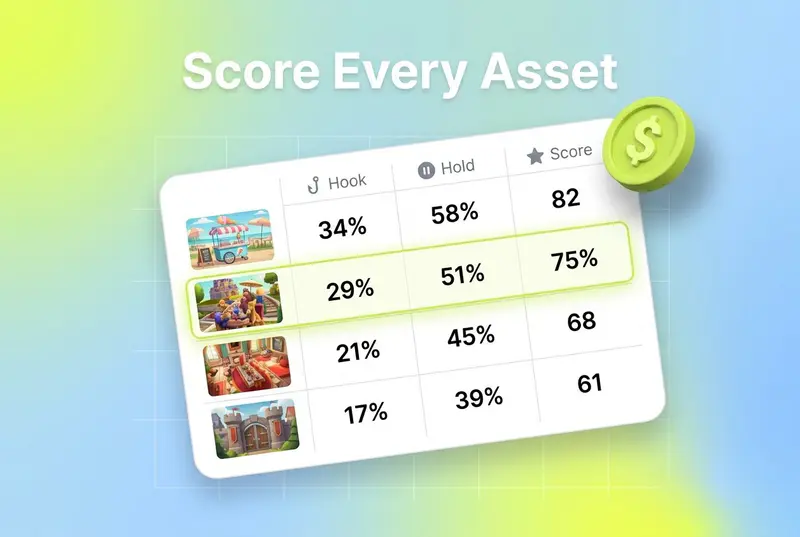
Also read about AI-Powered Creative Testing in Programmatic Campaigns: A 2026 Guide
The case for scoring every ad
Most teams still ship creative the same way they did in 2018: brief, design, launch, hope. Then they wait for ROAS to tell them whether it worked. By the time ROAS moves, the budget is already spent and the audience is already burned out.
That gap is expensive. According to Nielsen's analysis of nearly 500 CPG campaigns, 49% of a brand's sales lift from advertising comes from the creative itself, not the targeting or the bid. Yet creative is also the variable most marketers leave least instrumented. Targeting gets dashboards. Bid strategy gets MMM models. Creative gets a Slack thread.
Creative scoring closes that loop. It is the practice of rating an ad asset against a defined set of criteria, before it goes live and while it is in flight, then using the result to decide what to ship, kill, or iterate. The criteria can be performance-led (hook rate, hold rate, CTR), brand-led (logo placement, palette adherence, voice), or both. The point is that "did it perform" stops being a binary verdict and becomes a continuous signal you can act on.
This guide walks through what creative effectiveness actually means, how scoring works in practice, the benchmarks that matter in 2026, and the pitfalls that make most scoring programs fall apart inside six months.
Key takeaways
Creative effectiveness measures how well a creative drives business outcomes, isolated from media efficiency. Nielsen's research attributes 49% of ad sales lift to creative quality.
The 2026 baseline creative score weighting on social platforms is hook rate (25%), hold rate (20%), completion rate (20%), CTR (20%), and engagement rate (15%), per Benly's ad creative benchmarks.
Hook rate (3-second view ÷ impressions) is the earliest creative health signal. Target 30–40% on Meta, with anything above 35% indicating strong audience capture, according to Five Nine Strategy.
Meta's Andromeda ranking system has compressed creative lifespan from six weeks to roughly 10 days, with a 30–50% CTR drop by days 8–10, per Triple Whale's fatigue framework.
Without a structured scoring and review process, an estimated 15–25% of monthly ad spend is wasted on already-fatigued creative.
Brand consistency, the other half of creative scoring, drives a 33% revenue increase according to the Lucidpress State of Brand Consistency study.
Most ads underperform their potential: only 12% of ads score above 70 out of 100 on standard creative quality assessments, per Starti's 2026 metrics guide.
What creative effectiveness actually means
Creative effectiveness is the success metric for how much an individual creative asset contributes to business results, separate from media-side variables like bid, audience, or placement. If two creatives run against the same audience with the same budget and one drives 2x the ROAS, the difference sits in the creative.
This is different from creative scoring, which is the mechanism. Scoring is how you measure effectiveness. You can score for two things, and most mature programs do both:
Performance scoring rates the creative on metrics that predict or reflect outcomes: hook rate, hold rate, CTR, CVR, ROAS lift, completion rate. This is what growth and UA teams care about. It answers "will this perform" and "is this still performing".
Brand governance scoring rates the creative on adherence to brand and platform best practices: logo treatment, color palette, disclaimer placement, safe-area compliance, CTA copy. This is what brand managers and agencies care about. It answers "should we be allowed to ship this".
Vidmob's 101 guide on creative scoring makes the distinction explicit: brand governance is the strategy, scoring is the measurement, and effectiveness is the outcome. The three connect into one system. You define brand and platform best practices, you score against them, and you measure whether assets that scored higher actually drove more business.
The reason this matters in 2026 is that creative volume has exploded. A mid-size DTC brand now runs hundreds of variants a week across Meta, TikTok, YouTube, and AppLovin. A mobile game studio can be testing 50+ playables a month. Manually reviewing each one against brand guidelines is not feasible, and waiting for ROAS to sort the winners means most of the budget is gone before the data is reliable.
Why score creative in the first place
Three reasons keep showing up across the practitioner literature.
1. Most ad spend goes to creative that has already broken
Triple Whale's fatigue framework puts the number at 15–25% of monthly spend wasted on already-fatigued creative when there is no structured review. The math is simple: ROAS is a lagging indicator. By the time it drops, you have already paid for the impressions that delivered the signal. CTR moves first, then frequency rises, then CPM climbs, then CPA follows. Scoring in-flight catches the early signals.
Get Ryze's 2026 fatigue guide notes that on Meta prospecting, performance starts declining above a weekly frequency of 2.5 and falls off a cliff past 4.0. A scoring system that tracks frequency alongside CTR week-over-week catches the slide two to three days before ROAS confirms it.
2. Creative is the biggest controllable lever
The Nielsen number gets cited often because it is the cleanest data point on the question. Their analysis of CPG campaigns found creative drove 49% of sales lift, with media context contributing another 2%. Algorithm changes have shifted media variables further out of the marketer's control. Meta's Andromeda, Google's Performance Max, and TikTok's Smart+ all moved targeting, placement, and bid into the platform's hands. What you can still control is the creative itself.
3. Speed of decay has accelerated
Meta's Andromeda ranking system weights creative signals harder than the previous generation. Five Nine Strategy reports that a single concept that used to last six weeks now burns through its audience in two or three. Most concepts follow a 10-day decay curve: peak days 1–3, warning signs days 4–7, 30–50% CTR drop by days 8–10. If you are not scoring creative weekly, you are running ads at half their potential efficiency for half their lifespan.
How creative scoring works
The Vidmob primer lays out a clean four-step loop that holds up well in practice. The execution details have changed since the original framework, but the structure is durable.
Step 1: Define criteria
Pick the best practices you want to monitor. A useful starter set splits into three buckets.
Performance criteria: hook rate, hold rate (3-second to 25% completion), 75% completion rate, CTR, CVR, ROAS, CPI, spend share. These are the metrics that predict outcomes.
Brand criteria: logo presence and placement, color palette adherence, font usage, on-brand voice in voiceover or copy, presence of required disclaimers, CTA wording matches approved options.
Platform criteria: safe-area compliance for each placement (Reels, Stories, in-feed, TikTok For You), aspect ratio matching, sound-on vs sound-off versioning, captions for accessibility, file size and codec compliance.
The criteria should reflect the channel, market, and campaign objective. A brand awareness campaign on YouTube CTV weights completion rate higher than CTR. A direct response campaign on TikTok weights hook rate higher than completion. There is no universal scorecard.
Step 2: Score assets pre-flight
Rate each creative against the criteria before it goes live. Pre-flight scoring catches obvious failures (missing logo, wrong aspect ratio, CTA copy that violates platform policy) and flags creative that does not meet the predicted performance bar. The asset either passes, gets sent back for fixes, or runs as a test.
The mature version of this uses AI to do the scoring automatically. Computer vision reads the frame for visual elements. Audio transcription pulls dialogue and music. Text extraction reads on-screen copy. Each element gets tagged and scored against the criteria. Predictive creative scoring uses historical performance data on similar creative patterns to estimate how the asset will perform before it spends a dollar.
Step 3: Monitor in-flight
Once creative is live, track its score against actual performance. The in-flight loop is where most teams fall short. They score pre-flight, ship, and then move on. The point of scoring is to refresh the criteria as you learn what actually drives performance for your brand and audience.
Watch for the four-signal fatigue stack: CTR declining week-over-week, frequency rising past 2.5, CPM increasing, completion rate softening. When three of four trigger, the creative is fatiguing. Score declines on the assets that share elements with the fatiguing creative, because the audience is tiring of the underlying pattern, not the specific ad.
Step 4: Refresh criteria and iterate
Use the in-flight data to update the criteria. If your top-performing creatives over 90 days all use a specific hook style (UGC testimonial in the first 1.5 seconds), that becomes a criterion the next batch must hit. If creatives with a specific CTA underperform, retire the CTA. The criteria set is a living document.
This is also where the production loop closes. Identify the winning elements (specific hooks, visual styles, characters, CTAs) and feed them back into the brief for the next round. Modern AI-powered platforms can generate new creatives directly from the winning element data, cutting the lag between insight and asset.
Score every asset, in flight and pre-flight - Segwise's Creative Tagging Agent tags every creative element with multimodal AI, then maps every tag to hook rate, hold rate, completion, CTR, CVR, and ROAS across Meta, TikTok, Google, Snapchat, YouTube, AppLovin, Unity Ads, Mintegral, and IronSource, with native fatigue detection that alerts before ROAS drops
The 2026 benchmarks that matter
Scoring without benchmarks is just data collection. Here is what the practitioner literature reports as the current standard for 2026.
Hook rate. The percentage of impressions that turn into 3-second views. The first creative health check. Benly's 2026 benchmarks report 28% on Meta, 33% on TikTok, 22% on YouTube as solid targets. Five Nine Strategy notes 30–40% as the strong-performance band on Meta, with above 35% indicating the ad captures interest quickly. Below 25%, the creative is bleeding budget.
Hold rate. The percentage of 3-second viewers who stay to 25% of the video. Measures whether the hook converts into actual attention. A hook rate above benchmark with a hold rate below 50% means the creative grabs attention but does not deliver on the promise.
Completion rate. The percentage of impressions that reach 75% or full view. Benly reports 18% on Meta and 24% on TikTok as 2026 targets. Strong predictor of brand recall and message comprehension.
CTR. Video CTR benchmarks land at 1.62% on Meta, 0.84% on TikTok, 0.42% on YouTube in 2026, per Benly. CTR is a mid-funnel signal, not a creative health signal. Use it as a confirmation, not a primary score.
Weighted creative score. The composite. Starti's 2026 metrics guide reports that only 12% of ads score above 70 out of 100 on standard creative quality assessments. If your scoring system shows most of your creatives in the 80+ band, the criteria are too lenient.
A useful pattern in 2026 is to score UGC and polished creative separately. UGC ads outperform polished ads on hook rate by 31% and CTR by 33%, so scoring them on the same scale gives an unfair edge to the format rather than the asset.
Brand governance scoring vs performance scoring
The Vidmob framework focuses heavily on brand governance, which is the right framing for enterprises managing thousands of assets across regions. Performance marketers tend to focus on outcome metrics. The mature practice does both, and the two systems intersect.
Brand governance scoring asks: does this asset comply with brand standards (logo, palette, voice, disclaimer) and platform requirements (safe area, aspect ratio, sound-on)? It is enforcement. The output is binary or near-binary: ship, fix, or kill.
Performance scoring asks: how is this asset likely to perform, or how is it performing? It is prediction and measurement. The output is a continuous score that informs budget allocation, testing strategy, and creative iteration.
The two intersect because brand-compliant creative often performs better. Brand consistency drives a 33% revenue increase per the Lucidpress State of Brand Consistency study, because audiences recognize and trust consistent brand cues. Scoring for both means you ship creative that is both legal/on-brand and likely to perform.
The risk in confusing them is real. A brand governance tool will score a perfectly compliant ad with weak hook rate at 95/100. A performance tool will score a wildly successful ad that uses a wrong-shade logo at 95/100. Neither is wrong, but neither is sufficient alone.
Common pitfalls
Five failure modes show up repeatedly when teams set up creative scoring programs.
Scoring without acting. Teams build dashboards, calculate scores, and then ignore them. The score has to drive a decision: ship, kill, iterate, refresh criteria. If no one is responsible for acting on the score, the program dies in six months.
Same criteria across formats. Scoring a 6-second TikTok hook and a 30-second YouTube pre-roll on the same scale produces useless data. Criteria need to be format-specific. Hook rate matters more for short-form, completion rate matters more for long-form.
Brand criteria that block performance experimentation. Strict brand governance can lock out the UGC and creator-led content that drives the best performance on TikTok and Reels. The fix is to define a brand criteria tier system: hard rules (logo presence, no profanity, no competitor mentions) and soft rules (preferred palette, voice guidelines) that can flex for performance tests.
Ignoring tag-level patterns. Scoring at the creative level tells you which asset won. Scoring at the element level (hook style, character, CTA, visual treatment, audio choice) tells you why. The why is what informs the next brief.
Manual scoring at scale. Human reviewers cannot keep pace with the volume modern UA programs require. Manual scoring also introduces inconsistency between reviewers. AI-powered tagging and scoring is now standard for any team running more than 50 creatives a week.
Building a creative scoring stack
A minimum viable scoring stack in 2026 has four components.
Tagging layer. Multimodal AI that automatically tags every element in every creative: visual, audio, on-screen text, hook style, character, CTA, pacing. This is the foundation. Without element-level creative tagging, you can score creatives but you cannot diagnose them.
Performance integration. Live connection to ad networks (Meta, TikTok, Google, Snapchat, YouTube, AppLovin, Unity Ads, Mintegral, IronSource) and MMPs (AppsFlyer, Adjust, Branch, Singular) so the score updates with actual performance data, not just predicted scores.
Fatigue detection. Automated monitoring for the four-signal fatigue stack (CTR decline, frequency rise, CPM increase, completion softening) with alerts before ROAS drops. The point is to act on warning signs, not confirmation. Native creative fatigue tracking is now standard in mature scoring stacks because manual fatigue monitoring across hundreds of creatives is unworkable.
Brand compliance layer. Optional but recommended for enterprise: automated checks for logo, palette, voice, and disclaimer compliance before launch. Sprinklr, Adobe Brand Intelligence, and similar tools handle this at scale.
Putting it together
Creative effectiveness scoring is not a new idea, but the cost of not doing it has changed. Algorithm changes have made creative the single biggest controllable lever in paid social. Creative volume has scaled past what manual review can handle. Fatigue cycles have compressed from weeks to days. The teams that score every asset, pre-flight and in-flight, against criteria that adapt to actual performance, are the ones that compound their ad spend efficiency over time.
The four-step loop is straightforward: define criteria, score pre-flight, monitor in-flight, refresh criteria from results. The hard part is the tooling and the discipline to act on the score. The teams that close that loop turn creative from a cost center into a source of compounding insight.
If you are building a scoring program from scratch, start with one channel and the three performance metrics that matter most for your funnel stage. Layer in brand governance criteria once the performance side is working. Automate the tagging early, because manual tagging is where most programs die.
Frequently asked questions
What is creative effectiveness?
Creative effectiveness is the measurable contribution of an individual ad creative to business outcomes, separate from media-side variables like bid, audience, and placement. It is typically measured through a score that combines performance metrics (hook rate, hold rate, CTR, completion rate, ROAS) and, in enterprise contexts, brand compliance criteria. Platforms like Segwise score creative at the element level (hook, CTA, character, visual style) across Meta, TikTok, Google, and other networks so teams can isolate which elements drive performance.
How do you score ad creative?
Creative scoring follows a four-step loop: define criteria (performance metrics, brand standards, platform requirements), rate each asset against the criteria before it goes live, monitor in-flight performance and update scores as data comes in, then refresh the criteria based on what actually drives outcomes. The 2026 standard weighting is hook rate 25%, hold rate 20%, completion 20%, CTR 20%, engagement 15%. AI-powered platforms like Segwise, Vidmob, and Smartly automate the scoring through multimodal tagging.
What is a good creative score on Meta in 2026?
Only 12% of ads score above 70/100 on standard creative quality assessments, so anything above 70 is strong. On the individual metrics, target a hook rate of 30–40%, hold rate above 50%, completion rate above 18%, and CTR above 1.6% on Meta video placements. Below these bands, the creative is bleeding budget. Tools like Segwise, Ryze, and Madgicx report these benchmarks against your account's actual data.
What's the difference between creative scoring and brand governance?
Brand governance is the strategy of maintaining brand consistency and platform compliance across thousands of assets. Creative scoring is the mechanism that measures it. Brand governance scoring rates assets on adherence to brand standards (logo, palette, voice, disclaimers) and produces a near-binary pass/fix/kill output. Performance scoring rates assets on outcome prediction (hook rate, ROAS, etc.) and produces a continuous score. Mature programs run both. Segwise focuses on the performance side with element-level tagging across video, audio, image, text, and playable ads, while tools like Adobe Brand Intelligence handle the brand compliance side.
Why is creative effectiveness more important in 2026 than it was in 2023?
Three forces converged. Algorithm changes (Meta Andromeda, Google Performance Max, TikTok Smart+) moved targeting and bidding into the platform's hands, leaving creative as the main controllable lever. Creative volume scaled past manual review capacity. Fatigue cycles compressed from six weeks to roughly 10 days on Meta, per Triple Whale's framework. The result is that scoring every asset, in-flight and pre-flight, is now the difference between compounding ad efficiency and burning budget on fatigued creative. Platforms like Segwise track these signals automatically across Meta, TikTok, Google, Snapchat, YouTube, AppLovin, Unity Ads, Mintegral, IronSource, alongside MMP data from AppsFlyer, Adjust, Branch, and Singular.
How do I catch creative fatigue before ROAS tells me?
Watch the four-signal fatigue stack: CTR declining 10–15% week-over-week, frequency rising past 2.5, CPM increasing, completion rate softening. When three of the four trigger, the creative is fatiguing. ROAS is the last metric to move, typically two to three days after the early signals show up. Native fatigue detection in tools like Segwise monitors all four signals across platforms and alerts before ROAS drops, which can save the 15–25% of monthly spend typically wasted on already-fatigued creative.
Can AI actually predict how a creative will perform before it launches?
Predictive scoring works best when it has dense historical performance data on similar creative patterns from your own account. Predictive creative scoring uses tagged elements from past winners and losers to estimate how a new asset will perform. The prediction is more reliable for short-form direct response than for long-form brand work. Tools like Segwise, Smartly, and Madgicx use multimodal AI to tag elements and map them to past performance, which closes the gap between prediction and actual outcome over time.
Is scoring creative manually still viable for small teams?
For teams running fewer than 20 creatives a month, manual scoring against a simple checklist (logo present, hook in first 1.5 seconds, CTA clear, aspect ratio correct) is workable. Above 50 creatives a month, manual scoring breaks down because reviewer consistency drops and the time cost outweighs the insight. Automated tagging and scoring platforms like Segwise, Vidmob, and Ryze become necessary at that scale. The breakeven point is usually when the team is spending more than 10 hours a week on manual creative review.