
Creative analytics is the practice of measuring ad performance at the level of the individual creative and its elements, not just the campaign or ad set. For performance teams, that shift answers the question campaign reporting never could: not which ads won, but why they won and what to make next. Segwise builds this layer by unifying creative data across 15+ ad networks and MMPs, tagging every element with multimodal AI, and mapping each tag to the metrics that move ROAS.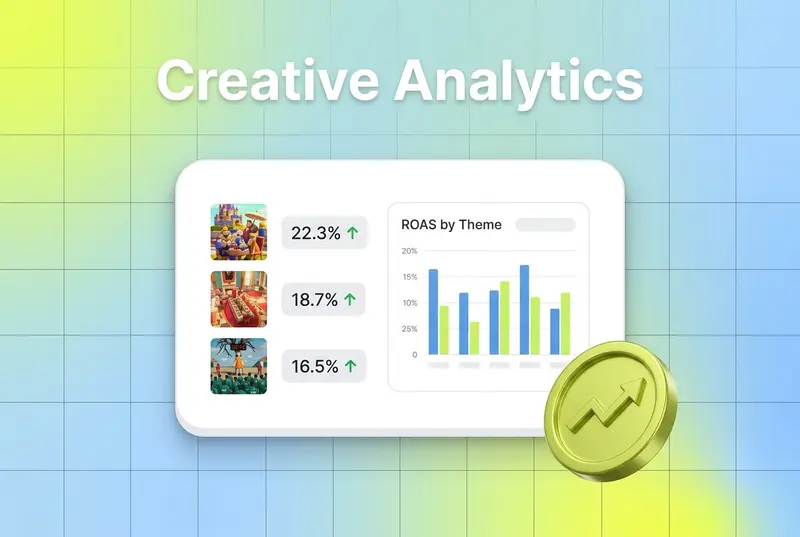
Most teams can tell you which ad spent the most last month. Far fewer can tell you why it worked. That gap is the whole problem with campaign-level reporting, and it is why creative analytics has become the lever serious advertisers reach for first in 2026.
Targeting used to be where you won or lost. Then the platforms automated it. Advantage+, Smart Bidding, and broad targeting moved most of the optimization work inside the algorithm, and the human edge moved to the creative. The trouble is that measurement did not move with it. Reporting still lives at the campaign and ad-set level, where a number like ROAS tells you something happened but nothing about the hook, the format, the offer, or the first three seconds that actually caused it.
Research has been saying this for years, and marketers keep underrating it. Nielsen found that when creative is strong, it can account for up to 89% of a digital campaign's in-market success, more than reach, targeting, and recency combined. NCSolutions reached a similar conclusion and went further: marketers vastly understate the sales effect of creative and overestimate the impact of targeting. If creative is the biggest driver of performance, then the analytics layer that explains your creative is the most valuable reporting you are probably not doing yet.
This guide covers what creative analytics is, how it differs from campaign reporting, the metrics that actually predict ROAS, how the full workflow runs end to end, and how to build it on your own stack without drowning in spreadsheets.
Key takeaways
Creative analytics measures performance at the creative and element level (hooks, CTAs, formats, visual styles), so you learn why an ad worked, not just that it spent.
Creative is the single largest driver of ad performance. Nielsen attributes up to 89% of digital in-market success to strong creative, yet most teams still report only at the campaign level.
The metrics that matter at the creative level are hook rate, hold rate, thumb-stop rate, CTR, CVR, and creative-level ROAS, not account-wide averages.
The hard part is data, not math. Every network reports differently, so each platform tells a different story about the same campaign until you unify it.
AI tagging is what makes creative analytics scale. Tagging thousands of creatives by hand can eat 20+ hours a week per app or brand, which is why most teams skip it.
Creative analytics is one half of a loop: understand what works, then generate more of it. Segwise closes that loop by feeding winning patterns straight into creative generation.
What is creative analytics?
Creative analytics is the discipline of analyzing ad performance by creative and by creative element rather than by campaign, ad set, or audience. Instead of asking "how did this campaign do," it asks "which hook, format, character, color, CTA, or message drove the result, and how does that pattern repeat across everything we run."
A campaign-level report tells you a bucket of spend returned a number. A creative-level report tells you that your 3-second talking-head hooks hold 40% more viewers than your text-on-screen openers, that your discount CTAs convert worse than your social-proof CTAs at the same CPM, and that one visual style is quietly carrying half your ROAS. Same spend, completely different decision quality.
The reason this matters more every year is structural. As the platforms commoditized targeting and bidding, the creative became the main variable a human still controls. So the analytics that explain the creative became the analytics that explain performance.
Creative-level vs campaign-level analytics
The cleanest way to understand creative analytics is to put it next to the reporting you already have.
Campaign-level analytics aggregates everything inside a campaign or ad set into one row. It is great for budget pacing and account health. It is useless for creative decisions, because a single campaign usually contains many creatives, and the average hides which ones are working.
Creative-level analytics breaks that row apart. Every creative gets its own performance profile, and every creative is described by its elements through tagging. Now you can group by element across the whole account: all ads with a UGC hook, all ads with a 9:16 format, all ads featuring a specific offer. That is where patterns show up, and patterns are what you can act on.
For a deeper breakdown, see our guide to creative-level vs campaign analytics.
Here is the distinction in practice:
Campaign view: "Prospecting campaign returned 2.1x ROAS this week."
Creative view: "Our top-quartile creatives all open on a problem-first hook in the first second, and they return 3.4x. The bottom quartile open on brand logos and return 1.2x."
The second statement tells you exactly what to brief next. The first does not.
Why creative analytics matters in 2026
Three shifts made creative the center of gravity for performance marketing, and creative analytics the way to manage it.
First, targeting got commoditized. With broad targeting and automated bidding now the default on Meta, TikTok, and Google, the algorithm decides who sees the ad. Your input is the creative. When everyone has access to the same targeting machine, the creative is the only durable edge.
Second, the research finally caught up to practice. Beyond Nielsen's findings, analysis covered by Marketing Charts shows creative quality remains the biggest single contributor to ad effectiveness, even as brand factors rise. If creative drives the result, creative is what you need to measure precisely.
Third, creative volume exploded. AI generation means teams now ship dozens of variations a week instead of a handful a month. Without creative-level analytics, that volume is just noise. You cannot learn from a hundred new ads a week if your reporting collapses them into one campaign average.
The teams winning right now treat creative as the unit of analysis. They know which elements drive performance, they catch decay early, and they brief the next round from data instead of opinion. That is the practical promise of creative analytics: faster, evidence-based creative decisions instead of guesswork dressed up as instinct.
The creative metrics that actually predict ROAS
Not every metric is worth tracking at the creative level. The ones that consistently predict downstream performance cluster around attention and conversion.
Hook rate measures how many people are still watching after the first 3 seconds. It is the earliest signal of whether a creative earns attention at all. Weak hook rate caps everything downstream.
Hold rate (and completion rate) measures whether the creative keeps attention past the hook. A strong hook with a weak hold means your opening writes a check the rest of the ad cannot cash.
Thumb-stop rate measures how effectively the creative interrupts the scroll, usually tracked as the share of impressions that become 3-second views relative to reach.
CTR still matters as a mid-funnel intent signal, but only read it alongside hold rate. High CTR with low hold often means a misleading hook.
CVR ties the creative to actual outcomes. A creative can win attention and still convert poorly, which is exactly the kind of mismatch creative analytics is built to surface.
Creative-level ROAS and CPI are the bottom line, measured per creative rather than per campaign, ideally connected to MMP data so you are reading installs and revenue, not just clicks.
The point is not to chase any single number. It is to read them together, per creative, and then map them back to the elements that produced them. For the full method, see how to measure ad creative performance and which creative metrics that predict ROAS deserve the most weight. A hook rate by itself is a number. A hook rate mapped to "talking-head opener vs product-shot opener" is a decision.
How creative analytics works end to end
Mature creative analytics is a pipeline, not a dashboard. It runs in four stages, and each stage is a place teams get stuck.
1. Unify the data
Creative performance data is scattered by default. Meta reports one way, TikTok another, Google another, and your MMP reports installs and revenue on its own logic. As one analysis put it, each channel defines its own metrics and attributes conversions its own way, so none of the stories are complete until you bring them together. Stage one is getting every creative, from every network and MMP, into one place with consistent definitions.
2. Tag the creative elements
Raw performance numbers do not explain themselves. You need to describe each creative by its elements: hooks, CTAs, characters, visual styles, emotions, on-screen text, audio, format. This is creative tagging, and done by hand it is brutally slow. Teams that try to tag manually often spend 20+ hours a week per app or brand on it, which is why most teams quietly stop doing it.
3. Map tags to metrics
Once creatives are tagged and unified, you connect each tag to performance. Now "UGC hook" or "discount CTA" or "9:16 vertical" has a ROAS, a hook rate, and a CVR attached to it across every creative that used it. This tag-to-metric mapping is the heart of creative analytics. It turns thousands of individual ads into a readable map of what your audience responds to.
4. Act on the patterns
The output is decisions: which elements to brief more of, which to retire, which creatives are fatiguing and need a refresh, and what the next test should isolate. The loop only matters if it changes what you ship.
The real bottleneck is data, not insight
Most teams do not lack the desire to do this. They lack the operational capacity. The work of consolidating 15+ networks, tagging every creative, and keeping it current is enormous, and spreadsheets break down fast at scale. Formula errors, copy-paste mistakes, and version drift turn the analysis into something nobody trusts, which is worse than no analysis at all.
This is the gap modern creative analytics platforms close. Segwise unifies creative and performance data from 15+ ad networks, including Meta, Google, TikTok, Snapchat, YouTube, AppLovin, Unity Ads, Mintegral, and IronSource, alongside MMPs AppsFlyer, Adjust, Branch, and Singular. Setup is no-code and takes minutes rather than weeks, with historical data imported automatically (up to 14 days on the free trial and up to 3 months for paid customers).
On top of that unified data, Segwise's Creative Tagging Agent uses multimodal AI to tag every element across video, audio, image, and text automatically, including playable ads, which it is the only platform to tag. Each tag is mapped to performance through tag-to-metric mapping, so the analysis that takes a team 20 hours a week runs continuously in the background. The same multimodal tagging powers a Competitor Tracking Agent that analyzes competitor ads on Meta, so you can read their creative strategy the same way you read your own.
The interface is built for creative work specifically. Card View shows creative thumbnails next to their performance data, so you analyze the actual ad and not an abstract row in a table. Studio View handles multiple apps and brands in one workspace, which matters for studios and agencies managing portfolios. And the always-on Creative Strategy Agent lets you ask questions in plain language, like which hook style drove the most installs last month, and get an answer with full context across your account.
Creative analytics is one half of a loop
Understanding what works is only useful if it changes what you make. The strongest version of creative analytics closes a loop: analytics surfaces the winning patterns, generation builds new creatives from those patterns, and those new creatives get tracked back in analytics, which sharpens the next round.
This is where creative analytics connects to AI ad creative generation. The same tag-to-metric mapping that explains your winners becomes the brief for your next batch. Instead of generic AI output, generation grounded in your own performance data produces variations that are statistically more likely to work. Segwise's Creative Generation Agent does exactly this, producing net-new and variation creatives across image, video, and playable formats, all built around your winning tags, and automatically tagging and tracking each one once it goes live so the loop stays closed.
That loop is the difference between a dashboard you check and an engine that compounds. Analytics on its own tells you what happened. Analytics wired into generation tells you what to do next, then helps you do it.
How to build a creative analytics workflow
If you are starting from campaign-level reporting today, here is a sane order of operations.
Consolidate first. Get every creative from every network and MMP into one view with consistent metric definitions. Do not start tagging until your data is unified, or you will tag the same creative differently across sources.
Standardize a tag taxonomy. Decide the elements you care about: hook type, format, offer, CTA, visual style, audio. Keep it small enough to be consistent and large enough to be useful. Automated tagging makes a richer taxonomy practical.
Map tags to your real outcome metric. Connect tags to creative-level ROAS or CPI through your MMP, not just clicks. Attention metrics like hook rate are leading indicators, but revenue is the scoreboard.
Review by element, not by ad. In your weekly creative review, group performance by tag across the whole account. Find the elements that repeat in winners and the ones that repeat in losers.
Brief from the data, then feed results back. Turn the patterns into your next creative brief, ship the variations, and track them. The workflow is a loop, not a report you run once.
The teams that scale creative do this continuously, not quarterly. The faster the loop runs, the faster you compound learnings into wins.
Common pitfalls to avoid
Reading averages. Account-wide ROAS hides everything. If you only look at aggregates, you will scale mediocre creatives and kill good ones inside underperforming campaigns.
Tagging inconsistently. Manual tagging drifts. Two people tag the same hook differently, and the analysis quietly becomes meaningless. Consistency matters more than granularity.
Ignoring fatigue. A winning creative is not winning forever. Watch for declining performance and spend-share drop, and refresh before the budget burns, not after. Catching ad creative fatigue early, with automated fatigue tracking, beats a manual weekly scan.
Stopping at clicks. CTR without CVR and ROAS leads you toward attention-grabbing creatives that do not convert. Always tie back to the real outcome.
Treating analytics as the finish line. The value is in what you make next. If the insight does not change your briefs, the loop is broken.
Conclusion
Creative analytics is no longer a nice-to-have for sophisticated teams. With targeting commoditized and creative driving the bulk of performance, the analytics layer that explains your creative at the element level is the most direct path to better ROAS. The shift is simple to state and hard to operationalize: stop asking which campaign won and start asking which creative elements won, then make more of them.
The reason most teams have not made the shift is not strategy, it is operations. Unifying fragmented data, tagging at scale, and keeping it current is too much manual work for spreadsheets to hold. That is exactly what an AI-powered creative intelligence platform is for.
If you want to see why your ads win instead of just which ones spent, Segwise unifies your creative data across 15+ networks and MMPs, tags every element automatically, and maps it all to performance, saving teams up to 20 hours a week and helping them improve ROAS by up to 50%. Then it closes the loop by generating new creatives from your winning patterns.
Explore the creative analytics cluster
Creative analytics sits at the center of a wider creative intelligence workflow. To go deeper on the parts that matter most to your team:
Turn insight into a plan with our guide to AI creative strategy.
See how the same tagging powers competitor ad tracking so you can read rival creative the way you read your own.
Compare the best ad creative analytics tools before you commit to a stack.
Understand why card view vs spreadsheets changes how fast your team actually learns from creative data.
Frequently asked questions
What is creative analytics?
Creative analytics is the practice of measuring ad performance at the level of the individual creative and its elements, such as hooks, CTAs, formats, and visual styles, rather than at the campaign or ad-set level. It answers why a creative performed, not just that it spent. Platforms like Segwise use AI to tag those elements automatically and map each one to metrics like ROAS, so teams can see which creative choices actually drive results.
What is the difference between creative-level and campaign-level analytics?
Campaign-level analytics aggregates every creative inside a campaign into one average, which is useful for budget pacing but hides which specific ads and elements worked. Creative-level analytics breaks that average apart, giving every creative its own performance profile and grouping results by element across the whole account. The practical difference is that campaign data tells you a bucket of spend returned a number, while creative data tells you exactly what to brief next.
Which metrics matter most in creative analytics?
The metrics that best predict performance at the creative level are hook rate, hold rate, thumb-stop rate, CTR, CVR, and creative-level ROAS or CPI. Attention metrics like hook rate and hold rate are leading indicators, while ROAS connected to MMP data is the bottom line. The key is reading them together per creative and mapping them back to the elements that produced them, rather than chasing any single number.
How does AI creative tagging work?
AI creative tagging uses multimodal models to automatically analyze and label every element in an ad: visual styles, characters, on-screen text, hooks, CTAs, audio, and emotional tone across video, audio, image, and text. Segwise's Creative Tagging Agent does this across 15+ networks and is the only platform that also tags playable ads. Automated tagging replaces the 20+ hours a week teams spend tagging by hand, and keeps the taxonomy consistent so the analysis stays trustworthy.
Do I need creative analytics if the platforms already optimize for me?
Yes, and arguably more than before. Platform automation optimizes delivery and bidding, but it does not tell you why a creative worked or hand you the patterns to brief your next round. As targeting got commoditized, the creative became the main lever you control, so the analytics that explain your creative are now the analytics that explain your performance. The platforms optimize within your creative; creative analytics improves the creative itself.
How is creative analytics connected to AI ad generation?
They form a closed loop. Creative analytics surfaces the winning patterns in your existing ads, AI ad generation builds new creatives grounded in those patterns, and the new creatives get tracked back in analytics to sharpen the next round. Segwise connects the two directly: its Creative Generation Agent builds net-new and variation creatives from your winning tags and automatically tags and tracks each one once live, so generation is always grounded in real performance data rather than generic prompts.
What tools do I need to do creative analytics at scale?
At a minimum you need a way to unify creative data across all your ad networks and MMPs, automated tagging to describe creative elements, and tag-to-metric mapping to connect those elements to outcomes. Spreadsheets break down quickly because manual consolidation and tagging do not scale past a few hundred creatives. A dedicated platform like Segwise handles unification, multimodal tagging, fatigue tracking, and a plain-language Creative Strategy Agent in one place, with no-code setup that connects your sources in minutes.