
Competitor creative gap analysis is the practice of mapping the creative angles, hooks, and messages your competitors run, then finding the white space they are ignoring and the angles they are oversaturating. It tells you where the category is crowded and where it is wide open, so you brief creative into gaps instead of into a fight everyone is already having. The fastest way to do it at scale is to tag competitor ads by element with AI, which is what Segwise's Competitor Tracking Agent does for ads on Meta.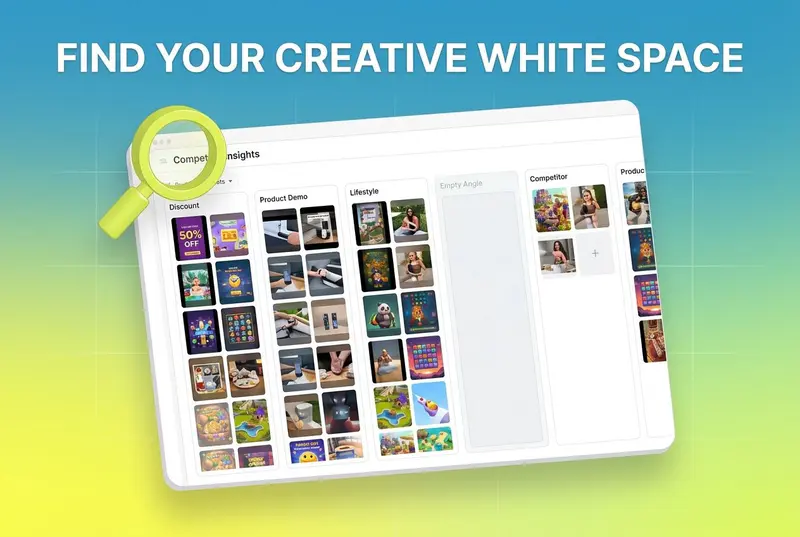
Most teams research competitors by scrolling the Meta Ad Library and saving a few ads they like. That tells you what one competitor is doing. It does not tell you what the whole category is doing, which angles are saturated, or where nobody is playing. The gap between those two things is the difference between copying a rival and finding your own lane.
This guide covers what competitor creative gap analysis is, why white space matters more than ever in 2026, and a step-by-step method to run it on Meta. It also covers the two outputs that should come out of every analysis: the oversaturated angles to avoid and the white space to test next.
Key takeaways
Competitor creative gap analysis maps every competitor angle, then sorts them into oversaturated (everyone runs it) and white space (nobody does), so you brief into the gaps.
White space analysis is a systematic method for discovering untapped opportunities competitors have not addressed. Applied to creative, the unit of analysis is the angle, not the product.
Creative is the biggest lever in the funnel. NCSolutions and Nielsen found creative drives roughly 49% of incremental sales, more than targeting and reach, yet most teams underrate it.
The Meta Ad Library is the free starting point, but it has no follow feature and no history once an ad is turned off, so manual research misses the pattern.
The bottleneck is scale, not strategy. Watching one competitor is easy; tagging hundreds of ads across a category by hand is not, which is why most gap analysis stays shallow.
Segwise's Competitor Tracking Agent AI-tags competitor ads on Meta and surfaces white space and oversaturated angles automatically, so the gap map builds itself.
What is competitor creative gap analysis?
Competitor creative gap analysis is the discipline of analyzing your competitors' ad creative by angle and element, then identifying the gaps: the messaging territory they have left open and the territory they have crowded. It borrows from white space analysis, a systematic business research method for discovering untapped market opportunities competitors have not yet established a presence in. The twist is that the unit of analysis is not a product or a feature. It is the creative angle.
An angle is the core idea a creative leads with. Think problem-first hooks, price and discount messaging, social proof, founder story, before-and-after, speed, convenience, or a specific emotion. When you map every competitor ad to its angle, two things become obvious fast. First, the angles everyone is running, which are saturated and expensive to win in. Second, the angles nobody is running, which is the white space.
Here is the distinction that matters. A swipe file tells you "this competitor ran a UGC testimonial ad." A gap analysis tells you "every competitor in our category is running UGC testimonials and discount hooks, and not one of them is running a problem-first demonstration angle." The first is inspiration. The second is a brief.
The reason this is worth doing is structural. As platform targeting got commoditized, creative became the main variable a human still controls, and the angle is the highest-leverage creative decision you make. Knowing which angles are contested and which are open is how you stop briefing into a crowded fight.
Why creative white space matters in 2026
Creative is the biggest single driver of performance, which is exactly why the angle nobody else is using is so valuable. Research from NCSolutions and Nielsen, based on nearly 450 sales-effect studies, found creative drives roughly 49% of incremental sales, more than targeting, reach, and recency combined. The same research found marketers credit creative with only about 19% of the effect, so most teams systematically underinvest in the thing that moves the needle most.
If creative drives performance, then a differentiated angle is a performance advantage, not a branding nicety. When every competitor leads with the same discount hook, the audience tunes it out and CPMs climb for everyone fighting over the same message. The team that finds an open angle gets cheaper attention because it is the only one saying that thing.
Marketing Charts, summarizing the same body of research, reports that creative quality remains the biggest contributor to ad effectiveness even as brand factors rise. Combine that with the volume of creative teams now ship with AI generation, and the risk is not running too few ads. It is running a hundred variations of the same saturated angle. Gap analysis is what keeps volume pointed at open territory.
So the practical promise of competitor creative gap analysis is this: it turns competitor research from "what should we copy" into "where is nobody playing, and can we own it." That is a far more defensible position than matching a rival ad for ad.
How to do competitor creative gap analysis: a step-by-step method
Gap analysis follows the same logic as classic white space analysis, adapted for creative. The standard process runs through scope, data, gaps, evaluation, and prioritization. Here is how that maps to competitor ad creative on Meta.
1. Define your competitive set and scope
Pick the 5 to 10 competitors that actually compete for your audience, not every brand in the category. Mixing a premium incumbent with a budget challenger muddies the angle map, because they are deliberately playing different games. Narrow scope first, the way any white space analysis starts by defining its scope to avoid analysis paralysis.
2. Pull every competitor ad you can find
The free starting point is the Meta Ad Library, which lets anyone view the active ads any advertiser is running across Facebook and Instagram. Search each competitor and pull their currently running creatives. Two limits to know: the library has no follow feature, so you have to check manually and repeatedly, and once a competitor turns an ad off it disappears, so anything you do not capture is gone. That is why a one-time scroll undersells what the category is doing, and why a structured approach to Meta Ad Library competitor research beats ad-hoc scrolling.
3. Tag every ad by angle and element
This is the step that makes or breaks the analysis. For each competitor ad, label the angle (problem-first, social proof, discount, founder story, and so on), the hook, the format, the CTA, and the core message. Done consistently across hundreds of ads, this is what turns a pile of screenshots into a readable map. Done by hand, it is brutally slow and it drifts, because two people tag the same hook differently. This is the bottleneck where most gap analysis quietly stays shallow.
4. Find the oversaturated angles and the white space
With every ad tagged, count the angles. The angles that show up across most competitors are oversaturated: contested, expensive, and hard to differentiate in. The angles that barely appear, or do not appear at all, are your white space. This is the moment the analysis pays off, because you can now see the category as a map instead of a feed.
5. Evaluate and prioritize the gaps
Not every gap is worth filling. Some angles are open because they do not work for your category, not because nobody thought of them. Evaluate each gap against fit with your product, the size of the audience that angle could reach, and whether you can credibly own it. Then prioritize the one or two open angles most worth testing, and brief creative into them.
The real bottleneck is tagging at scale
Most teams understand the strategy. What stops them is the operational load. Watching one competitor is easy. Tagging every ad from 8 competitors across hundreds of creatives, keeping it current as ads rotate, and doing it consistently enough that the angle counts mean something is a different job entirely. The Meta Ad Library hands you the raw ads but does nothing to organize them, and a manual swipe file decays the moment a competitor cycles their creative.
This is the gap a creative intelligence platform closes, and it sits inside the broader practice of competitor ad tracking. Segwise's Competitor Tracking Agent tracks and monitors competitor ads in one dashboard and applies the same multimodal AI it uses on your own creatives to competitor ads, analyzing their hooks, CTAs, visual styles, and messaging patterns automatically. It is Meta-supported today, tracking competitor ads across Facebook and Instagram, with additional platforms in development.
The payoff is the part you actually came for. Because every competitor ad is tagged the same way, Segwise surfaces the gap map directly: it helps you identify white space, the creative angles and messaging themes competitors are not leveraging, and spot the oversaturated angles, the approaches overused across your competitive landscape. The same tagging powers competitor diff and benchmarking, so you can compare your creative approach against rivals and see where you are crowded and where you are open.
That turns gap analysis from a quarterly research project into something that stays current on its own. And because it lives in the same platform as your own creative analytics, the white space you find feeds straight into briefs, through the always-on Creative Strategy Agent you can ask in plain language which angles your competitors have abandoned.
Turning gaps into a creative brief
Finding the white space is only half the value. The other half is briefing into it before a competitor notices the same gap. A good gap analysis hands the creative team two lists: angles to avoid because they are saturated, and angles to test because they are open.
The strongest version connects gap analysis to your own performance data. An open angle is a hypothesis, not a guarantee. So you test it, tag the result, and check whether the white-space angle actually beats your saturated baseline. If it does, you scale it and you now own territory the category left behind. If it does not, you have learned the gap was open for a reason, which is also useful.
This is where competitor gap analysis stops being a standalone exercise and becomes part of a loop. You read the category to find the opening, brief into it, measure the result against your own creatives, and feed what you learn back into the next read of the category. The teams that compound this advantage run it continuously, not once a quarter.
Common pitfalls to avoid
Confusing a swipe file with an analysis. Saving ads you like tells you what looks good. Counting angles across the whole set tells you where the gaps are. Only the second one is gap analysis.
Tracking too many competitors. A loose competitive set blends brands playing different games and blurs the angle map. Keep it to the 5 to 10 who actually compete for your buyer.
Tagging inconsistently. If the same angle gets labeled three ways, the counts are meaningless. Consistency across the set matters more than granularity on any one ad.
Treating every gap as opportunity. Some angles are open because they do not work. Evaluate fit and audience size before you brief into a gap.
Doing it once. Competitors rotate creative constantly, and the Meta Ad Library forgets ads the moment they stop. A one-time pass is stale within weeks. Gap analysis has to stay current to stay useful.
Conclusion
Competitor creative gap analysis is how you stop briefing into a crowded fight and start briefing into open territory. With creative driving the bulk of performance and targeting largely automated away, the angle nobody else is running is one of the few durable edges left. The method is straightforward to describe: map every competitor angle, separate the saturated from the open, evaluate the gaps, and brief into the ones worth owning.
The reason most teams never get past a swipe file is not strategy, it is scale. Tagging hundreds of competitor ads consistently and keeping it current as creative rotates is too much manual work to sustain. That is exactly what an AI-powered creative intelligence platform is for.
If you want to see the white space in your category instead of guessing at it, Segwise AI-tags every competitor ad on Meta, surfaces the angles your rivals oversaturate and the ones they ignore, and connects those gaps to your own creative performance, helping teams save up to 20 hours a week and improve ROAS by up to 50%.
Frequently asked questions
What is competitor creative gap analysis?
Competitor creative gap analysis is the practice of mapping your competitors' ad creative by angle and element, then identifying the messaging territory they oversaturate and the white space they ignore. Instead of asking what a single competitor is doing, it asks what the whole category is doing and where nobody is playing. Tools like Segwise use AI to tag competitor ads on Meta automatically and surface those gaps, so the analysis covers hundreds of ads rather than a handful.
How do I find white space in my competitors' ads?
Pull every active ad from your competitive set using the Meta Ad Library, tag each ad by its angle, hook, format, and message, then count how often each angle appears. Angles that show up across most competitors are oversaturated; angles that barely appear are your white space. The hard part is tagging consistently at scale, which is why platforms like Segwise AI-tag competitor ads and surface the white space and oversaturated angles for you.
What is the difference between a swipe file and a creative gap analysis?
A swipe file is a collection of competitor ads you saved for inspiration, which tells you what individual ads look like. A creative gap analysis tags and counts angles across the whole competitive set, which tells you which angles are crowded and which are open. The swipe file is a starting point; the gap analysis turns it into a brief by revealing where the category is saturated and where there is room to differentiate.
Can I do competitor gap analysis with the Meta Ad Library alone?
You can start there, since the Meta Ad Library is free and shows the active ads any advertiser is running on Facebook and Instagram. The catch is that it has no follow feature and no history once an ad is turned off, so you have to check manually and repeatedly, and anything you do not capture is gone. For an accurate angle map across many competitors, you need a way to tag and track ads at scale, which is what Segwise's Competitor Tracking Agent adds on top of the library.
Does Segwise track competitor ads on networks other than Meta?
Segwise's Competitor Tracking Agent is Meta-supported today, tracking competitor ads across Facebook and Instagram, with additional platforms in development. Within Meta, it applies the same multimodal AI it uses on your own creatives to competitor ads, tagging hooks, CTAs, visual styles, and messaging so it can surface white space and oversaturated angles automatically. If your competitors advertise primarily on Meta, that covers the bulk of the creative intelligence you need.
How often should I run competitor creative gap analysis?
Treat it as continuous, not quarterly. Competitors rotate creative constantly, and because the Meta Ad Library drops ads the moment they stop running, a one-time pass goes stale within weeks. Running it manually that often is impractical, which is why teams use a platform that tracks competitor ads in real time and keeps the gap map current, so the white space you act on reflects the category as it is now.