
Competitor ad tracking is the practice of systematically monitoring the ads your rivals run, then breaking down their creative choices to learn what they are betting on and where they are exposed. Done well, it is not about copying winners. It is about reading the competitive landscape closely enough to find the angles nobody else is using and avoid the ones everyone is fighting over.
Segwise is an AI creative-analytics platform that auto-tags competitor and your own ad creatives across 15+ networks and maps every element to performance, turning competitor tracking into testable insight.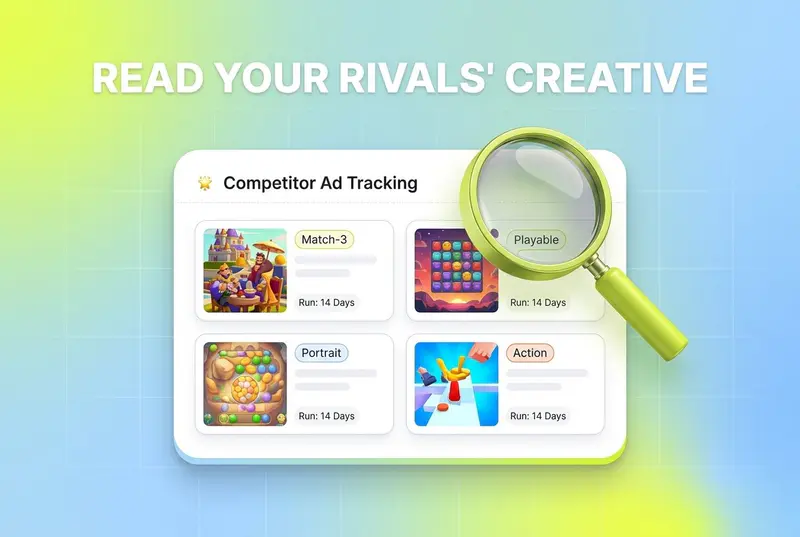
Most marketers already peek at competitor ads. Far fewer turn that peeking into a repeatable process. They open the Meta Ad Library once before a launch, screenshot a few ads, and call it research. That is a snapshot, not intelligence, and it ages out the moment a competitor refreshes their creative set.
The gap is structural. The raw material is free and public. Meta runs a searchable database of every active ad on Facebook and Instagram, open to anyone, no login required. The problem is what happens after you find the ads. Reading a hundred competitor creatives by eye, tagging the patterns, and tracking how they shift week over week is slow manual work, and slow manual work is the first thing a busy team drops.
This matters more than it used to because creative is now the main lever in performance marketing. Targeting got automated. NCSolutions and Nielsen research found that creative drives 49% of incremental sales while targeting contributes only 11%, yet marketers consistently underrate creative and overrate targeting. If creative is where the competition is won, then knowing what your rivals are doing with theirs is no longer optional.
This guide covers what competitor ad tracking is, why it works, how to run the analysis step by step in the Meta Ad Library, how to turn raw ads into a creative gap analysis, and how to do it at scale without burning a week a month on manual review.
Key takeaways
Competitor ad tracking means systematically monitoring rivals' live ads and analyzing their creative choices, not just glancing at the Meta Ad Library before a launch.
The Meta Ad Library is a free, public database of every active ad on Facebook and Instagram, which makes competitor creative the most accessible intelligence source in performance marketing.
Creative is the lever worth watching. NCSolutions found creative drives 49% of incremental sales versus 11% for targeting, yet most teams undervalue it.
Ad longevity is the strongest free performance signal. One 2025 analysis found only 11.3% of tracked ads survived past 60 days, so the ads that keep running are the proven winners worth studying.
The output of good tracking is a creative gap analysis: white space competitors are not using, and oversaturated angles everyone is fighting over.
Manual tracking does not scale. Tagging competitor creatives by hand is the same 20-hours-a-week problem teams already face with their own ads, which is why a Competitor Tracking Agent that applies AI tagging matters.
What is competitor ad tracking?
Competitor ad tracking, sometimes called competitor ad monitoring or ad intelligence, is the ongoing process of collecting your competitors' live ads and analyzing them to understand their creative strategy. It answers a different question than your own analytics. Your dashboards tell you what is working for you. Competitor tracking tells you what the rest of the market is testing, scaling, and abandoning.
The unit of analysis is the creative, not the campaign. You cannot see a competitor's spend, ROAS, or targeting from the outside. What you can see is the ad itself: the hook, the format, the messaging, the offer, the visual style, and crucially, how long it has been running. From those observable signals you reverse-engineer strategy. It is the same creative-level lens covered in our complete guide to creative analytics, turned outward onto the competition.
There is a useful distinction between competitor ad monitoring and competitor ad analysis. Monitoring is the collection layer, a running record of what is live. Analysis is the interpretation layer, turning that record into patterns and decisions. Most teams do a little monitoring and almost no analysis, which is exactly backwards. The collection is the easy part now that the data is public.
Why it works: ads are a behavioral signal
A competitor's ad account is a confession. Companies do not keep spending on ads that lose money, at least not for long. So the ads still running after several weeks are, with high probability, the ones earning a return. That makes the public ad library a window into what is actually working in your category, paid for by your competitors' testing budgets.
This is why run duration is the single most valuable free signal. As one guide on using the library put it, an ad running 45 or more days in a competitive space is not an accident. A 2025 analysis of competitor advertising found only 11.3% of tracked ads survived beyond 60 days of continuous running, because advertisers systematically kill the ones that do not work. The survivors are your shortlist.
Why competitor ad tracking matters in 2026
Three things have made competitor creative intelligence more valuable than it was a few years ago.
The first is that creative carries the result. With broad targeting and automated bidding now the default across Meta, the algorithm decides who sees an ad and the advertiser's real input is the creative. NCSolutions research found marketers estimate creative at about 19% of sales effect when the true contribution is closer to 49%. When creative is the deciding factor, watching competitor creative is watching the thing that decides outcomes.
The second is that the data got better. As of early 2026, Meta added an impression range bucket to every ad in the library, from under 1,000 up to over a million, according to coverage of the 2025 to 2026 library updates. That gives outside observers a rough sense of scale, not just existence, so you can tell a tested-and-scaled ad from a brand-new experiment.
The third is creative velocity. Competitors now refresh creative constantly to fight fatigue. Industry benchmarks suggest high-performing campaigns refresh creative roughly every 10 days, and Reels creative can fatigue in as little as 7 to 14 days. A once-a-quarter peek is useless against a competitor shipping new variations every week, so tracking has to be continuous to keep up. The teams that win treat competitor creative as a live feed, not an annual audit: they know which angles rivals are scaling, they spot new entrants early, and they brief against a clear map of the landscape rather than a hunch.
How to analyze competitor ads step by step
Here is a workflow that turns the Meta Ad Library from a curiosity into a repeatable process. It runs in five stages, and each one feeds the next.
1. Build your competitor set
Start with a real list, not just the obvious names. Include direct competitors, adjacent brands fighting for the same attention, and one or two category leaders worth learning from even if you do not compete head to head. Keep it to around five to ten so the analysis stays deep instead of shallow. For each one, find their official Page in the Meta Ad Library and confirm you have the right one, since brands often run several Pages by region or product line.
2. Pull their live ads
Open the Meta Ad Library, search each competitor by Page name, and filter to active ads. For a deeper walkthrough of search operators, Page filtering, and saved searches, see our guide to Meta Ad Library competitor research. Capture the full set, not a flattering sample, because the spread is the strategy. A competitor running forty variations of one angle is telling you something different than one running four angles with ten variations each. Record the basics for each ad: format, hook, core message, offer, visual style, and launch date.
3. Read the longevity signals
Sort by how long each ad has been running. The long-running ads are your highest-signal set, because survival implies performance. If three of a competitor's five oldest ads open on the same problem-first hook, that hook is almost certainly carrying their account. Then look at refresh cadence: a fast rate signals an aggressive testing program, while a slow one with a few evergreen survivors signals a brand milking its winners.
4. Tag the creative elements
This is where most manual processes collapse. To find patterns you have to describe each ad by its elements: hook type, format, messaging angle, visual style, CTA, emotional tone, characters or products shown. Tagging is what lets you group across the whole set and ask questions like "how many competitors open on a discount" or "which visual style shows up in the longest-running ads." Done by hand across hundreds of competitor ads, it is brutally slow and inconsistent. Two people tag the same hook differently and the analysis quietly drifts into noise. This is the same tagging bottleneck teams hit with their own creative, and the same discipline behind solid creative tagging applies here: a consistent taxonomy is what makes the patterns legible. For an approach to applying it across a competitor set, see tagging competitor ads with AI. It is the reason most competitor analysis stays superficial.
5. Synthesize into a creative gap analysis
The payoff stage. With every competitor ad tagged, you can finally see the landscape as a map. Two outputs matter most: the white space nobody is using, and the angles everybody is crowding into. The next section covers this in detail, because it is where tracking turns into strategy.
From tracking to creative gap analysis
Collecting and tagging competitor ads is the means, not the end. The end is a creative gap analysis, and it has three moves. Our dedicated guide to competitor creative gap analysis goes deeper on each, and the findings feed directly into a broader AI creative strategy for what you brief next.
Identify white space
White space is the set of creative angles, messaging themes, and positioning strategies your competitors are not using. If every brand in your category opens on price and discounts, the emotional or status-driven angle is wide open. If everyone uses polished studio shots, raw user-generated content might be your wedge. White space is where you can own attention cheaply, because you are not competing for the same hook in the same auction with the same message. Finding it requires the tagged dataset: you are hunting for the gaps in the distribution, the hook types, formats, and messages that barely appear across the whole competitive set.
Spot oversaturated angles
The mirror image. Oversaturated angles are the creative approaches everyone is already running. When ten competitors all lead with the same "limited time" urgency play, that angle is exhausted, and your version will blend into the wall. Tracking shows you which messages have hit saturation so you can stop briefing creative that is already invisible. Saturation also moves over time. This is why trend analysis matters: watching how the competitive creative mix shifts tells you when a winning angle is about to become a crowded one.
Benchmark your own creative against it
The third move is creative benchmarking. Lay your own creative mix next to the competitive landscape. Are you crowding into the same oversaturated angles as everyone else? Are you missing a format that is clearly working for rivals? Benchmarking turns the gap analysis into a direct critique of your current strategy, which is what makes it actionable.
The real bottleneck is analysis, not access
Here is the honest problem. The Meta Ad Library solved access years ago. Anyone can see competitor ads for free. What nobody solved with free tools is analysis at scale. Reading every competitor's full ad set, tagging each creative consistently, tracking how the mix changes week over week, and turning all of it into a clean gap analysis is enormous manual work. It is the same 20-hours-a-week tagging problem teams already struggle with on their own creative, doubled, because now you are tagging the competition too.
So most teams do the cheap version. They eyeball a few competitor ads, form an impression, and move on. The impression feels like intelligence but it is just a vibe, and it does not survive the next creative refresh. If you are weighing software to carry the load instead, our roundup of the best ad spy tools compares the options on coverage and tagging.
This is the gap a dedicated tool closes. Segwise's Competitor Tracking Agent brings competitor ads into a unified competitor dashboard and applies the same multimodal AI Segwise uses on your own creatives to the competition. That means AI tagging for competitor ads across hooks, CTAs, visual styles, and messaging patterns, surfacing their creative positioning the same way you read your own. Competitor tracking currently supports Meta, covering Facebook and Instagram, with additional platforms in development, so it works against the same public ad data this guide describes, just without the manual labor.
On top of that tagged data, the agent runs trend analysis to track how competitor strategies evolve, creative benchmarking to compare your approach against theirs, and competitor gap analysis that surfaces both the white space they are not leveraging and the oversaturated angles they are overusing. The analysis that would take a person days runs continuously in the background.
It connects to the rest of your stack the same way. Segwise unifies creative and performance data across 15+ ad networks and MMPs, including Meta, Google, TikTok, Snapchat, YouTube, AppLovin, Unity Ads, Mintegral, and IronSource, alongside AppsFlyer, Adjust, Branch, and Singular. So your own creative intelligence and your competitor intelligence live in one place, read by the same AI.
Competitor tracking is a continuous loop, not a one-time audit
The biggest mistake teams make is treating this as a project with an end. You audit before a launch, file the deck, and never look again. But competitor creative changes weekly, so the white space you found last quarter may be crowded now, and a new entrant may have opened a gap you cannot see because you stopped looking. Competitor ad tracking only compounds when it runs continuously, reading the landscape closely enough and often enough to keep finding the angles nobody else is using before they get crowded. That is the shift: from glancing at competitor ads before a launch to maintaining a standing map of the landscape that sharpens every brief you write.
Common pitfalls to avoid
Copying instead of analyzing. The goal is not to clone a competitor's winning ad. It is to understand the landscape and find your own angle. Copying puts you in the same crowded auction with a worse version of their creative.
Mistaking a snapshot for intelligence. One look before a launch is not tracking. Without a continuous feed, your picture is stale before you act on it.
Ignoring run duration. A flashy new competitor ad means nothing yet. A boring ad that has run 60 days means everything. Longevity is the signal; novelty is noise until it proves itself.
Tagging inconsistently. Manual tagging drifts across people and weeks, and inconsistent tags make the gap analysis meaningless. This is the strongest argument for automated tagging.
Tracking ads but never benchmarking. Collecting competitor ads without comparing them to your own mix is half a job. The value is in the contrast.
Conclusion
Competitor ad tracking has moved from a nice-to-have to a core part of creative strategy, because creative is now the main driver of performance and competitor creative is the most accessible signal you have. The raw material is free and public in the Meta Ad Library. The hard part was never access. It was turning a wall of competitor ads into a clear read on what rivals are scaling, what they are abandoning, and where the open lanes are.
The honest reason most teams do not do this well is operational. Tagging hundreds of competitor creatives consistently and keeping it current is too much manual work to sustain by hand. That is precisely what AI-powered competitor intelligence is for: read the competition's creative the way you read your own, continuously, so you can find the white space before it closes.
If you want to stop guessing at your competitors' creative strategy and start mapping it, Segwise brings competitor ads into one dashboard, tags them with the same multimodal AI it runs on your creatives, and surfaces white space, oversaturated angles, and benchmarks automatically, while saving teams up to 20 hours a week on the creative analysis that used to eat their schedule.
Frequently asked questions
What is competitor ad tracking?
Competitor ad tracking is the ongoing practice of monitoring the ads your competitors run and analyzing their creative choices to understand their strategy. It uses public sources like the Meta Ad Library to collect rivals' live ads, then breaks down hooks, formats, messaging, and run duration to reveal what they are scaling and where they are exposed. Unlike your own analytics, which show what works for you, competitor tracking shows what the rest of the market is testing.
How do I track competitor ads on Facebook and Instagram?
Use the Meta Ad Library, a free public database of every active ad on Facebook and Instagram. Search each competitor by their Page name, filter to active ads, and capture their full live set rather than a sample. Record each ad's format, hook, message, offer, and launch date, then sort by how long each has been running, since the longest-running ads are usually the proven winners worth studying most closely.
What is the difference between competitor ad monitoring and competitor ad analysis?
Monitoring is the collection layer, keeping a running record of which competitor ads are live and what is new. Analysis is the interpretation layer, turning that record into patterns, gaps, and decisions through tagging and benchmarking. Most teams do some monitoring and almost no analysis, which is backwards, because collection is the easy part now that the data is public and interpretation is where the value lives.
What is a creative gap analysis?
A creative gap analysis is the main output of competitor tracking. It has two halves: identifying white space, the angles and messages competitors are not using, and spotting oversaturated angles, the approaches everyone is already crowding into. White space is where you can win attention cheaply, while oversaturated angles are where your creative blends into the wall. The point is to brief creative that occupies open lanes rather than fighting in crowded ones.
Is it legal to look at competitors' ads in the Meta Ad Library?
Yes. The Meta Ad Library is a public transparency tool that Meta built specifically to make active ads searchable by anyone, no login or account required. Viewing competitor ads there is the intended use. The judgment call is what you do with what you see: studying the landscape to find your own angle is smart, while directly copying a competitor's creative usually just drops you into the same crowded auction with a weaker version.
How often should I check on my competitors' ads?
Continuously, not once. Competitor creative changes fast, with high-performing campaigns refreshing roughly every 10 days, so a single pre-launch audit is stale almost immediately. A weekly or biweekly cadence keeps your map of white space and oversaturated angles current. Because manual review at that frequency is unsustainable across a full competitor set, this is where an automated competitor tracking tool earns its place.
Can I tag competitor ads automatically instead of by hand?
Yes, and at any real scale you should. Manually tagging hooks, formats, visual styles, and messaging across hundreds of competitor ads is slow and drifts into inconsistency. Segwise's Competitor Tracking Agent applies the same multimodal AI tagging it uses on your own creatives to competitor ads on Meta, then runs trend analysis, creative benchmarking, and gap analysis on top, so the interpretation that would take days happens continuously in the background.