A Claude and Nano Banana ads workflow uses Claude to read your brand context and write the prompts, then Nano Banana (Google's Gemini image model) to render the static Meta ad variants, so one operator can go from brand research to a batch of on-brand static creatives in an afternoon instead of a week. For performance marketers, that turns static ad production from a design bottleneck into a volume game you can actually feed. The catch is that generating 40 static variants tells you nothing about which ones will work, and that gap is exactly where Segwise's multimodal creative tagging closes the loop by mapping every image, headline, and audience signal back to real performance.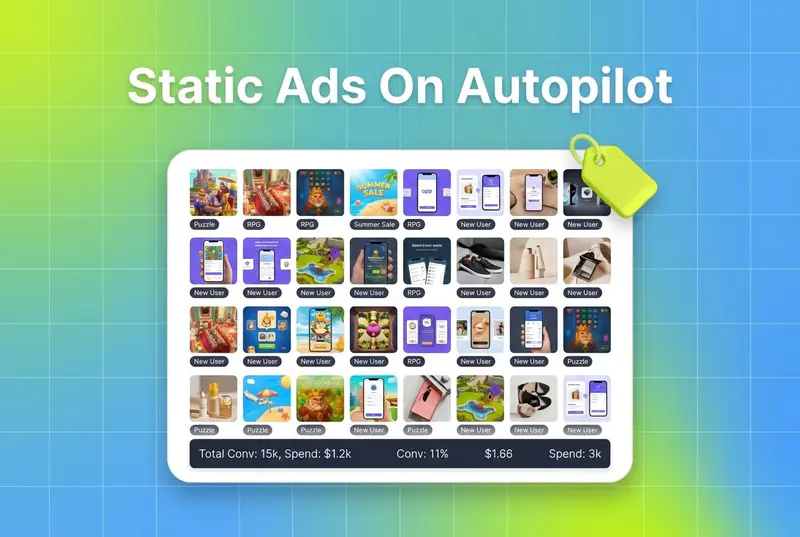
If you run paid social, you already know the static ad math. Meta's delivery rewards creative volume, but static production is slow, and most of it dies in the feed before it teaches you anything. So you ration. You ship three or four "safe" concepts a week, watch two of them flop, and never get enough at-bats to find the outliers that actually scale.
The Claude plus Nano Banana stack breaks that ration. Google released Nano Banana 2, built on Gemini 3.1 Flash, with 4K resolution, multilingual text rendering, and subject consistency across multiple objects. When you wire that model to Claude, Claude does the thinking part (reading your brand, writing the prompt, judging the output) and Nano Banana does the rendering. The result is a repeatable line that produces clean, on-brand static ads at a few cents each.
This is the practical build. It covers the four-stage stack from brand scrape to batch QC, a prompt-template library you can copy, a brand-context checklist that stops the model from guessing, and a scoring rubric for deciding what ships. It is written for UA managers, DTC media buyers, and creative strategists who want static ad volume without hiring three more designers. One note up front: this is the static-image slice. If you want competitor research or AI video, those are different workflows.
Also read if you should Hire a Creative Strategist or Stay Solo on Meta Ads? (2026 Framework)
Key takeaways
A Claude and Nano Banana ads workflow splits the job: Claude handles brand research, prompt writing, and quality judgment, while Nano Banana renders the static image variants.
Nano Banana 2 runs about $0.04 to $0.05 per image at standard resolution and roughly $0.15 at 4K, so a full batch of static variants costs a few dollars, per The AI Maker's setup breakdown.
The stack has four stages: scrape the brand site for context, mine reviews and forums for hooks, generate static variants from prompt templates, then run a batch QC pass.
The biggest prompting shift is to act as a creative director, not a prompt engineer. You give five high-level inputs and let the model translate them, as AI Fire's 5-input system documents.
Generation is the easy half. Knowing which generated variants drove ROAS requires tagging every creative and mapping tags to performance, which is what Segwise's Creative Tagging Agent does across image, text, and audience signal.
What the Claude + Nano Banana ads stack actually is
The stack is two tools doing two different jobs. Claude is the reasoning layer. Nano Banana is the rendering layer. Connecting them turns "describe an image, get an image" into "describe a campaign, get a batch of on-brand ads."
Nano Banana is Google's image model. The current version, Nano Banana 2, is built on Gemini 3.1 Flash and delivers Pro-level quality at Flash speed, with text rendering that holds up and subject consistency that can maintain multiple characters and objects across a set. For static ads, two of those features matter most: clean text rendering (so your headline is legible, not garbled) and consistency (so a product looks the same across ten variants).
You can drive Nano Banana from Claude in two ways. The lighter setup wraps Google's Gemini CLI in a Claude Code skill, like Keanan Koppenhaver's cc-nano-banana, which exposes commands such as /generate, /edit, and --count=N for variations and defaults to the gemini-2.5-flash-image model at roughly $0.04 per image. The heavier setup connects a Nano Banana MCP server so Claude generates and edits images inside the same conversation where it read your brief. Either way, the point is the same: Claude's understanding of your content meets Nano Banana's rendering, with no tab-switching in between.
One reason to keep Claude in the loop rather than prompting the image model directly is context handling. Working through a web image UI tends to lose context between generations, while Claude Code holds the thread and can even look at a rendered image, decide something is off, and regenerate until it is right. That self-critique behavior is what makes batch generation viable instead of a manual one-at-a-time slog.
The four-stage workflow

The workflow is a production line. Each stage feeds the next, and the whole thing is designed to run the same way every cycle so the only variables are the hooks going in and the performance data coming out.
Stage 1: Scrape the brand site for context
Before Claude writes a single prompt, it needs to know the brand. Point it at the brand's site and product pages and have it pull the raw material: product names and specs, the actual value propositions, the visual tone, the color language, and the proof points (reviews, ratings, guarantees). This is the step that stops Nano Banana from inventing a generic mug when you sell a specific 12oz matte black one.
The goal here is a structured brand brief, not a vibe. The brand-context checklist later in this post is the exact list to extract. If Claude has clean brand context, every downstream prompt inherits it, and your variants stay on-brand without you restating the rules each time.
Stage 2: Mine reviews and forums for hooks
A static ad lives or dies on its hook, and the best hooks are usually the customer's own words. Have Claude read the brand's reviews, support threads, and relevant communities, then extract the recurring language: the specific complaint the product fixes, the moment of relief, the phrase customers repeat. These become your headline and angle candidates.
This is angle mining, and it is the highest-leverage input in the stack. Write eight to ten hook candidates per concept before you generate anything. A hook framework keeps this from being random: lead with the problem, the outcome, the objection, the comparison, or the proof. You are not writing final copy yet, you are building a menu of angles to test as static variants.
Stage 3: Generate static variants from templates
Now Claude turns each approved hook into a structured image prompt and sends it to Nano Banana. This is where the prompt-template library does the work. Instead of hand-writing prompts, you feed Claude five inputs and let it generate three prompt variations per concept (literal, creative, premium).
Render in batches. The cc-nano-banana skill supports generating multiple variations per call, and Nano Banana can batch-generate several images per request with a consistent style across the set. Export each variant in the aspect ratios Meta needs (1:1, 4:5, 9:16) so they drop straight into Ads Manager. At a few cents per image, a full matrix of hooks times layouts is still cheaper than one stock photo subscription.
Stage 4: Batch QC
Generated does not mean usable. Nano Banana is strong, but static ads have failure modes the model will happily ship: garbled text, an off-brand color drift, a product that mutated between variants, or a claim the image implies that your legal team would not. The QC pass catches these before anything goes live.
Two QC moves save the most time. First, do not regenerate a whole image for a small flaw. Use the Edit feature to make a surgical fix to lighting, text, or positioning while keeping the composition intact, a point AI Fire stresses as the difference between masters and beginners. Second, score every variant against a fixed rubric (below) so the ship-or-kill decision is consistent, not a mood. Nano Banana Pro is also genuinely good at text, including preserving, adding, and replacing it, so headline fixes are usually an edit, not a regenerate.
The brand-context-extraction checklist

This is the structured brief Claude should build in Stage 1. Hand it the brand URL and have it fill in every field. Missing fields are where the model starts guessing, so the base prompt should refuse to proceed on incomplete inputs rather than invent them.
Product: exact name, format, size, material, and the one spec that matters most (for example, "12oz matte black ceramic mug, minimalist, subtle texture").
Primary value proposition: the single promise in the customer's words, not marketing copy.
Audience: who the ad is for, described by taste and mindset, not just age (for example, "working professionals 30 to 45 who prefer calm, minimal aesthetics").
Brand vibe: three to seven feeling words (clean, warm, premium, playful, calm). Tone beats hex codes here, since the model reads intent better than rules.
Color language: the two or three colors that must appear, plus anything to avoid.
Proof points: ratings, guarantees, social proof, or specific results you are allowed to show.
Reference image: one real product photo or a past ad that almost worked. A single strong reference can replace paragraphs of description.
Placement and format: where the ad runs (feed, Stories, Reels static) and the aspect ratios needed.
The prompt-template library
The core idea, drawn from the references, is that modern image models reward intent over keywords. Keyword soup adds noise and causes style drift, while a clear statement of purpose, audience, subject, and brand vibe produces consistent, professional output. So the templates below capture intent and let Claude handle the technical translation.
Template 1: The 5-input request (you write this)
Purpose: [where the ad runs and its job, e.g. Meta feed ad to stop the scroll]
Audience: [taste and mindset, e.g. busy parents who want reassurance]
Subject: [the literal product in plain words, e.g. 12oz matte black ceramic mug]
Brand vibe: [3-7 feeling words, e.g. warm, premium, calm, natural light]
Reference: [attach one image if you have it]
Hook: [the headline angle from Stage 2, e.g. "Your last mug, finally"]

Write three Nano Banana prompts for this as JSON: literal, creative, premium.
Template 2: The three output variations (Claude writes these)
Claude returns three structured prompts per concept so you can match the variant to the placement, the literal, creative, premium split AI Fire's base-prompt engine produces:
Version A, Literal: clean, accurate, product-forward. Best for catalog-style feed ads and product-page reuse.
Version B, Creative: looser, more mood and story. Best for top-of-funnel social where the scroll-stop matters more than the spec.
Version C, Premium: polished, editorial, high-end. Best for hero ads, launches, and brand campaigns.
Template 3: Hard rules to append to every render
These come straight from the practitioner guides and prevent the most common static-ad failures:
"No text" unless the headline is the point, since rendered text is the most common failure mode. When you do want a headline, state the exact words and keep them short.
Name the color palette explicitly. Vague prompts produce inconsistent colors across a variant series.
State the style early (editorial photo, flat lifestyle, studio product).
Use the variations flag to get three to five options per concept in a single call, then pick.
Template 4: The edit instruction (for QC fixes)
/edit variant-07.png "shift background to warm cream, move the mug to center,
keep everything else identical"
Edit-in-place keeps the composition you already liked instead of rolling the dice on a full regenerate.
The output quality scoring rubric

Score every generated variant on these five dimensions before it ships. Anything below a 3 on a critical dimension is an edit or a kill, not a launch. A fixed rubric is what makes batch QC fast and what keeps a junior operator's ship list matching a senior's.
Brand accuracy (1 to 5): does the product, color, and tone match the brief? Critical. A drifted product is an instant kill.
Text legibility (1 to 5): is every word crisp and correctly spelled? Critical for any ad with a headline.
Hook clarity (1 to 5): can someone get the angle in under a second of scroll? This is the performance dimension.
Composition (1 to 5): is the focal point clear, with room for Meta's UI overlays and no awkward cropping at 1:1 and 4:5?
Claim safety (1 to 5): does the image imply anything you cannot substantiate? Critical for regulated or health-adjacent brands.
A simple gate: ship only variants that score 4-plus on all three critical dimensions (brand accuracy, text legibility, claim safety) and 3-plus on the rest. Everything else goes to the edit queue or the bin.
Where the workflow breaks at scale
This stack is excellent at producing static volume. It is blind to performance. That blindness is the real ceiling, and it shows up in three places.
First, generation has no memory of what worked. Nano Banana will happily make your hundredth variant as confidently as your first, with no idea that variants built on a particular hook or color have been your winners. The practitioner guides are candid that these tools produce "good enough to ship" assets, not strategy.
Second, the feedback is buried. Once 40 static variants are live across Meta, the performance data sits in Ads Manager at the ad level, not the creative-element level. You can see that ad 23 beat ad 11, but not that the winning element was the founder-photo hook plus the warm palette. Without that, your next batch is guesswork again.
Third, a human cannot tag static creatives fast enough to keep up with a stack that makes 40 a day. Manual tagging is the bottleneck most teams quietly skip, which is exactly why the generation loop never closes.
This is the gap Segwise is built to fill. The shift that makes a Claude and Nano Banana ads workflow compound, rather than just produce, is connecting generated output back to performance at the element level.
Closing the loop with Segwise

Segwise's Creative Tagging Agent uses multimodal AI to automatically tag every static creative: the image elements (colors, composition, characters, products, emotions, visual styles) and the text elements (headlines, CTAs, benefit statements). Every tag is then mapped to performance metrics, so you see which hooks, palettes, and layouts actually drove CTR and ROAS, not just which ad ID won. That is the element-level read the generation stack cannot give you.
Because Segwise unifies creative data across Meta, Google, TikTok, Snapchat, YouTube, AppLovin, Unity Ads, Mintegral, and IronSource, plus MMPs AppsFlyer, Adjust, Branch, and Singular, the read works across every placement your variants land in. Feed those winning patterns back into Stage 2 and Stage 3, and the next Claude prompt is built on evidence instead of intuition. Segwise's Creative Generation Agent can also generate net-new static, video, and playable creatives grounded in that tag-to-metric mapping and export them in every aspect ratio, so the loop can run inside one platform if you want it to.
The combination is the point. The Claude and Nano Banana stack gives you cheap static volume. Segwise's tagging and tag-to-metric mapping turn that volume into a learning system, where last week's winning element becomes next week's brief. Teams using Segwise report up to 20 hours a week saved on manual creative work and up to 50% ROAS improvement from catching what works earlier.
Bottom line
A Claude and Nano Banana ads workflow is the cheapest way in 2026 to break the static production bottleneck: Claude reads the brand and writes the prompts, Nano Banana renders the variants, and a four-stage line takes you from brand scrape to a QC'd batch in an afternoon. The prompt-template library and scoring rubric above make it repeatable rather than a one-off. But generation is only half a system. The half that compounds is reading which generated variants actually performed, tagged at the element level and mapped to revenue, which is exactly what Segwise adds on top.
Frequently asked questions
What is a Claude and Nano Banana ads workflow?
It is a static ad production process that pairs Claude as the reasoning layer with Nano Banana, Google's Gemini image model, as the rendering layer. Claude scrapes brand context, mines customer language for hooks, and writes structured image prompts, then Nano Banana generates the static variants for a few cents each. It is distinct from AI video workflows and from competitor ad research, which use different tools. To know which generated variants perform, teams pair the stack with creative analytics like Segwise, which tags each creative and maps it to ROAS.
How much does it cost to generate static ads with Nano Banana?
Nano Banana 2 runs roughly $0.04 to $0.05 per image at standard resolution and about $0.15 at 4K, while the Pro tier is around $0.13 at 2K. A full batch of static variants for one concept usually costs a few dollars, which is why volume is the whole advantage. The larger cost is analyzing what worked, which is where a platform like Segwise replaces hours of manual tagging.
How do I set up Nano Banana with Claude?
The common path is a Claude Code skill that wraps Google's Gemini CLI nanobanana extension: install the Gemini CLI, get an API key from Google AI Studio, install the nanobanana extension, then clone a skill like cc-nano-banana into your Claude skills directory,After that, Claude routes image requests automatically. For analyzing the output, Segwise connects to your ad networks with a no-code setup in minutes, no engineering required.
What's the difference between this and an AI video ad workflow?
A Claude and Nano Banana ads workflow produces static images: feed ads, product shots, and hero creatives rendered by an image model. An AI UGC or video workflow produces talking-head clips and motion ads using avatar and video tools, with hooks, scripts, and lip-sync as the variables. They share the same idea of cheap testable volume but use different generation tools and QC checks. Segwise tags and scores both static and video creatives, mapping each to performance in one unified view.
How do I keep my static ads on-brand across a big batch?
Lock the brand context once and reuse it. Build the brand-context checklist (product, value prop, audience, vibe, colors, proof, reference image) in Stage 1, attach a reference image to anchor style, and name the color palette in every prompt so the model does not drift. For verifying consistency at scale after launch, Segwise's creative tagging surfaces which visual styles and elements recur across your winners, unlike a manual spot check.
Can this workflow tell me which generated ads will actually perform?
No. Generation tools render variants but have no view into performance, so they cannot rank what will win. You learn that only after the variants run, by tagging each creative at the element level and mapping those tags to metrics like CTR and ROAS. That is the closed loop Segwise provides with its Creative Tagging Agent and tag-to-metric mapping, where competitors that only handle generation leave you reading raw Ads Manager data by hand.
Is Nano Banana good enough for production ads, or just drafts?
It is strong enough to ship the majority of static ads most performance teams need, especially with clean text rendering and the Edit feature for surgical fixes. The honest limit, which the practitioner guides name directly, is that it does not replace a human designer for flagship brand campaigns. For everyday testing volume on Meta, it is more than enough, and Segwise then tells you which of those production variants earned their spend.