
The best static ad generation tools in 2026 are Segwise, AdCreative.ai and Pencil. Segwise builds new statics from the creative patterns already winning in your own ad accounts and recommends the campaign and ad group each one should run in. AdCreative.ai produces scored statics in bulk. Pencil pairs generation with pre-launch scores.
Segwise is an AI creative analytics and creative generation platform that helps UA and creative teams 10x their output by turning their winning creative patterns into new, data-backed ads. It leads this list because its statics start from your results, not from a blank prompt.
Creative is the biggest lever in advertising overall. In an NCSolutions meta-study of nearly 450 CPG campaigns, published by Circana in August 2023 as an update to The Five Keys to Advertising Effectiveness, creative drove 49% of incremental sales, more than brand, reach, targeting or recency. In a static, that creative is one image, one headline and one offer; our breakdown of the anatomy of a high-converting static ad covers each piece. Static generators are one slice of the wider set of AI ad generation tools; this guide covers the nine that produce finished static ads and two component tools that make one layer of them.
Which static ad generator should you pick?
Segwise, if you buy across several networks and want new statics built from your own winning ads, matched to a campaign and ad group, sized for every network and scored before spend.
AdCreative.ai, if you want many scored variations fast. Generation is unlimited and you pay in download credits, from $39/month.
Pencil, if you have a solid brand library and want generation and AI scores in one editor, from $14/month.
The Brief (formerly Creatopy) or Canva, if a designer wants hands-on control of every layout.
Abyssale, if you need hundreds of sized versions of an approved template.
Predis.ai for a small team that also posts organic social, Madgicx for DTC brands that live in Meta Ads Manager, and Smartly for enterprises localizing across many markets.
Bannerbear or Photoroom, if you need one layer of the ad: images rendered from data, or clean product photos.
How do the 11 static ad generation tools compare?
How do you choose a static ad generator for your spend, networks and team?
Find your row for each factor. Where two rows point at different tools, go with the one that matches your biggest constraint.
How many new statics does a team need each month?
More than most teams can design by hand. MHI Growth Engine's DTC static vs video analysis puts static fatigue at 20 to 30 days, against 40 to 60 days for video. Run 20 statics at once, replace each about every 25 days, and you need roughly 24 new statics a month just to hold position. Add ten new concepts a month at four variants each and the number passes 60. For the right static-to-video mix, see our static vs video ratio data for Meta ads.
Volume only pays if each round learns from the last. Segwise has analyzed over $1B in ad spend, tagged over 200,000 ad creatives and generated over 6,000 data-backed creatives (Segwise platform figures). Each new static becomes another data point on which hooks, offers and layouts win in your account, and fatigue tracking flags a static as it starts to decline, so its replacement can be ready before spend leaks.
When should you hold off on a static ad generator?
A generator multiplies whatever you feed it. Three situations call for something else first:
You have never run paid ads, so there is no winning pattern to build from. Test a few distinct concepts by hand, or use a free Canva account, until something works.
Your bottleneck is the offer or the landing page. More statics pointing at a weak page will not lift conversion.
You only need clean product photos for a marketplace listing. Photoroom does that job on its own.
What are the 9 best end-to-end static ad generators?
1. Segwise: best for statics built from your own winning ads
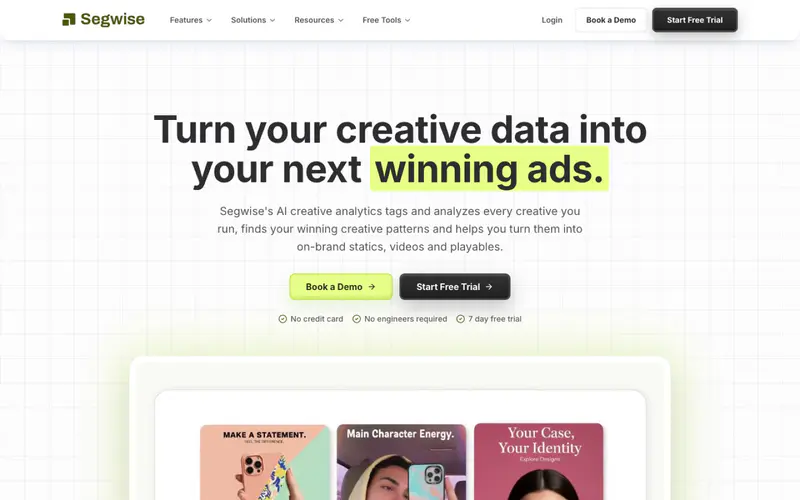
Segwise starts from your ad data rather than a prompt. It connects to 15+ ad networks and MMPs, its Creative Tagging Agent tags every creative element (hooks, CTAs, characters, visual styles, offers, on-screen text) with multimodal AI, and maps each tag to ROAS, CPA, IPM, CTR or any metric you track. The Creative Generation Agent then drafts new statics from the patterns winning in your account. You ask for what you need, by persona, product, season or country, and it works inside your brand guidelines, products and messaging. Your team reviews, edits and ships.
What Segwise does for statics:
Generates from your own winning patterns: net-new concepts and variations of proven winners, grounded in tag-to-metric data rather than generic AI guesses. Each suggested ad carries a "Why this ad" explanation tied to your creative patterns and competitor gaps.
Makes ad-group-aware statics: you can generate statics per ad group, and each one comes with a recommendation of the campaign and ad group it should run in, so the team knows where to launch it as well as what it looks like.
Remixes winning elements: smart element remixing combines the best hooks, CTAs, visual styles and characters from several top creatives into one new static.
Edits by prompt: rework the hook, copy, product, visual or layout with a plain-English note, with no rebuild from scratch.
Exports to each network's specs: every static comes in the dimensions each of your networks needs, under one consistent file name, in whatever aspect ratios those placements use.
Localizes winners: adapt a winning ad into new languages and markets, including idioms, tone and each market's native register.
Delivers on a schedule: scheduled creative drops bring a fresh batch of data-backed concepts on the cadence your team sets, and you can generate on demand in between.
Scores before spend: Pre-flight Testing scores up to 10 statics at a time, each out of 100, with a run-or-hold verdict, a confidence level, the winning ads it compared each one against, and a check that each static clears every network and placement you buy.
Tracks itself once live: every generated static is tagged and tracked automatically when it runs, and the results feed the next round.
Statics are one output of the same loop. Segwise also generates video up to 30 seconds, AI UGC-style video, storyboards and creative briefs, and runs playables and CTV spots as managed services. Around generation sit fatigue tracking, Meta competitor tracking and the Creative Strategy Agent, an AI chat that answers questions about your creative data. Our guide to generating ad creatives from winning patterns walks through the workflow.
What customers report, from Segwise's published case studies:
Whow Games, which runs more than 800 slot games, produces four static variants per concept across all its channels in a few hours once source assets are ready. A Segwise-generated take on Fishin' Frenzy cracked the French market.
HiveMinds, the agency running paid media for Jio Financial Services, has generated 400 to 500 statics and 20 to 25 videos in Segwise since June 2026, inside the brand's compliance rules, and 50 to 60 of them went live as generated. A refreshed credit card campaign built from what the tags showed cut cost per acquisition 25% on Meta and 28% on Google.
At Medialicious, Segwise-generated creatives carry about 30% of total ad spend, and a Segwise-generated ad is the best-performing static in its flagship app, beating every human-made static on cost per purchase.
Pick it if you buy paid media across several networks and want more statics that share the DNA of your winners, with a clear answer on where each one should run. It fits UA managers, creative teams, DTC growth teams and agencies.
Where it fits less well: Segwise works from connected ad network data (MMP data is used when connected, not required). If you have never run ads, or you need a one-off graphic that is not an ad, a design tool is quicker.
Pricing: Segwise starts at $499/month for advertisers spending up to $250K/month, with a special 50% discount for startups spending under $50K/month, and includes a 7-day free trial.
2. AdCreative.ai: best for high-volume scored static ads

AdCreative.ai is built for volume. Set up a brand with your logo, colors and description, and it generates batches of static concepts with copy and layout done. Its Creative Scoring AI ranks each one so you can shortlist before spending, and connecting your ad accounts lets it tailor designs and predictions to your brand.
What it does: unlimited generation, batch creatives, Creative Scoring AI, a Compliance Checker AI, Ad Creative Insight AI on connected accounts, competitor insights, custom templates, product videos and unlimited iStock photos.
Pick it if you are a solo marketer or small team that needs many banner and social variations fast and a quick way to decide which to test first.
Limitations: you generate freely but pay a credit for each download, and Starter includes 20 credits a month, which is 20 downloaded creatives, so heavy testing pushes you up a tier. The score is a prediction from its own models; the live test still decides.
Pricing: billed monthly, Starter is $39/month (20 credits), Professional $249/month (300 credits) and Ultimate $999/month (300 credits, more brands and users). Quarterly billing takes 25% off and yearly billing 50%.
3. Pencil: best for generation plus pre-launch scoring in one editor

Pencil generates static image ads, video and copy from your brand assets through self-serve AI agents, and shows real-time AI insights and scores next to each creative.
What it does: AI image, video and text generation; AI predictions and creative insights, with a results dashboard; launch and tracking on Facebook, Instagram, TikTok, YouTube, Google Display, DV360 and LinkedIn; Figma and Photoshop import.
Pick it if you already have a good brand library and want to produce and pre-screen paid social creative without enterprise pricing.
Limitations: Pencil counts a generation each time you use an AI model, so iterating on one ad uses several, and Core's 50 a month go quickly. Output also depends on the brand assets you feed it.
Pricing: Core $14/month (50 generations) and Growth $55/month (250 generations), billed monthly; annual billing saves 20%. Pro is custom.
4. The Brief (formerly Creatopy): best for designer-led display and social sets

The Brief is the name Creatopy took on. It is a design-led ad studio: build or import a design, then produce every size, language and variant a campaign needs. AI image, video, copy, resize and background generation come with every plan, with no credit counter.
What it does: Ad Studio and Canvas with 5,000+ templates; Photoshop and Figma import; exports to JPG, PNG, WEBP, GIF, HTML5, MP4, PDF and AMP; an ads library for tracking competitor brands; on Ultra and Team, ad serving to 25+ networks and publishing to Meta and Google Ads; on Ultra, AI Translate and automated A/B testing.
Pick it if a designer wants a canvas and your campaigns need many sizes and languages of the same approved creative.
Limitations: you bring the concept; it handles sizes and serving. Ad serving and publishing need Ultra or Team, and AI Translate and automated A/B testing need Ultra, not the $39 Pro plan.
Pricing: billed monthly, Pro is $39/month, Ultra $99/month and Team $59 per seat per month; yearly billing brings these to $29, $79 and $49. Enterprise is custom. 7-day free trial, no card.
5. Canva: best for hands-on static ad design
Canva is the design tool many marketers already use. Its AI tools resize, translate and remove backgrounds inside the editor, and every plan now lists ad insights and AI ad creation. For statics it wins on ease: start from a template, add an AI visual, export in the size you need.
What it does: 1.6M+ templates on the free plan and 3.6M+ on paid plans; AI tools for resizing, translation and background removal; brand kits; social content scheduling on Pro.
Pick it if you are a generalist team or small business that wants full manual control with light AI help and a free starting point.
Limitations: a person still drives each layout. The free plan allows up to 20 AI uses, Pro raises that tenfold, and heavier AI use needs the paid AI Pass add-on.
Pricing: a free plan, plus Pro Lite, Pro and Business plans priced in your local currency on Canva's pricing page, each with a free trial.
6. Abyssale: best for automated banners at scale

Abyssale is a creative automation platform. Design a template once and it produces the banner, GIF or video in every format you need, from a spreadsheet, a URL or its API.
What it does: image, video and GIF generation; AI auto-resize; spreadsheet generation and dynamic image URLs; API, MCP and no-code integrations; on Suite, HTML5 generation, ad-network compliance and design approvals.
Pick it if the same ad has to exist in dozens of versions and you want to automate versioning rather than design each one.
Limitations: it scales a design you already have. Pricing is per seat, and each plan includes a set number of generation and AI credits, with top-ups at $0.01 per credit.
Pricing: billed monthly, Pro is $45 per seat per month and Suite $75; annual billing brings them to $36 and $60. Enterprise is custom. 14-day free trial, no card.
7. Predis.ai: best for bulk social statics on a small team

Predis.ai makes static ads, videos and UGC-style content, reports back on what earned the click, and schedules and publishes to social channels. Small businesses without a designer use it to keep a steady stream of on-brand content going.
What it does: ad and post generation; competitor analysis runs; brand templates; publishing to 10 to 60 channels depending on plan, with auto posting from Rise up; API access.
Pick it if you want volume and a simple workflow that covers paid and organic social.
Limitations: it leans toward organic social workflows, and the 3-day trial needs a card.
Pricing: billed monthly, Core is $32/month, Rise $79/month and Enterprise+ $249/month. Annual billing takes up to 30% off.
8. Madgicx: best for Meta-focused DTC statics

Madgicx is a Meta-first ads platform with an AI Ads Generator built into its suite. For DTC brands, generation sits next to the ad account, with tools to analyze ads, spot fatigue and launch new ones.
What it does: AI Ads Generator; Ad Analyzer; an ad fatigue detector and Creative Refresh Agent; Ads Launcher; automation, targeting, analytics and ad management in one plan.
Pick it if you are a DTC or e-commerce team that lives in Meta Ads Manager and wants generation and campaign management in one place.
Limitations: the price climbs with your ad spend, and the suite centers on Meta.
Pricing: from $45/month billed monthly under $1K ad spend, rising with ad spend. 7-day free trial. Tracking Pro is a $49/month add-on.
9. Smartly: best for enterprise creative automation

Smartly serves large advertisers running creative across social, programmatic and CTV. Its DCO engine turns one concept into thousands of variants localized by region, language and demographic, and creative sits in the same platform as media buying.
What it does: image, video, audio and HTML5 templates, or imports from After Effects, Photoshop, Figma and Google Web Designer; pre-flight insights such as heatmaps, attention scores and decay curves; AI Studio for variations and image-to-animation; Creative Insights that rank creative by your KPIs; brand governance and approvals.
Pick it if you are a large brand or agency where localization and volume across many markets are the bottleneck.
Limitations: it is a sales-led enterprise platform, out of reach for small teams.
Pricing: no public pricing page; you talk to sales.
Which component tools power static ads?
These two do not write the ad or pick the offer. Each makes one layer of a static, so you pair them with a full generator.
10. Bannerbear: best for rendering statics through an API

Bannerbear renders images from a template you design and data you supply. Feed in product names, prices and photos, and finished images come out.
What it does: Image, Video, Animation, PDF and Workflow APIs; a REST API plus an MCP server; 50+ app integrations; AI credits for generative elements.
Pick it if you have an engineer or ops person and a product feed or spreadsheet that should become ads without a design pass.
Limitations: it is built for developers and does not write copy or choose what to test.
Pricing: Automate $49/month (1,000 API credits), Scale $149/month (10,000) and Enterprise $299/month (50,000). Free trial with 30 API credits, no card.
11. Photoroom: best for e-commerce product visuals

Photoroom handles the product photo, the visual half of most e-commerce statics. It removes backgrounds and places products into AI backgrounds and on AI fashion models; you finish the ad in a layout or performance tool.
What it does: background remover and retouching; AI backgrounds; AI fashion models; a video generator and Shopify integration on Max and above; up to 50 seats.
Pick it if you sell physical products and need polished product visuals at volume without a photo studio.
Limitations: it makes the image, not the headline, offer or performance logic.
Pricing: Pro, Max and Ultra plans priced in your local currency, plus custom Enterprise. Pro and Max start with a free trial.
Which static ad tools learn from your own ad results?
A static ad tool can do three jobs: make the ad, predict whether it will work, and learn from how it actually did. Several tools here touch more than one. AdCreative.ai scores creatives and reads connected ad accounts, Pencil pairs AI predictions with a results dashboard, Smartly adds pre-flight attention insights and ranks live creative by your KPIs, The Brief runs automated A/B tests on Ultra, and Madgicx analyzes ads inside Meta.
The difference is what each step is measured against. Segwise generates from element tags mapped to your results across every connected network (plus AppsFlyer, Adjust, Branch, Singular or Kochava data if you run an app). It scores new statics against your own winning ads and names the ads it compared against, recommends the campaign and ad group for each one, and tags every static once it runs so the next round starts from the result. If your statics are judged on ROAS across several networks, start with Segwise.