
The best pre-launch creative testing tools in 2026 are Segwise for scoring new ads against your own winners, Neurons and Attention Insight for predicted attention, Kantar LINK AI and System1 for brand and sales potential, CreativeX and VidMob for guideline checks, plus Smartly and Hawky. Choose by what you need checked, not by the biggest accuracy number.
The hard part is that most pre-launch scores compare your ad with a panel or a rulebook, not with the ads already making money in your account. Segwise is an AI creative analytics and creative generation platform that scores up to 10 new creatives at a time against the winners in your own ad accounts, so you can hold the weak ones before they spend a dollar.
This guide covers tools that score or predict creatives before launch. If you want tools that split live budget across variants, such as A/B testing and multivariate platforms, those are in our guide to the best creative testing tools.
TL;DR: which pre-launch testing tool fits which team
- Performance teams with live winners in their ad accounts: Segwise scores each new ad against those winners and checks where it can run. Hawky scores draft elements against your winners on Meta, Google and TikTok.
- Brand teams that need panel-grade brand and sales signals: Kantar LINK AI and System1 predict brand impact from huge survey databases.
- Designers who want fast attention heatmaps: Neurons and Attention Insight predict where the eye lands. Attention Insight has public prices from $31 a month.
- Global brands with many agencies: CreativeX and VidMob score every asset against brand guidelines and platform best practices before launch.
- Teams already buying Smartly: Creative Predictive Potential adds attention and emotion scores inside the same platform.
Pre-launch testing tools side by side
| Tool | Best for | What it scores against | Key strength | Price (checked Nov 24, 2026) |
|---|---|---|---|---|
| Segwise | Performance teams on 15+ ad networks | Your own winning ads | Score out of 100 with Run, Refine or Hold, plus placement checks | From $999/mo ($499 for startups under $50K spend) |
| Neurons | Brand and creative teams | Eye tracking and consumer neuroscience data | Attention, cognitive demand and memory scores | Quote only |
| Kantar LINK AI | Brand advertisers | 300k+ Kantar survey ad tests | Brand metric predictions in minutes | Pay as you go, no public LINK AI price |
| System1 Test Your Ad | Brand and TV advertisers | Real consumer emotional response | Star, Spike and Fluency ratings tied to growth | Contact sales |
| Smartly Creative Predictive Potential | Smartly customers | Attention and emotion models | Heatmaps and scene insights in one platform | Not published |
| CreativeX | Global brands | Brand guidelines per channel and format | Pre-Flight Scoring for every asset source | Not published |
| VidMob | Enterprise brands and agencies | Brand and platform best practices | Pre-Flight Quality across 13 channels | Per brand by impressions, no $ |
| Hawky | Meta-heavy DTC teams | Your winners and category benchmarks | Element-level scoring of drafts | Talk to sales |
| Attention Insight | Designers and small teams | Eye-tracking fixations | Heatmaps and Clarity Score inside Figma | $31, $129 or $324 a month |
What should a pre-launch creative test check?
A pre-launch test should answer five questions before a creative gets budget: will people look at it, will they know it is your brand, does it follow the rules, where can it run, and will it beat what already wins for you. Most tools answer one or two of these, which is why teams often pair two tools.

Attention and brand: will people notice it and remember you?
Attention tools predict where the eye lands in the first seconds and whether the product and logo get seen. Brand tools go a step further and predict recall, brand linkage and emotional response. These checks come from eye tracking studies and survey panels, so they work for any ad, even one from a brand with no ad history. They tell you nothing about your specific audience or offer.
Compliance and placement: is it allowed, and where will it run?
Compliance checks look for your brand guidelines and each platform's best practices, such as a logo in the first seconds or sound off captions. Placement checks are more mechanical: a square ad clears a feed but fails Stories, and a 1:1 image has no slot on some app networks. Placement errors are cheap to catch before launch and costly to find after, when a finished ad never delivers where you planned.
Predicted performance: will it beat what already wins for you?
This is the check performance teams care about most, and the hardest one. A model can only say whether an ad will beat your winners if it can see your winners. That means it needs your ad account data. Panel and eye tracking scores are not built to give this answer, however accurate they are at their own job.
Can AI predict ad performance before launch, and how accurate is it?
Yes, within limits. AI can predict attention and brand response with high agreement against human studies, and it can rank new ads against your past winners. None of these vendors documents a prediction of a single ad's return on ad spend. The sales and ROAS figures that do exist, such as Kantar's 37% result below and the +74% ROAS at Nestlé that CreativeX cites on its homepage, describe customers or groups of ads, not a forecast for one ad.
The confusing part is that every vendor quotes "accuracy", but each number is measured against something different.
| Accuracy claim | Measured against | What it tells you | What it does not tell you |
|---|---|---|---|
| Neurons: "over 95% accuracy" | Eye tracking with 100 to 150 people | Where people will look | Whether they will buy or install |
| Attention Insight: "up to 96% accurate" | Eye tracking data from earlier studies | Where people will look | Whether they will buy or install |
| System1 Test Your Ad Screen (AI): "9 out of 10 times" | System1's own human panel tests | Whether the AI matches a panel result | Results in your account |
| Kantar LINK AI: "more than 7 out of 10" ads | Kantar's own survey ratings | Whether the AI matches a survey result | Results in your account |
| Kantar LINK AI: top third drove "37% more incremental platform-driven sales" | 8,500 digital ads for one FMCG client | Scores rank ads in a useful order | How any single ad will do |
| Segwise, Hawky: no published accuracy figure | Your own winning ads | How a draft compares with what works for you now | How a brand new concept will do |
Two vendors are honest about the ceiling. Smartly's FAQ asks whether its tool predicts performance and answers, "No, and that's intentional. Performance depends on variables like audience, placement, and timing." CreativeX says its score "does not predict or guarantee an individual ad's performance."
How to judge an accuracy claim before you buy
Ask three things on the demo: what the score was compared with, how many ads were in the check, and whether those ads came from your category. Kantar's own team warns that running "a handful of ads through AI testing" and comparing them with live results is the wrong way to validate a tool, because a few ads cannot show whether a ranking holds. The fair test is ranking: score a batch of 20 or more past ads you already have results for, and see whether the top scored third beat the bottom third. That is a rule of thumb, but it is the same shape as Kantar's sales check.
The 9 best pre-launch testing tools, reviewed
1. Segwise: best for scoring new ads against your own winners

Best for: UA and performance teams at apps, games and DTC brands that already have winning ads on Meta, TikTok, Google, AppLovin's Axon and other networks.
Segwise Pre-flight Testing scores up to 10 images or short videos at a time, each out of 100, against the ads already winning in your account. Each score comes with a Run, Refine or Hold verdict, a confidence level and reasoning that names the winners it compared against.
What it scores:
- Winning pattern alignment, hook strength, messaging and CTA fit, visual style fit, and novelty versus what is already saturated in your account.
- Placement eligibility for every network and placement you buy, so you see that an ad clears Meta Feed but not Stories before you upload it.
- File types: JPG, PNG and WebP images, and MP4, MOV and WebM videos.
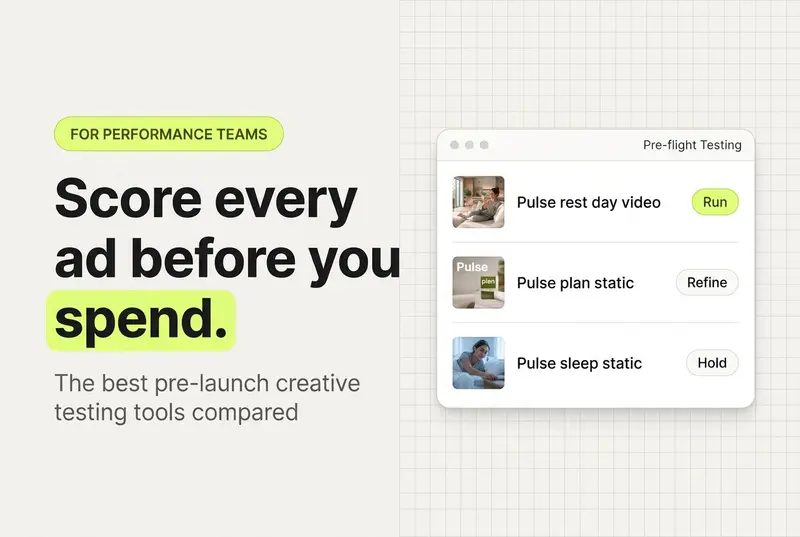
In this example, a fitness app called Pulse scores its next four creatives before launch. The rest day video scores 91 and gets Run. The reworked plan static scores 74 and gets Refine, and the two type led statics score 41 and 23 and get Hold. All four are square, so each one needs a vertical cut for Stories.

The score is useful because it explains itself. The 41 breaks down into five dimension scores, and every line cites the account's own live winners: none of the 8 winners is a static, type led image, and all of them open on a face within the first second. That tells the designer exactly what to change.

What you can do with it next: the scores sit on top of Segwise's creative tagging, which tags hooks, CTAs, characters, visual styles and audio in every live ad and ties them to installs, ROAS and other results from your networks and MMP. When a creative gets Hold, the Creative Generation Agent lets you make new statics and videos up to 30 seconds from the patterns your winners share. You can use each agent on its own, or do it all in one place by chatting with the Segwise agent: ask how your ads are performing, see what competitors are running, and make new ads from your winners. Through the Segwise MCP, you can also ask Claude or ChatGPT a question such as "which hooks opened our top ten Meta ads by ROAS this month?" before you brief the next batch.
Pricing: Segwise starts at $999/month for advertisers spending up to $250K/month; startups spending under $50K/month pay $499/month (limited eligibility). Pre-flight Testing is included.
Limitations:
- It needs connected ad network data to benchmark against, so a brand with no ad history gets little from it. An MMP is optional.
- It scores and explains; your team still reworks the creative.
- It does not predict attention heatmaps or survey style brand recall. Pair it with a panel tool if brand lift matters.
Rank your next batch first: Segwise lets you rank up to 10 new creatives against your live winners and fix placement gaps before any spend. Book a demo.
2. Neurons: best for predicted attention and brand memory

Best for: brand, creative and insights teams that want neuroscience style attention and memory scores on statics and video.
Neurons predicts attention, cognitive demand, focus and ad memory, and says its models were trained and tested on data from 300,000+ people. Its knowledge base says the winning model "predicts eye-tracking results with over 95% accuracy", measured against eye tracking with 100 to 150 people.
Key features: the Neurons Impact Score, attention heatmaps, Seen Brand and Seen Product checks, and visual recommendations.
Pricing: three packages (Starter, Pro and Scale), each by quote. All include unlimited analysis and predictions, with 500, 1,000 or 2,000 visual recommendations.
Limitations: the 95% figure describes agreement with eye tracking, not sales or installs. Neurons benchmarks against its own database of 300,000+ people, and we found no page describing scoring a draft against your own winning ads. Its Campaign Analytics product puts Neurons metrics "next to impressions, clicks, and CTR" once a campaign has run.
3. Kantar LINK AI: best for brand metric predictions at scale

Best for: brand advertisers who already trust Kantar LINK norms and want results faster than a survey.
LINK AI, sold through Kantar Marketplace, predicts brand metrics such as awareness, consideration and intent, plus attention and engagement. Kantar says it is "built on a database of 300k+ ad tests" and that individual predictions arrive in minutes, with thousands of assets in hours. It covers digital, TV, static and creator content.
Accuracy, in Kantar's words: "more than 7 out of 10 digital video and TV ads achieve comparable ratings" to its survey results, and for one FMCG client "the top third of ads on LINK AI delivered 37% more incremental platform-driven sales than the bottom third."
Pricing: pay as you go, or a subscription that bundles LINK+ and LINK AI. No LINK AI price is listed; the survey based LINK+ starts from $4,500.
Limitations: results are benchmarked to Kantar's channel norms and built around brand metrics such as awareness, consideration and intent. Kantar does not describe benchmarking a draft against your own past ads.
4. System1 Test Your Ad: best for emotion based growth predictions
Best for: brand and TV advertisers who plan around long term market share as well as short term sales.
System1 gives three ratings in Test Your Ad from real consumers: a Star Rating for long term growth, a Spike Rating for short term sales potential, and a Fluency Rating for how many people link the ad to the brand. Reports arrive "from 24 hours". Its AI tool, Test Your Ad Screen, returns ranges in minutes and System1 says it is "accurate to human testing 9 out of 10 times".
Pricing: not listed; System1 asks you to contact it to review your testing needs.
Limitations: the ratings are built for brand growth, not direct response metrics like cost per install.
5. Smartly Creative Predictive Potential: best for teams already on Smartly

Best for: enterprise advertisers that run creative production and media buying in Smartly.
Creative Predictive Potential scores image and video ads before launch for attention, emotion and engagement, with attention heatmaps, scene by scene insights and recommendations. Smartly suggests uploading "ideally 20 or more" assets for richer benchmarks.
Pricing: not published. Every path leads to a demo.
Limitations: Smartly says plainly that it does not predict performance, because results depend on audience, placement and timing. It makes most sense if you already buy the wider Smartly platform.
6. CreativeX: best for brand guideline checks across many agencies

Best for: global brands with many agencies, creators and AI tools producing assets that must all meet the same standard.
CreativeX Pre-Flight Scoring checks each asset "against the guidelines that apply to its brand, channel and format", and applies the same score whether the asset came from an agency, a creator, an in-house studio or a generative AI tool. Before launch, it shows guideline failures and which revisions to prioritise.
Pricing: not published; contact sales.
Limitations: CreativeX says the score "does not predict or guarantee an individual ad's performance". It checks whether you followed your rules, not whether the ad beats your winners.
7. VidMob: best for enterprise pre-flight across 13 channels

Best for: large brands and agencies buying across Meta, Amazon, Google, TikTok, Pinterest, Snapchat, The Trade Desk and other channels.
VidMob includes Pre-Flight Quality in every package to "ensure every asset meets platform specs before spend begins", and its Pre-test lets you upload batches to be scored against your guidelines before they go live. VidMob trains a model on 13 months of your creative and platform history during activation.
Pricing: three packages priced per brand by annual impressions (up to 1B, 1B to 10B, and 10B+). No dollar figures; activation is scoped per account.
Limitations: pre-flight is built on guidelines and best practices. VidMob's 13 channels do not include mobile app networks such as AppLovin, Unity or Moloco.
8. Hawky: best for Meta-heavy DTC teams that want element scores on drafts

Best for: DTC teams whose spend sits mostly on Meta, with Google and TikTok as secondary channels.
Hawky lets you upload a draft and "scores each element against your winners and category benchmarks", which it describes as a "pre-launch gate to kill weak hooks before paying for them". It also tags live ads and flags fatigue.
Pricing: no published price; every tier is talk to sales, and the pricing page offers a 14-day free trial.
Limitations: no published accuracy figure for draft scores, and its listed data sources are Meta, Google and TikTok only, so app networks are not covered. Placement eligibility checks are not documented.
9. Attention Insight: best budget option for attention heatmaps

Best for: designers and small teams who want a quick attention check inside their design tools.
Attention Insight predicts where people look on an ad, page or video, from AI "trained on millions of real eye-tracking fixations", and says its heatmaps are "up to 96% accurate". It adds a Clarity Score and Focus Score, and plugs into Figma, Chrome and Adobe tools.
Pricing: Basic $31 a month for 40 image credits, Pro $129 a month for 200 credits with video, Hero $324 a month with unlimited credits, and custom Enterprise plans. It offers a 14-day free trial with no card.
Limitations: its pages describe attention heatmaps and attention scores. We found no page describing brand recall, guideline compliance or scoring against your own ad results.
How to choose a pre-launch testing tool: a decision rule
Use your monthly creative volume and what your campaigns are judged on. These are rules of thumb, not hard cut offs.
| Your situation | What to use |
|---|---|
| Fewer than about 5 new creatives a month | No paid tool. Use the five checks above as a checklist and run a native A/B test |
| About 5 to 9 new creatives a month | The checklist plus a low cost attention tool such as Attention Insight, then a scorer that uses your ad history once volume grows |
| 10 or more new creatives a month, judged on installs, purchases or ROAS, with live winners in your accounts | A scorer that uses your own ad history: Segwise to score against your winners across 15+ networks including app networks, Hawky if you are mostly on Meta, or VidMob for enterprise brands on its 13 channels |
| Brand campaigns, TV or online video judged on awareness and recall | Kantar LINK AI or System1 |
| Many agencies and creators, strict brand standards | CreativeX or VidMob |
| Designers who want a quick attention check | Attention Insight, or Neurons for deeper brand memory scores |
Worked cost math for a performance team
Say your team gives each new creative about $500 of test spend before deciding whether to scale it. That figure is an example; use your own. At Segwise's $999 a month, the tool pays for itself if it stops two weak creatives a month from getting that test budget. If you ship 20 creatives a month and Pre-flight puts even a few on Hold, the saved test spend covers the plan. If you ship 3 a month, it will not, and a checklist is the better buy.
For a deeper method on gating creatives by score, see our pre-flight testing frameworks for Meta and TikTok and the creative effectiveness scoring guide.
When is pre-launch scoring not enough?
Pre-launch scoring ranks creatives and catches obvious misses. It cannot see the auction, the audience on the day or how your offer converts. You still need an in-market test in four cases.

A new concept your winners do not cover
A winner-benchmarked score rewards what looks like your past winners. A genuinely new angle will score low on pattern alignment even if it could become your next winner. Segwise's novelty dimension helps here, but a bold new concept deserves a small live test rather than a Hold.
A new market, audience or network
Your winners in the US on Meta say little about Germany on TikTok. When the audience or network is new, treat the score as a sense check and let live spend decide.
Campaigns judged on ROAS, retention or LTV
Attention and brand scores stop at the click. If the decision rests on day 7 ROAS or subscription retention, only live data answers it.
Low confidence scores
When a tool flags low confidence, usually because there are few comparable winners, run the test.
In all four cases, score first to cut the field, then test the top scorers on a small, capped budget. How to set that test up, including budgets and how long to run it, is covered in our creative testing tools guide and in how to pretest creatives.
Tip:
Before you trust any vendor's accuracy number, score 20 or more past ads you already have results for and check whether the top third beat the bottom third.
Which pre-launch creative testing tool should you start with?
Start with the check you are missing. If you run performance campaigns and already have winners, a tool that scores new ads against those winners will save the most test spend, and Segwise does that across 15+ ad networks with placement checks included. If brand lift is the goal, add Kantar LINK AI or System1, and if guideline control across agencies is the pain, add CreativeX or VidMob. Whatever you pick, keep a small in-market test for new concepts, new markets and ROAS calls.