
The best AI creative brief generators in 2026 are Segwise, Rule1 and Atria. Segwise builds data-backed briefs and concepts from your own tagged ad performance across 15+ networks and MMPs, Rule1 auto-generates production-ready briefs from Meta and TikTok data and drops them in Slack, and Atria writes briefs from your own ad results instead of a blank template.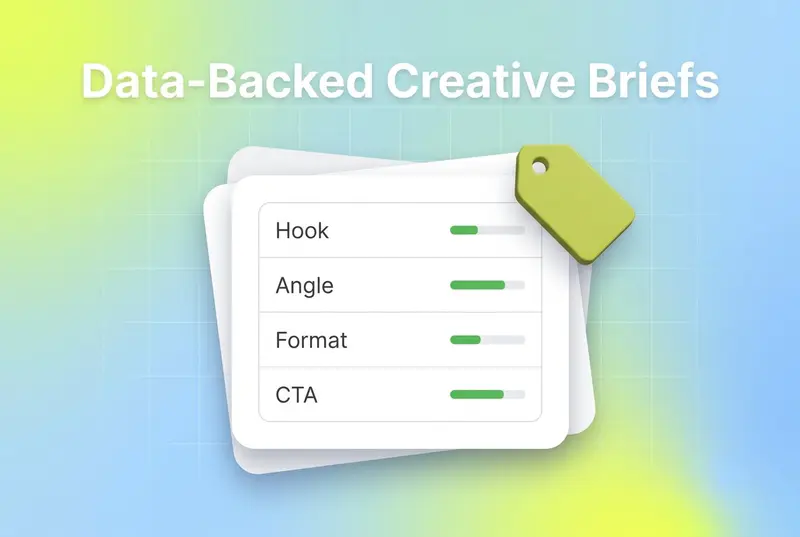
A creative brief used to be a Google Doc someone filled in from memory. In 2026 the good ones are built from data: which hook actually stopped the scroll, which angle had the lowest CPA, which format your audience kept converting on. That shift matters because platform targeting is now mostly automated, so the creative itself is the main lever you still control, and a brief that starts from evidence beats a brief that starts from a blank page.
Segwise is an AI creative analytics and generation platform that tags your ad creative, maps it to performance, and helps teams turn those patterns into data-backed briefs and ads. We build it, so we flag our own bias up front and tell you where other tools fit better.
This guide maps the real category. It covers the tools that turn ad performance into a brief, the general-purpose AI writers plenty of teams already use for first drafts, and a short list of adjacent tools that feed a brief without writing one. Every tool was checked against its own live site in October 2026. One note up front: MagicBrief, which many teams used for research and briefing, was shut down on 31 July 2026 after Canva acquired it in June 2025, so it is context here, not a live option.
What an AI creative brief generator actually does
"Creative brief generator" covers two different jobs, and mixing them up is the most common buying mistake.
A data-backed brief generator connects to your ad accounts, tags what is inside your creatives, and writes a brief that names the hook, angle, format and CTA that your own data says will work. The brief is an output of your performance history. Segwise, Rule1, Atria, Foreplay and VidMob sit here.
A general-purpose AI writer turns a prompt or a template into a clean brief document. It is fast and flexible, but it knows nothing about your ad performance unless you paste it in. ChatGPT, Claude, Jasper and Notion AI sit here.
It does: structure a brief, suggest hooks and angles, and (for the data-backed tools) ground those suggestions in real metrics.
It does not always produce the finished ad. Some tools stop at the brief; a few, like Segwise, can also generate the creative from it.
It is not a replacement for a creative strategist. The best setups keep a human deciding what to brief and what to ship.
TL;DR
Data-backed beats template. For ad creative, a brief built from your own performance (Segwise, Rule1, Atria) out-converts a brief written from a blank doc (ChatGPT, Jasper, Notion AI).
Only Segwise also makes the ad. Most tools hand you a brief; Segwise's Creative Generation Agent can turn the brief into statics, video, AI UGC-style ads and playables, then track them.
Watch the currency. Rule1 prices in euros (from 20 euro/mo), not dollars. Foreplay starts at $59/mo, Atria at $129/mo billed annually, Segwise from $499/mo.
General-purpose AI is cheap and useful for first drafts: ChatGPT and Claude from $20/mo, Notion AI from $10/member/mo, Jasper from $69/seat/mo.
For mobile games and UGC, the brief needs format-specific fields (playable hook scene, core mechanic, creator casting). Segwise is the only tool in this list that documents playable ad tagging.
AI creative brief generators compared (October 2026)
1. Segwise - Best for data-backed briefs tied to live UA performance
Segwise is an AI creative analytics and generation platform for UA, performance and creative teams. It is the strongest fit for this list because the brief is a by-product of work it is already doing: watching every ad you run, tagging what is inside it, and mapping those elements to the metrics you care about. The brief writes itself from evidence rather than opinion, and a human strategist stays in charge of what gets briefed and shipped.
Here is how the brief comes together. The Creative Tagging Agent uses multimodal AI to tag video, audio, image, text and playable elements, then maps each tag (hook, dialogue, visual style, emotion, CTA) to ROAS, CPI, IPM, CTR and any custom metric you track. The Creative Strategy Agent, the in-app AI chat, reads all of that and generates data-backed briefs and creative concepts on request, grounded in your winning patterns and the gaps the Competitor Tracking Agent finds on Meta. You can then hand the brief to your team, or let the Creative Generation Agent turn it into finished statics, video (including AI UGC-style ads), playables and storyboards, editable by prompt and exportable in any aspect ratio.
Key features
- Creative Strategy Agent (AI chat) that writes data-backed briefs and concepts from your tagged performance, in plain language.
- Element-level tagging across 15+ ad networks and five MMPs (AppsFlyer, Adjust, Branch, Singular, Kochava), so the brief reflects every channel you buy on.
- Playable and interactive ad tagging, the only tool in this comparison that documents it, which matters on AppLovin/Axon, Unity and Mintegral.
- Creative Generation Agent that turns the brief into statics, video, AI UGC-style ads and playables, with a "why this ad" rationale attached.
- Segwise MCP (read-only, available on request) that pulls your creative, tag, MMP and Meta competitor data straight into Claude or ChatGPT as brief input. Writing briefs through the MCP is on the roadmap as "coming soon"; today the brief generation happens in the in-app Creative Strategy Agent.
- Native fatigue detection with thresholds you set and alerts to email or Slack, so briefs refresh before spend is wasted.
When you should try it
Try Segwise if your creative decisions have to answer to UA performance data, if you run mobile games, subscription apps or DTC at scale, or if you want the brief and the finished ad in one place. Ride-hailing app Namma Yatri uses it to build design briefs from patterns spotted across campaigns and cities, and Influence Mobile credits clearer briefs alongside a 10% lift in D7 ROAS (both are named Segwise case studies).
Limitations
Segwise is built for teams that already run paid ads; it needs connected ad-network and MMP data to ground a brief, so a brand-new account with no history gets less out of it on day one. Competitor tracking is Meta only today. And we build this product, so treat our own entry as an interested party and use the free trial to judge it.
Pricing
Segwise starts at $499/month for advertisers spending up to $250K/month, with a special 50% discount for startups spending under $50K/month. Every plan includes a 7-day free trial with no credit card, and history is backfilled on connection (two weeks on trial, three months on paid).

2. Rule1 - Best for automated weekly briefs delivered to Slack
Rule1 is the most brief-native dedicated tool in the set. It auto-tags every ad in your Meta and TikTok accounts across 20 creative dimensions, correlates each element with performance, and generates a production-ready brief that names the winning hook format, the lowest-CPA messaging angle, the converting CTA and the top visual format. The brief lands in your creative team's Slack channel, on a weekly schedule or on demand.
Key features
- Auto-tagging across 20 creative dimensions (hooks, pacing, angles, CTAs, emotional triggers, text overlays).
- AI-generated briefs with specific production direction, for example a problem-agitation hook in the first three seconds.
- AI Creative Reports pulling from 17 data modules across Meta and TikTok.
- Slack delivery with scheduled or on-demand generation.
When you should try it
Rule1 fits a solo media buyer or a small performance team with no dedicated strategist, buying mainly on Meta and TikTok, that wants briefs handed to freelancers without building them by hand.
Limitations
Coverage is Meta and TikTok, so Google, AppLovin/Axon, Unity and MMP data are out of scope. Unlike Segwise, it briefs but does not generate the finished ad.
Pricing
Priced in euros: an MCP Server tier at 20 euro/mo for AI power users, and a Growth tier at 149 euro/mo (most popular) for brands spending 10,000 euro-plus a month on Meta. Both include five seats and a 7-day free trial.
3. Atria - Best for briefs built from your own ad results
Atria markets itself on a sharp line: "data-driven briefs built from your own ad performance, not from a blank Google Doc template." Its AI teammate, Raya, layers your results with competitor intel and customer insight to surface the personas, hooks and key messages that consistently win, then auto-generates the brief and the ad scripts to match.
Key features
- Raya agent that builds briefs from your performance plus competitor analysis.
- Ad script and copy generation tied to the brief.
- A 25M-plus ad library across Meta and TikTok for reference and inspiration.
- Creative tagging, performance grading, batch upload and one-click launch to Meta.
When you should try it
Try Atria if you are a DTC or growth team on Meta and TikTok that wants the brief and fast production in one tool, and you like the idea of an agent proposing concepts from your own data.
Limitations
The focus is Meta and TikTok, so it is a weaker fit for mobile-game networks or teams that need MMP-grounded briefs. Pricing is billed annually, which is a bigger commitment than a monthly swap.
Pricing
Core is $129/mo, Plus is $479/mo and Business is $959/mo, all billed annually (the page notes roughly 20% off for annual). Enterprise is custom.
4. Foreplay - Best for turning a swipe file into a creator brief
Foreplay is the research-to-brief workflow a lot of creative strategists already live in. Its Briefs builder lets you storyboard, script and attach brand context, then send one brief to multiple creators and collect their work in one place, without chasing links across tools. It pairs that with a strong swipe file and competitor tracking, so the brief is informed by real ad references.
Key features
- Briefs builder with storyboarding, scripting and brand-profile management.
- Swipe File to save and organise ads, plus Discovery across a 200M-plus ad search engine.
- Spyder for 24/7 competitor ad tracking and Lens for creative analytics.
- Chrome extension, mobile app and API.
When you should try it
Try Foreplay if you run UGC or performance creative and spend your day in a swipe file, briefing creators and agencies, and you want the handoff organised rather than ad-hoc.
Limitations
Foreplay organises and briefs but does not pull MMP data or generate the finished ad, and its briefs are built from references and your input rather than auto-written from live performance the way Segwise or Atria do.
Pricing
Basic is $59/mo, Workflow is $175/mo and Agency is $459/mo (around 15% cheaper billed annually), with Enterprise custom and $20 per extra user.
5. VidMob - Best for enterprise briefs grounded in creative scoring
VidMob is the enterprise option. It scores creative against a large set of proprietary models and correlates creative tags to outcomes like ROAS, completion rate and brand recall. Those insights then feed directly into GenAI prompts and creative briefs, so an agency team starts smarter instead of from zero on every account.
Key features
- Creative scoring and analytics that tie creative elements to performance outcomes.
- Insights that flow into briefs and GenAI prompts via the Vidmob360 layer and APIs.
- Creative Data API and exports for enterprise tooling.
- Influencer Intelligence and brand-guideline enforcement.
When you should try it
Try VidMob if you are a global brand or agency group that needs creative briefs grounded in measurement, with governance and channel coverage across a large portfolio.
Limitations
No public pricing and no self-serve entry, so evaluation runs through an enterprise sales cycle. It measures and scores to inform the brief, but it is not a lightweight tool for a solo buyer.
Pricing
Not published; enterprise contract and demo only.
6. ChatGPT - Best for fast, flexible first-draft briefs
ChatGPT is the default general-purpose option, and it is genuinely useful for briefs. Paste in your goals, audience and a few winning examples, and it will structure a clean brief in seconds. The catch is that it knows nothing about your ad performance on its own, so the quality depends entirely on what you feed it. This is where a tool like Segwise complements it: with the Segwise MCP you can pull your real creative and MMP data into ChatGPT as brief input instead of typing from memory.
Key features
- Flexible prompt-based drafting for any brief format or template.
- File and image analysis to work from your own documents.
- Custom GPTs and Projects to save a repeatable brief workflow.
- Web and deep research for market context.
When you should try it
Try ChatGPT if you want a fast, cheap first draft, you are comfortable supplying the data and context yourself, and you do not need the brief tied to live ad metrics.
Limitations
No performance grounding unless you paste it in, no ad-network connectors, and no creative generation for ad formats like playables.
Pricing
Free tier available; ChatGPT Plus is $20/mo, with higher Pro and Business tiers above that.
7. Claude - Best for structured briefs from your own research
Claude is the other strong general-purpose writer, and it shines when you have a lot of input to work from. Its long context window and Projects let you drop in research, transcripts and past performance notes and get a tightly structured brief back. Like ChatGPT, it has no native ad data, but the Segwise MCP (read-only, available on request) can feed your tagged performance and Meta competitor research straight into Claude as brief input.
Key features
- Large context window for long research and reference inputs.
- Projects and Skills to save a reusable brief-writing workflow.
- Artifacts and file analysis for drafting from your own documents.
- Works as a client for the read-only Segwise MCP.
When you should try it
Try Claude if you brief from a pile of research and want a high-quality structured draft, and you are happy to bring your own data or connect it through the Segwise MCP.
Limitations
Same as any general-purpose LLM: no ad-performance grounding out of the box and no ad-format generation. The brief is only as good as the inputs you give it.
Pricing
Free tier available; Claude Pro is $20/mo (around $17/mo billed annually), with Max tiers from $100/mo and Team and Enterprise plans above that.
8. Jasper - Best for on-brand campaign briefs at scale
Jasper is marketing-specific AI, so briefs sit naturally inside it. Its Campaign Brief job drafts a plan with goals and deliverables, and Jasper IQ injects your brand voice and rules so the output reads on-brand rather than generic. It is a fit for teams that want brief drafting and downstream content in one governed workspace.
Key features
- Campaign Brief job for structured marketing briefs.
- Jasper IQ for brand-voice and brand-context embedding.
- Purpose-built marketing agents from plan to execution.
- Enterprise governance and brand rules.
When you should try it
Try Jasper if you are a marketing team that wants on-brand briefs plus the content that follows, and brand consistency across many assets matters more than ad-performance grounding.
Limitations
It is template and prompt based, not connected to your ad results, so it does not know which hook or angle actually won. Seat-based pricing adds up for larger teams.
Pricing
Pro is $69/seat/mo ($59/seat/mo billed annually); Business is custom. A 7-day free trial is available.
9. Notion AI - Best for briefs that live next to your docs
Notion AI is the easy choice if your team already runs on Notion. It drafts briefs inline in your pages, pulls from linked databases, and keeps the brief next to the project, the assets and the approvals. It will not analyse your ad performance, but it keeps the whole brief workflow in one familiar place.
Key features
- Inline AI drafting and writing enhancement in any page.
- Database autofill and linked records for approvals.
- Research mode for longer summaries and reports.
- Custom Agents for recurring brief workflows.
When you should try it
Notion AI makes sense when your briefs, docs and project tracking already live in Notion and you want AI drafting without adding another tool.
Limitations
Purely general-purpose: no ad data, no creative tagging, no generation. Custom Agents move to a credit model, so heavy use adds cost on top of the seat price.
Pricing
Free tier available; Plus is $10/member/mo and Business is $20/member/mo, with the AI add-on billed at $10 per 1,000 Notion credits. Enterprise is custom.
10. Supernormal - Best for turning kickoff calls into briefs
Supernormal comes at the brief from a different angle. It is an AI meeting notetaker that captures a client call or creative kickoff and turns it into a structured brief (design, campaign or content) in a few minutes, using the actual words said about direction, audience and success metrics. It is the right tool when the brief should start from a conversation, not a dashboard.
Key features
- Meeting capture across Zoom, Google Meet and Teams.
- Brief templates generated from the call, with direction, audience and metrics.
- Action items and structured notes.
- Free tier to start.
When you should try it
Try Supernormal if your briefs come out of discovery calls and kickoffs, and you want the client's exact words captured while they are fresh.
Limitations
It is a notetaker first, so it captures intent rather than performance evidence, and it has no ad-network data or creative generation.
Pricing
Free tier with monthly credits; paid Team and Business plans are available.
What a data-backed creative brief contains
Whichever tool you pick, a brief is only as good as its fields. Here is a usable template for a performance creative brief, the kind Segwise, Rule1 and Atria aim to fill from data rather than guesswork. If you want the long version, the Segwise data-backed creative brief guide and brief template for performance creative walk through each field.
Objective and target metric: the number this creative has to move (for example D7 ROAS above 3.5, or CPI under $2.50).
Audience and persona: the winning segment, taken from the cohorts that already convert.
Hook: the opening that earns attention, with the evidence (for example a problem-agitation hook with the highest thumb-stop rate).
Messaging angle: the angle correlated with your lowest CPA.
Visual format and style: UGC, studio or motion graphic, chosen on what outperforms in your account.
CTA: the call to action that actually converts, not the default.
Format, placements and specs: aspect ratios and networks the ad will run on.
What to avoid: fatigued or saturated elements the data says are tiring.
Reference ads: your own winners plus the competitor gaps worth taking.
Success criteria and test plan: how you will judge it and what you are testing against.
Start from your winners, not a blank page The fastest way to a strong brief is to pull your top three creatives and ask what they have in common. Tools like Segwise and Rule1 do this element by element so the brief names the exact hook, angle and format to repeat.

The UGC ad variant
A UGC brief needs a few extra fields, because the win is in the authenticity. Add creator persona and casting (who should front it), the spoken hook line for the first three seconds, authenticity cues (handheld feel, real setting, unpolished audio), a shot list or scene structure, on-screen captions, and any disclosure requirements. Data-backed tools help here by telling you which creator styles and hook lines already drive installs or sales, so the brief casts to evidence. Foreplay is strong for collecting UGC references and briefing creators, while Segwise can tie the UGC angle to performance and even generate AI UGC-style video from the brief.
The mobile game ad variant
A game brief is its own format. Add the core mechanic to show, the gameplay-to-CG ratio, the hook scene (the first interactive or visual moment), the tutorial or UI framing, the end card and CTA, and the network specs for AppLovin/Axon, Unity and Mintegral. Playables deserve their own line: the mechanic the player touches first, and the fail-or-win moment that drives the install. This is where Segwise stands out, because it is the only tool in this list that documents playable ad tagging, so a game brief can be built from what actually works inside your playables and videos. Teams running UA across these networks can see more in the Segwise mobile gaming solution.
When you might not need a dedicated brief generator
Not every team needs to buy one of these. If you ship only a handful of creatives a month, run on a single platform, and already know what works, a free general-purpose writer like ChatGPT or Claude (or a Notion AI template) will structure a perfectly good brief, and your own ad manager has the numbers you need. Dedicated data-backed tools like Segwise, Rule1 and Atria start to pay off once you are testing dozens of creatives a month across more than one network, fatigue is hard to track by hand, and "what should we make next" is a weekly question rather than an occasional one. Spend is the simplest signal: below roughly $10k a month, a template plus your dashboards is usually enough; above it, the time a data-backed brief saves tends to cover its cost.
How to choose the right AI creative brief generator
The right tool depends on where your bottleneck is, and on your scale: your monthly ad spend, how many creatives you test a week, and your team size. Match the tool to the job rather than the loudest feature list.
If you test dozens of creatives a month across networks and MMPs (usually above $10k monthly spend), Segwise is the best fit, because it writes briefs from element-level tags mapped to ROAS and CPI and can generate the ad from the brief.
If you are a solo buyer or small team on Meta and TikTok and want automated weekly briefs without building them, Rule1 delivers production-ready briefs straight to Slack from 20 euro/mo.
If you are a DTC or growth team on Meta and TikTok that wants briefs from your own results plus fast production, Atria's Raya agent is built for that from $129/mo.
If you brief a roster of creators and agencies from a swipe file, Foreplay keeps research, briefs and handoff in one place from $59/mo.
If you are an enterprise running many accounts that needs briefs grounded in creative scoring, VidMob brings measurement and governance at scale.
If you ship only a few creatives a month and will supply the data yourself, ChatGPT, Claude, Jasper or Notion AI are cheap and flexible, and the Segwise MCP can feed them real performance data as input.
In short, the data-backed tools (Segwise, Rule1, Atria) win when the brief must reflect what is actually working, and the general-purpose writers win when speed and cost matter more than performance grounding.
Final word
A creative brief is now a performance document, not an admin one, and the tool you choose decides whether it starts from evidence or from a blank page. General-purpose writers like ChatGPT, Claude and Jasper draft a tidy brief fast, and dedicated tools like Rule1, Atria and Foreplay pull real ad data into the process. Segwise goes one step further by tagging every creative element across 15+ networks and five MMPs, writing the brief from what drives ROAS, and then generating the ad from it, with a human strategist in charge throughout. If you want the brief and the creative to come from the same source of truth, start a free Segwise trial and connect your accounts.
Frequently asked questions
What is the best AI creative brief generator in 2026?
For ad creative, Segwise is the best overall because it writes briefs from your own tagged performance across 15+ networks and MMPs and can generate the ad from the brief. Rule1 is the best dedicated brief generator for Meta and TikTok teams that want automated briefs in Slack, and Atria is strong for DTC brands that want briefs plus production. If you only need a quick draft, ChatGPT or Jasper will write a clean brief from a prompt, just without the performance data behind it.
What is the best AI creative brief generator for UGC ads?
For UGC, you want a tool that knows which creator styles and hooks convert, then briefs to that. Segwise ties UGC angles to performance and can generate AI UGC-style video from the brief, while Foreplay is excellent for collecting UGC references and briefing multiple creators from one place. General-purpose writers like ChatGPT can structure a UGC brief, but they will not tell you which authentic hook actually drove installs, so pair them with performance data from a tool like Segwise.
What is the best AI creative brief generator for mobile game ads?
Mobile game briefs need format-specific fields for playables, core mechanics and network specs, and Segwise is the strongest fit because it is the only tool in this comparison that documents playable ad tagging across AppLovin/Axon, Unity and Mintegral. Rule1 and Atria cover Meta and TikTok game creative well, but if your UA runs on gaming networks and leans on playables, Segwise gives the brief the data those other tools do not see. ChatGPT can draft the document, but it cannot grade your gameplay creative.
What AI tools generate data-backed creative briefs?
The data-backed brief generators in 2026 are Segwise, Rule1, Atria, Foreplay and VidMob. Segwise writes briefs from element-level tags mapped to ROAS and CPI across 15+ networks and five MMPs, Rule1 generates briefs from 20 creative dimensions on Meta and TikTok, Atria builds briefs from your own ad results, Foreplay structures briefs from a swipe file, and VidMob feeds enterprise creative scoring into briefs. General-purpose tools like ChatGPT and Jasper are template-based and only become data-backed if you supply the numbers yourself.
How do I write a data-backed creative brief?
Start from your winners, not a blank page: pull your top-performing creatives and identify the hook, angle, format and CTA they share, then write those into the brief as the direction to repeat. A tool like Segwise or Rule1 does this element by element so you are briefing to evidence, whereas a general-purpose writer like Claude will structure the document but needs you to bring the data. The core fields are objective and target metric, audience, hook, angle, visual format, CTA, specs, what to avoid, reference ads, and a test plan.
What is the difference between a data-backed brief generator and a general-purpose AI writer?
A data-backed brief generator (Segwise, Rule1, Atria) connects to your ad accounts and writes the brief from your real performance, so it names the hook and angle your data says will work. A general-purpose AI writer (ChatGPT, Claude, Jasper, Notion AI) turns a prompt or template into a clean brief but has no idea what performed unless you paste it in. The difference shows up at spend: a data-backed brief repeats proven winners, while a template brief relies on judgement. You can bridge the two by pulling Segwise data into ChatGPT or Claude through the read-only Segwise MCP.
Do AI creative brief generators also make the ads?
Most do not. Rule1, Atria, Foreplay and VidMob stop at the brief or the analysis, and ChatGPT, Claude, Jasper and Notion AI write the document but not the ad. Segwise is the exception in this list: its Creative Generation Agent turns the brief into statics, video, AI UGC-style ads and playables, then tracks them so the next brief is better informed. If having the brief and the creative in one tool matters to you, that narrows the shortlist quickly.