
The best AI ad variation generator is the one that knows why your winning ad wins. Segwise fits teams that want variations built from tagged results. AdCreative.ai fits high-volume static sizes, Arcads fits AI-actor UGC video, Marpipe fits catalog ads, and Smartly fits enterprise localization. As a rule of thumb, test 3 to 5 variations per winner, each changing one part.
Most tools will happily make dozens of versions of an ad. The hard part is knowing which part of the winner to change and which part to leave alone. Segwise is an AI creative analytics and creative generation platform that tags the hook, headline, visuals, voiceover, offer and CTA in every ad you run and ties each one to network and MMP results such as installs, CPI and ROAS, so a variation swaps the weak part and keeps the part that is earning the installs or sales.
A quick word on scope. A variation keeps a proven ad and replaces parts of it: the hook, headline, copy, voiceover, actor, background, offer, language or size. A net-new creative is a fresh ad built from patterns across your winners, which is a different job covered in our guide to generating ad creatives from winning patterns. If you want general AI ad makers, see our list of the best AI ad generation tools.
TL;DR
- You want variations driven by your own results across networks: Segwise tags every element of your ads, then lets you make statics and videos up to 30 seconds that keep the winning parts.
- You need many static sizes and copy versions fast: AdCreative.ai or Pencil. Both are self-serve and start under $40 a month on monthly billing.
- You run UGC-style video: Arcads swaps the actor, hook and language on a winning video, and its Workflows can turn one winner into 20 variations in a single run. Creatify remakes winners and writes new hooks when one fatigues.
- You sell from a product catalog: Marpipe varies catalog ad designs across every SKU in your feed.
- You are a large brand with many markets: Smartly turns one concept into thousands of localized variants.
- You buy only on Meta and want cheap image variations:Madgicx's AI Ad Generator starts at $29 a month.
AI ad variation generators compared
Prices are each vendor's own monthly-billing figures, taken from its pricing page.
| Tool | Best for | Key strength: what it swaps | Decides what to change from | Price |
|---|---|---|---|---|
| Segwise | Variations from tagged winners across 15+ networks | Hook, headline, copy, voiceover, visuals, language, size | Your own results, tagged by element | From $999/mo ($499 for startups under $50K spend) |
| AdCreative.ai | High-volume static sizes and copy | Sizes, layouts, text, product video versions | Patterns from its training data, plus a creative score | From $39/mo (20 credits) |
| Pencil | Template variants and localization at scale | Template variants, language, audience, size | Predicted performance and your results | From $14/mo (50 generations) |
| Arcads | AI-actor UGC video variations | Actor, hook clip, language, voice | Your choice; its agent reads basic ad results | Not published (credit plans) |
| Creatify | Remaking winners as new video and image ads | Hooks, script, avatar, format | Connected ad account results | Free plan; paid from $15/mo |
| Smartly | Enterprise localization and DCO | Region, language, audience, video edits | Rules, DCO and Creative Insights | Not published (demo) |
| Marpipe | Catalog and product feed ads | Template design per SKU, dynamic fields | SKU performance and feed data | Free plan; Startup $199/mo |
| Madgicx | Meta image ad variations | Image ads from a prompt, image or Ad Library ad | Meta account data and your prompt | $29/mo add-on; plans from $45/mo |
How does an AI variation generator decide what to change?
This is the question that separates the tools more than any feature list. Every tool can swap a headline. What differs is where the instruction to swap it comes from. There are three sources.
Your own results, broken down by element
The tool reads your ad accounts, labels what is inside each ad (hook, scene, actor, offer, CTA) and ties each label to spend and outcomes. A variation then keeps the elements with the best numbers and changes the rest. Segwise works this way across networks and MMPs. Madgicx does it for Meta, and Creatify's agent reads connected accounts and writes new hooks when a winner fatigues. Of the three sources, this is the one that can tell you which part of your winner is carrying it.
A prediction or a score
The tool scores a draft against a model trained on many advertisers' ads, or against your history. AdCreative.ai says its generator is "trained on patterns learned from $35B+ in ad spend data", and Pencil says it analyses creatives "against billions of performance data points, predicting winners". A score helps you rank drafts before spend. It can't see that your audience responds to streak counters and not discount badges unless that shows up in your own data.
Your prompt or your judgment
You pick what to change and the tool executes it well. Arcads, Smartly's template tools and most generators sit here for the variation step itself. That is fine when a creative strategist already knows the answer. It is guesswork when nobody has checked which element is working.
Meta's own advice is the reason this matters. Its learning phase guidance says ad sets usually stabilize "after about 50 results in the week after the ad set's last significant edit", and warns: "When you create many ads and ad sets, the delivery system learns less about each ad and ad set." Ten random variations split your budget ten ways. Three variations that each test one deliberate change teach you more.
How many variations should you test, and which part should you change?
How many: let your budget set the number
Here is a rule of thumb, not a platform rule. Decide how many results (purchases, installs, leads) you want per variation before you call it, then divide.
Variations you can read in a week = weekly test budget ÷ (cost per result × results needed per variation)
A worked example: you have $6,000 a week for testing and a $30 cost per result. That buys about 200 results. If you want about 40 results per variation before you judge it, you can read 5 variations a week. At $1,500 a week, the same math gives you 1. That team should test one variation against the winner, not five.
Two Meta limits back this up. A Meta A/B test compares "up to five versions of an ad", and Meta's text generation also caps out at five versions of your primary text and headline. So 3 to 5 variations per winner is the practical ceiling for most accounts, even when a tool can make 20 or 1,000.
Which part: match the swap to the problem
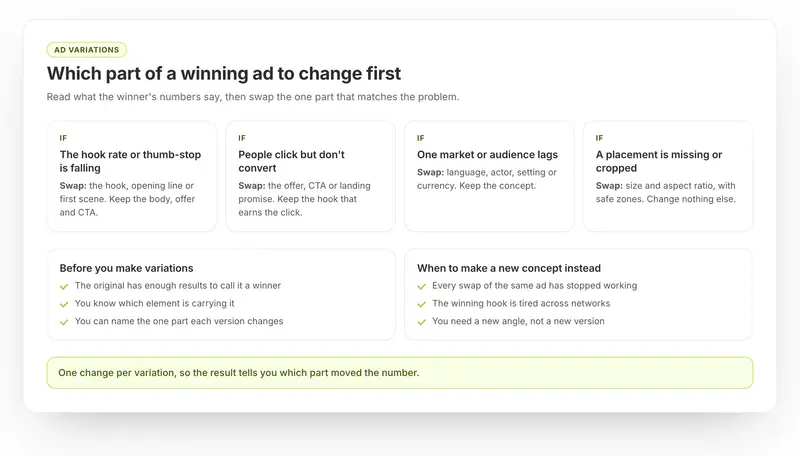
Change the part your numbers point at, and only that part:
- Falling hook rate or thumb-stop rate: swap the hook, first line or opening scene. Keep the body, offer and CTA.
- Good click-through, weak conversion: swap the offer, CTA or landing promise. Keep the hook that earns the click.
- One market or audience lags: swap the language, actor, setting or currency. Keep the concept.
- A placement is missing or cropped: make the size or aspect ratio you lack. Change nothing else.
When every swap of the same ad has stopped working, you need a new concept, not another version. Our guide on Facebook ad creative testing covers how to structure the test itself.
How to see which part is carrying a winner
You can't pick the right part to swap until you know which parts the winner contains and how each one performs across your other ads. That is a tagging job. Segwise Creative Tagging watches, reads and listens to every ad and tags each element: the headline, the hook angle, the visual, the CTA, the offer and the language, with 20+ standard tags plus custom ones you define. Each tag is tied to ROAS, CPA, IPM and CTR.
In this example, a language app called Echo has a static that reads "Day 47. Still going." Segwise tags its hook angle as "Streak progress" (a custom tag), and the results strip shows $12.6K of Meta spend over 30 days at an IPM of 8.2 and a $1.84 CPI. Because the same tag runs across Echo's other ads, the team can see whether the streak angle or the free-week offer is doing the work before deciding what to swap.

See which part of your winner wins: Segwise lets you rank every hook, offer and CTA in your account by results, then make variations that keep the winning part. Book a demo.
The 8 best AI ad variation generators
1. Segwise: best for variations built from tagged winners

Best for: performance and creative teams on several networks who want each variation to keep the elements that are winning in their own account.
What it swaps:Creative Generation lets you make variations of a winner or net-new ads, as statics and videos up to 30 seconds, including AI UGC-style video. You can edit a static with a plain-English note ("make the headline shorter and lead with the protein"), and in the video editor you can rewrite the voiceover, change the headline, toggle captions or swap B-roll. You can localize a winner into another language, with on-screen text, currency and people adapted, and export every size your networks need with safe zones kept.
How it decides: each draft starts from your tagged top performers and comes with a "Why this ad" explanation that points back to your own winners. Statics also come with a recommended campaign and ad group. Once a variation runs, Segwise tags it and tracks it like every other ad, so the next round knows whether the swap worked.
In this example, Echo asks for one new hook, Spanish and Japanese versions, and one offer-led take on the streak winner. Each version shows what changed and what was kept.

You can use each agent on its own, or do it all in one place by chatting with the Segwise agent: ask how your ads are performing, see what competitors are running, and make new ads from your winners. Teams that work in Claude, ChatGPT, Cursor, Codex or Grok Bot can also query their tagged data through the Segwise MCP, for example "which hook angle has the best IPM on Meta this month?" Generation through the MCP is coming soon. To check drafts before spend, Pre-flight Testing scores up to 10 creatives at a time, each out of 100, with a Run, Refine or Hold verdict.
Whow Games, which runs 800+ slot games, reports turning out four ad variants per concept on every channel in hours, according to its case study.
Pricing: Segwise starts at $999/month for advertisers spending up to $250K/month; startups spending under $50K/month pay $499/month (limited eligibility).
Limitations: it needs connected ad network data with some history, because variations start from your winners; a brand with no running ads has nothing to tag yet. It is priced for teams with real spend, not for a solo founder making a few ads. Finished ads are exported to your networks rather than pushed straight into them today. Playables and CTV spots come through a managed service, not a self-serve editor.
2. AdCreative.ai: best for high-volume static sizes and copy

Best for: small teams and agencies that need many static sizes and copy versions of one ad, fast.
What it swaps: AdCreative.ai promises to "create every ad size and variation you need in seconds" from ready-made or custom templates, plus ad text and "multiple video variations" from a product photo. Generation is unlimited; you spend a credit when you download.
How it decides: outputs come from a model "trained on patterns learned from $35B+ in ad spend data", and its Creative Scoring AI rates drafts. Scoring is not on the Starter plan.
Pricing: Starter $39/mo for 20 credits, Professional $249/mo for 300 credits and Ultimate $999/mo, all on monthly billing. There is a 7-day trial that needs a card.
Limitations: credits run out fast if you download many sizes of many versions. It documents templates, a model trained on ad spend data and Creative Scoring as the basis for its variations, so you still pick which part of your winner to change.
3. Pencil: best for template variants and localization at scale

Best for: brand and agency teams that need one approved ad turned into many market, language and audience versions.
What it swaps: Pencil says you can "generate thousands of variants from a single template", localise and translate across markets, and personalise by audience segment, region or product. AI Auto Resize covers the sizes.
How it decides: Pencil predicts performance before spend and says "performance data flows back into generation". It can launch to Facebook, Instagram, TikTok, YouTube, Google Display, DV360 and LinkedIn.
Pricing: Core $14/mo for 50 generations, Growth $55/mo for 250 generations, and Pro at custom pricing with unlimited generations.
Limitations: the low tiers are thin for real variation volume, and the enterprise features sit on custom pricing. Its predictions come from Pencil's model, so you still need your own results to confirm which part of a winner to change.
4. Arcads: best for AI-actor UGC video variations

Best for: DTC brands and apps that already have a winning UGC-style video and want it with new faces, hooks and languages.
What it swaps: Arcads documents three swaps on a winner. Replace Actor keeps "a winning ad's script, timing and scene" and changes the person on screen. Translate Video takes a winner into new markets. New hooks generates "several short opening clips" and joins each to the same body. Workflows can "turn one winning ad into 20 UGC variations, in a single run". Its library has 1,000+ AI actors.
How it decides: you choose the swaps. Its agent, Mark, can read how ads perform on connected Meta, TikTok and X accounts, but we found no page describing element-level tagging of your ads.
Pricing: dollar prices are shown only inside the app. Plans are credit pools, from Starter (8,000 credits a month) to Business (192,000), and Workflows needs Creator or above. The trial lasts 72 hours with 1,000 credits, needs a card and rolls into Starter unless cancelled.
Limitations: it is built around video and AI actors, and 20 variations from one run is far more than most budgets can read in a week, going by the budget math above.
5. Creatify: best for remaking winners as new video and image ads

Best for: performance teams that want one tool to spot a tiring winner and remake it.
What it swaps: Creatify has Ad Clone to "remake a winning ad", AI avatars and URL-to-video. Its Performance Agent says: "When a winner fatigues, the same chat writes the new hooks and renders fresh video and image ads to test."
How it decides: from connected accounts (Meta, Google Ads, TikTok, Snapchat, Reddit and OpenAI Ads, plus AppLovin for read-only analysis), with "test plans, variants and a called winner, from your ad platform's own results."
Pricing: a free plan with 10 credits and watermarked exports, then Standard $15/mo, Pro $55/mo (connects 3 ad accounts), Ultra $95/mo and Business $195/mo on monthly billing.
Limitations: connecting ad accounts starts on Pro. We found no page describing MMP data joined to creative elements, which matters for app teams judged on installs and in-app revenue.
6. Smartly: best for enterprise localization and DCO

Best for: large brands running many markets, languages and audiences on social, programmatic and CTV.
What it swaps: Smartly turns "one concept, thousands of variants personalized to every audience", and its DCO engine "localizes creative in real time by region, language, and demographic". It also says it can "build mountains of video variations in minutes".
How it decides: templates and DCO rules, with Creative Insights to "identify top-performing elements, rank creative by your KPIs".
Pricing: not published (its pricing page returns a 404); every call to action is "Get a Demo".
Limitations: built and priced for enterprise teams with production and media operations staff. Overkill for a team testing a handful of variations a week.
7. Marpipe: best for catalog and product feed variations

Best for: ecommerce brands whose variations are mostly catalog ads across many SKUs.
What it swaps: Marpipe turns "your product feed into your brand's best catalog ads", with dynamic fields in each design. You vary the template, and the feed fills in every product. It publishes to Instagram, Facebook, Google, Snapchat, Pinterest, X, Reddit and Axon.
How it decides: product and feed data, with SKU Optimization to "automatically filter out the worst performers".
Pricing: a free plan, Startup at $199/mo (one channel, one market, three live designs, 500 SKU cap) and Enterprise at $999/mo.
Limitations: it is a catalog tool. If your winners are UGC videos or designed statics, it does not make those variations.
8. Madgicx: best for cheap Meta image variations

Best for: small DTC brands that buy only on Facebook and Instagram.
What it swaps: Madgicx's AI Ad Generator "generates new image ads from a prompt, an image or any ad in the Meta Ad Library", and its AI ads page says you can pick the ad copy and CTA based on performance.
How it decides: its Creative Insights uses AI tagging of creative elements in videos and images, on Meta data.
Pricing: the AI Ad Library and AI Ad Generator are a $29/mo subscription. Full plans are priced by ad spend, from $45/mo under $1K spend to $329/mo at $20K to $30K (monthly billing), with a 7-day free trial.
Limitations: it optimizes Meta only, and it describes image ad generation, not video variations.
What Meta does natively, for free
Before you pay for a tool, know what Ads Manager already does. These are platform features, not a substitute for the tools above.
- Text generation: Meta can generate up to five variations "of primary text and headline respectively" from your own inputs, currently for English, Portuguese and Spanish primary text.
- Image expansion: Meta's generative AI features can "automatically expand your image to fit more placements".
- Background generation: this one "currently only works with dynamic product ads or Advantage+ catalog ads on Mobile Feed".
- Translations: Meta's generative AI translations translate your primary text and headline, translate text in image overlays, and dub a video's voiceover from English into 13 languages, including Spanish, Portuguese, Hindi and French. Voiceover dubbing works on single video ads with voiceover in Facebook Feed, Instagram Feed, Reels and Stories.
We found no Meta page describing a way to see which element of your winner to change, or to make a new hook or actor version of a video. If text, size and language versions on Meta are all you need, you may not need a paid variation tool yet.
What do AI ad variation generators cost?
The sticker price misleads, because tools charge for different units. Here is what each entry price buys, on monthly billing:
| Tool | Entry price | What it buys |
|---|---|---|
| Pencil | $14/mo | 50 generations a month |
| Creatify | $15/mo (free plan exists) | 55 credits a month |
| Madgicx | $29/mo | AI Ad Library and AI Ad Generator |
| AdCreative.ai | $39/mo | 20 credits a month, spent on downloads (generation unlimited) |
| Marpipe | $199/mo (free plan exists) | One channel, one market, 500 SKUs |
| Segwise | $999/mo ($499 for startups under $50K spend) | Tagging, analytics and generation across your networks |
| Arcads, Smartly | Not published | Credit plans in-app; enterprise demo |
A worked comparison: if you make 4 variations of each of 5 winners a month in 3 sizes, that is 60 files. If each static download uses one credit, AdCreative.ai's 20-credit Starter would cover a third of them, and the $249 Professional plan (300 credits) would cover all 60 with room to spare. The real cost of a cheap generator is the hours spent deciding what to change and checking whether it worked, which is the part a results-driven tool replaces.
A decision rule by spend and volume
- Under about $10K a month in spend, one network: Meta's built-in text and size variations plus a low-cost generator (Pencil, Creatify or Madgicx) are enough.
- $10K to $50K a month, or two networks: add a tool that reads your results, so variations stop being guesses. Creatify or Madgicx on one platform; Segwise's startup pricing if you run several networks or an MMP.
- Over $50K a month, three or more networks, or 20+ new ads a month: you need element-level tagging across networks feeding the variations. That is where Segwise fits, with Arcads or Marpipe alongside for UGC video or catalog volume if you need them.
These spend bands are rules of thumb. Read our how-to on turning winning ads into variations for the step-by-step process.
Which AI ad variation generator should you start with?
Pick by where your instruction to change comes from. If you already know which part of your winner to swap, a fast generator such as AdCreative.ai, Arcads or Pencil will make the versions. If you don't, start with a tool that tags your ads and ties each element to results, because a variation is only as good as the choice of what to change. The next step is the same either way: pick one winner, name the one part you will swap, and test 3 to 5 versions against it.