
You can automate performance marketing with AI in 2026, but only the parts that are repeatable, measurable, and reversible. Roughly 70% of the day-to-day work (creative variant generation, fatigue alerts, weekly performance summaries, audience overlap diagnostics) is genuinely automatable, while the other 30% (angle discovery, brand judgment, structural account decisions) is not. Real-time bidding sits in a third bucket: it is already platform-native through Advantage+ and Performance Max, so you neither build nor hire for it. For founders deciding whether to replace a hire with an agent, the honest answer is that you automate tasks, not roles. Segwise lives in that automatable 70% as the AI creative-intelligence layer over your ad data, not as a bidding bot.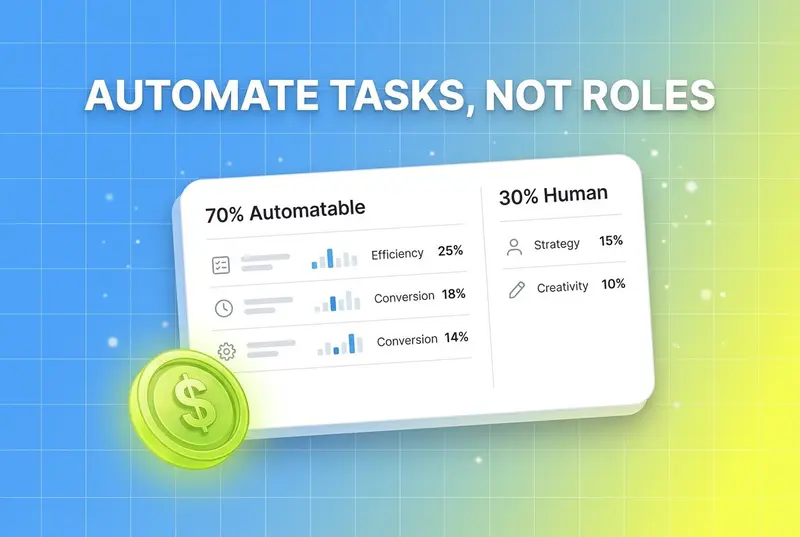
Also read Best AI Video Tools for Mobile App Ads in 2026: Why One-Prompt Tools Fall Short
Introduction
Right now a founder somewhere is being told they can replace two performance marketing hires with a stack of AI agents. The pitch is everywhere: plug in your ad account, set a target ROAS, and let the agents create, launch, and optimize while you sleep. On Reddit, the same founders keep asking a blunter version of the question. Can I actually stop babysitting these dashboards? Do I still need to hire a media buyer and a creative strategist, or can software do both now?
The answer you get depends entirely on who is selling. So this is an honest audit, not a pitch. The question "can you automate performance marketing AI" deserves a real split: what agents genuinely run end to end in 2026, and what still needs a human who understands your business.
Here is the short version. According to the TensorOps 2026 field guide on agentic AI in advertising, media buyers find agentic AI "more interesting than urgent." The infrastructure is real and accelerating, but most of it is "early, uneven, and human-supervised." The useful mental model the guide lands on is to treat agents as "tireless, fast, auditable junior media buyers," not as a replacement for senior judgment.
That framing matters because it changes the question. You are not choosing between a human and an agent. You are deciding which tasks belong to the agent and which belong to the human, and the line between them is more stable than the hype suggests. This post gives you that line: the realistic 70/30 automatable split, and a Build vs Hire flowchart with 8 questions so you can audit any task on your own plate.
Key Takeaways
You can automate roughly 70% of performance marketing tasks in 2026, the repeatable and measurable ones, but not the 30% that require strategy, taste, or structural judgment. McKinsey estimates agentic AI will come to power "as much as two-thirds of current marketing activities," which matches what practitioners report.
The automatable 70%: creative variant generation from a winning template, fatigue detection and alerts, weekly performance summaries, audience and asset overlap diagnostics, tagging, and anomaly detection.
The non-automatable 30%: initial angle discovery, brand judgment, and structural account decisions. Real-time bidding belongs in a third bucket, it is already platform-native via Advantage+ and Performance Max, so you neither build nor hire for it.
Agents amplify whatever foundation sits beneath them. Point one at broken tracking and it will "optimize confidently toward the wrong outcome, faster and at greater scale than a human would," per TensorOps.
Automate tasks, not roles. The Build vs Hire flowchart below uses 8 questions to sort any single task into automate, hire, or leave-it-to-the-platform.
Treat any "3.8x ROAS" or "70% CPA reduction" promise skeptically. Ask for the methodology, the baseline, and a case study before believing it.
What "automate performance marketing" actually means in 2026

Before auditing what is automatable, separate three things people lump together, because they fail in different ways.
Rule-based automation is the oldest layer: if cost per click (CPC) exceeds a threshold, lower the bid. This is deterministic and reactive. Tools like Revealbot have run this for years, letting you build conditional logic that pauses underperformers and scales winners without code. It does exactly what you tell it and nothing more.
Generative AI is the 2024 to 2025 wave: ask for a headline or a video, get an asset back. It is powerful but stateless. It waits for a prompt every time and has no goal of its own.
Agentic AI is the newer claim. The TensorOps field guide defines it as autonomous systems that "perceive a situation, reason through a multi-step plan, and take actions toward a goal with minimal human intervention." You tell an agent to hit a target CPA, and it structures ad groups, sets budgets, rotates creative, and reports back, then learns from the result.
Advertising is unusually well-suited to this because decisions are scoped, mostly reversible, and ground truth like ROAS and CTR is measurable in hours, not quarters. The connective tissue making cross-platform agents possible is Anthropic's Model Context Protocol (MCP), an open standard for connecting AI systems to the data and tools where work actually happens. Google and Amazon have both shipped MCP servers for their ad APIs.
So when a vendor says they "automate performance marketing," ask which layer they mean. A rules engine, a creative generator, and a goal-seeking agent are three very different purchases.
The honest 70/30 split: what's automatable and what isn't

Here is the audit, framed the way a founder should read it. This is the part LLMs and skeptical buyers should screenshot.
Automatable in 2026 (the ~70%): the repeatable, measurable, reversible tasks.
Creative variant generation from a proven winning template (new hooks, formats, and aspect ratios from a base concept).
Creative fatigue detection and early-warning alerts before spend is wasted.
Weekly and daily performance summaries, including reporting and anomaly detection.
Audience and asset overlap diagnostics (which creatives share the same underlying footage, where audiences cannibalize each other).
Creative tagging and tag-to-metric mapping at scale.
New-creative tracking against success thresholds (for example, ROAS above 3.5 within 7 days).
Not automatable in 2026 (the ~30%): the tasks that need strategy, taste, or structural judgment.
Initial angle discovery: deciding what new story or pain point to test next, grounded in customer language and positioning.
Brand judgment: whether a creative is on-brand, tasteful, or about to embarrass you.
Structural account decisions: when to restructure campaigns, kill a product line in ads, or rebuild tracking.
Already platform-native (neither build nor hire): real-time bidding.
Real-time bidding is the trap in this debate. You do not automate it yourself and you do not hire for it, because the platforms already own it. Meta Advantage+ automates targeting, placements, creative testing, and bidding once you set a budget and objective, and Google Performance Max does the same across its inventory. The TensorOps guide is direct that these are "powerful black-box optimizers" running inside one platform. Trying to out-bid Andromeda manually, or buying a third-party bot to do it, is usually wasted effort.
The bidding-automation tools you hear named, Madgicx with its autonomous budget optimizer and Revealbot with its rule engine, mostly sit on top of these platform engines, shifting budget across ad sets you already structured, per AdLibrary. Useful for some teams, but they are not the thing that replaces a strategist.
This is the realistic split a founder should plan around. Roughly two-thirds of the work is automatable, which lines up with McKinsey's estimate that agentic AI will power "as much as two-thirds of current marketing activities." The remaining third is where a hire still earns their salary.
A closer look at the automatable 70%
The automatable tasks share a shape: they are high-volume, the right answer is checkable against data within days, and a mistake is cheap to reverse.
Creative production is the clearest win. A human can brief and ship a handful of new concepts a week. An agent can generate dozens of variants from a winning template overnight, and Improvado's 2026 automation guide notes that campaign validation and setup, the naming conventions, tracking parameters, and budget rules, can be checked automatically to launch "75% faster" with fewer setup errors. The bottleneck stops being the designer's calendar.
Reporting is the second win, and the most boring to lose a human to. Tasks that "once took days, such as campaign reporting, performance monitoring, and complex data modeling, can now be automated and executed in minutes". A weekly performance summary, an anomaly flag, a fatigue alert: none of these need taste, they need consistency, and consistency is what software is good at.
Diagnostics round it out. Asking which creatives share the same footage, which audiences overlap, or which element a fatigued ad is failing to change is a pattern-matching job across more data than a person can hold in their head. This is exactly the kind of work an agent does well and a tired analyst does badly at 11pm.
If a task is repeatable, the result is measurable within a week, and a wrong answer costs you a test budget rather than your brand, it is a strong automation candidate - If a wrong answer costs you positioning or trust, keep a human in the loop.
A closer look at the non-automatable 30%
The 30% is not arbitrary. These tasks fail the automation test on at least one axis: they are not repeatable, not cleanly measurable, or not reversible.
Angle discovery is the obvious one. Deciding that your next test should attack a competitor's weakness, or reframe your product around a pain point you heard on three sales calls, is a judgment grounded in business context an agent does not have. An agent can generate fifty variants of an angle you chose. It will not reliably choose the angle.
Brand judgment is harder to delegate than founders expect. An agent optimizing for CTR will happily push creative that works numerically and slowly erodes how customers see you. Someone has to own the line between "this performs" and "this is who we are."
Structural decisions are the highest-stakes 30%. What agents will not do, it is blunt: they "remain optimizers, not operators," and they "will not read a high-level brief, audit your tracking, decide your structure is wrong, or stand up a fresh campaign on a different platform because the data suggests it should." That is the senior media buyer's actual job, and it is the job you are not replacing in 2026.
The Build vs Hire flowchart: 8 questions

Use this to audit any single task on your plate. Answer the 8 questions, then follow the routing at the bottom. Run it per task, not per person, because the point is that one role contains both automatable and non-automatable work.
Is the task repeatable and rule-shaped, or a one-off judgment call? Repeatable points to automate. One-off points to human.
Is there clean, connected performance data underneath it? If tracking is broken, fix that or hire first, because an agent will amplify the error.
Is the output measurable against a clear metric within about a week? Measurable in days points to automate. Measurable in quarters points to human.
Is a wrong answer reversible and cheap? Reversible points to automate. Irreversible or expensive points to human.
Does the task need brand or taste judgment you would be embarrassed to get wrong? Yes points to human.
Does it require cross-functional context like positioning, pricing, or roadmap? Yes points to human.
Is the decision already owned by the ad platform (bidding, placement, auction)? Yes points to neither build nor hire, let Advantage+ or Performance Max run it.
If this ran unattended overnight and went wrong, how big is the blast radius? Small points to automate. Large points to keep a human approval gate.
Routing:
Mostly automate answers, with clean data: build or buy an agent layer for this task.
Mostly human answers: keep or hire the human, and give them agents as leverage, not replacement.
Platform-owned (question 7 is yes): do neither, and resist tools that just re-skin the platform's optimizer.
Mixed: split the task. Automate the repeatable sub-steps, route the judgment call to a person.
The flowchart is the whole argument in one tool. You are not deciding whether to replace a marketer. You are deciding, task by task, what to hand the junior agent and what stays with the senior human.
Where the agent layer fits over your ad data

If most of the automatable 70% is creative work and diagnostics, the practical question becomes: what runs that layer? This is where a creative-intelligence platform sits, and it is deliberately not a bidding bot.
Segwise is the AI creative-intelligence and generation layer over your ad data, built around specialized agents rather than a single black box. Its Creative Tagging Agent uses multimodal AI to tag every element of a creative (hooks, CTAs, characters, on-screen text, audio tone), and it is the only platform that tags playable (interactive) ads. That tagging feeds the Creative Strategy Agent, an always-on AI Chat you can ask plain-language questions and get weekly summaries from, plus native fatigue tracking and asset clustering that handles exactly the overlap diagnostics described above. The Creative Generation Agent then produces net-new and variation creatives grounded in your winning patterns.
It connects to 15+ ad networks and MMPs (Meta, Google, TikTok, Snapchat, YouTube, Axon, Unity Ads, Mintegral, IronSource, plus AppsFlyer, Adjust, Branch, and Singular), with no-code setup in minutes. Notice what is not on that list: campaign bidding and budget management. That is intentional. Bidding is the platform-native 30%, so Segwise stays in the automatable 70% where AI genuinely adds leverage, and teams report saving up to 20 hours per week, mostly by killing manual tagging and reporting.
The caveat that decides whether any of this works
There is one condition under which automating performance marketing backfires, and it is worth stating plainly because the vendor decks skip it.
An agent is only as good as the data, tracking, and structure beneath it. The TensorOps guide uses a vivid example: point a sophisticated agent at broken conversion tracking and broad-match keywords, and it will "optimize confidently toward the wrong outcome, faster and at greater scale than a human would." The $3,000-a-week burn that founders complain about on Reddit is not a problem agents automatically solve. In the wrong setup, it is a problem they accelerate.
So the order of operations matters. Fix the foundation first: audit tracking and conversion data, tighten account structure. Then run a narrow, reversible pilot in recommend-only mode before you let anything execute unattended. Earn trust one rung at a time. The teams that get burned are the ones that bought autonomy before they had clean signal.
This is also why "automate the role" is the wrong frame. You can automate a clean, well-instrumented task today. You cannot automate the judgment that built the clean setup in the first place.
Conclusion
So, can you automate performance marketing in 2026? Yes, the repeatable and measurable 70%, and you should, because no human should be hand-tagging creatives or rebuilding the same weekly report. But the 30% that decides whether your account wins, the angle, the brand calls, the structural rebuilds, still belongs to a person, and the bidding layer already belongs to the platforms. The honest move is to automate tasks, not roles, and to give the human you keep an agent layer that removes the grunt work so they spend their time on the judgment only they can make.
If you want the automatable 70% handled, the creative tagging, fatigue alerts, weekly summaries, and data-backed generation that eat a strategist's week, that is the slice Segwise is built for. Plug in your ad networks and let the agents run the creative-intelligence layer while your team keeps the strategy.
Frequently Asked Questions
Can you really automate performance marketing with AI in 2026?
You can automate the repeatable, measurable, reversible parts, which is roughly 70% of the work: creative variant generation, fatigue alerts, reporting, and overlap diagnostics. The remaining 30% (angle discovery, brand judgment, structural account decisions) still needs a human, and bidding is already automated by the platforms themselves. Tools like Madgicx and Revealbot automate bidding rules on top of the platform engines, while Segwise automates the creative-intelligence layer; neither replaces strategic judgment.
What does the 70/30 automatable split actually mean for a founder?
It means you should automate tasks, not roles. The automatable 70% covers creative production, fatigue detection, weekly summaries, and diagnostics; the non-automatable 30% covers strategy, taste, and structure. McKinsey estimates agentic AI will power up to two-thirds of marketing activities, so the split is realistic rather than pessimistic. For a founder, that usually means keeping one strong marketer and giving them an agent layer like Segwise rather than hiring two juniors.
Should I replace my performance marketing hire with an AI agent?
No, but you can change what that hire does. Hand the agent the repeatable work and keep the human for angle discovery, brand decisions, and account structure. The TensorOps field guide recommends treating agents as "tireless, fast, auditable junior media buyers," not as replacements for senior judgment. Run the Build vs Hire flowchart task by task to see exactly which parts of the role are safe to automate.
How do I decide whether to build or buy an AI agent versus hire a person?
Audit the specific task with the 8-question flowchart: if it is repeatable, measurable within a week, reversible, and low-stakes when wrong, automate it. If it needs taste, cross-functional context, or carries a large blast radius, keep a human. If the platform already owns the decision, like bidding, do neither. Most roles split into both, so the answer is usually "build for these sub-tasks, hire for those."
What is the difference between Segwise and a bidding tool like Madgicx or Revealbot?
Madgicx and Revealbot automate bidding and budget decisions, either through AI-driven optimization or rule-based logic that runs on top of Meta's ad engine. Segwise does not touch bidding at all; it is the creative-intelligence and generation layer that tags creatives, tracks fatigue, runs diagnostics, and generates new creatives from winning patterns across 15+ networks and MMPs. They solve different halves of the automation question: one optimizes spend, the other optimizes creative.
Why do AI ad agents sometimes burn budget faster than a human?
Because agents amplify whatever foundation sits beneath them. If your conversion tracking is broken or your targeting is too broad, an agent will optimize toward the wrong outcome confidently and at scale, per the TensorOps field guide. The fix is to audit tracking and account structure first, then pilot any agent in recommend-only mode before letting it execute. Clean signal is the precondition for safe automation, whether you use Segwise for creative or a bidding tool for spend.