When AppLovin's in-house creative team operationalized generative AI across its production workflow, it nearly tripled creative output and saved roughly 1,600 hours in under a year, without removing humans from the process. For creative teams, the lesson is that AI pays off when it is woven into a defined workflow and paired with a way to measure which generated assets actually perform. That second half, knowing what works, is where creative intelligence platforms like Segwise fit.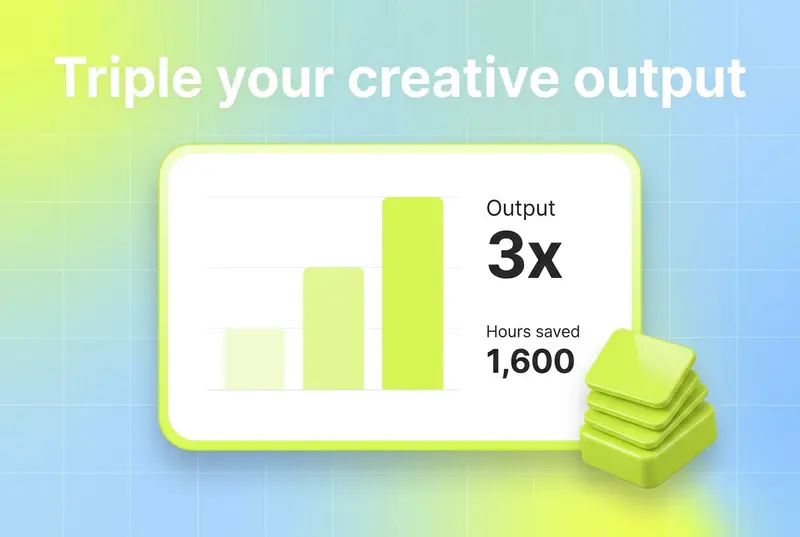
AppLovin's SparkLabs is the company's in-house creative team, responsible for producing tens of thousands of high-impact, interactive performance ads every year. In 2023, the team shared how it built generative AI into its day-to-day creative production. The headline result was concrete: production roughly tripled over the prior year, and the team saved nearly 1,600 hours across its creative processes.
What makes the SparkLabs story useful is not the tool list. Plenty of teams have tried ChatGPT and Midjourney. It is the operational discipline behind the rollout: a phased approach, a clear rule about where AI fits, and a culture that treated AI as a co-pilot rather than a replacement.
This post breaks down what SparkLabs did, the AI stack it used, the results it reported, and the practices any performance creative team can borrow. It also covers the part most AI-creative stories skip: once you can produce three times as many ads, how do you figure out which ones are worth scaling?
Also read How to Set Up AppLovin or Axon Ads: A 2026 Playbook
Key takeaways
SparkLabs is AppLovin's in-house creative team and produces tens of thousands of interactive performance ads per year, according to AppLovin.
After operationalizing generative AI, the team roughly tripled its creative output year over year and saved close to 1,600 hours in its creative processes in under a year.
SparkLabs used a phased, team-centric rollout and a culture of exploration rather than a single tool drop, per AppLovin's account.
The AI stack spanned scripting, voice and audio, generative art, and animation, combining tools like ChatGPT, Synthesia, Midjourney, and Runway with live-action footage, per AppLovin.
One AI-assisted CTV ad for the game Wordle! drove the highest install rates in its campaign, a 6.3% lift over the previous top performer at equal ROAS.
SparkLabs' core rule: use AI for inspiration and edits, keep a human in the loop, and never ship 100% raw AI output, per AppLovin.
What SparkLabs actually did
SparkLabs did not bolt AI onto the end of its pipeline. It injected generative AI into different parts of the production workflow to cut operational inefficiencies and speed up marketability testing, while keeping creative direction in human hands. The framing AppLovin used was that AI acts as an idea-to-reality generator for creatives that still need human craft and industry expertise.
The productivity numbers
The reported results are specific. SparkLabs roughly tripled its creative production compared to the previous year once AI was part of the process. Across its creative processes, the team saved close to 1,600 hours in less than a year.
Those numbers matter because of the volume SparkLabs handles. This is a team shipping tens of thousands of interactive performance ads annually, so a 1,600-hour saving is not a one-off experiment. It is time pulled out of a high-throughput pipeline and reinvested into more testing and more iteration.
A phased, team-centric rollout
The part worth copying is how SparkLabs got there. Rather than mandating a tool, AppLovin describes a phased process to operationalize generative AI, built on a culture of exploration and collaboration. The team learned the tools together, shared what worked, and folded the useful parts into daily operations over time.
That sequencing matters. Generative AI tools reward repeated, specific use, so a team that experiments collectively builds shared prompt knowledge faster than individuals working alone. SparkLabs treated adoption as a team behavior, not a software purchase.
The AI creative stack SparkLabs uses

SparkLabs does not rely on one model. It chains tools by function, combining their output with live-action footage. AppLovin shared the stack behind a CTV ad it presented at its Amplify events, organized by what each tool contributes.
Scripting and language
For scripting and language modeling, SparkLabs used ChatGPT and Bard to draft and shape ad copy and concepts before production.
Voice, music, and audio
For voice, music, and sound, the team used Synthesia for lifelike video avatars, plus PlayHT and Soundraw for speech, music, and audio, per AppLovin. This let them test multiple voiceover and soundtrack styles quickly.
Generative art
For art and imagery, SparkLabs used DALL-E, Midjourney, and Stable Diffusion to generate visual styles ranging from stylized to photorealistic, according to AppLovin.
Animation and motion
For animation, the team used Runway and DEEPMOTION to bring static concepts into motion, per the same source.
Iterating across these tools let SparkLabs test different voice, video, music, art, and animation styles fast, which sped up marketability testing of multiple ad variations. The point of the stack is not any single tool. It is the ability to spin up many variations cheaply, then test them.
What worked: the Wordle! example
The clearest proof point AppLovin shared was a CTV ad for Lion Studios' game Wordle!. The team combined live-action footage with the AI stack above to produce the spot.
The result: that video led to the highest install rates in its CTV campaign, a 6.3% lift over the previous top performer, at equal ROAS. AI did not replace the creative work. It accelerated the path from concept to a testable, high-performing ad.
This is the pattern behind the productivity gains. When you can produce variations faster, you can test more of them, and testing more is how you find the winner that beats your current best ad.
SparkLabs' best practices for using AI

AppLovin shared the operating principles SparkLabs follows. They read less like a tool tutorial and more like a discipline for keeping quality high while moving fast.
Use tools cleared for commercial use. Generative AI is new enough that legal frameworks are still forming, so SparkLabs prioritizes tools that are approved for commercial work, per AppLovin.
Keep a human in the loop. AppLovin is direct that AI has limited utility without a human co-pilot. SparkLabs uses AI for inspiration and edits and avoids shipping 100% raw output. Human direction is what turns model output into a usable ad.
Build prompt skill and give the tools time. SparkLabs advises learning the language of each tool, providing context, and iterating. Output quality improves with repeated, specific use, so the advice is to keep at it rather than judge a tool on its first result.
Experiment without fear. The team's guidance is to twist the knobs, learn what works, and not be afraid to break and rebuild. The teams that experiment now build an advantage over those that wait.
What this means for your creative team
Here is the implication SparkLabs' results point to. Generative AI removes the production bottleneck, but it creates a new one: once your output triples, the hard question shifts from "can we make enough ads?" to "which of these actually work, and why?"
That is a measurement problem, not a production problem. If you ship three times as many AI-assisted variations across Meta, TikTok, Google, and other networks, you need to know which hooks, visual styles, voiceovers, and CTAs are driving installs and ROAS, and which are quietly burning budget. Doing that by hand across hundreds of creatives is the manual tagging work that eats 20+ hours a week.
This is where Segwise fits alongside an AI production stack. Segwise unifies creative data from 15+ ad networks and MMPs, then uses multimodal AI to automatically tag every creative element, video, audio, image, and text, including playable ads. Its creative tagging maps each element to performance, so you can see which AI-generated hook or visual style is actually winning. Its fatigue tracking flags declining creatives early, before budget is wasted, which matters even more when you are testing at higher volume.
In other words, SparkLabs shows how to produce more. Creative intelligence is how you make sure the extra volume is the right volume.
Bottom line
The SparkLabs story is a clear case study in operationalizing generative AI: a phased rollout, a human-in-the-loop rule, and a tool stack chained by function produced roughly triple the output and saved close to 1,600 hours. The takeaway for performance creative teams is that AI is most valuable when it is built into a real workflow and paired with a way to measure results, because production speed only pays off if you can tell winners from losers fast. Pairing an AI production stack with creative intelligence like Segwise closes that loop.
Frequently asked questions
How did AppLovin SparkLabs use generative AI to boost productivity?
SparkLabs injected generative AI into multiple stages of its creative production workflow rather than adding it at the end, per AppLovin. It chained tools across scripting, voice, art, and animation, kept humans directing the work, and rolled the tools out in phases. The reported result was roughly triple the creative output and close to 1,600 hours saved in under a year. Teams looking to do the same often pair production tools with a creative intelligence platform like Segwise to track which AI-assisted creatives perform.
How much time did SparkLabs save with AI?
SparkLabs saved close to 1,600 hours across its creative processes in less than a year after operationalizing generative AI, according to AppLovin. Because the team produces tens of thousands of interactive ads annually, that time was reinvested into more testing and iteration rather than one-off projects.
What AI tools does AppLovin SparkLabs use for ad creatives?
For one CTV ad, SparkLabs combined ChatGPT and Bard for scripting, Synthesia, PlayHT, and Soundraw for voice and audio, DALL-E, Midjourney, and Stable Diffusion for art, and Runway and DEEPMOTION for animation, alongside live-action footage, per AppLovin. The exact stack matters less than the approach of chaining tools by function to test many variations quickly.
Does generative AI replace human creative teams?
No. AppLovin is explicit that AI has limited utility without a human co-pilot, and that SparkLabs uses AI for inspiration and edits rather than shipping 100% raw output, per AppLovin. Human direction turns model output into a usable, on-brand ad. AI speeds up production, but people still set the creative direction, and platforms like Segwise help those people see which creative decisions paid off.
What does this mean for performance marketers in 2026?
It means the bottleneck is moving from production to measurement. When AI lets you produce far more creative variations, the harder question becomes which elements drive installs and ROAS, per the volume challenge SparkLabs' results highlight. A creative intelligence platform like Segwise auto-tags creative elements and maps them to performance across Meta, TikTok, Google, and other networks, so teams can scale winners and catch creative fatigue before it wastes budget.
How do I start operationalizing AI in my creative workflow?
Start the way SparkLabs did: pick tools cleared for commercial use, roll them out in phases, and build prompt skill through repeated use, per AppLovin. Keep a human in the loop on every asset, experiment freely, and treat adoption as a team behavior. Then connect your ad networks to a creative intelligence tool like Segwise so you can measure which AI-assisted creatives are actually working as your output scales.