
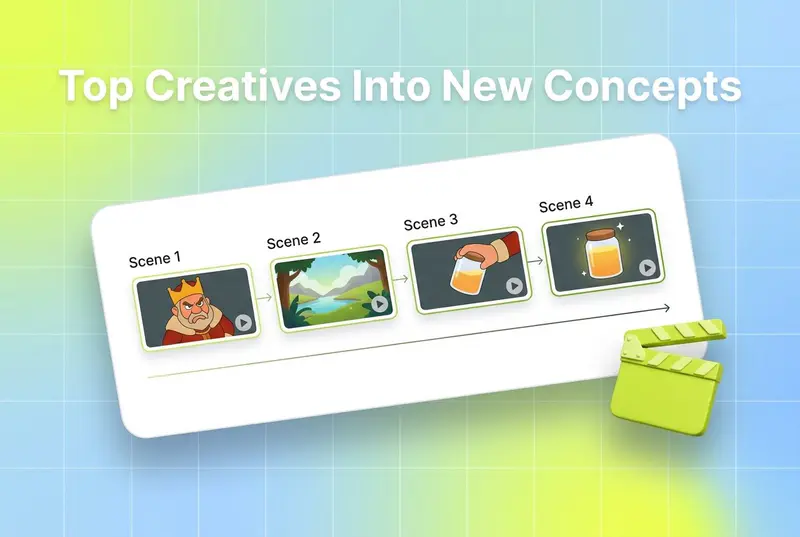
An AI video ad storyboard is a scene-by-scene plan for a new video ad, generated automatically from the patterns in your best-performing creatives instead of from a blank page. For performance teams, that means the slowest part of video production, deciding what to shoot, becomes a few minutes of work grounded in real data. Segwise generates these storyboards directly from your winning tag-to-metric patterns, then exports them ready to hand off to your editor or agency.
Most video ads die in pre-production, not on the timeline. The hard part was never the editing. It was staring at a brief and guessing which hook, which opening shot, and which beat order would actually hold attention this time. An AI video ad storyboard removes the guessing by building the plan from what your audience has already rewarded.
Here is the shift. You have a top creative that is printing ROAS. The instinct is to make ten more like it. But "like it" usually means copying the surface and missing what actually worked, the three-second problem-first hook, the talking-head open, the on-screen text cadence. A storyboard generator that reads your performance data captures the real reason a creative won, then lays out new scenes around it. That is the difference between an ad storyboard generator that remixes pixels and one that remixes proven patterns.
This guide covers what an AI video ad storyboard is, why teams that test video at volume need one, how the workflow runs from a top creative to a finished storyboard, and how to use one without losing the human judgment that good video still needs.
Key takeaways
- An AI video ad storyboard is a scene-by-scene plan for a new video concept, generated from the patterns in your top creatives rather than from scratch.
- Storyboarding is roughly half of pre-production, and a good one reduces production risk, improves communication, and controls cost before anyone shoots a frame.
- The reason this matters now is volume. Competitive mobile UA teams need 50+ video variations per testing sprint, and manual storyboarding cannot keep that pace.
- A data-backed ad storyboard generator works from your tag-to-metric mapping, so each new concept is built around the hooks, formats, and styles that actually drove results.
- Segwise auto-generates scene-by-scene storyboards from your winning creatives, then exports them in multiple aspect ratios ready to produce in-house or hand to your agency.
- Storyboards are the blueprint, not the build. The AI plans the concept from data; your team still owns the craft.
What is an AI video ad storyboard?
An AI video ad storyboard is a scene-by-scene outline for a new video ad, produced by AI that has analyzed your existing creative performance. Each scene describes what happens on screen, the rough shot, the hook or message, and the order of beats, so an editor or agency can produce it without starting from a blank brief.
A traditional storyboard is a series of frames that map out a video before production. It notes the main action, the camera movement, the on-screen text, and the audio for each scene. As one production guide puts it, storyboarding makes up about half of the pre-production process and is what lets a team produce the video efficiently instead of improvising on set.
The AI version changes where the plan comes from. Instead of a creative strategist sketching frames from intuition, the system reads which creative elements are winning across your account and builds the storyboard around them. So a scene might read "open on a problem-first talking-head hook, the format that holds 40% more viewers than your product-shot openers," because the data said so, not because someone had a hunch. It is one piece of the broader shift toward AI ad creative generation grounded in performance data.
That grounding is the whole point. An ad storyboard generator that ignores your performance data is just a faster way to produce average ideas. One that reads your tag-to-metric mapping turns your own winners into the brief for the next round.
How it differs from generic AI storyboard tools
Plenty of tools will turn a text prompt into a sequence of frames. Type a description, get a storyboard. They are useful for visualizing an idea you already have.
The gap is that they do not know what works for your audience. They generate from a prompt, which means the quality of the output is capped by the quality of your guess. If your guess is wrong, you get a polished version of a wrong idea.
A data-backed video storyboard generator starts from the other end. It already knows which hooks, CTAs, visual styles, and pacing patterns drive your ROAS, because it has tagged and scored every creative you have run. The storyboard it produces is a recombination of proven elements, not a fresh gamble. Same speed, very different odds. This is the same line that separates data-backed AI ad generation from generic AI output: the grounding in your own performance data is what makes it work.

Why video storyboards matter for performance teams
Three things make the storyboard the real bottleneck in video creative, and an AI video ad storyboard the way through it.
First, video testing runs on volume now. The days of shipping a handful of hero videos a quarter are gone. Competitive mobile UA teams aim for 50+ video variations per sprint, and networks reward freshness, with AppLovin and TikTok wanting new creative every one to two weeks. You cannot feed that machine if every concept starts with a slow, manual planning phase.
Second, video is expensive to get wrong. Creative video production runs $1,500 to $7,000 per minute depending on style and polish. A storyboard is the cheapest place to catch a bad idea. Planning scene by scene saves time and limits unforeseen costs by killing weak concepts before the shoot, not after.
Third, most concepts fail for a reason you could have predicted. When the storyboard is built from intuition, you relearn the same lessons every cycle. When it is built from your tag-to-metric data, the predictable failures get filtered out before they reach an editor. That is the practical promise here: turn your proven winners into the starting point for new concepts, so the slow part of video gets fast and the expensive part gets safer.
The teams pulling ahead treat the storyboard as a data product, not an art project. They know which elements carry their performance, and they brief new video from that, not from the last thing that felt clever in a meeting.
How AI generates a storyboard from your top creatives
The workflow runs in four stages, and each one depends on the creative intelligence underneath it.
1. Tag what is already winning
Before AI can plan a new video, it has to understand your old ones. Every creative gets analyzed and tagged across video, audio, image, and text: the hook style, the opening shot, the characters, the on-screen text, the CTA, the pacing, the audio tone. Done by hand, this is the work teams spend 20+ hours a week on and usually skip. Automated multimodal tagging does it continuously in the background.
2. Map tags to performance
Tags alone are a catalog. The value comes from connecting each tag to metrics, so "problem-first hook" or "9:16 vertical" or "UGC talking-head" carries a real ROAS, hook rate, and CVR across every creative that used it. This tag-to-metric mapping is what tells the system which elements are worth building a new concept around.
3. Generate the scene-by-scene storyboard
Now the AI assembles a new concept. It takes your highest-performing elements and lays them out as scenes: scene one opens on the winning hook, scene two carries the proven message beat, scene three lands the CTA that converts. The output is a structured storyboard, ready to produce, grounded in what your data says works rather than what a prompt guessed.
4. Export and produce
A storyboard is only useful if your team can act on it. The finished plan exports in the aspect ratios each network needs, so it is ready to hand to an in-house editor or an agency. The concept is decided; the craft is theirs.

Where Segwise fits
This is the gap Segwise is built to close. It starts by unifying creative and performance data from 15+ ad networks, including Meta, Google, TikTok, Snapchat, YouTube, AppLovin, Unity Ads, Mintegral, and IronSource, alongside MMPs AppsFlyer, Adjust, Branch, and Singular. Setup is no-code and takes minutes, with historical data imported automatically (up to 14 days on the free trial and up to 3 months for paid customers).
On top of that unified data, the Creative Tagging Agent uses multimodal AI to tag every element across video, audio, image, and text automatically, including playable ads, which Segwise is the only platform to tag. Each tag is mapped to performance, so the system always knows which hooks, formats, and styles are actually driving your results.
From there, the Creative Generation Agent does the storyboard work. It automatically generates scene-by-scene video storyboards that lay out the structure of new video concepts, built around your winning creative patterns rather than generic prompts. Because the generation is grounded in your tag-to-metric mapping, every concept is a recombination of proven elements, not a guess. It can also remix winning hooks, CTAs, and visual styles from across different top creatives into a single new concept, instead of reworking one source ad.
The output is ready to use. Generated storyboards and creatives export in multiple aspect ratios (1:1, 4:5, 9:16, 16:9, and more) tailored to each network, ready to produce in-house or hand off to your agency. And once a generated creative goes live, it gets tagged and tracked automatically, so its performance feeds straight back into the same intelligence that produced it. The loop stays closed. Segwise helps teams save up to 20 hours a week and halve creative production time by turning this from a manual planning slog into a continuous, data-backed pipeline.
How to use AI storyboards without losing the plot
A storyboard generator is a force multiplier, not a replacement for judgment. Here is a sane way to fold it into a real workflow.
- Unify and tag first. The storyboard is only as good as the data behind it. Get every creative from every network and MMP into one place and tagged consistently before you generate anything. A storyboard built on partial data inherits the gaps.
- Generate from proven patterns, not prompts. Point the system at your top creatives and let it build around the elements that actually scored. Resist the urge to override it with a hunch in the first pass. See what the data suggests first.
- Review the concept, then add the craft. Treat the AI storyboard as a strong first draft of the concept. Your editor or strategist still owns shot quality, casting, music, and the thousand small choices that make a video feel human. The AI decided what to make; your team decides how good it is.
- Ship variations, then close the loop. Produce the storyboard, run it, and feed the results back. The point of a data-backed generator is that every new concept makes the next one sharper, but only if you track what happens after launch.
The mistake to avoid is treating the storyboard as the finished product. It is the blueprint. AI gets you to a data-backed starting point in minutes instead of days, which is exactly where the speed should go, freeing your team for the part that still needs taste.
Conclusion
Video creative has flipped. The expensive, slow part used to be production; now it is deciding what to produce at the volume modern testing demands. An AI video ad storyboard solves that by turning your best-performing creatives into the scene-by-scene plan for your next ones, so the concept stage stops being a blank-page guess and becomes a data-backed first draft.
The teams that win at video do not just make more of it. They make more of what already works, faster, and they reserve their human judgment for craft instead of burning it on planning. That is the whole case for a data-backed ad storyboard generator: proven patterns in, new concepts out, with the loop closing automatically as each one goes live.
If you want to generate scene-by-scene storyboards from your own winning creatives, Segwise unifies your creative data across 15+ networks and MMPs, tags every element automatically, and maps it all to performance, then generates storyboards and creatives grounded in your winning patterns. Teams save up to 20 hours a week, halve creative production time, and improve ROAS by up to 50%.
Frequently asked questions
What is an AI video ad storyboard?
An AI video ad storyboard is a scene-by-scene plan for a new video ad, generated automatically by AI that has analyzed your existing creative performance. Each scene lays out the hook, the on-screen message, the rough shot, and the beat order, so an editor or agency can produce the video without building a brief from scratch. Tools like Segwise generate these storyboards from your winning tag-to-metric patterns, so the concept is grounded in what already drives your results.
How is an AI ad storyboard generator different from a regular storyboard tool?
A regular storyboard tool turns a text prompt into a sequence of frames, so the output is only as good as the idea you typed in. A data-backed ad storyboard generator works from your actual performance data, building the storyboard around the hooks, formats, and styles that already win for your audience. The first visualizes a guess; the second recombines proven elements, which changes the odds the concept performs.
How does AI generate a storyboard from my top creatives?
It runs in four steps. First it tags every element of your existing creatives across video, audio, image, and text. Then it maps each tag to performance metrics like ROAS and hook rate. Next it assembles a new scene-by-scene concept around your highest-performing elements. Finally it exports the storyboard in the aspect ratios each network needs, ready to hand to your team.
Can AI storyboards actually save my team time?
Yes, mostly by collapsing the planning stage. The slow part of video has shifted from editing to deciding what to make at testing volume, and manual storyboarding cannot keep up with the 50+ variations a competitive UA sprint needs. Generating the concept from proven patterns turns days of planning into minutes. Segwise reports teams save up to 20 hours a week and halve creative production time this way.
Does an AI storyboard replace my creative team?
No. The storyboard is the blueprint, not the build. AI decides what concept to make by reading your performance data, but your editor, strategist, and designers still own shot quality, casting, music, and the craft that makes a video feel human. The point is to spend human judgment on the parts that need taste, not on guessing which idea to try next.
What do I need before I can generate data-backed storyboards?
You need your creative and performance data unified across your ad networks and MMPs, automated tagging to describe every creative element, and tag-to-metric mapping to connect those elements to outcomes. Without that foundation, a storyboard generator is just guessing in a nicer interface. A platform like Segwise handles the unification, multimodal tagging, and generation in one place, with no-code setup that connects your sources in minutes.