
The best AI tools for diagnosing ad performance in 2026 are Segwise, Madgicx, and Triple Whale: Segwise pinpoints which creative element drove a ROAS or CPI shift and what to change next, Madgicx lets you chat with your Meta ads data for account-level diagnostics, and Triple Whale's Moby explains DTC revenue swings across channels in plain language.
Your ROAS dropped last week. The dashboard shows the number. It does not tell you why. Was it a fatigued hook, a saturated audience, a placement Meta quietly reweighted, or a recent Meta delivery change that pushed CPMs up and made creative fatigue the dominant performance lever (as marketers reported in early 2026)? Answering that used to mean an afternoon of pivot tables. A new class of AI does the diagnosis for you: it isolates the driver of the change, explains it in a sentence, and tells you the specific fix. This guide covers the nine tools that do it best in 2026, what each is actually good at diagnosing, and how to pick one.
This is a spoke in our performance-marketing AI series. If you want the wider category map, start with our pillar on the AI copilot for performance marketing. If your question is not "what changed?" but "what should I make next?", read how AI recommends creative improvements. This post stays in the diagnostic lane: why performance moved, and what to fix.
Key takeaways
Diagnostic AI explains the "why" behind a metric change and hands you the fix, replacing hours of manual pivot-table forensics with a plain-language answer.
Segwise leads for creative-level diagnosis across 15+ ad networks and MMPs: it auto-tags every creative, isolates which element (hook, CTA, visual style) drove a ROAS or CPI shift, flags fatigue before spend burns, and its Creative Strategy Agent answers questions in chat.
Madgicx is strongest for chatting with Meta ads data, while Superads brings the same natural-language querying across Meta, TikTok, LinkedIn, and Google.
Triple Whale, Polar Analytics, and Peel Insights are built for DTC ecommerce, tying ad swings to revenue and retention.
Optmyzr and Vaizle cover Google/PPC diagnostics and agency multi-account reporting.
Verify pricing against each vendor before you buy, since most tiers scale with ad spend.
What "AI that diagnoses ad performance" actually means
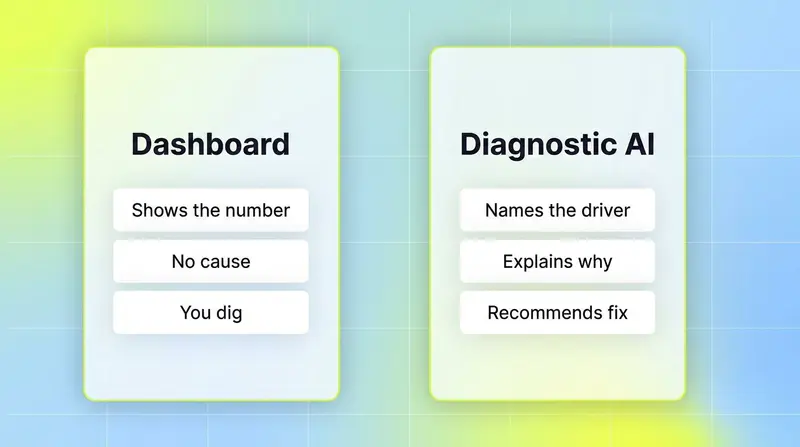
Diagnostic AI answers a different question than a reporting dashboard. A dashboard shows you that CPI rose. Diagnostic AI tells you the CPI rose because your top-spending video hit fatigue on day 9 and a new audience segment started converting worse, then recommends the swap. It is the difference between a thermometer and a doctor.
It also sits between two neighboring categories. It is narrower than a full AI copilot, which also plans, builds, and launches campaigns. It is separate from creative generation, which produces new ads rather than explaining old ones. Diagnostic AI is the "why did this move and what do I do" layer in the middle.
What this category does and does not cover:
Does: explain metric changes (ROAS, CPI, CTR, CVR), name the driver (creative, audience, placement, budget), and recommend a fix.
Does: answer plain-language questions about your ad data ("why did this campaign spike?", "what's different about my bottom 5 creatives?").
Does not: replace media buying execution, or generate net-new creative concepts from scratch (that is the copilot and generation layers).
The 9 best AI tools to diagnose ad performance in 2026
1. Segwise - Best for creative-level diagnosis of what changed and what to fix
Segwise is an AI creative-analytics copilot for performance marketers and UA teams. Where most tools stop at the campaign or ad-set level, Segwise diagnoses performance at the creative-element level, which matters because creative drives roughly half of ad sales lift (Nielsen). Plug in your ad networks and it tells you not just that ROAS moved, but which hook, CTA, visual style, or audio cue moved it, and what to change.
Key features:
Multimodal creative tagging (creative tagging) automatically labels every visual, audio, text, and interactive element in your ads, so performance can be traced to specific creative variables rather than guessed at.
Performance-change explanations map each tag to metrics like ROAS, CPI, CTR, and CVR, isolating which element drove a shift instead of leaving you to eyeball a chart.
Native fatigue detection (fatigue tracking) flags creatives sliding into decline before budget burns, with thresholds you set (for example, 20% ROAS decline over 7 days).
Asset clustering groups ads that share footage or audio, so you can isolate which single change (a new hook, a text overlay) caused a difference between two similar creatives.
Creative Strategy Agent (AI Chat) is an always-on strategist with full context across your account. Ask "why did my top video's CPI jump last week?" or "what's different about my winning hooks?" and get a direct answer, no dashboards to build.
Pricing: Free trial with up to 14 days of historical data imported automatically; paid plans import up to 3 months. Paid pricing is available on request via segwise.ai.
Limitations: Segwise is built for paid-acquisition creative intelligence, not organic social or SEO. Competitor tracking is currently Meta-only (Facebook and Instagram). Teams running only a handful of creatives may not need element-level diagnosis.
2. Madgicx - Best for chatting with your Meta ads data
Madgicx is an agentic Meta ads platform built around conversational diagnostics. Its "Chat with your Meta ads data" feature and AI Marketer agent let you ask plain-English questions like "why did my ROAS drop yesterday?" or "which ads are fatiguing?" and get answers with one-click fixes, since Madgicx also handles bid and budget automation that pure analytics tools do not.
Key features:
Chat with your Meta ads data in natural language, connected to your account with no external setup.
AI Marketer agent runs daily audits, flags budget waste, and surfaces fixes.
Automation for bidding, budgets, and audience targeting alongside the diagnostics.
Pricing: No single public headline price. The Madgicx Pro Complete with AI plan uses an in-app calculator based on your monthly ad spend; a 7-day free trial is available.
Limitations: Meta only (Facebook and Instagram), so it will not diagnose Google, TikTok, or app-network creative. Some users note AI suggestions need manual review.
3. Triple Whale - Best for DTC revenue diagnostics with Moby
Triple Whale positions itself as the AI operating system for ecommerce, and its Moby assistant is the diagnostic core. Moby lets DTC brands chat directly with unified store and ad data to explain trends, generate reports, and trace a performance swing all the way through to revenue, which account-only tools cannot do.
Key features:
Moby conversational AI: ask why a metric moved and get a data-backed answer, not just a chart.
60+ one-click integrations spanning Shopify, Meta, Google, TikTok, Klaviyo, and Amazon.
Attribution and creative analytics tie ad changes to profit and LTV.
Pricing: Free tier at $0; Starter from $179/month including Moby Chat; higher tiers add MMM and creative analytics. Pricing scales with GMV.
Limitations: Built for ecommerce, so it is a poor fit for mobile app UA or B2B. Diagnosis stops at the campaign and channel level rather than the creative element.
4. Superads - Best for natural-language reporting across Meta, TikTok, and Google
Superads is an AI paid-media reporting platform with a built-in conversational Copilot. You unify Meta, TikTok, LinkedIn, and Google data into one report, then use Superads AI to query performance, ask for explanations, and summarize what changed in plain language.
Key features:
AI Copilot to chat with unified cross-platform reports and get instant summaries.
Multi-platform reporting across Meta, TikTok, LinkedIn, and Google in a single view.
Report editing by typing, no manual dashboard building.
Pricing: Professional from $150/month (covers up to $100k monthly ad spend, then scales), or billed annually at a discount; Enterprise is custom. A 14-day free trial is available.
Limitations: Reporting-first, so it diagnoses at the metric and campaign level rather than the individual creative element. No standalone free plan for new signups.
5. Polar Analytics - Best for DTC cross-channel conversational analytics
Polar Analytics is a warehouse-native ecommerce BI platform. Its Ask Polar data-analyst agent lets DTC teams ask the business anything in plain English and get a full report back, tying ad performance to retention, LTV, and multi-touch attribution across the store.
Key features:
Ask Polar agent answers plain-English questions with customized reports, not just charts.
45+ connectors including Shopify, Meta, Google, TikTok, Amazon, and Klaviyo.
Pre-built ecommerce metrics and multi-touch attribution out of the box.
Pricing: Custom / on request. The official pricing page lists plan names (Core, Custom) without public dollar figures.
Limitations: Ecommerce-focused, so not built for app UA or creative-element diagnosis. Custom pricing means evaluation requires a sales conversation.
6. Ads Chat - Best for multi-platform campaign Q&A
Ads Chat is a lightweight conversational layer over your ad accounts. You connect campaigns across Google, Meta, TikTok, LinkedIn, Amazon, and X, then ask questions like "what's my best performing campaign this week?" and get metrics plus optimization recommendations without opening each platform.
Key features:
Natural-language queries across 15+ ad platforms in one chat.
Instant campaign metrics, conversion data, and optimization recommendations.
Fast setup aimed at marketers who want answers, not dashboards.
Pricing: Free plan (2 ad accounts, 100 monthly messages); Professional from $490/year (10 accounts, unlimited messages); Agency at $1,490/year with white-label options.
Limitations: Younger and lighter than the incumbents, with breadth over depth; it does not reach creative-element or playable-ad diagnosis.
7. Peel Insights - Best for Shopify retention and cohort diagnostics
Peel Insights is an automated analytics platform for Shopify brands, strongest at diagnosing the downstream revenue and retention consequences of your ad and marketing changes. Its Magic Dashboards feature plugs into a generative AI model so you can build dashboards and surface insights by asking questions the way you would in a chatbot, then see how a spend or creative shift moved repeat purchases and LTV.
Key features:
Magic Dashboards: create dashboards and get headline insights by asking in natural language.
SKU-level profitability and cohort, retention, and subscription analytics.
Connectors for Shopify, Amazon, Walmart, and Klaviyo.
Pricing: Essentials from $449/month billed annually (or $499 monthly) for stores above 16,000 monthly orders; higher tiers scale by order volume. A free 7-day trial is available.
Limitations: Retention and revenue analytics first; ad diagnosis is secondary and it does not tag creative. Pricing suits higher-volume stores.
8. Vaizle - Best for agencies diagnosing across many client accounts
Vaizle is a marketing analytics assistant that connects Meta, Google, LinkedIn, YouTube, Google Analytics, and Shopify into a single chat interface. It answers questions in plain English, runs full marketing audits, flags what is underperforming, and suggests where the next budget should go, which suits agencies juggling many accounts.
Key features:
Conversational AI across multiple channels with up to 12 months of history.
Automated audits that flag underperformance and recommend budget shifts.
Multi-account support (up to 150 social accounts) for agencies.
Pricing: From $14/month, with the most useful AI insights gated to paid plans.
Limitations: Broad but shallower per-channel than specialists; creative-element diagnosis is not its focus.
9. Optmyzr - Best for Google and PPC diagnostic recommendations
Optmyzr is a PPC management platform for Google, Microsoft, Amazon, Meta, and LinkedIn. Its AI Sidekick assistant and AI-powered account insights diagnose what is dragging performance and recommend concrete fixes, from bid changes to structure and ad-copy improvements, which makes it the strongest pick when your spend is search-heavy.
Key features:
AI Sidekick for natural-language PPC assistance and account insights.
AI-generated performance summaries and optimization recommendations.
Deep automation and rule engine tuned for search and shopping campaigns.
Pricing: Custom / on request. Plans (Essentials, Premium, Enterprise) scale with monthly ad spend, with a discount for annual billing.
Limitations: Search and PPC first, so it is not built for social creative or app UA diagnosis. Feature depth carries a learning curve.
How AI pinpoints what changed (and what to fix)
Under the hood, diagnostic AI follows a consistent four-step loop. Understanding it helps you judge which tools do the whole job versus which stop halfway.
Detect the change. The AI watches your metrics and flags a meaningful move, a ROAS drop, a CPI spike, a CTR slide, against your baseline or thresholds.
Isolate the driver. It decomposes the change by dimension: creative, audience, placement, budget, or an external delivery shift. Segwise pushes this to the creative-element level; account-level tools stop at campaign or ad set.
Explain in plain language. It states the cause in a sentence you can paste into Slack, not a chart you still have to interpret.
Recommend the fix. It tells you the next action: pause the fatigued creative, shift budget, refresh the hook, or consolidate ad sets.
The tools differ mostly on step 2. If the true driver is which creative element fatigued, an account-level tool will tell you "creative 4 dropped" but not "the fast-cut hook stopped working," which is why creative-level diagnosis matters for teams whose performance lives and dies on creative.
Diagnose before you generate Nail down what actually changed and why first. Only then does it make sense to brief or generate the fix, otherwise you are iterating on a guess.
How to choose the right diagnostic AI tool

If you need to know which creative element drove the change and what to make next, Segwise is the right fit, because it tags and diagnoses at the element level across every connected ad network and MMP rather than stopping at the campaign line. Creative is roughly half of performance, so element-level diagnosis is where most of the answer lives.
If you want to interrogate your ad account in chat, Madgicx handles Meta spend, audience, and placement questions in natural language, while Superads answers the same across Meta, TikTok, LinkedIn, and Google.
If you run a DTC ecommerce brand and need ad swings tied to revenue, Triple Whale, Polar Analytics, or Peel Insights connect Shopify and your ad accounts so the "why" reaches all the way to profit and retention.
If your spend is concentrated in Google and search, Optmyzr's diagnostics and recommendations are built for PPC.
If you are an agency diagnosing many accounts at once, Vaizle and Ads Chat prioritize multi-account reporting and fast cross-client answers.
If you want the full copilot that also plans and launches, not just diagnoses, step up to the wider category in our AI copilot for performance marketing guide.
Bottom line
A dashboard tells you performance changed; it rarely tells you why or what to do. That gap is where budget quietly leaks. Different tools close different parts of it: account-level chat tools like Madgicx answer platform questions, DTC tools like Triple Whale tie swings to revenue, and Segwise diagnoses the creative element behind the move and the fix to ship next. If your performance is driven by creative, and for most teams it is, start with element-level diagnosis at segwise.ai.
Frequently Asked Questions
What AI tool explains why my ad campaign performance changed?
Tools built for diagnostic analytics do this in 2026. Segwise explains creative-level changes, naming which hook, CTA, or visual style moved your ROAS or CPI and what to fix, across 15+ ad networks and MMPs. For account-level Meta questions, Madgicx lets you chat with your ads data, and for DTC revenue swings Triple Whale's Moby traces the change back to profit. The right pick depends on whether your driver is creative, audience, or channel mix.
How do I chat with my Meta ads data using AI?
Several tools now let you ask questions about your Meta account in plain language. Madgicx and Superads connect directly to your Meta ad account so you can ask about spend, audiences, and placements and get instant answers. Segwise's Creative Strategy Agent does this for creative performance specifically, answering questions like "which hook drove the most installs last month?" with full context across your account. You do not need SQL or dashboard-building for any of them.
What is the difference between diagnostic AI and a reporting dashboard?
A reporting dashboard shows you that a metric changed; diagnostic AI explains why and recommends a fix. A dashboard might show CPI rose 30%; a tool like Segwise tells you the rise came from a fatigued top creative plus a weaker audience segment, then suggests the swap. Madgicx and Triple Whale apply the same explain-and-recommend logic at the account and revenue levels. Dashboards report, diagnostic AI reasons.
Which AI tool tells me what to fix in my ad campaigns?
Diagnostic tools that pair a cause with a recommended action. Segwise flags a fatiguing creative and tells you to swap the hook or refresh the asset before spend burns; Optmyzr recommends bid and structure fixes for Google Ads; Madgicx suggests audience and budget changes for Meta. Segwise focuses the fix on the creative element, which is where roughly half of ad performance is decided.
What is the best AI tool for diagnosing ad performance for mobile game and app UA teams?
Segwise is built for exactly this: it tags gameplay footage, hook dialogue, and playable ads (it is the only platform that tags interactive playables), connects to app networks and MMPs like AppsFlyer and Adjust, and diagnoses which creative element drove installs, CPI, or ROAS. Account-level tools like Madgicx are strong on Meta but do not reach creative-element or playable-ad diagnosis. For app UA teams whose performance rides on creative iteration, element-level diagnosis is the differentiator.
Can these tools diagnose DTC ecommerce ad performance, not just app installs?
Yes. Triple Whale, Polar Analytics, and Peel Insights are DTC-first: they connect Shopify and your ad accounts so a performance swing traces through to revenue, LTV, and retention. Segwise also serves DTC brands, adding creative-element diagnosis on top of the ecommerce metrics so you see which product shot, hook, or offer drove the change. Choose DTC-native analytics for revenue attribution, and add Segwise when the creative "why" matters.
How much do AI ad-diagnostic tools cost in 2026?
Pricing usually scales with monthly ad spend and ranges widely. Entry tools like Vaizle start around $14 per month and Ads Chat from roughly $490 per year, mid-market reporting like Superads runs from $150 per month, and DTC platforms like Triple Whale start at $179 per month while Polar Analytics quotes custom pricing. Segwise offers a free trial and quotes paid pricing on request. Always confirm current tiers on each vendor's pricing page, since spend-based pricing changes.